International Horror Film Review: Pieces (dir by J. Piquer Simon)


It’s a strange world out there.

This 1982 Spanish-produced slasher film was advertised, at least in the United States, with the brilliant tag line: “You don’t have to go to Texas for a chainsaw massacre.”  And indeed, Pieces takes place in Boston, Massachusetts.  And yet, it’s a Boston that has little relation to the Boston of the real world.  (Some of that may be because, while a few scenes were filmed in Boston, the majority of the film was shot in Spain.)  Indeed, one can argue that Pieces takes place in an alternate reality, one that was created with bits of giallo suspense, slasher gore, and scenes randomly borrowed from every other exploitation film ever made.

In the 1950s, a little boy wears a bowtie and plays with a pornographic jigsaw puzzle.  His mother takes the puzzle away from him, which he doesn’t appreciate at all.  It leads, as things usually do, to an axe murder.

In the 1980s, a college student tries to roller skate down a sidewalk, just to suddenly lose control.  As she helplessly rolls down the street, two workman carrying a sheet of glass just happen to step out in front of her.  Pieces of blood-stained glass fly everywhere.  As is typical of Pieces, this actually has nothing to do with the larger plot of the film.  We never learn the girl’s name.  We never hear learn if she survived nor do we hear much else about the accident.  Instead, it’s just a random incident, tossed in to illustrate that the world is going mad.

On campus, a chainsaw killer is killing students and teachers.  He’s the boy with the bowtie, all grown up.  He takes body parts home with him so that he can stitch them together, recreating the jigsaw puzzle that was stolen from him years before.  Oddly enough, he never makes much of an effort to hide his chainsaw.  He casually gets on an elevator with one of his victims.  She notices that he’s carrying a chainsaw but she doesn’t say anything about it until he actually turns it on.

Dean Foley (played by Eurohorror veteran Edmund Purdom) is upset that students keep getting dismembered on campus, as well he should be.  Lt. Bracken (Christopher George, barking out his lines with the same annoyed energy that he brought to Graduation Day) is also upset because he’s supposed to arrest criminals and stuff.  Unfortunately, all of Bracken’s cops are incredibly incompetent.  Bracken is forced to rely on the help of Kendall James (Ian Sera).  Despite being kind of scrawny and unappealing, Kendall is the most popular student on campus.  Kendall also knows every victim and discovers the majority of them.  You would think that Kendall would be the obvious suspect but instead, Kendall somehow ends up directing the entire investigation.  Kendall’s not a cop but he’s soon ordering around the veteran detectives and everyone’s okay with that.  (One detective even mentions that Kendall might as well be a part of the force.)

Lt. Backen decides that the best way to solve the case is to send in Mary Riggs (Linda Day George), who is not only an undercover cop but also a top-ranked tennis player!  There’s a lot of tennis in Pieces, as Mary works on her game in between working with Kendall to solve the murders.  Kendall and Mary aren’t very effective though.  After discovering that one victim was chopped in half in the showers while Kendall and Mary were trying to find the source of some loud marching band music, Mary lets the killer know exactly what she thinks of him.

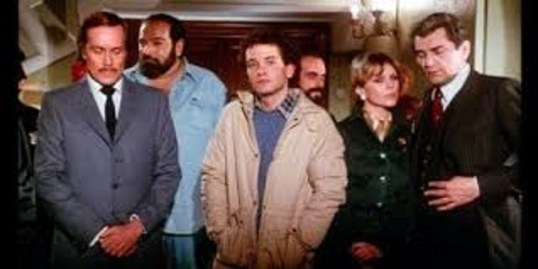
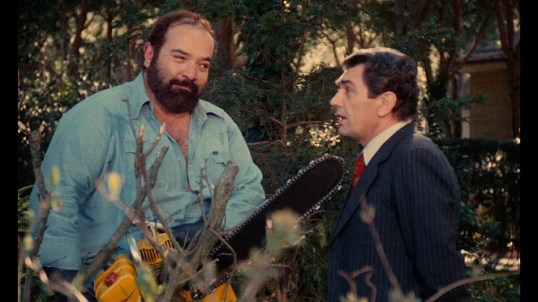
But who is the killer?  Because Pieces was as inspired by the giallo genre as the slasher genre, there are several suspects.  Kendall seems like the obvious one but, for whatever reason, no one makes that connection.  Instead, we’re left to wonder if maybe it could be the Dean.  Or how about Prof. Brown (Jack Taylor), the somewhat odd professor who seems to be a bit repressed?  Or maybe it’s the handyman, Willard (Paul L. Smith)?  Willard is creepy and he works with a chainsaw!  There are a lot of suspects and helpfully, after a murder at the pool, every single one of them shows up at the scene of the crime.  At one point, they all even gather in the same corner and look straight at the camera.  You half expect Kendall to announce, “Well, I can’t possibly solve this one!  Can you?”
But that’s not all!  When Kendall and Mary aren’t solving murders, they’re having to deal with all of the other weird things that happen on campus.  At one point, Mary is randomly attacked by the school’s karate instructor.  After Kendall shows up and explains who the man in, they all laugh it off as being the result of “bad chop suey.”  Later, Kendall walks Mary back to her place and, after she rejects his attempts at romance, Kendall turns around to be confronted by another student who taunts him by yelling, “Casanova!”  Meanwhile, other students are still walking around campus in the middle of the night and making plans to meet up in a room that contain the height of campus luxury, a waterbed!

(Yes, a murder does occur on the waterbed.  Yes, water goes everywhere.  It’s Chekhov’s waterbed. You can’t introduce it without including a scene where it gets punctured.)

Many things happen, none of which make sense.  The entire film is so over-the-top in its combination of gore, overacting, and general absurdity that it becomes strangely fascinating.  From today’s perspective, it’s easy to imagine that the film was actually meant to be a parody but director J. Piquer Simon has said that it was meant to be viewed as a serious thriller, regardless of how the film was subsequently advertised in the United States.  Even the film’s ending, in which someone who is not the killer is randomly castrated just because, was meant to be taken seriously.  Every weird moment was included to give the audience what they wanted.  Audiences loved Bruce Lee so, of course, a random karate fight was tossed in.  People love chainsaws so, of course …. well, you get the idea.

On the one hand, Pieces is a really heavy-handed and mean-spirited film, one in which the victims are almost exclusively women and where sex and violence are too often connected.  Mary may be an absurd character but you’re happy when she shows up because she’s the one woman in the film not presented as being a passive victim.  On the other hand, Pieces is just so over-the-top and absurd that it’s hard not to watch the film all the way through.  Perhaps the only thing that keeps the film from being incredibly offensive is that, regardless of what the director has claimed, it is so obviously not meant to be taking place in the real world.  When that plate glass was shattered, it obviously opened a vortex that sucked the campus into a world where every slasher and giallo trope has been adapted to the point of absurdity.  This is one of those films that just gets more and more strange with each passing minute.  You watch it and you find yourself continually thinking, “This movie can’t get any weirder” and then it manages to do just that.  Watching the movie is like stepping through a portal into some sort of strange alternate reality.  Just try to look away.
Who could the murderer be?
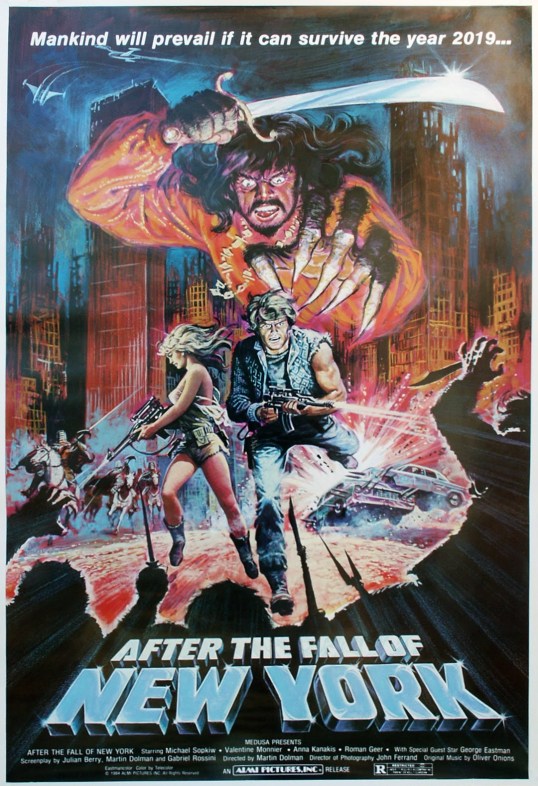
Sci-Fi Film Review: 2019: After The Fall of New York (dir by Sergio Martino)


afterthefallofnewyork_onesheet

Where is this woman can make babies!?”

— Big Ape (George Eastman), asking the question that everyone’s wondering in

2019: After The Fall Of New York (1983)

“Giara, if love had any meaning in the world, you would be the one I love.”

Parsifal (Michael Sopkiw) in 2019: After The Fall of New York (1983)

New York City was a frequent location for Italian exploitation films and why not?  Seeing as how most of the Italian exploitation films of the 70s and 80s were specifically designed to pass for an American product (with the actors and directors often credited under Americanized pseudonyms), it would only make sense to use America’s best-known city.  Interestingly enough, these films rarely portrayed New York as being a very pleasant place.  There was always either a mob war or a zombie invasion or police corruption or a madman with a knife to deal with.  This portrayal of New York as Hell-on-Earth reached its logical conclusion with Lucio Fulci’s The New York Ripper but even films less extreme than Fulci’s still presented New York as representing every negative thing that has ever been thought about Americans.

After the international success of the first two Mad Max films and John Carpenter’s Escape From New York, there was a handful of Italian films that were meant to portray what life would be like in New York after a nuclear apocalypse.  (In most cases, life would not be pleasant.)  Of the films that made up this odd, yet undeniably energetic genre, 1983’s 2019: After The Fall of New York is one of the best.

Every post-apocalyptic film opened with the task of explaining who went to war with who.  In this case, the war was started 19 years earlier by the European-Asian Alliance.  After reducing America to atomic rubble, the Euracs (as they’re called) set up their headquarters in New York.  When 2019: After the Fall of New York opens, the few radiation-scarred survivors have been reduced to living in the sewers and eating rats.  The Eurac army rides through the streets atop white horses, capturing survivors and subjecting them to terrible medical experiments.  Consider this: 2019: After The Fall of New York was an Italian-made film about evil Europeans (including, presumably, soldiers recruited from Italy) invading America.  If you ever had any doubt about how determined the Italian film industry was to appeal to American audiences, 2019: After The Fall of New York should erase them.

SOL

Despite losing the war, there is still an American government.  The President of the Pan-American Confederacy (played by Edmund Purdom, who regularly showed in strange movies like this one and Don’t Open Til Christmas) is determined to savage what he can of American society before relocating to either Alaska or the moon.  Just in case you had any doubt that this movie was made a long time ago, the supporters of the Pan-American Confederacy are called the Confederates.  And they’re the heroes of the film…

It turns out that there is only one fertile woman left on Earth.  And the Confederate President is determined to take her to the moon to harvest her eggs and use in vitro fertilization to restart the human race.  However, she is currently in a state of hibernation in New York (which, we are told, protects her from the radiation.  That doesn’t really sound quite right but we’ll just go with it).  President Purdom wants her rescued before the Euracs track her down!

ANY

Meanwhile, Parsifal (Michael Sopkiw) is in Nevada, where he makes his living by winning violent car races.  After his latest race, he is rewarded with a sex slave but, because he’s a good guy, he lets the slave go free.  (Before leaving, the slave does tell Parsifal about the existence of cyborgs, which is information that comes in useful later on.)  No sooner has Parsifal done his good dead then he’s grabbed by some Confederate soldiers and taken to see President Purdom.  Purdom doesn’t quite say, “I heard you were dead,” but he might as well.

Working with the one-eyed Ratchet (Roman Geer) and a bitter former academic named Bronx (Vincent Scalondro), Parsifal enters New York and tries to find the woman while staying on step ahead of the Eurac commander (Serge Feuillard).  Along the way, Parsifal gains allies like a little person named Shorty (Louis Ecclesia), a kickass warrior named Giara (Valentine Monnier), and former circus performer turned gang leader, Big Ape (George Eastman).

George Fucking Eastman

That’s right, George Eastman is in this movie.  If you know the least bit about Italian exploitation cinema, you will not be surprised when George Eastman shows up.  You also won’t be disappointed.  Eastman (whose real name is Luigi Montefiori) was a regular presence in everything from Spaghetti Westerns to grisly thrillers like Anthropophagus to flamboyant gialli like Delirium to post-apocalyptic thrillers like Raiders of Atlantis and this one.  As always, Eastman is a lot of fun to watch in the role of Big Ape.  Nobody played hulking menace with quite the flair of George Eastman at his best.

Along with Eastman, 2019: After the Fall of New York also some cult appeal because it starred Michael Sopkiw.  The handsome Sopkiw had a short film career, starring in four Italian films and working with directors like Lamberto Bava and Sergio Martino, before retiring from acting.  The briefness of his career and his backstory as a former sailor-turned-marijuana smuggler-turned-model have given Sopkiw a certain enigmatic mystique among fans of Italian exploitation.  2019: After the Fall of New York was Sopkiw’s first role and he brings a lot of enthusiasm to the role.

As directed by Sergio Martino, 2019: After The Fall of New York is full of interesting oddities that set it apart from your typical Italian post-apocalyptic thriller.  For instance, a radiation-scarred man is occasionally seen wandering through the rubble, playing a trumpet and, at one point, serving as a chorus to the action.  Another character, in a scene reminiscent of a Fulci film, has his eyes graphically ripped from their sockets and spends the rest of the film preparing for an eye transplant.  Two of Big Ape’s followers are dressed up as gorillas and Big Apes even gets a chance to show off his skills with a scimitar.  Perhaps my favorite random detail is that the Euracs do their evil plotting in front of a reproduction of Picasso’s Guernica.  It’s just so wonderfully weird.

Guernica

In fact, the whole movie is wonderfully weird.  2019: After The Fall of New York is Italian exploitation at its best!

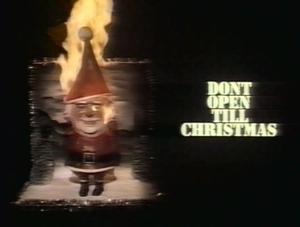
Film Review: Don’t Open ‘Til Christmas (dir. by Edmund Purdom, et al)


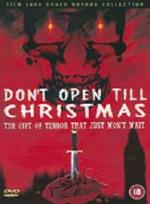
It’s been a while since I reviewed a real grindhouse/exploitation film on this site so I want to remedy that by talking about an English slasher film called Don’t Open ‘Til Christmas.

As the movie opens, we find ourselves in England with Christmas quickly approaching.  The fog-drenched streets of London have apparently been besieged by drunk old men dressed up like Santa Claus.  However, at least one citizen has taken things into his own hands by wandering the streets at night and killing anyone he comes across dressed as Santa Claus.  Seriously, we see a lot of Jolly St. Nicks meeting an untimely end in this film.  Most of them are done in by straight razor but at least one ends up getting shot and then another ends up bursting into flame and one Santa even up getting a spear driven through the back of his head.

That Santa has a daughter named Kate (Belinda Mayne) and Kate has a boyfriend named Cliff (Gerry Sundquist).  While they make most of their money by standing out in the middle of street and playing the flute, Cliff also has a side job as just a generally sleazy guy.  The day after Kate’s father dies, Cliff tries to convince Kate to take part in a pornographic, Santa-themed photo shoot.  Needless to say, Kate doesn’t react well to this and storms out.  So, Cliff convinces another model to wear the Santa suit.  That model is later caught outside in that Santa suit by the killer.  However, after opening the suit and giving the camera an excuse to linger over the model’s body the killer leaves without harming her.  This would seem to indicate that he’s only looking to kill men in Santa suits.  Normally, I’d be all for this development because fair play is fair play except for the fact that its eventually revealed that the whole Santa suit thing is pretty much just a red herring.  But, more on that later.

Anyway, Kate wants justice for her father but unfortunately, the police investigation is being headed up by Inspect Harris and you know that Harris isn’t going to be much help because he’s played by Edmund Purdom.  Purdom appeared in a lot of Italian and Spanish horror films in the 70s  and 80s and he was always the epitome of British incompetence.  Purdom is also credited as being director here but again, more on that later.

Now, by the time the 100th Santa has been brutally murdered, you might think that people would just naturally stop dressing up as Santa Claus when they’re out in public but no, that doesn’t appear to occur to anyone.  Instead, we get a mall Santa getting castrated while standing at a urinal.  And then we get another one getting killed while visiting a local sex shop and talking to a character credited as “the Experience Girl” (played surprisingly well by Kelly Baker).  Yet another Santa finds himself getting murdered while backstage at a TV variety show.  His body is discovered by Caroline Munro (star of Starcrash and Maniac) who plays herself and gets to sing a disco song before finding the body.  She also gets to wear this really amazing red dress that I would kill to own because, seriously…

Suddenly, this guy named Giles (played by Alan Lake, who apparently died right before this film was released) pops up and tells Kate that he’s a reporter and he starts asking her all theese questions about her father.  Kate gets mad and tries to call up Inspector Harris just to be told that Harris is out for the day taking care of some personal business.  Hmmm…could Harris be our killer?  It makes sense since he’s played by Edmund Purdom.  Then again, Cliff could be the killer as well because, while Kate is doing all this, Cliff is making money by selling her sexual favors to his friends.  Then again, it seems that Giles might be the killer because he then promptly shows up and kills Kate.

Meanwhile (we’re only about 40 minutes in to the film by this point), the Experience Girl is being interviewed by Harris’s partner, a tall guy named Powell who hates women.  The Experience Girl tells Powell that she would know who the killer is if she saw the killer smile.  Powell tells her she’s an idiot.  So, the Experience Girl goes back to work.  Giles shows up and smiles.  Experience Girl screams.  Giles kidnaps her but instead of killing her, he takes her to his flat and chains her up.  Giles explains that he’s a killer because Inspector Harris is his brother and Giles is jealous.  The Experience Girl knows who Harris is despite the fact that we’ve only seen her meet Powell. 

Speaking of Powell, he investigates Kate’s death and realizes he may have made a mistake dismissing the Experience Girl.  Then he tries to open a car door and gets electrocuted until he eventually ends up blowing up.

Now, none of this qualifies as being a spoiler because, even at this point, there’s still nearly 40 minutes of plot left.

Like a lot of 80s grindhouse films, the production of Don’t Open ‘Til Christmas is shrouded in mystery.  Shooting on the film apparently started in 1981 but it the film wasn’t actually completed and released until 1984.  Reportedly, Edmund Purdom was the original director but he ended up walking off the set which led to screenwriter Derek Ford taking over the movie for two days before he was apparently fired.  The film was then completed by Alan Birkinshaw (and possibly a few other people), working under the name of Al McGoohan.

Certainly, this explains why the film is such a huge mess but it’s also a part of the fun as watching the movie becomes a game of trying to figure out who directed what. 

Since Purdom walked off the film, I think it’s fairly safe to assume that he directed all of the scenes that he appears in.  (It also explains why his character disappears from the movie after the first 40 minutes.)  These scenes are all distinguished by the general immobility of the camera.  Purdom’s scenes are so static and so defiantly dull that they almost work in a strangely Warholian way.  The actors wander into frame, the actors wander out of the frame, the out-of-focus lens rebelliously refuses to follow them. 

The non-Purdom scenes — the scenes in which men dressed like Santa are graphically murdered and the scenes featuring the “Rxperience Girl” — appear to have snuck in from a totally different movie and often, they’re only link to anything we’ve seen in the Purdom scenes is some awkwardly dubbed dialogue.  These scenes feel as if they’re drenched in sleaze.  The camera not only moves, it lingers and it invades like a voyeur looking at dirty pictures in a public library.  Unpleasant on their own, these scenes somehow become even more distasteful when compared to the aritificiality of the Purdom scenes. 

It all makes for a very disorienting viewing experience and if the film isn’t really well-done enough to ever become disturbing or nightmarish, it still had a very odd dream-like feel to it.  Major characters wander through the film without every actually meeting each other.  Seemingly important plot points are brought up just to be quickly abandoned and forgotten.  Even all the multiple murders turn out to have very little to do with Santa Claus or Christmas.  If nothing else, this is a unique slasher film in that the murders are pretty much just  red herrings.

There’s a lot in this movie that doesn’t work but, as with many grindhouse films, that just adds to the charm of Don’t Open ‘Til Christmas.  Even the ending — which everyone seems to criticize — is oddly appropriate in that it makes as little sense as everything else we’ve seen on screen.  Also, like most grindhouse films, there’s a handful of memorable moments that actually do work.  For instance, the killer’s mask is genuinely creepy.  The scene where Giles chases the Experience Girl through the streets of London is also handled well and is even more suspenseful in that it takes place during the day as opposed to expected dark and foggy night.  And again, Kelly Baker is a sympathetic, if unexpected, protaganist in the role of the Experience Girl (though you get the feeling that the role was created and cast long after Purdom left the initial production).  Finally, this is a film that epitomizes the spirit that makes the Grindhouse great — i.e., it may have taken two years and multiple directors and the end result might be kind of chaotic but, in the end, the movie got made.

I ended up watching Don’t Open ‘Til Christmas last night because there have been reports that its about to finally snow here in North Texas and, as a result, I was in a holiday mood.  Since this is apparently one of those movies that has entered the public domain, the version I own is a part of one of those “50 Horror Classics” collections that Mill Creek puts out.  As a result, the transfer looked and sounded terrible.  But you know what?  That terrible transfer added a certain charm to the film.  Don’t Open ‘Til Christmas is a movie that was meant to be seen with a lot of random scratches and faded colors flashing across the screen. 

So, in the end, Don’t Open ‘Til Christmas is a pretty bad movie but it’s an undeniably watchable and oddly memorable one.  Plus, it features that really great red dress.  Seriously, just to die for…

6 Trailers For A December Moon


This week’s edition of Lisa Marie’s Favorite Grindhouse and Exploitation Trailers features sinful dwarves, dead Santas, the Peter Cushing Guide To Getting Laid, and the voice of John Carradine!

1) The Sinful Dwarf

How can you not be enthusiastic about a film with a title like “The Sinful Dwarf?”  That said, I think Peter Dinklage could kick this guy’s ass.  This was apparently a “lost film” until a copy was found in a janitor’s closet in Denmark. “What do you think of the blonde?”  “hahahahahahaha”

2) Don’t Go In The House

This is actually a rather depressing rip-off of Maniac.  The trailer makes it look a lot more interesting (and fun) than it actually is.  Which, of course, is what a trailer is supposed to do.  (The DVD, by the way, features a pretty interesting interview with the star of this film, Dan Grimaldi.)

3) Corruption

“No women will dare go home alone after seeing Corruption!”  That’s right, boys, go see Corruption and you will get laid!  You can say a silent prayer of thanks to Peter Cushing after…By the way, I’m planning on seeing Corruption on DVD but I’ll be sure to watch it at a male’s house or apartment in order to make sure that I have someone to escort me home afterward.  So, if any of you guys out there have an hour or two to kill (so to speak)…

4) Swamp Girl

I like this trailer and I have a feeling I might find something to enjoy in the actual film is just because I come from a long line of swamp girls.  That said, I don’t think I could be one myself.  There’s too many little buggies and things flying around the swamp.

Is the haunting Theme From Swamp Girl stuck in your head now?

5) Journey Into The Beyond

In previous editions of Lisa Marie’s Favorite Grindhouse and Exploitation Trailers, I haven’t highlighted any of the several hundred mondo film trailers that are out there because I kind of agree with something that Giovanni Lombardo Radice said: mondo movies are a remnant of fascism.  And they are.  But, I had to include Journey Into The Beyond here because how can you not enjoy listening to John Carradine?

6) Don’t Open Till Christmas

If you happen to watch an Italian or Spanish slasher film made between 1979 and 1983, there’s a fairly good chance that Edmund Purdom will turn out to be the killer.  Well, I guess Purdom got sick of being typecast because, in 1983, he directed a film of his own and it’s a holiday film!