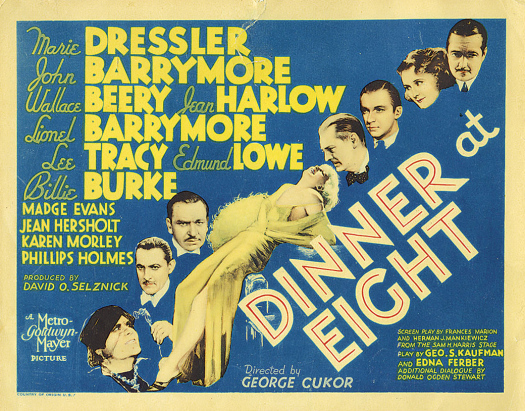
After the success of 1932’s all-star GRAND HOTEL, MGM studio boss Louis B. Mayer kept his sharp eyes peeled for a follow-up vehicle. The answer came with DINNER AT EIGHT, based on the witty Broadway smash written by George S. Kaufman and Edna Ferber. Mayer assigned his newest producer (and son-in-law) David O. Selznick, fresh from making hits at RKO, who in turn handed the director’s reigns to another MGM newcomer, George Cukor. Both would have long, prosperous careers there and elsewhere. Frances Marion and Herman Mankiewicz adapted the play to the screen for the studio with “more stars than there are in heaven”, and those stars truly shine in this film (in the interest of fairness, the stars will be presented to you alphabetically):
John Barrymoreas Larry Renault
The Great Profile plays aging, alcoholic former silent star Larry Renault in a role that surely hit close to home.
With that in mind, I recently watched the 1928 film In Old Arizona. In Old Arizona is a bit of an oddity in Oscar history. Even though it is considered to have been a best picture nominee, it was never officially nominated. In fact, in 1929, there were no official nominees. Instead, the Academy simply announced the names of the winners. The winners were selected by a small committee of judges. The committee’s intentions are particularly obvious when you notice that not one film won more than one Oscar in 1929. At a time when the industry was struggling to make the transition from silent film to the talkies, the 1929 Oscars were all about spreading the wealth and reassuring everyone that they were doing worthwhile work. In Old Arizona‘s star, Warner Baxter, was named the year’s best actor while Broadway Melody was declared to have been the best picture.
(At that year’s Oscar ceremony, the second in the Academy’s history, the awards were reportedly handed out in 10 minutes and nobody gave an acceptance speech. If this all seems strange when compared to the annual extravaganza that we all know and love, consider that Louis B. Mayer originally formed the Academy in order to give the studio bosses the upper hand in a labor dispute. The awards were largely an afterthought.)
Years later, Oscar historians came across the notes of the committee’s meeting. The notes listed every other film and performer that the committee considered. Before settling on Broadway Melody, the committee apparently considered In Old Arizona. For that reason, In Old Arizona is considered to have been nominated for best picture of the year.
If it seems like I’ve spent a bit more time than necessary discussing the history behind the 1929 Oscars, that’s because In Old Arizona isn’t that interesting of a film. It was a huge box office success in 1929 and it was an undeniable influence on almost every Western that followed but seen today, it’s an extremely creaky film. Influential or not, there’s not a scene, character, or performance in In Old Arizona that hasn’t been done better by another western.
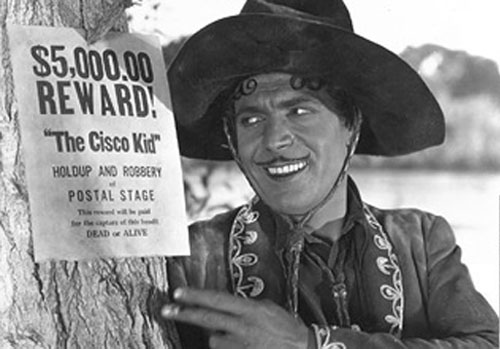
Based on a story by O. Henry, In Old Arizona tells the story of a bandit named The Cisco Kid (Warner Baxter). Cisco may be an outlaw but he’s also a nice guy who enjoys a good laugh and occasionally sings a song while riding his horse across the Arizona landscape. (California and Utah stood in for Arizona.) The Cisco Kid may rob stagecoaches but he always does it with a smile. Besides, he only needs the money so that he can give gifts to his girlfriend, Tonia (Dorothy Burgess). What the Cisco Kid doesn’t know is that Tonia is bored and frustrated by his frequent absences and she has been cheating on him. Then she’s approached by Sgt. Mickey Dunn (Edmund Lowe), the big dumb lug who has been ordered to bring the Kid in (dead or alive, of course). Will Tonia betrayed the Kid?
If you’re watching In Old Arizona and hoping to be entertained, you’ll probably be disappointed. Almost everything about this film has aged terribly. Watching the film, it’s obvious that none of the actors had quite figured out how to adapt to the sound era and, as such, all of the performances were very theatrical and overdone. Probably the easiest to take is Edmund Lowe, who at least managed to deliver his lines without screeching. Sadly, the same cannot be said of Dorothy Burgess. As for Warner Baxter, he may have won an Oscar for playing the Cisco Kid but that doesn’t make his acting any easier to take.
And yet, if you’re a history nerd like me, In Old Arizona is worth watching because it really is a time capsule of the era in which it was made. In Old Arizona was not only the first Western to ever receive an Oscar. This was also the first all-talking, all-sound picture. Watching it today, without that knowledge, you might be tempted to wonder why the film lingers so long over seemingly mundane details, like horses walking down a street, the ticking of a clock, a baby crying, or a church bell ringing. But, if you know the film’s significance, it’s fun to try to put yourself in the shoes of someone watching In Old Arizona in 1929 and, for the first time, realizing that film could not just a visual medium but one of sound as well. For some members of that 1929 audience, In Old Arizona was probably the first time they ever heard the sound of a horse galloping across the landscape.
(I have to admit that, as a student of American history, I couldn’t help but get excited when one of the characters mentioned President McKinley. McKinley may be forgotten today but audiences in 1929 would not only remember McKinley but also his tragic assassination. By mentioning that McKinley was President, In Old Arizona not only reminded audiences that it was taking in the past but that it was also taking place during what would have been considered a more innocent time. Much as how later movies would use John F. Kennedy as a nostalgic symbol of a more idealistic time, In Old Arizona uses William McKinley.)
In Old Arizona is no longer a particularly entertaining film but, as a historical artifact, it is absolutely fascinating.
Last night, as a part of my effort to clean out my DVR by watching and reviewing 38 movies in 10 days, I watched the 1956 Best Picture winner, Around The World In 80 Days.
Based on a novel by Jules Verne, Around The World In 80 Days announces, from the start, that it’s going to be a spectacle. Before it even begins telling its story, it gives us a lengthy prologue in which Edward R. Murrow discusses the importance of the movies and Jules Verne. He also shows and narrates footage from Georges Méliès’s A Trip To The Moon. Seen today, the most interesting thing about the prologue (outside of A Trip To The Moon) is the fact that Edward R. Murrow comes across as being such a pompous windbag. Take that, Goodnight and Good Luck.
Once we finally get done with Murrow assuring us that we’re about to see something incredibly important, we get down to the actual film. In 1872, an English gentleman named Phileas Fogg (played by David Niven) goes to London’s Reform Club and announces that he can circumnavigate the globe in 80 days. Four other members of the club bet him 20,000 pounds that he cannot. Fogg takes them up on their wager and soon, he and his valet, Passepartout (Cantinflas) are racing across the world.
Around The World in 80 Days is basically a travelogue, following Fogg and Passepartout as they stop in various countries and have various Technicolor adventures. If you’re looking for a serious examination of different cultures, this is not the film to watch. Despite the pompousness of Murrow’s introduction, this is a pure adventure film and not meant to be taken as much more than pure entertainment. When Fogg and Passepartout land in Spain, it means flamenco dancing and bullfighting. When they travel to the U.S., it means cowboys and Indians. When they stop off in India, it means that they have to rescue Princess Aouda (Shirley MacClaine!!!) from being sacrificed. Aouda ends up joining them for the rest of their journey.
Also following them is Insepctor Fix (Robert Newton), who is convinced that Fogg is a bank robber. Fix follows them across the world, just waiting for his chance to arrest Fogg and disrupt his race across the globe.
But it’s not just Inspector Fix who is on the look out for the world travelers. Around The World In 80 Days is full of cameos, with every valet, sailor, policeman, and innocent bystander played by a celebrity. (If the movie were made today, Kim Kardashian and Chelsea Handler would show up at the bullfight.) I watch a lot of old movies so I recognized some of the star cameos. For instance, it was impossible not to notice Marlene Dietrich hanging out in the old west saloon, Frank Sinatra playing piano or Peter Lorre wandering around the cruise ship. But I have to admit that I missed quite a few of the cameos, much as how a viewer 60 years in the future probably wouldn’t recognize Kim K or Chelsea Handler in our hypothetical 2016 remake. However, I could tell whenever someone famous showed up on screen because the camera would often linger on them and the celeb would often look straight at the audience with a “It’s me!” look on their face.
Around The World in 80 Days is usually dismissed as one of the lesser best picture winners and it’s true that it is an extremely long movie, one which doesn’t necessarily add up to much beyond David Niven, Cantinflas, and the celeb cameos. But, while it may not be Oscar worthy, it is a likable movie. David Niven is always fun to watch and he and Cantinflas have a nice rapport. Shirley MacClaine is not exactly believable as an Indian princess but it’s still interesting to see her when she was young and just starting her film career.
Add to that, Around The World In 80 Days features Jose Greco in this scene:
Around The World In 80 Days may not rank with the greatest films ever made but it’s still an entertaining artifact of its time. Whenever you sit through one of today’s multi-billion dollar cinematic spectacles, remember that you’re watching one of the descendants of Around The World In 80 Days.
Down here in Dallas, we have a county commissioner named John Wiley Price. Even if you don’t live in Texas, you might have heard about him. A few years ago, Price stormed out of a commissioners meeting while shouting, “All of you are white! Go the Hell!” It was a popular YouTube video for a while and attracted all of the usual type of comments that you see online. It even made the national news.
Nobody down here in Dallas was surprised by Price’s outburst. To us, that was just John Wiley being John Wiley. For that matter, nobody was particularly surprised when it was reported that he was being investigated by the FBI. Everyone always took it for granted that John Wiley Price was taking bribes and receiving kickbacks. That’s just the way that things are done down here in Dallas, by politicians both white and black. (Of course, most of the white politicians who do it don’t get publicly investigated by the FBI.)
Now, if you ask the majority of people in Dallas county what they think about John Wiley Price and they’ll probably say something negative. I’ll admit that I would probably be among them. But the thing is — John Wiley Price’s constituents love him. John Wiley Price was first elected to the commissioner’s court before I was even born and, as long as he’s on the ballot, he will be reelected. Even if Price is convicted on corruption charges, he will still be reelected.
I can still remember the night that it was announced that John Wiley Price was on the verge of being arrested by the FBI. All across his district, emergency meetings were held in churches and ministers stood behind the pulpit and, while the TV cameras rolled, they called upon everyone to pray for John Wiley Price. In Price’s district, he’s known as “our man downtown,” the idea being that John Wiley Price is standing up to the rich and white Dallas establishment and, if he makes some money for himself in the process, so be it. As long as he’s doing right for the people who elected him, who cares how he does it?
And, as much as we may want to judge the John Wiley Prices of the world, the fact that of the matter is that he’s a part of a long American political tradition. That political tradition is also the driving force behind today’s final entry in Shattered Politics.
First released in 1958 and directed by John Ford, The Last Hurrah tells the story of Frank Skeffington (Spencer Tracy), the mayor of an unnamed city in New England that’s obviously meant to be Boston. Skeffington is the flamboyant head of a large and powerful (but, as the film makes clear, aging) Irish-American political machine. He’s preparing to run for his fifth term for mayor, a campaign that he says will be his last.
Whether Frank Skeffington is a good mayor or not depends on who you ask. The poor and the disenfranchised love him. Skeffington, after all, is the son of Irish immigrants. He was born poor. His mother worked as a maid and was even fired by a member of the wealthy and influential Force family. They know that Skeffington has had to cut corners and that he’s gone out of his way to reward his cronies but they also know that Skeffington is on their side. Though the phrase is never used in the film, Skeffington is “their man downtown.”
Meanwhile, the wealthy and the upper class see Frank Skeffington as being a crook, a man who has run a corrupt administration and who uses class warfare to keep the city divided against itself and to make himself and his cronies rich. Newspaper editor Amos Force (John Carradine) has thrown his considerable influence between Skeffington’s opponent, a wealthy but dull man named Kevin McCluskey.
Reporter Adam Caulfield (Jeffrey Hunter) is in an interesting position. On the one hand, he is Skeffington’s nephew. On the other hand, as a journalist, he works for Amos Force. Skeffington invites Adam to follow and record his final campaign for posterity.
It’s interesting to compare The Last Hurrah to films like The Boss or All The King’s Men. Whereas those two films came down squarely on the sides of the reformers, The Last Hurrah is firmly on the side of Frank Skeffington. It presents Skeffington as being a sentimental figure, the type of old-fashioned, populist politician who won office by going out and meeting the people face-to-face and personally giving them a reason to vote for him. As Skeffington himself points out, he’s the type of politician that will soon be made obsolete by television and modern campaigning.
And it’s impossible not to enjoy The Last Hurrah‘s refusal to pass judgment on its lead character. It helps, of course, that Spencer Tracy plays Skeffington with a twinkle in his eye while all of his opponents are played by villainous and aristocratic character actors like John Carradine and Basil Rathbone. Yes, the film says, Skeffington may have been corrupt but at least he wasn’t boring!
Finally, I enjoyed the film because all of the “good” guys were Irish Catholic and all of the bad guys most definitely were not.
So, with that last hurrah, we conclude Shattered Politics for today. We’ll be back tomorrow, when we’ll start to get into the 1960s.



 Through the Shattered Lens