Well, if you’ve ever seen the original 1947 Miracle on 34th Street than you already know the answer. There is a Santa Claus and he looks exactly like Edmund Gwenn!
In this scene, Kris Kringle is on trial. He swears that he is Santa Claus. The prosecution claims that not only isn’t he Santa Claus but Santa doesn’t exist at all. Fortunately, it’s the U.S. Post Service to the rescue!
The original Miracle on 34th Street is true Christmas classic and I hope you enjoy this holiday scene that I love.
This is from the original, 1947 version of Miracle of 34th Street, starring Edmund Gwenn as the one and only Kris Kingle. Yes, the scene below is colorized. I’m not a fan of colorization but at least it’s not as poorly done here as it’s been in some other films that I’ve recently watched.
Anyway, on to the scene! Kris Kringle is on trial. His lawyer (John Payne) is attempting to prove the Kris really is Santa Claus and he gets some help from the U.S. Postal Service.
I love this scene and I love this movie. It always puts me in the mood for Christmas. And, if nothing else, it shows that postal service has gotten at least one thing right over the years. Anyone who has ever seen Edmund Gwenn as Kris Kringle know that there’s no way he isn’t Santa Claus!
First released in 1950, Mister 880 is a wonderful surprise.
The film opens like a typical 50s crime drama. We’re told that counterfeiting is a serious crime and that the dedicated agents of the Secret Service are working very hard to try to wipe out the scourge of fake money. We’re also told that Mister 880 is based on a true story and that it was produced with the full cooperation of the U.S. Treasury Department. As a result, modern viewers will probably be expecting Mister 880 to be a work of pro-government propaganda, where wholesome treasury agents track down and stop soulless thieves. Instead, Mister 880 turns out to be a wonderfully charming portrait of a criminal who doesn’t mean to cause anyone any harm.
Burt Lancaster stars as Steve Buchanan, a Treasury agent who is well-known for never letting a case go. He’s developed a personal obsession with tracking down a counterfeiter who, for the last ten years, has been passing phony one dollar bills around a certain New York neighborhood. The Treasury Department has named him Mister 880. Mister 880 is definitely an amateur. The money that he prints is sloppy. At the same time, he also only prints one dollar bills and it appears that he only does so on occasion. Just as no one can figure out his identity, everyone is also baffled by his motivation. If he was looking to get rich through printing his own money, he would surely print more than just a bunch of sloppy one dollar bills.
Investigating the neighborhood that he believes to be Mister 880’s base of operations, Buchanan meets and falls in love with Ann Winslow (Dorothy McGuire). He also happens to meet Ann’s neighbor, Skipper Miller (Edmund Gwenn). Skipper is an elderly man, a Navy veteran who lives with a dog and who says that he is financially supported by a rich cousin who nobody has ever met. Skipper is a junk dealer and he’s a genuinely nice man. Everyone in the neighborhood, including Ann, loves Skipper. Buchanan soon comes to like the old eccentric as well.
Of course, as you’ve probably already guessed, Skipper is the counterfeiter. He is Mister 880. He doesn’t mean to cause any harm, of course. He only prints money when he absolutely needs to and he always makes sure to not use too much of it. He doesn’t want to steal from anyone. He’s just an elderly man who wants to live out his days in peace and who doesn’t want to be a bother to anyone.
When Buchanan discovers the truth about Skipper, he’s faced with a dilemma. Skipper is hardly a master criminal but Buchanan has sworn an oath and he has a job to do. Not making things any simpler is that Skipper doesn’t deny what he’s done and he also says that he’ll plead guilty to his crime because …. well, he is guilty. Skipper’s not a liar, despite the fake money. Both Buchanan and Ann know that Skipper won’t survive spending years behind bars. What do you do with a man who has broken the law but who, at heart, is not really a criminal? Can a crime be forgiven just because the man who committed it is really, really likable?
Mister 880 is a sweet-natured comedy, one that doesn’t necessarily argue that Skipper’s crime should have been forgiven but which, at the same time, does make the case that not all law-breakers are created equal. Gwenn, who is best-known for playing Santa Claus in the original Miracle on 34th Street, gives a wonderful performance as Skipper. It’s hard not to love Skipper. It’s not just that Skipper doesn’t make any excuses for being a counterfeiter. And it’s not just that Skipper is an eccentric who loves his dog and has his own unique way of looking at the world. It’s that Skipper is just a genuinely kind man. He’s someone who would rather go to prison than be too much of a burden to the people who he cares about. He’s the sweetest criminal you could ever hope to meet.
Gwenn was rightfully nominated for an Academy Award for his work in this film. Not nominated but equally strong were Burt Lancaster and Dorothy McGuire. Even though they don’t get any big, show-stopping moments like Gwenn does, both Lancaster and McGuire bring their characters to wonderful life and both do a great job of capturing their own mixed feelings about what should be done about Skipper. Lancaster, in particular, is convincing as the by-the-book agent who is torn between his professional obligations and his feelings for both Ann and Skipper.
Mister 880 is one of my favorite movies, a wonderfully and unexpectedly good-hearted film about a real-life criminal who wasn’t the bad of a guy. Emerich Juenetter, the real-life counterfeiter who served as the model for Skipper, reportedly made more money from the release of this film than he ever did over the course of his counterfeiting career. After watching Mister 880, it’s hard not to feel that he earned every cent of it.
In this 1936 film (which has absolutely no relation to the AMC zombie show), Boris Karloff plays John Ellman. John Ellman is perhaps one of the unluckiest guys ever. Seriously check this out:
John Ellman was once an acclaimed concert pianist. However, he was wrongly convicted of killing his wife and spent ten years in prison. Now that he’s finally been paroled, he can’t get anyone to hire him. Meanwhile, the judge who originally sent him to prison is in the news for having defied the mob and sentenced a well-known gangster to prison. The mob is out for revenge but, rather than take the fall themselves, they’d rather frame a patsy. And who could be a better patsy than a man who everyone already knows has a grudge against the judge?
Nolan (Ricardo Cortez), a crooked lawyer, arranges for Ellman to be given a job. Ellman is told that he simply has to spy on the judge for a few nights to determine whether the judge is having an extramarital affair. Ellman agrees and soon finds himself being set up. The gangsters kill the judge and plant the body in Ellman’s car. Ellman is arrested and sentenced to die. It doesn’t matter that there are witnesses who know that Ellman’s innocent. No one is willing to cross the mafia.
Ellman is convicted and promptly executed but his story isn’t over. A scientist named Dr. Beaumont (Edmund Gwenn, who later played the man who might be Santa Claus in Miracle on 34th Street) knows that Ellman is innocent. He takes Ellman’s body and, through an artificial heart and a bunch of other science-y things, he manages to revive Ellman. John Ellman lives again! Of course, he’s a bit of a zombie now and he doesn’t have any memory of his former life. And yet, he instinctively knows who set him up to be executed and he sets out for revenge.
What’s interesting is that Ellman doesn’t kill anyone. Even after he’s revived and presumably has no concept of right and wrong, John Ellman remains a rather passive zombie. For the most part, the racketeers die because of how they react to the sight of the previously dead Ellman coming towards them. For that matter, Beaumont isn’t the typical mad scientist that you might expect to turn up in a film like this. He’s a benevolent man who was simply doing what he thought was the right thing. Though the film ends with a warning about playing God, one can’t hep but get the feeling that, unlike Frankenstein, the film is overall very supportive of the idea of reviving the dead.
Directed by Michael Curtiz (who also did Casablanca, Mildred Pierce, The Adventures of Robin Hood, and countless other classic films), The Walking Dead is a combination horror/gangster film. The film’s plot is a bit too convoluted for its own good but, overall, The Walking Dead works because of Boris Karloff’s performance. He’s poignantly pathetic as the living John Ellman and then rather chilling as the vengeance-driven, recently revived Ellman. The film’s most effective scenes are the ones where he just stares at his enemies, fixing them with a gaze that takes no prisoners and offers no hope. It’s a great performance that elevates an otherwise uneven film.
On this date, in 1813, Jane Austen’s Pride and Prejudice was first published. The book was published Thomas Egerton, who bought the rights for £110. Apparently, Austen didn’t expect the book to become the success that it did. As a result, she ultimately only made £140 off of the book. (Egerton made considerably more.) When the book was originally published, Austen’s name was nowhere to be found on the manuscript. Instead, it was credited to “the author of Sense and Sensibility.”
(When Sense and Sensibility was originally released, it was simply credited to “A Lady.”)
The rest, of course, is history. 205 years after it was first published, Pride and Prejudice remains one of the most popular and influential novels ever written. Every year, new readers discover and fall in love with the story of outspoken Elizabeth Bennet, the proud Mr. Darcy, the pompous Mr. Collins, and the rather sleazy George Wickham. There have been countless film and television adaptations. My personal favorite is Joe Wright’s 2005 version, with Keira Knightley as Elizabeth. My least favorite would have to be Pride and Prejudice and Zombies.
The very first film adaptation of Pride and Prejudice was released in 1940. Originally, the movie was envisioned as being a George Cukor film that would star Norma Shearer and Clark Gable. However, the film’s production was put on hold after the death of Shearer’s husband, the legendary Irving Thalberg. When the film finally resumed pre-production in 1939, Gable was now busy with Gone With The Wind. Cast in his place was Robert Donat (who, interestingly enough, would have played Rhett Butler if Gable had refused the role). With the film originally meant to be filmed in Europe, the outbreak of World War II led to yet another delay. By the time production resumed, Cukor had been replaced by Robert Z. Leonard and Norma Shearer had also left the project. With Gone With The Wind breaking box office records, MGM came up with the idea of once again casting Vivien Leigh opposite of Clark Gable. However, Gable eventually left the film and Laurence Olivier, looking for a chance to act opposite Leigh, agreed to play Darcy. However, the studio worried that casting Olivier and Leigh opposite each other would lead to negative stories about the two of them having an affair despite both being married to other people. So, Leigh was removed from the project and Greer Garson was cast. Olivier was so annoyed with the decision that, after Pride and Prejudice, it would be eleven years before he would work with another American studio.
Despite all of the drama behind-the-scenes, MGM’s version of Pride and Prejudice is a thoroughly delightful film, one full of charming performances and witty lines. Though she was 36 when she made Pride and Prejudice, Garson is still the perfect Elizabeth, giving a lively and intelligent performance that stands in stark contrast to the somewhat staid films that she was making at the same time with Walter Pidgeon. As for Olivier, from the first minute he appears, he simply is Darcy. That said, my favorite performance in the film was Edmund Gwenn’s. Cast as Mr. Bennet, Gwenn brought the same warmth and gentle humor to the role that he would later bring to Kris Kringle in Miracle on 34th Street. I also liked the performances of Maureen O’Sullivan as Jane and Edward Ashley as disreputable Mr. Wickham.
Pride and Prejudice is not an exact adaptation. For one thing, the movie takes place in the early Victoria era, supposedly because MGM wanted to cut costs by reusing some of the same costumes that were previously used in Gone With The Wind. As well, Lady Catherine (Edna May Oliver) is no longer as evil as she was in the novel. Finally, because the production code forbid ridicule of religion, the theological career of Mr. Collins (Melville Cooper) was considerably downplayed. Not even Jane Austen (or, more specifically, the film’s screenwriter, Aldous Huxley) could defy the Code.
Seventy-eight years after it was first released, the 1940 version of Pride and Prejudice holds up surprisingly well. It’s an enjoyable film and one that, despite a few plot changes, remains true to the spirit of Austen.
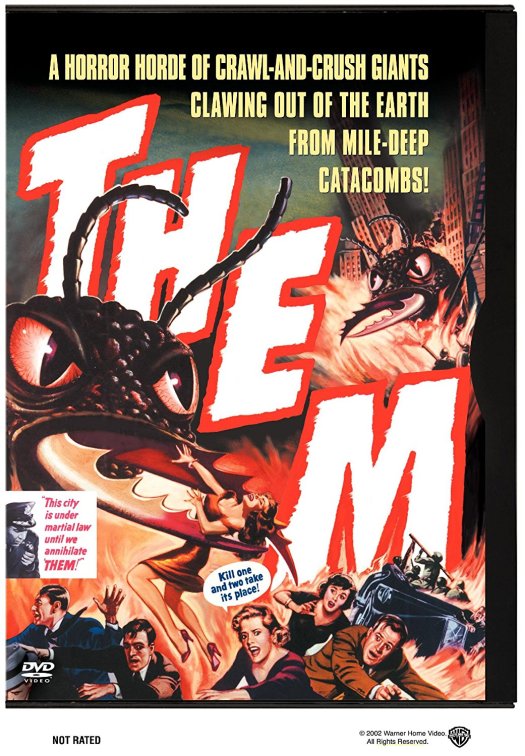
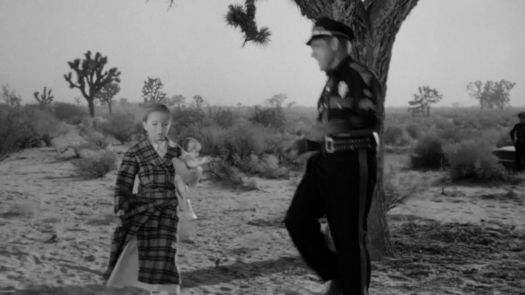
The iconic, bloodcurdling scream of little Sandy Descher heralds the arrival of THEM!, the first and best of the 50’s “Big Bug” atomic thrillers. Warner Brothers had one of their biggest hits of 1954 with this sci-fi shocker, putting it up there with Cukor’s A STAR IS BORN, Hitchcock’s DIAL M FOR MURDER, and Wellman’s THE HIGH AND THE MIGHTY as their highest-grossing films of the year. Not bad company for director Gordon Douglas , previously known for his work with Our Gang and Laurel & Hardy! THEM! was also Oscar nominated that year for its special effects (and should’ve been for Bronislaw Kaper’s terrific score).
The movie begins with the look and feel of a noir mystery courtesy of DP Sidney Hickox’s (DARK PASSAGE, THE BIG SLEEP , WHITE HEAT) brooding shadows and sandstorm-battered landscape. New Mexico policemen Ben Peterson and Ed Blackburn come across a little girl wandering…
(When Maddy Loves Her Classic Films invited me to join in on the Alfred Hitchcock Blogathon, I jumped at the chance! I’ve just completed the Ball State/TCM 50 YEARS OF HITCHCOCK course, and have been knee-deep in his movies for a month now!)
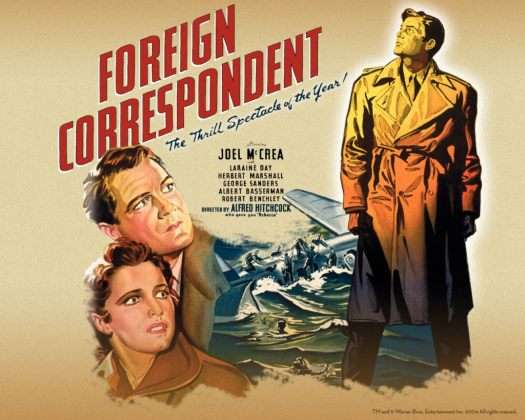
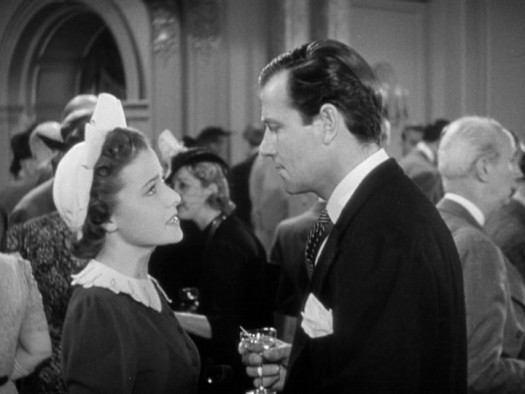
Alfred Hitchcock’s second American film found the Master of Suspense back in the spy game with FORGEIGN CORRESPONDENT, this time with American star Joel McCrea caught up in those familiar “extraordinary circumstances” we’ve all come to love. Like REBECCA that same year, this film was nominated for Best Picture, an extraordinary circumstance indeed for a director new to these shores. Offhand I can only think of three other directors to hold that distinction – John Ford (also in ’40), Sam Wood (1942), and Francis Ford Coppola (1974). Good company, to say the least! (And please correct me if I’m wrong, any of you film fans out there).
The 1950’s were a time of change in movies. Television was providing stiff competition, and studios were willing to do anything to fend it off. The bigger budgeted movies tried 3D, Cinerama, wide-screen, and other optical tricks, while smaller films chose to cover unusual subject matter. The following five films represent a cross-section of nifty 50’s cinema:
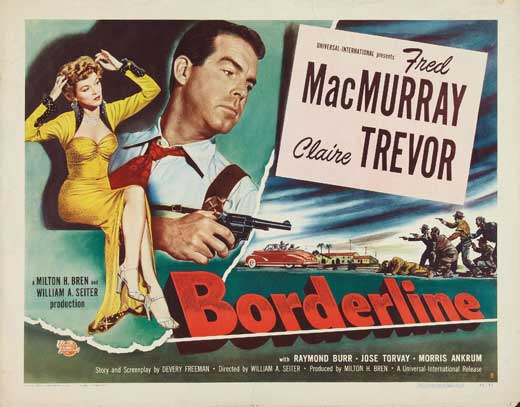
BORDERLINE (Universal-International 1950; D: William A. Seiter)
BORDERLINE is a strange film, straddling the borderline (sorry) between romantic comedy and crime drama, resulting in a rather mediocre movie. Claire Trevor plays an LAPD cop assigned to Customs who’s sent to Mexico to get the goods on drug smuggler Pete Ritchey (Raymond Burr , being his usual malevolent self). She’s tripped up by Ritchey’s rival Johnny Macklin (Fred MacMurray , channeling his inner Walter Neff), and taken along as he tries to get the dope over the border. What she doesn’t know is he’s also…
I’ve spent so much time talking about how much I love It’s A Wonderful Life that I’m running the risk of overlooking my second favorite Christmas film of all time, 1947’s Miracle on 34th Street!
So, now that you’ve had a chance to enjoy the radio version of It’s A Wonderful Life and the behind-the-scenes documentary about the making of that classic film, why not sit back and listen to Lux Radio Theater’s production of Miracle on 34th Street!?
This was originally broadcast on December 22nd, 1947 and it features the cast from the film — Natalie Wood, Edmund Gwenn, John Payne, and Maureen O’Hara!
Well, if you’ve ever seen the original 1947 Miracle on 34th Street than you already know the answer. There is a Santa Claus and he looks exactly like Edmund Gwenn!
In this scene, Kris Kringle is on trial. He swears that he is Santa Claus. The prosecution claims that not only isn’t he Santa Claus but Santa doesn’t exist at all. Fortunately, it’s the U.S. Post Service to the rescue!
Miracle on 34th Street is true Christmas classic and I hope you enjoy this holiday scene that I love.
(The remake with Richard Attenborough is also pretty good, as long as you can ignore the fact that Mara Wilson grew up to be one of the most annoying people on the planet.)


 Through the Shattered Lens