Horror Film Review: The Giant Claw (dir by Fred Sears)


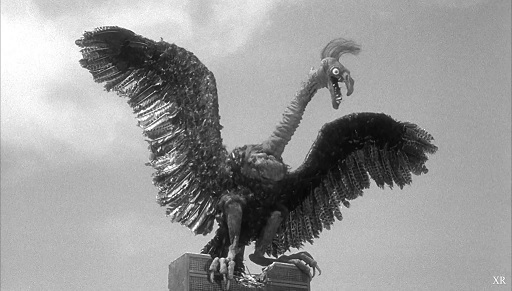
You know, a lot of people are a bit of dismissive of 1957’s The Giant Claw because they say that the monster — a big flying turkey from an anti-matter universe that has somehow slipped into our universe — is not convincing.

They make fun of the fact that, instead of hiring Ray Harryhausen like they were originally planning to do, the producers decided to save money by going for his non-union, Mexican equivalent.

They make fun of the scene in which a French-Canadian trapper announces that the Turkey Monster is actually a mythological beast that has the body of a woman, the head of a wolf, and the wings of a bat because the Turkey Monster certainly looks nothing like that.

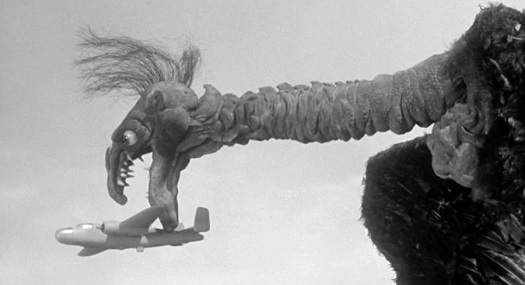
They laugh at the scene where the Turkey Monster chases an airplane, even though I think that would be pretty terrifying if I was actually on the airplane.  I mean, the last time we were flying home from the UK, we hit a bit of turbulence and it traumatized me for days.  I can only imagine how I would feel if I looked out the window and I saw a giant flying turkey chasing after the plane.

Critics will even make fun of how the turkey sounds, mocking it for its weird “caw caw” noises.

Well, alright.  Let’s just admit it.  The turkey isn’t the most menacing monster in the world and yes, it does sometimes sound a bit hoarse and it could definitely stand to put on a little weight but seriously, how can you not love this thing?
As for the film itself, it not only features one of the greatest monster of all time but it’s also a love story!  Mitch MacAfee (Jeff Morrow) is a pilot who sees a UFO and who faces an attempt, by the government, to cover up what he’s seen.  As happened to so many of the people who saw UFOs in the 50s, he’s accused of being either mistaken or an outright hoaxer.  Meanwhile, Sally Caldwell (Mora Corday) is a mathematician who is originally skeptical of Mitch and his claims but who realizes that he was right when they’re attacked by the Turkey Monster.  Their plane crashes in Canada, where they are rescued by a French-Canadian trapper named Pierre Brousssard (Lou Merrill).  While the Turkey Monster is terrifying the world, Sally and Mitch are falling in love and since Jeff Morrow and Mara Corday are the most attractive people in the film, it only seems right.  They’re a cute couple, who cares if the script makes any sense?

Anyway, back to the Turkey Monster.  The Turkey Monster is protected by an anti-matter shield, which makes it impossible for it to be attacked by missiles and planes.  A high-ranking general is left repeating, “Missiles and bombs,” after realizing that they’re all useless against the turkey.
Eventually, the Turkey Monster makes its way to New York City and announces that it’s not going anywhere!
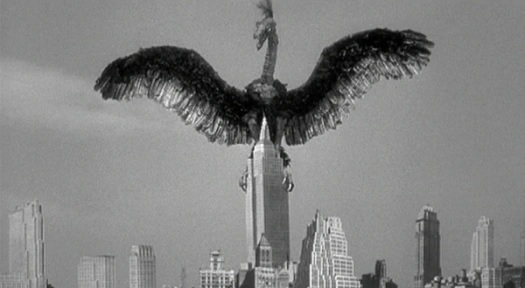
Well, you know what, Giant Turkey?  If you can make it there, you can make it anywhere!

Sadly, the Turkey’s New York visit doesn’t end well and that’s a shame.  Benjamin Franklin famously suggested that America’s official bird should have been the turkey as opposed to the eagle.  Looking at the Giant Turkey sitting on the Empire State Building, how can you disagree?

Seriously, don’t listen to the critics.  The Turkey Monster is one of the most entertaining monsters of all time and The Giant Claw is tons of fun!
A Blast From The Past: The Mercury Theatre Presents Heart of Darkness


Before he revolutionized cinema, Orson Welles revolutionized both theater and radio. As the host and mastermind behind the Mercury Theatre On The Air, Welles was heard on a weekly basis as the show broadcast adaptations of literary classics into American homes. In 1938, both Welles and Mercury Theatre On The Air achieved a certain immortality with their broadcast of War of the Worlds. What is often forgotten is that, one week after terrifying America, the Mercury Theatre presented an adaptation of Joseph Conrad’s Heart of Darkness, one which featured Welles in the role of Kurtz and his future Citizen Kane co-star, Ray Collins, as Marlow.

This broadcast was significant in that, when Welles first went to Hollywood, it was with an eye towards turning Heart of Darkness into a film. Welles planned to shoot the film strictly from the point-of-view of Marlow, with the camera serving as Marlow’s eyes. Welles not only planned to play Kurtz in the film but he also intended to provide the voice of Marlow. Unfortunately, the film was never made. With the outbreak of war in Europe, it was felt that the audience most likely to embrace Welles’s experiment would no longer be going to the movies. Welles would instead make his cinematic debut with Citizen Kane, a film that fully embodies Welles’s artistic vision regardless of what Mank tried to sell everyone last year. As for Heart of Darkness, it would later be adapted for television, appearing in greatly altered form as an episode of Playhouse 90 in 1958. Boris Karloff played Kurtz and Roddy McDowall played Marlow and someone decided that it would be a good idea to add a subplot in which Kurtz is revealed to by Marlow’s long lost father. There would be many attempts to turn Conrad’s novella into a feature film but it was not until 1979, with Francis Ford Coppola’s Apocalypse Now, that Conrad’s story would appear on the big screen, albeit in massively altered form. Nicolas Roeg would later direct his own version of Heart of Darkness, one that featured Tim Roth as Marlow and John Malkovich as Kurtz. (I haven’t seen it but that just sounds like perfect casting.)

Today, in honor of the 106th anniversary of the birth of Orson Welles, here is the Mercury Theatre On The Air’s production of Heart of Darkness. This broadcast also features an adaptation of the play, Life With Father. The casts are as follows:

Heart of Darkness: Orson Welles (Author, Ernest Kurtz), Ray Collins (Marlow), Alfred Shirley (Accountant), George Coulouris (Assistant Manager), Edgar Barrier (Second Manager), William Alland (Agent), Virginia Welles (Kurtz’s Intended Bride), Frank Readick (Tchiatosov)

(For those keeping track, Welles, Collins, Coulouris, and Alland would all have key roles in Citizen Kane. Alland played the reporter who is assigned to discover the meaning of Rosebud. Ray Collins played Boss Jim Gettys, the political boss who prevents Kane from being elected governor. Coulouris played Kane’s guardian, Walter Parkes Thatcher. And Welles, of course, was Charles Foster Kane, American. )

Life With Father: Orson Welles (Father), Mildred Natwick (Mother), Mary Wickes (Employment Office Manager), Alice Frost (Margaret), Arthur Anderson (young Clarence Day).

This program was originally aired on November 6th, 1938. Welles was 22 years old at the time of this broadcast. So, sit back and enjoy Orson Welles and the Mercury Theatre.

Halloween Havoc!: THE PHANTOM OF THE OPERA (Universal 1943)


gary loggins's avatarcracked rear viewer

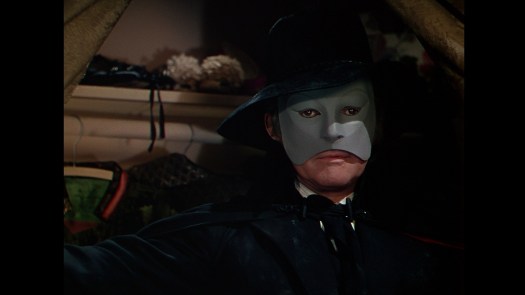
Universal’s 1943 remake of the 1925 Lon Chaney Sr. classic THE PHANTOM OF THE OPERA is definitely an ‘A’ movie in every way. A lavish Technicolor production with an ‘A’ list cast (Claude Rains, Nelson Eddy, Susanna Foster) and opulent sets (including the Opera House interiors built for the ’25 silent), it’s the only Universal Horror to win an Oscar – actually two, for Art Direction and Cinematography. Yet I didn’t really like it the first time I saw it. It’s only through repeated viewings I’ve softened my stance and learned to appreciate the film.

Claude Rains’s performance in particular has made me a convert. As Erique Claudin, he’s a sympathetic figure, and one can’t help but feel sorry for him. When he’s let go from the orchestra by the maestro, after twenty long years as a violinist, his arthritis causing his playing to become subpar, I felt pity for…

View original post 438 more words

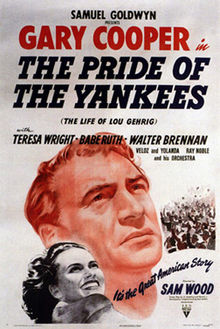
Lisa Reviews An Oscar Nominee: The Pride of the Yankees (dir by Sam Wood)


220px-The_Pride_Of_The_Yankees_1942

“People all say that I’ve had a bad break. But today … today, I consider myself the luckiest man on the face of the Earth.”

— Lou Gehrig (Gary Cooper) at the end of The Pride of the Yankees (1943)

After airing Foreign Correspondent earlier tonight, TCM followed up by showing the 1943 best picture nominee, The Pride of the Yankees.  Knowing that Pride of the Yankees was going to be a baseball film and that I know next to nothing about baseball, I recruited my sister, the Dazzling Erin, to watch the movie with me.  Erin loves baseball and I knew that she would be able to explain anything that went over my head.

Well, I absolutely loved watching this movie with my sister but it turns out that The Pride of the Yankees isn’t really much of a baseball movie.  True, it’s about a real life baseball player.  Several actual players appeared as themselves.  About 85% of the film’s dialogue deals with baseball and probably about 70% of the film features characters playing some form of the game.  But the film never goes into any great detail about baseball or how it’s played.  There’s no talk of strategy or rules or deeper meaning or anything else.  Going into the film, I knew that baseball was a game that involved throwing, swinging bats, and running.  And it turns out that was all that I needed to know.

The Pride of the Yankees is less about baseball and more about celebrity.  It’s a biopic of Lou Gehrig, who today is best known for his battle with ALS, a disease that is also known as Lou Gehrig’s disease.  Lou Gehrig died on June 2, 1941 and The Pride of the Yankees was released just a year later.  Watching the film, it’s obvious that Gehrig was a beloved figure, the type of celebrity who, if he were alive today, would probably be the center of stories like, “Lou Gehrig Did Something This Weekend And It Was Perfect.”  Watching the film, it easy to imagine how traumatic it must have been for the nation when a beloved athlete like Lou Gehrig died at the age of 37.

As a result, The Pride of the Yankees is less a biopic and more a case for canonization.  From the minute that the film’s Lou Gehrig appears on-screen, he is presented as being the type of saintly athlete who, by promising to hit two home runs in one game, inspires a crippled child to walk.  Lou is modest, kind, unpretentious, and never gets angry.  Over the course of the film, he takes care of his mother, displays a worthy work ethic, and marries Eleanor.  He and Eleanor have a perfect marriage without a single argument or a hint of trouble, except for the fact that Lou sometimes gets so busy playing baseball with the local children that he’s late coming home.  There’s not a hint of sadness in their life, until Lou suddenly gets sick.

And really, it should not work.  If ever there’s ever been a film that should be painfully out-of-place in our more cynical times, it would be The Pride of the Yankees.  However, the film still works because Lou is played by Gary Cooper and Eleanor is played by Teresa Wright.  These two excellent performers bring their considerable talents to making overly sentimental scenes feel credible.  Gary Cooper was 40 years old when he made The Pride of the Yankees and there’s a few scenes — especially the ones where Lou is supposed to be a student at Columbia University — where Cooper is clearly too old for the role.  But, for the most part, Gary Cooper did a great job as Lou Gehrig.  Cooper is especially memorable when Lou first starts to show signs of being ill.  Watching Lou struggle to swing a bat, I was reminded of a horse struggling to stand on an injured leg.  It was almost painfully poignant.

The Pride of the Yankees was nominated for 11 Academy Awards, including best picture.  However, it lost to another sentimental film that featured Teresa Wright, Mrs. Miniver.