For your Halloween pleasure, here is Edgar Allan Poe’s The Masque of the Red Death, as read by the great Basil Rathbone:
For your Halloween pleasure, here is Edgar Allan Poe’s The Masque of the Red Death, as read by the great Basil Rathbone:

Have you ever wanted to hear Christopher Walken read The Raven? Of course you have! Who hasn’t?
Well, today is your lucky day! Here is Christopher Walken, reciting Edgar Allan Poe’s The Raven. This was apparently recorded for a CD entitled Closed For Rabies, which featured several celebrities reading stories and poems by Mr. Poe.
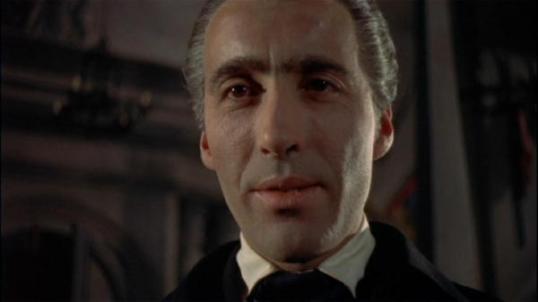
Here to help you get in the mood for the best day of the year is Christopher Lee reading Edgar Allan Poe’s The Fall Of The House Of Usher. Listening to this will require 40 minutes of your time but it’s totally worth it. Christopher Lee had an amazing voice and was a wonderful reader and one imagines that it was his voice that Poe heard in his head as he first wrote this short story.
Here is the wonderful voice of Christopher Lee….
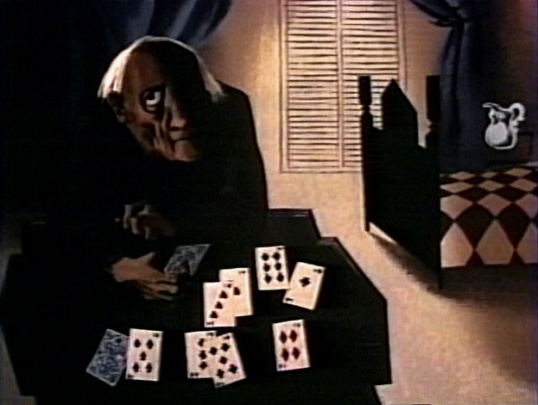
This short, animated film is from 1953 and it features James Mason reading a story from America’s first master of suspense, Edgar Allan Poe!
Here, for your listening and visual enjoyment, is The Tell Tale Heart! Along with featuring the voice of James Mason, the film was directed by Ted Parmlee. It was the first animated film to ever be given an X rating by the British Film Board of Censors.
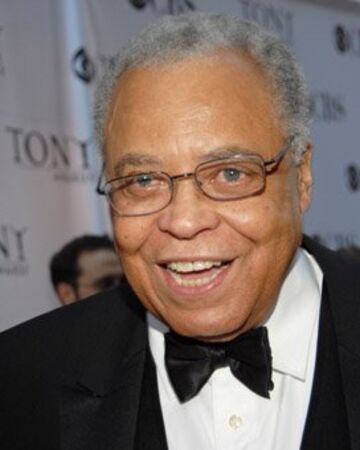 Need some help getting in the Halloween spirit?
Would listening to the great James Earl Jones read The Raven help?
Here to continue to spread the Halloween spirit is Vincent Price, performing The Tell-Tale Heart. This is from 1970 and was a part of a PBS special called An Evening With Edgar Allan Poe.
Did Roger Corman have an issue with cats?
That’s the question I asked myself as I watched 1964’s The Tomb of Ligeia. Loosely based on a short story by Edgar Allan Poe, The Tomb of Ligeia tells the story of Verden Fell (Vincent Price). Fell’s wife, Ligeia, has recently died but Fell worries that her spirit is still haunting and watching him. One gets the feeling that Fell hated his late wife but, at the same time, was obsessed with her. Fell has an eye condition which causes him to wear dark glasses on the rare occassions that he leaves his manor. He’s definitely a creepy guy but that doesn’t stop Rowena (Elizabeth Shepherd) from falling in love with him and leaving her fiancé, Christopher Gough (John Westbrook), to marry him. Unfortunately, Rowena is soon feeling the spirt of Ligeia as well, in the form of a black cat who keeps attacking Rowena.
Now, in all honesty, I doubt that Roger Corman specifically had an issue with cats. It’s possible the Edgar Allan Poe had an issue with cats, as he lived at a time when cats were rarely kept as pets and were instead just used to catch and kill mice and rats. (And, in fairness to the 19th century, that was a very important job in those days of bad hygiene and outhouses.) There’s no cats to be found in Poe’s short story about Ligeia but there was one very prominently featured in The Black Cat. As Ligeia was not exactly one of Poe’s most detailed stories, it’s probable that Corman and screenwriter Robert Towne just included the evil black cat because that story was one of Poe’s best-known.
That said, for me, it was difficult to watch an entire movie about people hating and attempting to destroy a cat. It’s certainly not the cat’s fault that it’s been possessed by the spirit of Ligeia. As I watched the film, it occurred to me that cats may not have been as popular in the 1960s as they are today. I mean, there was no internet when this film was made and, as a result, people weren’t constantly being bombarded by cute cat pictures. Instead, people probably just knew cats for their habit of hissing at people and scratching their owners. Today, we find that behavior to be cute. Perhaps back in 1964, people felt differently.
If I seem to be rambling on about the cat, that’s because there’s not really a lot to be said about The Tomb of Ligeia. It was the last of Corman’s Poe films and neither Corman nor Price seem to be particularly invested in the material. Price is actually rather miscast as Verden Fell. Fell is meant to be a mysterious aristocrat, in the spirit of Maxim de Winter from Rebecca. But Vincent Price is …. well, he’s Vincent Price. Vincent Price was a wonderful actor and personality but he wasn’t particularly enigmatic. From the first minute we see Price, we know that he’s being haunted by his dead wife because he’s Vincent Price and the same thing happened to him in several other films.
The Tomb of Ligeia is full of the ornate sets and beautiful costumes that were featured in all of Corman’s Poe films. And even a miscast Vincent Price is still fun to watch. But, when compared to the other films in the Poe Cycle, this one falls flat.

“A deep sleep fell upon me — a sleep like that of death.”
— Edgar Allan Poe, “The Pit and the Pendulum”

“All that we see or seem is but a dream within a dream.”
— Edgar Allan Poe
In 1964’s The Masque of the Red Death, Vincent Price stars as Prospero.
Prospero is a nobleman in medieval Italy, a decadent tyrant who rules his villages with an iron hand and who proudly and openly worships Satan. When an old woman in one of the villages dies of the plague, Prospero orders the village to be burned to the ground. He returns to his castle where, with his mistress (Hazel Court), he plans to throw a masquerade for the local nobility. His plan is for everyone to hide out in the castle until Death has passed. The problem, of course, is keeping Death from sneaking into the castle and claiming everyone within.
Prospero also abducts three villagers, Ludovico (Nigel Green), his daughter Francesca (Jane Asher), and Francesca’s boyfriend, Gino (David Weston). The three villagers find themselves in a decadent world, where Prospero and his attendants are motivated by their own greed and petty jealousies. Keeping Death from entering the castle would probably be a lot easier if the people in the castle would stop trying to kill each other. It’s an odd atmosphere within the castle. Everyone fears Death and yet, everyone seems to be doing all that they can do invite it in with them. Can anyone, even a worshipper of the Damned liked Prospero, truly escape Death?
The Masque of the Red Death is not only the best of Roger Corman’s Edgar Allan Poe adaptations but it’s also the best film that Corman ever directed. Working with cinematographer Nicolas Roeg (who was himself destined to have quite a career as a director of enigmatic films), Corman fills the screen with vivid colors and scenes of medieval decadence. Price gives one of his best performances, playing Prospero as someone who is in love with his own amoral nature but whose arrogance quickly gives way to fear when he starts to suspect the Death has somehow managed to enter the castle. The inhabitants of the castle are all memorably eccentric and, in many cases, evil. A man in an ape costume is burned to death and hardly anyone seems to notice or care. Prospero and his nobles think that they’re above death because of their wealth and their place in society but, of course, no one can escape Death.
David Weston and Jane Asher are both well-cast as the two lovers, though Asher is clearly more a product of the swinging sixties than medieval Italy. Patrick Magee and Skip Martin are both memorable as members of Prospero’s court, with Skip Martin giving an especially diabolical performance as a murderous court jester. In the end, though, this film truly belongs to Price, Corman, and Roeg. Roeg’s cinematography is dazzling, with the use of red foreshadowing his later film, Don’t Look Now. Corman’s direction puts the viewer right in the center of Prospero’s court. And Vincent Price gives one of his best performances as the self-amused but unashamedly evil Prospero. The Masque of the Red Death remains a classic of 60s pop art and the best of Corman’s many films.
 Through the Shattered Lens