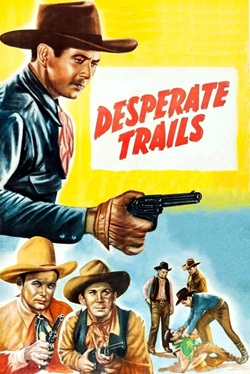
Desperate Trails (1939, directed by Albert Ray)


The frontier town of Denton has become lawless, plagued by murders, robberies, and cattle rustling.  The town’s sheriff (Russell Simpson) just cannot seem to bring peace to the streets.  That’s because the sheriff is secretly responsible for all the crime.  He’s working in cahoots with the town banker (Clarence Wilson) and he’s sets his sights on taking over a ranch owned by Frances Robinson.  As was so often the case with B-westerns, it all comes down to stealing someone else’s land.

The federal government sends Marshal Johnny Mack Brown to bring some order to the town.  Working undercover, Brown gets hired as Robinson’s ranch and he quickly chases off all of the bad ranchhands,  He brings his friend, singing cowboy Bob Baker, onboard to work as the ranch foreman.  With Fuzzy Knight providing comic relief, Brown sets out to thwart the next stagecoach robbery and to expose the evildoers of Denton.

This was the first western that Brown made with Universal Pictures.  Bob Baker, who had previously been the star of the studio’s B-westerns, was demoted to second lead and, eventually, he quit making films for Universal all together.  Unlike Baker, who was angry at being demoted, Fuzzy Knight was always happy to provide sidekick duty and would go on to co-star in all of Brown’s Universal westerns.  From the start, Brown and Knight had the chemistry that made them a good B-movie team.

Desperate Trails is a typical B-western but, as always, Brown elevates things with his performance.  From the minute that Brown rides into town, he screams authenticity.  He’s pretty tough in this film, which includes a scene where he coolly takes care of a gang of outlaws with just one rifle.  The best performance here comes from Russell Simpson, who gets angrier and angrier as the film goes on and all of his plans fall apart.

For fans of the B-western genre, Desperate Trails has a lot of entertainment to offer.
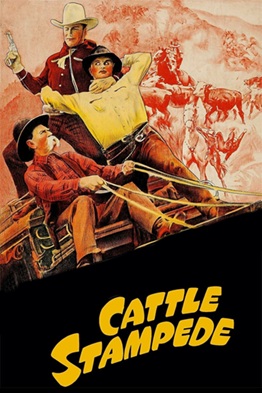
Cattle Stampede (1943, directed by Sam Newfield)


Billy the Kid (Buster Crabbe), that western do-gooder who has been framed for crimes that he didn’t commit, narrowly escapes being captured by a group of bounty hunters.  To thank the man who helped him and his sidekick, Fuzzy Q. Jones (Al  St. John), escape, Billy agrees to help the man’s family make a cattle drive.  It turns out that local ranchers are being targeted by rustlers who cause the cattle to stampede and then buy up what’s left of the herd at a discount.  Even though Mary Dawson (Frances Gladwin) doesn’t trust Billy and initially suspects him of being one of the rustlers, Billy and Fuzzy take over the cattle drive and protect the family from Coulter (Glenn Strange) and Elkins (Frank Ellis).  They even prove their worth by rescuing Mary after she’s kidnapped by the villains.

This is one of the many Poverty Row westerns to feature Billy the Kid not as an outlaw but instead as a hero.  Best-known for playing Tarzan, Flash Gordon, and Buck Rogers, Buster Crabbe was a believable hero even if he was more than a little too old to be nicknamed “the kid.”  Al St. John provides the comedic relief and veteran bad guys Charles King, Glenn Strange and Frank Ellis go through the motions as the villains, much as they did in countless other westerns of the era.  Cattle Stampede is typical of the cheap western programmers that came out of the Poverty Row studios in the 40s.  It was simplistic and predictable but featured enough western action to keep the kids in the audience entertained.  Today, its main selling point is a nostalgic one.

The Billy the Kid films are always strange because they avoid the reason why Billy is being pursued by the law and instead just present him as being another generic western hero.  It seems like a waste of a good legend.

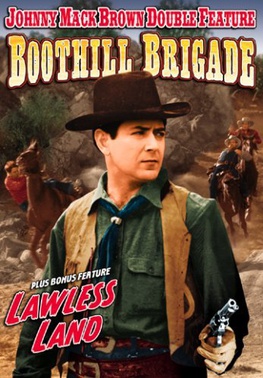
Boothill Brigade (1937, directed by Sam Newfield)


Rancher Jeff Reynolds (Frank LaRue) used to be one of the good guys on the frontier but he’s recently changed.  He fired all of his loyal ranch hands and instead hired a motely crew of outlaws.  He’s buying up land and evicting the squatters who have been living there.  About the only good thing he does is hire Lon Cardigan (Johnny Mack Brown) to be his new herd boss.  Lon is engaged to Reynolds’s daughter, Bobbie (Claire Rochelle).  With the help of Bobbie and comic relief cook Calico Haynes (Horace Murphy), Lon tries to figure out why Reynolds is now doing the bidding of the evil John Porter (Ed Cassidy).

The title is the most exciting thing about this movie, which is one of those old B-movies that puts the “creak” in creaky.  There’s surprisingly little gunplay but there is a lot of horse riding.  For a film that runs less than an hour, a surprising amount of it is just shots of people riding from one location to another.  The horses’ hooves sound impressive on the soundtrack but it’s not exactly exciting.  As always, Johnny Mack Brown is a convincing cowboy.  It’s a good thing he looks like he knows what he’s doing when he’s riding a horse!  The plot was standard B-western fluff.  Johnny Mack Brown appeared in a ton of westerns and almost all of them seemed to feature the same range war.  There are better Johnny Mack Brown movies out there.  This one is for completists only.

Roaring Rangers (1946, directed by Ray Nazarro)


Another frontier town is in trouble.

Sherriff Jeff Conner (Jack Rockwell) is having trouble ridding his town of outlaws so his son, Larry, (Mickey Kuhn) writes a letter to his hero to ask for help.  He addresses the letter to “Durango Kid, Texas.”  That’s all it takes for Steve Randall (Charles Starrett) and his sidekick, Smiley Burnette, to show up in town.

Steve and Smiley apply to be deputies but Sheriff Conner explains that someone is circulating a petition to get him fired.  Steve dresses up as the Durango Kid and pressures the citizens to give the Sheriff another chance.  Realizing that the Durango Kid is making them look bad, the outlaws decide to dress up one of their own as Durango and make the Kid look bad.  With the town turning on Durango, will Durango and Smiley be able to save Sheriff Conner from an assassination attempt?

This Durango Kid film is different from the rest of the series in that, for once, Steve is hired to be a deputy instead of a sheriff.  This really is Sheriff Conner’s story, as he tries to win the respect of the town and keep its citizens safe, even while his own brother (Ed Cassidy) is working with the outlaws.  There are all the usual horse chase and shootouts but this time, Durango and Smiley are mostly around to provide support to a man who is trying to do the right thing.  B-western fans will enjoy it.

Smiley sings a few songs, as always.  This time, musical accompaniment is provided by Merle Travis and his Bronco Busters.

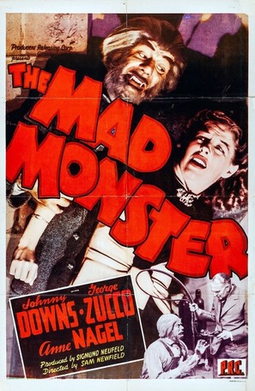
Horror On The Lens: The Mad Monster (dir by Sam Newfield)


In the 1942 film, The Mad Monster, the great George Zucco plays Dr. Cameron.  Dr. Cameron is a mad scientist who has a few issues with his colleagues and who makes the decision to deal with those issues by transforming his simple-minded handyman (Glenn Strange, who played Frankenstein’s Monster in a number of Universal films) into a wolfman.

The Mad Monster is one of the many horror films that were produced by Producers Releasing Corporation, which was one of the most poverty-stricken of the poverty row production companies.  To me, the interesting thing about the film is that Cameron initially wants to use his werewolf formula to help in the war effort.  He wants to help the United States win the war by turning soldiers into wolfmen.  It’s only after his plans are dismissed as being ludicrous that he starts using his wolfman to get revenge.  Unfortunately, the wolfman itself turns more savage and bloodthirsty with each act of revenge so I guess it’s a good thing that it wasn’t deployed on the battlefield because who knows what type of state the soldiers would have been in when they finally came home.

Here is 1942’s The Mad Monster!