For today’s horror on television, we’re very happy to present to you, Dead of Night!
From 1977, this television film is a horror anthology, made up of three stories directed by Dan Curtis and written by Richard Matheson. In the first story, a youngish Ed Begley, Jr. travels through time. In the 2nd story, Patrick Macnee plays a man whose wife is apparently being menaced by a vampire. And in the third story, Joan Hackett plays a mother who brings her dead son back to life, just to discover that sometimes it’s best to just let sleeping corpses lies.
The entire anthology is good, though the third story is clearly the best and the most frightening. Not only is it scary but it’s got a great twist ending.
When it comes to conspiracy theories involving presidential assassinations, the theories surrounding JFK may get all the attention but it’s the theories surrounding the death of Abraham Lincoln are usually far more plausible.
Unless, of course, it’s the theories that are pushed in the 1977 docudrama, The Lincoln Conspiracy.
A mix of documentary-style narration and really cheap-looking historical reenactments, The Lincoln Conspiracy essentially indicts almost everyone who was alive in 1865 as being a part of either the conspiracy or the subsequent cover-up. Really, it’s remarkable how many historical figures are implicated in this film.
With the Civil War coming to a close, President Lincoln (John Anderson) hopes to pursue a generous reconstruction policy for the former Confederate States. Secretary of War Edwin Stanton (Robert Middleton), Senator Ben Wade (Dick Callinan), and a host of other are all opposed to this plan, both because they want vengeance and they also want to make as much money as possible off of the Southern cotton fields. They come up with a plan to impeach Lincoln but, in order to draw up the articles, they have to make sure that Lincoln is not seen for a few days. When Col. Lafayette Baker (John Dehner) discovers that an actor named John Wilkes Booth (Bradford Dillman) is planning on kidnapping Lincoln, Stanton and his conspirators decide to give Booth their unofficial support. However, when the plan changes at the last minute and Stanton decides that it would actually be a bad idea to kidnap Lincoln, an angry Booth decides to just kill Lincoln, Andrew Johnson, and William Seward.
Booth succeeds in shooting Lincoln and making his escape. The other members of Booth’s group all fail in their assignments. Andrew Johnson becomes president. Though grievously wounded, William Seward survives. Booth flees to Canada and …. oh, you thought Booth died? No, that was just a look alike who was shot by a bizarre soldier named Boston Corbett. By allowing everyone to believe that Booth was killed, Stanton is able to cover up any role he and his allies played in inspiring the assassination. Unfortunately, Col. Baker keeps a diary and it seems like he might be planning on revealing the truth but he dies mysteriously before he can.
(And, to give the film some credit, Col. Baker’s sudden death at 41 was an odd one. And, though it’s not really explored in the film, Boston Corbett, the man who shoot Booth, really was a weirdo who was described by contemporaries as being a religious fanatic who castrated himself and claimed to hear the voice of God.)
It’s a big conspiracy theory that is presented in The Lincoln Conspiracy. In fact, it’s a bit too big to really be taken seriously. The film pretty much accuses everyone in Washington of having a part in the assassination. The film itself has the cheap look of a community theater production and the use of Dr. Samuel Mudd as a narrator only adds to the film’s silliness. If you’re a fan of gigantic and thoroughly implausible conspiracy theories, as I am, the film is entertaining in its way. If nothing else, Bradford Dillman certainly looks like how most people probably imagine John Wilkes Booth to have looked. Otherwise, The Lincoln Conspiracy is far-fetched and not at all realistic, which is why I assume that a lot of people in 1977 probably believed every word of it.
There have been many disturbing ventriloquist’s dummies over the years but I don’t know if there’s ever been one who is quite as hateful as Fats, the dummy that is used by Corky Withers (Anthony Hopkins).
Corky and Fats are at the center of the 1978 film, Magic. When we first meet Corky, he’s an aspiring magician without a dummy. He’s a talented magician and it’s obvious that performing is one of the only things that brings Corky happiness. But, from the start, there’s something off about Corky. There’s a desperation to him and his performance. He craves the applause of the audience just a bit too much, as if he doesn’t know who he is unless people are clapping for him. (This performance, from a youngish Anthony Hopkins, is quite a contrast to the characters that Hopkins is today known for playing.) Corky is told that he needs to get a “gimmick” if he’s ever going to be a success and that gimmick turns out to be Fats, a ventriloquist dummy who is as confident as Corky is insecure. Whereas Corky often seems to be struggling to find the right thing to say, Fats always has the perfect comeback ready.
Of course, Fats is Corky. Fats is the self-absorbed and cocky “person” that Corky wishes he could be. When Fats tells Corky that he’s a useless loser, it’s actually Corky saying that to himself. When Corky argues with Fats, he’s arguing with himself. With Fats, Corky has found a way to express himself but he’s also sacrificed half of his identity as a result. Can Corky survive without Fats? He’s not sure but he does know that Fats is a hit with audiences.
When Corky’s agent (Burgess Meredith) announces that he has gotten Corky a network television special, Corky panics. Corky doesn’t want to take the medical or mental exams that the network would probably require before giving him a contract. He flees to the Catskills, where he grew up. (Corky’s obsession with performing makes sense when one realizes that he grew up in the Catskills, a region that played home to many aspiring comedians.)
Corky visits Peggy Ann Snow (Ann-Margaret), with whom Corky went to high school and who he had a huge crush on. (Imagining Anthony Hopkins in high school — especially an American high school — is not particularly easy.) Peggy is unhappily married to Duke (Ed Lauter) and she soon finds herself falling in love with Corky. Corky appears to finally have a chance for happiness but Fats has other plans. Murder follows and it says something about how well this film is done that we think of Fats as being the mastermind behind the murders even though we know that Fats is really just Corky talking to himself.
Magic is the definitive evil ventriloquist’s dummy film, one that is beautifully shot by Richard Attenborough and which features a great performance from Anthony Hopkins. It’s a sign of the strength of his performance that we still feel sorry for Corky, even though he ends up killing one of the most likable characters in the film. Of course, it’s a dual performance for Hopkins because he’s playing both Corky and Fats. He is excellent and frightening in both roles.
For today’s horror on the lens, we’re very happy to present to you, Dead of Night!
From 1977, this television film is a horror anthology, made up of three stories directed by Dan Curtis and written by Richard Matheson. In the first story, a youngish Ed Begley, Jr. travels through time. In the 2nd story, Patrick Macnee plays a man whose wife is apparently being menaced by a vampire. And in the third story, Joan Hackett plays a mother who brings her dead son back to life, just to discover that sometimes it’s best to just let sleeping corpses lies.
The entire anthology is good, though the third story is clearly the best and the most frightening. Not only is it scary but it’s got a great twist ending.
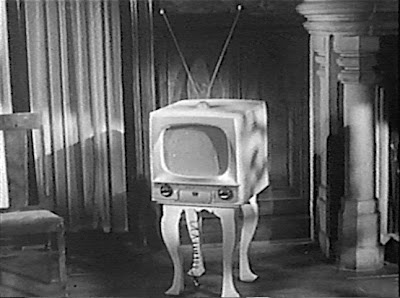 For today’s horror on television, we’re very happy to present to you, Dead of Night!
 Through the Shattered Lens