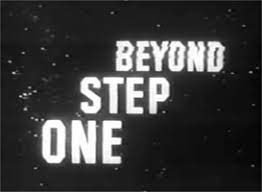
Horror on Television: One Step Beyond 1.1 “The Bride Possessed” (dir by John Newland)


During the month of October, we like to share classic episodes of horror-themed television.  That was easier to do when we first started doing our annual October Horrorthon here at the Shattered Lens because every single episode of the original, black-and-white Twilight Zone was available on YouTube.  Sadly, that’s no longer the case.

However, there is some good news!  Twilight Zone may be gone but there are other horror shows on YouTube!  For instance, there’s One Step Beyond, a supernatural-themed anthology show that claimed every story that it told was based on an actual incident.  This show ran on ABC from 1959 to 1961 and was scheduled to air opposite of Twilight Zone.

The very first episode of One Step Beyond aired on January 20th, 1959.  In this episode, a young bride (Virginia Leith) on her honeymoon suddenly starts to act differently.  (Not only does she become more outspoken but she also loses her Southern accent.)  Is it possible that she’s been possessed by the spirit of a murdered woman and now, she’s going to solve her own murder?

Watch to find out!

The TSL Horror Grindhouse: Garden of the Dead (dir by John Hayes)


The 1972 film, Garden of the Dead, takes place in a prison camp that sits out in the middle of what appears to the bayous.  The prisoners spend their days working on the chain gang, breaking rocks and cleaning highways.  The tough-as-nails guards spend their days watching the prisoners and carrying around their rifles.  This is the type of prison camp where the prisoners are all talkative and boastful and the guards all wear sunglasses and every day is just like the next.

A group of prisoners are trying to brighten things up on the chain gang by using some experimental formaldehyde to get high.  I’m sure that won’t lead to any complications!  When the prisoners later try to escape from the prison camp, they’re quickly captured by the guards who proceed to violate all sorts of laws by gunning the prisoners down and then ordering the other prisoners to bury the dead bodies in the prison camp’s garden.

That night, the dead prisoners come back to life as zombies.  Does this happen because they were getting high off of the formaldehyde or is it because the chemicals themselves were leaked into the garden?  The film doesn’t make it particularly clear but it doesn’t matter.  What’s important is that they’re now zombies.  You really don’t need a whole lot of explanations when it comes to zombies.  The dead prisoners are still obsessed with getting high and they start to kill everyone in the camp as a part of their effort to get their precious formaldehyde.

I’ll just admit right now that I absolutely love Garden of the Dead.  Some of that is because Garden of the Dead is a very short movie, clocking in at barely an hour’s running time.  It was a film that was obviously designed to be the second half of a double feature but no matter!  That short running time means that there’s no need for extra padding and the action move quickly.  The film ends before the viewer gets bored with the somewhat repetitive zombie action.  Seriously, we need to normalize 50 minute films.

Another thing that I love about Garden of the Dead is that it is full of foggy bayou atmosphere.  The film itself was obviously shot on a very low budget and on very cheap film but the grainy images actually contribute to the film’s nightmarish feeling.  The film captures the feeling of being isolated in the middle of nowhere.  One reason why the zombies in this film are frightening is because there’s literally nowhere safe to hide from them.  Even if you can get out of the prison camp, you’ll still have to brave the wilderness that surrounds it.

Finally, I liked that the zombies in Garden of the Dead were smarter than the average zombies.  Instead of just stumbling around and trying to eat every living thing that they met, these zombies worked together to get what they wanted.  I especially liked the spazzy zombie who was always running around the prison camp and jumping and yelling at everyone.  These are zombies who clearly enjoy being zombies and it makes Garden of the Dead all the more effective.

Garden of the Dead is a grindhouse gem!

<– October Hacks: Meatcleaver Massacre (dir by Ed Wood)

The Phillies Win Game One Of The NLCS  –>

Film Review: The Black Godfather (dir by John Evans)


The 1974 film, The Black Godfather, opens with two black men attempting to break into the house of a white drug dealer.  Unfortunately, the drug dealer happens to be home.  Both of the men are shot.  One dies in the alley.  The other, J.J. (Rod Perry), is shot in the arm but survives.

J.J. may not have been able to rob the dealer but his bravery impresses Nate Williams (Jimmy Whitherspoon), a powerful neighborhood crime lord.  Nate allows J.J. to hide out at his place and, while J.J. heals, Nate offers up some advice on how to survive on the streets.  J.J. says that he’s only interested in making some “bread,” but Nate thinks that J.J. has what it takes to become one of the top men in his organization.

One opening credits montage later and J.J. has indeed become a powerful man on the streets.  Though he may sell drugs, J.J. is a gangster with a conscience.  As he explains to his old friend, Diablo (Damu King), there’s no way to create change unless you make some money beforehand.  Diablo is a political militant who has no interest in working with J.J. until he discovers that J.J. is planning on running Tony (Don Chastain) out of the neighborhood.  Tony is a white gangster who has made a fortune by destroying black communities with heroin.  Diablo and his followers become J.J.’s enforcers as he wages war against Tony.

Unfortunately, the always pragmatic Nate doesn’t want J.J. to wage war against Tony.  Nate believes that it is important to keep the peace.  That Nate is tying to prevent a war doesn’t matter to Tony, of course.  As soon as Tony finds out that J.J. has been seeing Nate’s daughter, Yvonne (Diane Sommerfeld), he makes his move.

Made at the height of the Blaxploitation era, The Black Godfather‘s title brings to mind memories of Don Corleone, Michael, Sonny, and Tom Hagen.  And it is true that the wise and patient Nate does, in many ways, come across like a black version of Don Corleone.  Nate is pragmatic and cautious almost to a fault.  Just as Don Corleone resisted going to the war with the Tattaglias, Nate resists going to war with Tony.  (And, much like the Tattaglias, Tony proves himself to be unworthy of Nate’s generosity.)  However, J.J. has far more in common with Sonny than with Michael.  Unlike the  calculating and patient Michael, J.J. is in a hurry to prove that he’s the most powerful gangster in the community.  Like Sonny, J.J. doesn’t hesitate before striking back at his enemies.

Unfortunately, despite having an intriguing premise, The Black Godfather is a bit of a chore to sit through.  The story moves slowly and even the scenes of gangster violence feel rather rudimentary.  Rod Perry projects a confident charisma and Jimmy Witherspoon does a good job as the wise Nate but otherwise, the cast is stiff and unconvincing.  It’s a shame.  The mix of crime and militant politics had potential.  Early on, Diablo and J.J. debate whether or not good can come out of bad, with J.J. arguing that money can get a lot more done than idealism.  It’s a debate that’s still relevant today but it’s also an issue that the film abandons fairly quickly.  Based on the film’s title, I had some hope for The Black Godfather but, in the end, it’s just too slow and amateurish to really be memorable.

Embracing the Melodrama Part II #43: The Stepmother (dir by Howard Avedis)


stepmotherJust looking at the poster for the 1972 film The Stepmother, I bet you think it’s a pretty scandalous and sordid film.  I mean, there’s a picture of a woman wearing a black bra and there’s a tagline that reads, “She forced her husband’s son to commit the ultimate sin!”

CIP_Logo

Well, perhaps not surprisingly considering that this is a Crown International film, The Stepmother‘s poster and tagline have very little do with the actual film.  Yes, the film does feature a stepmother and, during the final 20 or so minutes of the film, her stepson does finally show up and she does end up sleeping with him.  It’s consensual.  There’s no forcing involved.  And, as far as the ultimate sin part is concerned — well, her husband has been doing a lot worse.

The film itself is actually about the husband.  Frank Delgado (Alejandro Rey) is a wealthy architect who is also insanely jealous of his new wife, Margo (Katherine Justice).  Whenever he suspects that Margo is cheating on him, he ends up killing someone.  And, as a matter of fact, even when he doesn’t think Margo is cheating on him, he ends up killing someone.  Frank, of course, has to find a way to cover up all of his various murders.  It doesn’t help that Inspector Darnezi (John Anderson) is constantly snooping around.  And then, once he discovers that his stepson actually has slept with Margo (as opposed to all the people he killed just because he assumed they had slept with Margo), Frank is forced to decide whether or not to kill his own son.

The Stepmother is available in about a dozen Mill Creek boxsets and it’s fun in a 1972 sort of way.  Frank and all of his friends are decadent rich people so you could argue that the film is meant to be a portrait of the immorality of the 1%.  (That would actually be a pretty stupid argument but it’s one that you could make if you’re trying to impress someone who hasn’t read this review.)  Director Howard Avedis tries to liven up the plot by including a lot of artsy touches that don’t really add up to much but which are still fun to watch.  Occasionally, he’ll toss in a freeze frame for no particular reason.  As well, Frank has a habit of hallucinating.  He continually sees his first victim running across the beach in slow motion.  Make a drinking game out of it.  Every time it’s obvious that The Stepmother was trying to fool people into thinking it was a European art film, take a drink.

To be honest, the most interesting thing about The Stepmother is that it is the only Crown International film to have received an Oscar nomination!  That’s right!  The Stepmother was nominated for Best Original Song.  The name of the song was Strange Are The Ways Of Love.  You can listen to it below if you want.  Feel free to dance.

Anyway, that’s The Stepmother for you.  It’s not my favorite Crown International film but, as a historical oddity, it’s still worth watching.

http://www.youtube.com/watch?v=lKO-U5J4Vrs

Embracing the Melodrama #26: Beyond the Valley of the Dolls (dir by Russ Meyer)


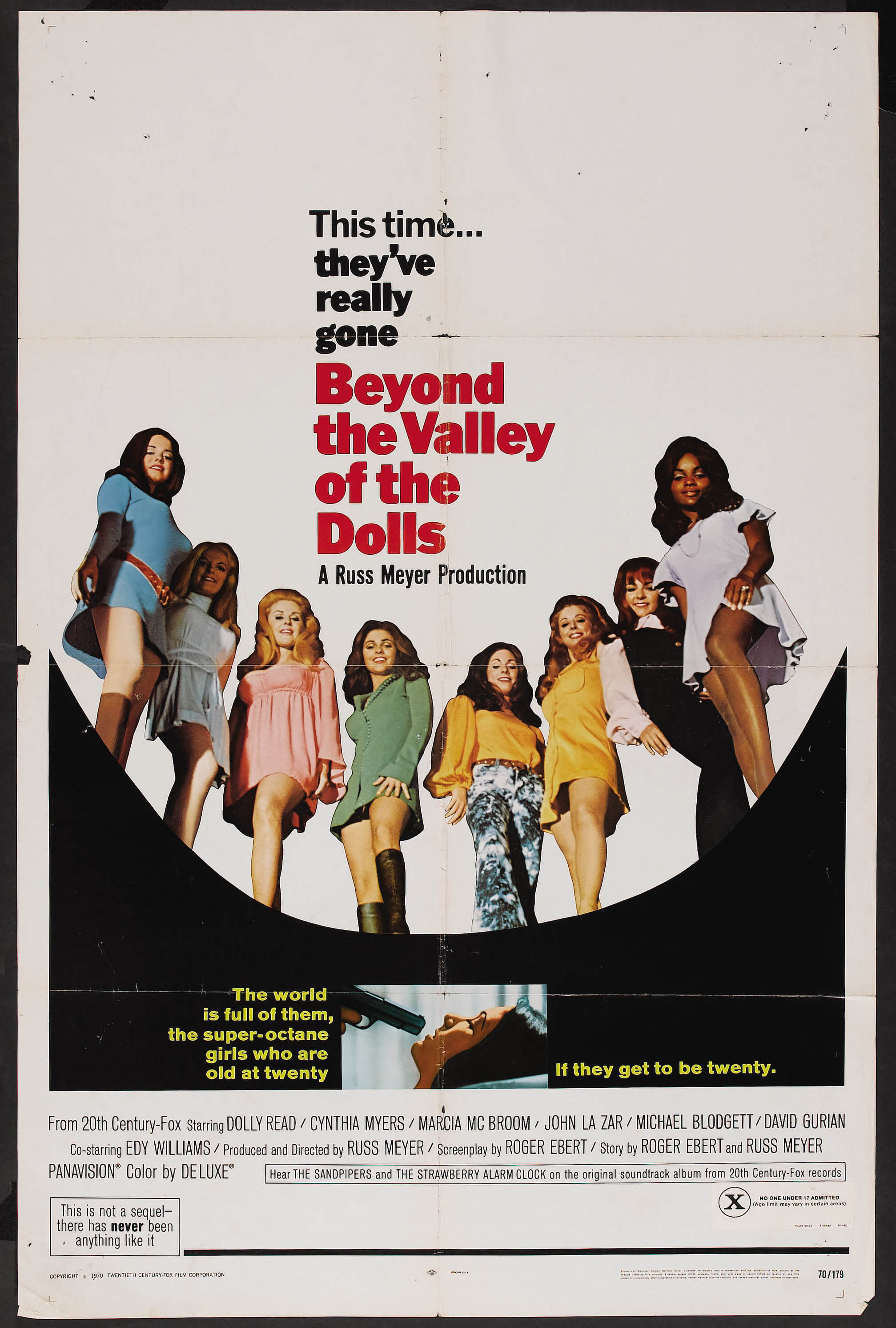
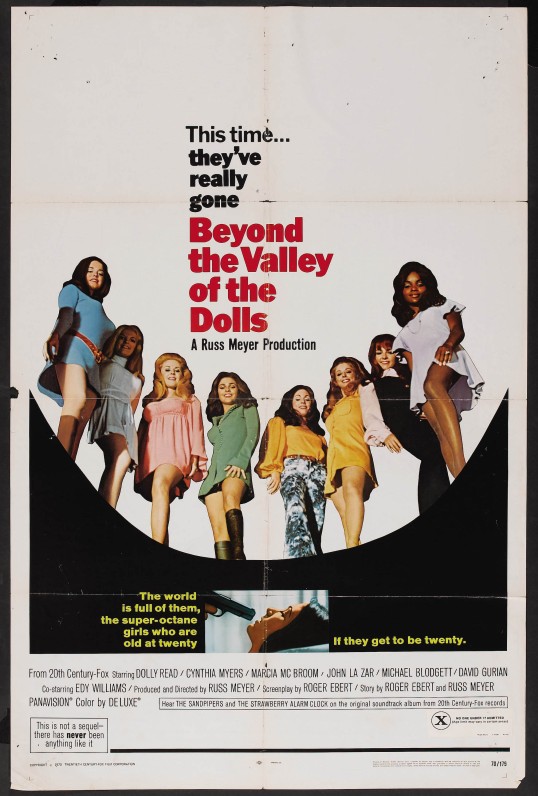
beyondposter

THE FILM YOU ARE ABOUT TO SEE IS NOT A SEQUEL TO “VALLEY OF THE DOLLS.” IT IS WHOLLY ORIGINAL AND BEARS NO RELATIONSHIP TO REAL PERSONS, LIVING OR DEAD. IT DOES, LIKE “VALLEY OF THE DOLLS” DEAL WITH THE OFT-TIMES NIGHTMARE WORLD OF SHOW BUSINESS BUT IN A DIFFERENT TIME AND CONTEXT. — Disclaimer at the beginning of Beyond The Valley of the Dolls (1970)

If I hadn’t reviewed it already, I would definitely have included 1967’s Valley of the Dolls in this series on film melodrama.  However, seeing as I have already reviewed it (and you can read that excellent review here!), I figured why not take this opportunity to review a film that was legally required to acknowledge that it was not a sequel to Valley of the Dolls.

I’m speaking of 1970’s Beyond the Valley of The Dolls, a satirical take on every Hollywood melodrama that had been made up until that point.  It was directed by notorious exploitation veteran Russ Meyer and written by film critic Roger Ebert.  The combination of Meyer’s unapologetic tawdriness and Ebert’s film school in jokes comes together to create a truly memorable film experience.

Okay, so what happens in Beyond the Valley of the Dolls?  Let’s see if I can keep all this straight because, in its clearly satirical way, BVD is a bit like the Game of Thrones of satiric Hollywood melodrama.  There are so many characters with so many subplots that it helps to have a flowchart to try to keep track of it all.

beyond-the-valley-of-the-dolls-05-1

Kelly (Dolly McNamara), Casey (Cynthia Myers), and Pet (Marcia McBroom) start a band and, after playing the high school graduation dance, they decide to head out to Los Angeles to become famous.  Accompanying them is their manager, Harris Allsworth (David Gurian), who is in love with Kelly and spends the entire film looking miserable.  As opposed to the three main characters in Valley of the Dolls, Kelly, Casey, and Pet do not arrive in Hollywood as wide-eyed innocents.  Instead, they’re already talking endlessly about their love of weed, pills, and sex but they do so in dialogue that is so deliberately over-the-top, so intentionally artificial, and so cheerfully delivered by the three girls that it’s impossible not to root for them.  More than that, though, these are three strong, independent women and, regardless of whether they’re appearing a film directed by a man best known for being obsessed with boobs, that’s still three more than you’ll find in most American films from both the 70s and today.

Fortunately, the girls already have a contact in Los Angeles.  Kelly’s rich aunt Susan (Phyllis Davis) knows all sorts of people and wants to share some of her fortune with Kelly.  Unfortunately, Susan’s lawyer is the evil Porter Hall (Duncan McLeod), who hates free spirits.  Porter tries to keep Kelly from getting the money but Kelly is willing to seduce Porter in order to get that money, even after she discovers that the uptight Porter wears his black socks to bed.  Obviously, Porter is a bad guy but who can help Aunt Susan realize this?  How about the wonderfully named man’s man, Baxter Wolfe (Charles Napier)?
ZMan

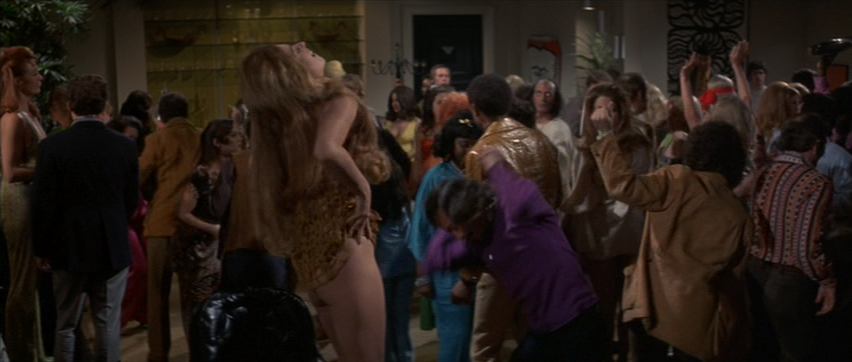
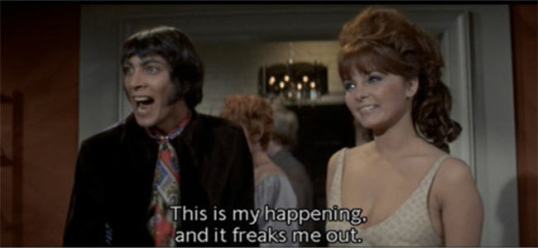
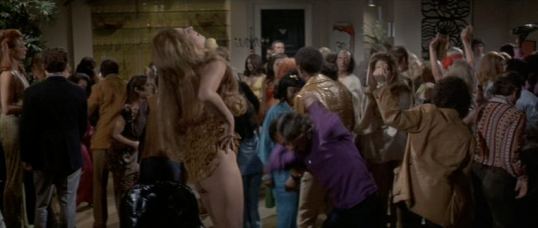
Through Aunt Susan’s influence, the girl’s end up at a party thrown by the legendary music promoter Z-Man (John Lazar).  Z-Man is one of those flamboyant 70s characters who simply has to be seen to be believed.  Z-Man speaks in some of the most florid dialogue ever heard and there are more than a few secrets hidden behind all of that eccentricity.  But, at the moment, what’s important is that Z-Man takes control of the girl’s group — now known as the Carrie Nations (which is actually a pretty good name for a band) — and makes them famous overnight.

Soon, Kelly is spending more and more time with notorious Hollywood gigolo Lance Rocke (Michael Blodgett, who gives a hilariously narcissistic performance) and ignoring poor Harris.  This drives Harris into the waiting arms of porn star Ashley St. Ives (Eddy Williams) who, with her unapologetic and non-neurotic approach to sex, is probably the most stable character in the entire film.

Beyond

Casey, feeling uncomfortable with the Hollywood jet set, is soon popping pills like they’re candy.  She finally starts to find some comfort and happiness with Roxanne (Erica Gavin).

And finally, Pet falls in love with Emerson Thorne (Harrison Page), a serious-minded law student.  However, as much as Pet and Emerson seem to be meant for each other (and they even get a slow-motion montage where they run through a green field), Pet is still tempted to stray by a punch drunk boxer (James Inglehart).

And finally, there’s Otto (Henry Rowland).  Otto is Z-Man’s butler.  Apparently, he’s also a Nazi war criminal.

And, not surprisingly, all of this lust and all of these secrets lead to a suicide attempt, renewed love, and finally a disturbingly violent massacre that leaves the surviving members of the cast feeling wiser and sadder but not necessarily older.  Fortunately, just in case we the viewers might be wondering how all of this could have happened, a somber-voiced narrator suddenly explains what every character did wrong and how those mistakes led to their fate.  Thanks, narrator guy!

So, obviously, Beyond the Valley of the Dolls is not meant to be taken seriously.  The film is a satire of all of the self-serious and hypocritically moralistic Hollywood melodramas that came before it .  Fortunately, the largely likable cast plays all of this absurd material with the straightest of faces and the end result is a film that is sordid and oddly likable.  This is one of those films that, if it offends you, you may be taking life too seriously.
beyond the valley of the dolls party