Late Night Retro Television Review: CHiPs 3.9 and 3.10 “Drive, Lady, Drive”


Welcome to Late Night Retro Television Reviews, a feature where we review some of our favorite and least favorite shows of the past!  On Mondays, I will be reviewing CHiPs, which ran on NBC from 1977 to 1983.  The entire show is currently streaming on Prime!
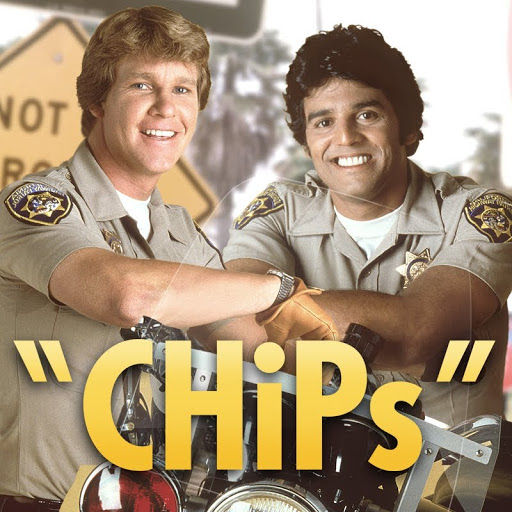
This week, it’s a special two-hour episode of CHiPs!

Episodes 3.9 and 3.10 “Drive, Lady, Drive”

(Dir by Don Weis, originally aired on November 10, 1979)

The police at nearby Palma Vista are on strike and the state of California has agreed to allow some members of the Highway Patrol to patrol the town until the strike is over.  Getraer assigns Baker, Ponch, Bear, and some new guy named Lenny (Leon Isaac Kennedy) to head over to the town,  Baker is named the OIC, which I eventually figured out stood for “Officer in Charge.”  Getraer knows better than to give the job to Ponch.

Ponch, by the way, is back!  After being absent for two episodes due to Erik Estrada actually injuring himself in a motorcycle crash, Ponch returns in this episode and he goes through the entire episode with this huge grin on his face as if he’s saying, “You know you missed me.”  Ponch’s return means that Baker is once again relegated to being the strong, silent partner who doesn’t really get to do anything.  In fact, Baker crashes his motorcycle early on in this episode, as if the show was trying to tell us, “See?  It could happen to anyone!”

The striking cops accuse Baker, Ponch, Bear, and Lenny of being scabs and strike breakers.  I’m not really a fan of public sector unions.  (When it comes to the police striking, my hero is Calvin Coolidge, who came to fame when he broke up a policeman’s strike in Massachusetts.)  Still, it felt strange to watch the show’s heroes cross that picket line.  That would definitely not happen on television today.

There’s a lot going on in Palma Vista.  There’s some rich kids who keep joyriding in a dune buggy and who think they can escape prosecution by crossing the city limits.  (Joke’s on them!  The Highway Patrol has jurisdiction everywhere!)  There’s some truck hijackers who are setting up a headquarters in town.  There’s an angry city councilman (Michael Conrad) who doesn’t feel his children should be held accountable for their actions.

That said, the majority of this two-hour episode centered on a stock car race and one of the racers, Candi Wright (Kelly Harmon).  Will Candi win the big race or will she lose to her friendly rival (and possible future romantic partner) Don Croyden (Jordan Clarke)?  Will Ponch be able to both date her and do his job?  And most importantly, will she be able to adopt a traumatized little girl (played by Tracey Gold) who Candi discovered outside of a burning house?  That’s a lot of storylines for someone who wasn’t even a regular cast member and a part of me wonders if maybe this episode was meant to be a secret pilot for a Candi Wright television series.  It would explain a lot.

This really was a basic episode of CHiPs, with the only real difference being that it was two-hours long for some reason.  A lot of what happened in the episode, especially the racing footage, felt like filler.  There was really no need for this to be a double-sized episode.  It also doesn’t help that, as opposed to the lovely Los Angeles scenery that we usually see, this episode took place in a rather ugly town.  There was some appropriately spectacular crashes but, in the end, this episode ran too long and felt a bit pointless.  Get the Highway Patrol back on the highways!

A Blast From The Past: Dragnet 1968 3.1 “Public Affairs: DR-07” (dir by Jack Webb)


May 1st is a day of many holidays, including Law Day.

President Dwight D. Eisenhower first proclaimed May 1st to be Law Day in 1958 and apparently, it’s been celebrated every year since.  On Law Day, Americans are meant to reflect on the role of law in the foundation of the nation and also consider its importance to the social order.

To observe this year’s Law Day, I’m happy to present our readers with my favorite episode of Dragnet 1968.  

Dragnet began as a radio program in 1949 before making it’s way over to television in 1951. Each episode starred (and the majority were directed by) Jack Webb, who played a no-nonsense cop named Joe Friday. Friday narrated every episode, dropping trivia about the history of Los Angeles while also showing viewers how the cops went about catching criminals. Despite what is commonly believed, Joe Friday never said, “Just the facts, ma’m,” but he did investigate each case with the cool determination of a professional who kept his emotions under control. The majority of Dragnet’s episodes were based on actual cases that were worked by the LAPD, hence the opening declaration of, “The story you are about to see is true.”

On television, Dragnet originally ran from 1951 to 1959, during which time Dragnet also became the first television series to be adapted into a feature film. Jack Webb decided to relaunch Dragnet in 1966 and he produced a made-for-television movie that followed Friday and his latest partner, the far more talkative Bill Gannon (Harry Morgan), as they worked multiple cases over the course of one long weekend.  That made-for-television movie led to a series that ran from 1967 to 1970.

The second television series is the best-remembered version of Dragnet, beloved for its scenes of Friday and Gannon debating the issues with a motely collection of hippies, campus radicals, and pipe-smoking academics.  Jack Webb viewed Friday as being the voice of the common American, who supported the troops, supported the president, and who wanted to spend the weekend grilling in peace.  Friday was the middle-aged suburbanite who wanted to the kids to stay off the grass, whether it was on his front lawn or being sold on a college campus.  These episodes were often campy.  It’s hard not to smile while listening to Friday and Gannon deadpan their way through conversations with flakey long-haired hippies.  It was often obvious that the writers of Dragnet had never actually had any experiences with the hippies, beyond what they saw on the evening news.  And yet, as silly as things often were, the show is an interesting time capsule of the time in which it was made.  If nothing else, it’s a chance to see the 60s through the eyes of the other side.

My favorite episode was the show’s third season premiere.  It originally aired on September 19th, 1968 and it features Joe and Gannon appearing on a talk show.  The subject of the show: “The Fuzz Who Needs Them?”  Joe and Gannon argue on behalf of the fuzz.  Appearing on the other side of the panel are a pipe-smoking academic (Stacy Harris) and the publisher (Howard Hesseman, credited as Don Sturdy) of an underground newspaper.  Questions are asked from the audience.  John Dietz (played by Lou Wagner, who also plays Harlan Arliss on CHiPs) wants to know why drug are illegal.  Mondo Mabamba (Dick Anthony Williams) wears blue glasses and demands to know why the cops are always sitting in squad cars.  Overseeing the show is the evil Chuck Bligh (Anthony Eisley).  Friday struggles to hold back his disgust as the newspaper publisher throws a “Make Love Not War” pin at him.

This an interesting episode, if just because both sides are allowed to make their case and, in a rarity for Dragnet, neither Friday nor Gannon change anyone’s mind.  On the one hand, the academic and the publisher are both portrayed as being fairly obnoxious.  On the other hand, Howard Hesseman delivers his lines with such sharpness that his character cannot be as easily dismissed as the usual Dragnet hippie.  Chuck Bligh’s talk show predicts the political panel shows of today and it’s interesting to see how we’re still debating many of the same issues that were raised in this episode.

Here is today’s Blast From The Past:

30 Days of Noir #6: Walk The Dark Street (dir by Wyott Ordung)


The 1956 film noir, Walk The Dark Street, opens with a platoon of soldiers fighting in the Korean War.

Dan Lawton (Don Ross) has been promoted to lieutenant and Sgt. Tommy Garrick (Eddie Kafafian) isn’t happy about it.  Despite the fact that he and Dan were once good friends, Tommy now is openly insubordinate.  Dan claims that Tommy is just jealous that Dan got promoted while Tommy didn’t.  Tommy, however, claims that Dan is too incompetent to lead the men.  He writes a letter to his older brother, Frank (Chuck Conners).  In the letter, Tommy says that, if he dies, Dan is to blame.  Shortly after sending the letter, Tommy is killed in battle.

After the war, Dan returns to the United States.  When he enlisted in the army, he left behind a small hardware store and now he’s returned to discover that the store’s insurance has lapsed and that he’ll need several thousand dollars to renew it.

While Dan tries to come up with a way to save his store, he also decides to pay a visit to Tommy’s brother.  Why does Dan drop by Frank’s apartment?  It’s difficult to say.  When Dan first shows up in Frank’s doorway, you assume that he’s going to praise Tommy or maybe seek some sort of forgiveness for Tommy’s death.  Instead, Dan just tells Frank that Tommy wouldn’t have gotten killed if he had followed orders (!) and then mentions that he and Tommy didn’t always get along (!!).  Like, seriously, what’s the point of telling Frank any of this?  What does Dan think that he’s accomplishing?

Frank doesn’t seem to be too upset over Tommy’s death.  In fact, Frank is actually a lot more interested in talking about his love of hunting.  Frank even shows Dan some film that he shot during his last safari, which means that those of us in the audience get to spend four minutes watching nature documentary stock footage that has little to do with the rest of the movie.  Frank explains that he has a heart condition so he can’t go abroad to hunt anymore.  Poor Frank!  But, hey, Dan’s going to be in Los Angeles for the next two days and Frank does still own a gun so maybe Frank could just hunt him!

At first, Dan’s not too enthusiastic about the idea of being hunted by Frank.  Frank, however, assures him that they won’t be using real bullets.  Instead, they’ll hunt each other with “camera guns.”  Apparently, you pull the trigger and, instead of firing a bullet, the gun fires a cartridge that takes a picture.  Dan’s still reluctant but then Frank offers to pay him $10,000.  You can renew a lot of insurance for $10,000!

Quicker than you can say “Most Dangerous Game!,” Frank is stalking Dan through Los Angeles.  What Dan doesn’t realize is that Frank was lying about using a camera gun.  He wants revenge for his brother’s death so he’s hunting Dan with live ammunition!

This is one of those films that probably sounds more interesting than it actually is.  After setting up an intriguing premise, Walk The Dark Street doesn’t really do much with it.  It turns out that neither Dan nor Frank is particularly clever so nearly the entire movie is just footage of them walking down various streets in Los Angeles.  If you’re a history nerd like me, you might get a kick out of seeing what the streets of Los Angeles looked like in the mid-50s but otherwise, there’s not much excitement to be found in this movie.

The film stretched its credibility to the breaking point when Dan, while trying to hide from Frank, just happens to randomly run into Tommy’s ex-girlfriend, Helen (Regina Gleason).  Whereas Frank is stoic to a fault and Dan is just an incredible dumbass, Helen at least gets to tell everyone off.  She’s not impressed with either Frank or Dan, which makes her the default audience surrogate.  Helen figures out what Frank is planning but Dan refuses to believe her because, again, Dan’s not very smart.  While it may not have been the film’s intention, it’s hard not to feel that Tommy had a point about Dan being incredibly incompetent.

Aside from offering a chance to see what Los Angeles looked like back in the 50s, Walk The Dark Street is largely forgettable.

http://www.youtube.com/watch?v=sBkdbXm07ow