HostageForADay is the only film that the much-missed John Candy ever directed. (It premiered on Canadian television, a few months after his death.) It’s also one of the only films to feature George Wendt in a leading role, as opposed to being a supporting player. The film is full of funny people like Don Lake and Robin Duke. John Vernon plays Candy’s father-in-law. A lot of talent went into this movie. It’s too bad that it’s not very good.
Wendt does give a good performance in the lead role. He plays Warren Kooey, who is depressed on his 41st birthday. His wife (Robin Duke) has drained their bank account to remodel their house and apparently shag their interior decorator, Hondo (Currie Graham). No one respects him at work. Warren’s reflection in the mirror tells Warren that he needs to do something with his life. Warren decides to fake a hostage situation so that he can collect the ransom. The problem is that the SWAT team has recently had their budget cut and can’t afford to pay the amount that Warren comes up with. Then some real kidnappers (led by John Candy, making a very brief appearance) hold him hostage for real. While this goes on, Wendt continues to talk to his reflection in the mirror and there are a few sweet but out-of-place scenes featuring him reuniting with his childhood sweetheart, Diane St. Clair (Christopher Templeton).
As a director, Candy never seems to be sure what type of film he’s trying to make. The comedy is broad but Candy also tries to sneak in some sentimental moments and the end results just doesn’t mix well. He gets some good performances for his cast but the film itself never really comes together. This was George Wendt’s only starring role and he does a good enough job that I regret he didn’t get bigger roles once Cheers went off the air because, judging by this film, he could have handled them I just wish this movie was better.
There are a lot of reasons why it’s hard to take Top Gun seriously but, for me, the biggest problem is that I’ve seen Hot Shots! Directed by Jim Abrahams, Hot Shots! does for Top Gun what Airplane! did for disaster movies.
Charlie Sheen plays Topper Harley, the hot shot Navy Pilot who is haunted by the death of his father. (“I’ve even got my father’s eyes,” Topper says before revealing that he carries them around in a cigarette case.) Topper has left the Navy and is living in a teepee with the Old One. Command Block (Kevin Dunn) asks Topper to return to the Navy to take part in Operation Sleepy Weasel. Topper puts on a leather jacket and hops on a motorcycle. The Old One tells Topper to pick up some batteries for his walkman.
Cary Elwes plays Kent Gregory, who says that Topper is not safe in the air. Valeria Golino plays Ramada, the psyciatrist who helps Topper deal with his father issues. Jon Cryer is Washout, who has wall-eyed vision. Kristy Swanson is Bo, the only female pilot. William O’Leary is the pilot who has the perfect life and wife but who everyone calls “Dead Meat.” And finally Lloyd Bridges is Admiral Tug Benson, who has never successfully landed a plane and who has suffered and recovered from almost every war wound imaginable. Tug is clueless but he loves America and his admiral’s hat.
Hot Shots! is one of the better parody films to come out in the wake of Airplane! Charlie Sheen’s limitations as a dramatic actor actually made him a good comedic actor and Cary Elwes does a decent Val Kilmer imitation. Some of the jokes have definitely aged better than others. In 1991, Valeria Golino singing on a piano automatically brought to mind Michelle Pfieffer in The Fabolous Baker Boys but does anyone remember that film (or that scene) in 2025? (The 9 1/2 Weeks scene is even more of a distant memory to most but Valeria Golino is so appealing in those scenes that most viewers — well, most male viewers — won’t mind. In this case, the parody is far more successful than the original.) Hot Shots! is at its best when imitating Top Gun‘s kinetic, music video-inspired style. The mix of quick-cut editing and ludicrous dialogue is hard to resist. After watching Charlie Sheen dance on his motorcycle and Cary Elwes explain what a chafing dish is for, it’s hard to take Top Gun seriously ever again.
Welcome to Late Night Retro Television Reviews, a feature where we review some of our favorite and least favorite shows of the past! On Saturdays, I will be reviewingthe Canadian sitcom, Check it Out, which ran in syndication from 1985 to 1988. The entire show is currently streaming on Tubi!
This week, everybody wants something they’ll never give up.
Episode 1.10 “Car Pool”
(Dir by John Bell, originally aired on December 4th, 1985)
One rainy morning, Howard comes to work, just to discover that his assistant manager, Jack Christian, has parked his new BMW in Howard’s space. As Jack explains it, there wasn’t any other place to park in the small lot. The other employees all mention that all of their parking space were also taken by customers. Howard tells his employees that he’s going to call Mrs. Cobb and tell her that they need a bigger parking lot.
That conversation does not go well. As Howard explains afterwards, negotiations with Mrs. Cobb always involve “give and take.” In this case, Mrs. Cobb gave Howard his job back after initially firing him and she even agreed to let him keep his parking space. And then Mrs. Cobb took away everyone else’s parking space.
Needless to say, no one is happy about this. (Considering that we already had a whole episode about Marlene organizing a union at the store, it’s a little surprising they don’t all stage a walk out in protest.) However, Christian has a solution. He organizes a car pool. He agrees to pick everyone up in his van and drive them to work. He’ll only charge each of them $5 for the trip to the store and then $8 for the trip home. (“The drive home is mostly uphill,” Christian explains.) After everyone agrees, Christian then swindles Howard out of an additional $40 to cover expenses.
Unfortunately, the van has faulty brakes and Christian ends up slamming into the back of someone else’s car while driving everyone to work. As a result, everyone ends up in the hospital and Christian ends up getting sued by the woman who was driving the car that he hit. He agrees to settle for $15,000, which he raises by selling his BMW to Howard.
However, no sooner has new luxury car owner Howard started wearing aviator shades and a scarf then a cop (played by Don Lake) shows up and inform Christian that the old woman he hit was actually a con artist and has been arrested. The cop hands Christian back his money and Howard gives Christian back his BMW. Then the cop mentions that the old woman tried to flee from police and crashed into a BMW, which causes Christian to faint. The cop, however, is more concerned with talking to his bookie on the phone than with checking to see if Christian is still alive.
I haven’t even mentioned the scene where Edna explains that she doesn’t care about employee parking because she just parks illegally in the street. When Howard asks her about the parking tickets that she gets, Edna says that she just tears them in half and tosses them in a nearby garbage can. Way to go, Edna! Of course, when the cop first shows up, there’s an extended sequence of Howard claiming that Edna is actually named Doris and that the Edna that the cop is looking for has gone on vacation to Cuba.
There was a lot going on in this weird but funny episode. In this episode, the show acknowledges that, while dumb people can be funny, dumb people who think they’re smart are even funnier. Everyone in this episode thought they were more clever than they actually were. Howard thought he could talk Mrs. Cobb into expanding the parking lot. Christian thought he could swindle the other employees (and it turned out that actually he could, even if his own natural bad luck ultimately thwarted him). Con artist Ruby Wexler thought she could swindle Christian (and she nearly succeeded). In the end, only Edna actually got away with anything, with the cop explaining that Edna had accidentally been issued diplomatic plates and was therefore not subject to traffic laws. This episode definitely made me laugh more than any other episode of this show that I’ve watched so far. Check that out.
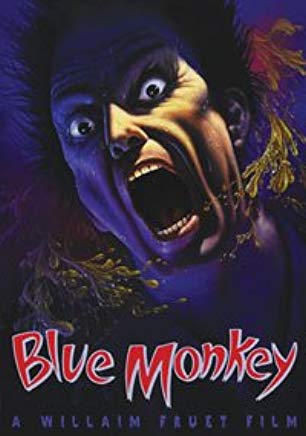
Last night, as I sat down to watch the 1987 Canadian film, BlueMonkey, I found myself singing a song in my head:
How does it feel When you treat me like you do And you’ve laid your hands upon me And told me who you are?
I thought I was mistaken And I thought I heard your words Tell me, how do I feel? Tell me now, how do I feel?
Unfortunately, it turned out that the only thing BlueMonkey had in common with the classic New Order song, BlueMonday, was an enigmatic title. Just as the song never really mentions anything about Monday, BlueMonkey does not feature a single monkey. One minor character does mention having a dream about a monkey but, otherwise, there are no monkeys in the film. Speaking as someone who believes that almost any film can be improved the presence of a monkey, I was disappointed.
(Seriously, Nomadland would have been a hundred times better if Frances McDormand had a pet monkey.)
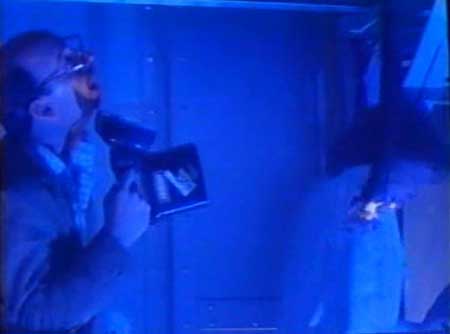
What BlueMonkey does have is a lot of blue. The characters wear blue shirts and some wear blue uniforms. Another wears a blue hat. The film takes place in a hospital where almost all of the walls are painted blue. Even worse, the majority of the film’s scenes are saturated with blue lighting.
Here’s just two screenshots:
Seriously, some scenes were so blue that I was reminded of John Huston’s decision to suffuse ReflectionsinaGoldenEye with the color gold. Personally, I think Huston made a mistake when he did that with Reflections but I can still understand the reasoning behind the decision and I can see what Huston was attempting to accomplish. The blue in BlueMonkey feels like a distraction, as if someone realized, on the day before shooting, that the title didn’t make any damn sense. “We’ll just make the whole movie blue!”
The problem, of course, is that the film goes so overboard with the blue lighting that it actually becomes difficult to look at the screen for more than a few minutes. I had to keep looking away, specifically because all of those blue flashing lights were starting to make me nauseous and were on the verge of giving me a migraine. At times, the image is so saturated in blue that you literally can’t make out what’s happening in the scene. Of course, once you do figure out what’s happening, you realize that it doesn’t matter.
BlueMonkey takes place in a hospital. A handyman has been having convulsions after pricking his finger on a plant that came from a mysterious island. Perhaps that’s because a mutant larvae is now using his body for a host. The larvae eventually develops into a giant grasshopper — NOT A MONKEY! — who stalks around the hospital and kills a few people. The Canadian government is threatening to blow up the hospital unless something is done about the blue grasshopper.
It’s a Canadian exploitation film but Michael Ironside isn’t in it so it somehow feels incomplete. That said, John Vernon plays a greedy hospital administrator and it’s fun to watch him get irritated with everyone. A very young Sarah Polley has an early role as an annoying child. There’s actually several children in this film and you’ll want to throw something at the screen whenever they show up, that’s just the type of film this is. (Some of my fellow movie-watching friends were actually upset that the children survived that film. I wouldn’t go that far but I still found myself hoping John Vernon would tell them all to shut up and let the adults handle things.) Susan Anspach plays a doctor, showing that anyone can go from FiveEasyPieces to Canadian exploitation. The film’s nominal star is Steve Railsback, playing a cop who comes to the hospital to check on his wounded partner and who ends up on grasshopper duty. Steve Railsback has apparently said that he’s embarrassed to have appeared in this film. Consider some of the other films that Steve Railsback has appeared in and then reread that sentence.
In the end, BlueMonkey doesn’t add up too much. There’s no Michael Ironside. There’s no monkeys. There’s just a lot of blue.
I finally got a chance to watch Zootopia last night and oh my God, what a sweet and wonderful little film it turned out to be!
Zootopia is an animated film from Disney and it started out with a premise that sounds very Disney-like. Zootopia takes place in a world where there are no humans. Instead, animals walk and talk and scheme and plan and joke and dance and … well, basically, do everything that humans do. Except they’re a lot cuter when they do it because they’re talking animals.
Judy Hopps (voiced by Gennifer Goodwin) is a rabbit who happens to be an incurable optimist. (We should all try to be more like Judy.) Even when she was growing up on the farm, Judy knew that she would someday move to the sprawling metropolis of Zootopia and become the first rabbit on the city’s police force. When she finally does graduate from the police academy, Judy gets a lot of attention as a trailblazer. But she quickly discovers that she’s only been hired to be a token, a political tool to help the city’s mayor, a blowhard of a lion named Lionheart (J.K. Simmons, voice the role that he was born to voice), win reelection.
See, Zootopia may look like a wonderful place to live but, as quickly becomes apparent, it’s a city in which the peace is very tenous. Animals that are traditionally prey — like Judy and her fellow rabbits — may live with the predators but they certainly don’t trust them. And the predators may not eat the prey but they certainly don’t respect them. Underneath the cute face of every talking animal, there lies prejudice and resentment. Lionheart is a predator who needs the votes of prey to remain in office. What better way to win their trust then to make Judy Hopps a police officer?
Judy may be a member of the police force but that doesn’t mean that she’s going to be allowed to actually do anything. While every other member of the force gets an exciting assignment, Judy is assigned to traffic duty.
However, an otter has recently vanished. He’s just the latest of 14 predators to vanish in the city. With the help of seemingly sympathetic deputy mayor, Judy gets herself assigned to the case. But there’s a catch. She has 48 hours to find the otter. If she doesn’t find that otter, she’ll resign from the force and go back to the farm.
Luckily, Judy is not working alone. She knows that the last animal known to have seen the otter is a fox named Nick Wilde (Jason Bateman). Nick’s a bit of a con artist and, as a predator, he wants nothing to do with Judy and she doesn’t quite trust him. But, events — which I’m not going to spoil here — force them to work together and uncover the darkest secrets of life in Zootopia…
If Zootopia sounds cute, that’s because it is. It’s perhaps one of the most adorable films that I’ve ever seen, full of wonderful animation and memorable characters. But, at the same time, there’s a very serious theme running through Zootopia. Zootopia is about more than just talking animals. It’s a film about prejudice, racism, sexism, and intolerance. It’s a film that invites us to not only laugh but also to reconsider the world around us.
Zootopia is currently on Netflix and, if you haven’t seen it yet, I highly recommend it. It’s great for children and adults.
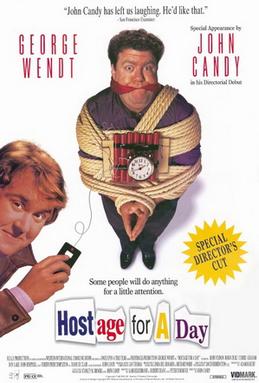 Hostage For A Day is the only film that the much-missed John Candy ever directed. (It premiered on Canadian television, a few months after his death.) It’s also one of the only films to feature George Wendt in a leading role, as opposed to being a supporting player. The film is full of funny people like Don Lake and Robin Duke. John Vernon plays Candy’s father-in-law. A lot of talent went into this movie. It’s too bad that it’s not very good.


 Through the Shattered Lens