First released in 1971, McCabe & Mrs. Miller takes place in the town of Presbyterian Church at the turn of the 19th Century.
Presbyterian Church is a mining town in Washington State. When we first see the town, there’s not much to it. The town is actually named after its only substantial building and the residents refer to the various parts of the town as either being on the right side or the left side of the church. The rest of the town is half-constructed and appears to be covered in a permanent layer of grime. This is perhaps the least romantic town to ever appear in a western and it is populated largely by lazy and bored men who pass the time gambling and waiting for something better to come along.
When a gambler who says that he is named McCabe (Warren Beatty) rides into town, it causes a flurry of excitement. The man is well-dressed and well-spoken and it’s assumed that he must be someone important. Soon a rumor spreads that McCabe is an infamous gunfighter named Pudgy McCabe. Pudgy McCabe is famous for having used a derringer to shoot a man named Atwater. No one is really sure who Atwater was or why he was shot but everyone agrees that it was impressive.
McCabe proves himself to be an entrepreneur. He settles down in Presbyterian Church and establishes himself as the town’s pimp. Soon, he is joined by a cockney madam names Mrs. Miller (Julie Christie). The two of them go into business together and soon, Presbyterian Church has its own very popular bordello. Sex sells and Presbyterian Church becomes a boomtown. It attracts enough attention that two agents of a robber baron approach McCabe and offer to buy him out. McCabe refuses, thinking that he’ll get more money if he holds out. Mrs. Miller informs him that the men that he’s dealing with don’t offer to pay more money. Instead, they just kill anyone who refuses their initial offer.
Three gunmen do eventually show up at Presbyterian Church and we do eventually get an answer to the question of whether or not McCabe killed Atwater or if he’s just someone who has borrowed someone else’s legend. The final gunfight occurs as snow falls on the town and the townspeople desperately try to put out a fire at the church. No one really notices the fact that McCabe is fighting for his life at the time and, as befits a revisionist western, there’s nothing romantic or dignified about the film’s violence. McCabe is not above shooting a man in the back. The killers are not above tricking an innocent cowboy (poor Keith Carradine) into reaching for his gun so that they’ll have an excuse so gun him down. McCabe may be responsible for making Presbyterian Church into a boomtown but no one is willing to come to his aid. The lawyer (William Devane) that McCabe approaches is more interested in promoting his political career than actually getting personally involved in the situation. Mrs. Miller, a businesswoman first, smokes in an opium den with an air of detachment while the snow falls outside.
It’s a dark story with moments of sardonic humor. It’s also one of director Robert Altman’s best. The story of McCabe and Mrs. Miller and the three gunmen is far less important than the film’s portrayal of community growing and changing. Featuring an ensemble cast and Altman’s trademark overlapping dialogue, McCabe & Mrs. Miller puts the viewer right in the heart of Presbyterian Church. There are usually several stories playing out at once and it’s often up to the viewer to decide which one that they want to follow. Yes, the film is about Warren Beatty’s slick but somewhat befuddled McCabe and Julie Christie’s cynical Mrs. Miller. But it’s just as much about Keith Carradine’s Cowboy and Rene Auberjonois’s innkeeper. Corey Fischer, Michael Murphy, John Schuck, Shelley Duvall, Bert Remsen, and a host of other Altman mainstays all have roles as the people who briefly come into the orbit of either McCabe or Mrs. Miller. Every character has a life and a story of their own. McCabe & Mrs. Miller is a film that feels as if it is truly alive.
As with many of Altman’s films, McCabe & Mrs. Miller was not fully appreciated when initially released. The intentionally muddy look and the overlapping dialogue left some critics confused and the film’s status as a western that refused to play by the rules of the genre presented a challenge to audience members who may have just wanted to see Warren Beatty fall in love with Julie Christie and save the town. But the film has endured and is now recognized as one of the best of the 70s.
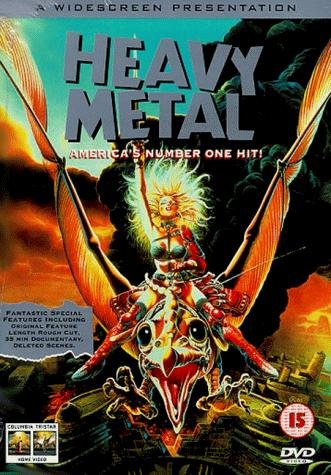 I think I was twelve when I first saw Heavy Metal. It came on HBO one night and I loved it. So did all of my friends. Can you blame us? It had everything that a twelve year-old boy (especially a 12 year-old boy who was more than a little on the nerdy side) could want out of a movie: boobs, loud music, and sci-fi violence. It was a tour of our secret fantasies. The fact that it was animated made it all the better. Animated films were not supposed to feature stuff like this. When my friends and I watched Heavy Metal, we felt like we were getting away with something.
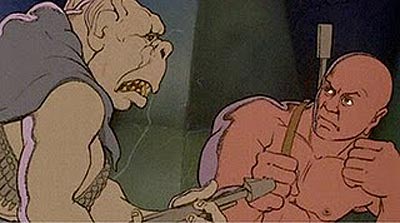 Den (directed by Jack Stokes, written by Richard Corben)
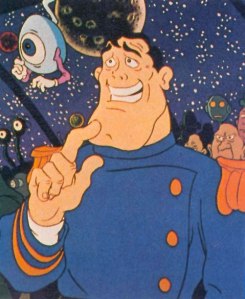 On a space station orbiting the Earth, Captain Lincoln F. Sternn is on trail for a countless number of offenses. Though guilty, Captain Sternn expects to be acquitted because he has bribed the prosecution’s star witness, Hanover Fiste. However, Hanover is holding the Loc-Nar in his hand and it causes him to tell the truth about Captain Sternn and eventually turn into a bloodthirsty giant. Captain Sternn saves the day by tricking Hanover into getting sucked out of an air lock.
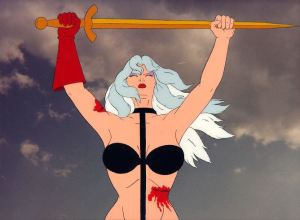 In the film’s final and most famous segment, Taarna, the blond warrior was featured on Heavy Metal‘s poster, rides a pterodactyl across a volcanic planet, killing barbarians, and finally confronting the Loc-Nar. She sacrifices herself to defeat the Loc-Nar but no worries! We return to Earth where, for some reason, the Loc-Nar explodes and the girl from the beginning of the film is revealed to be Taarna reborn. She even gets to fly away on her pterodactyl. Taarna was really great when I was twelve but today, it is impossible to watch it without flashing back to the Major Boobage episode of South Park.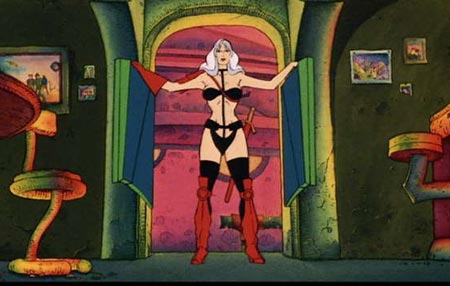
 Through the Shattered Lens