Trading Places (1983, directed by John Landis)


It all starts with a bet.

As Christmas approaches, Mortimer (Don Ameche) and Randolph Duke (Ralph Bellamy) make a bet to determine whether it’s nature or nurture that shapes someone’s future.  The fabulously wealthy owners of Duke & Duke Commodity Brokers, the brothers casually frame their director, Louis Winthrope III (Dan Aykroyd), for everything from dealing drugs to sealing money to cheating on his girlfriend (Kirstin Holby).  After Louis is kicked out of both his job and his mansion, the Dukes hire a street hustler named Billy Ray Valentine (Eddie Murphy) to take his place.  Earlier Winthrope tried to get Valentine arrested for approaching him in the street.  Now, Valentine is living in Winthrope’s mansion, with Winthrope’s butler and Winthrope’s job.

While Winthrope tries to survive on the streets with the help of a outwardly cynical but secretly kind-hearted prostitute named Ophelia (Jamie Lee Curtis, in her first non-horror starring role), Billy Ray surprises everyone by using his street smarts to become a successful, suit-wearing businessman.  The Dukes, of course, have no intention of keep Billy Ray Valentine on as their director.  Not only are the Dukes snobs but they’re racists as well.  Once their one dollar bet has been settled, they start planning to put Billy Ray back out on the streets with Winthrope.

Trading Places was Eddie Murphy’s follow-up to 48 Hrs and he again showed himself to be a natural star while playing the type of role that could have been played by Dan Ayrkroyd’s partner, John Belushi, if not for Belushi’s early death.  (Jim Belushi has a cameo as a party guest.)  Murphy gets to show off a talent for physical comedy and Trading Places is one of the few films to really take advantage of Dan Aykryod’s talents as both a comedian and actor.  Winthrope goes from being a coddled executive to being as streetwise as Valentine.  This is probably Aykroyd’s best performance and he and Eddie Murphy make for a good team.

But the real stars of the film are four actors who weren’t really thought of as being comedic actors, Denholm Elliott, Don Ameche, Ralph Bellamy, and especially Jamie Lee Curtis.  Ophelia is a much edgier character than the “final girls” that Curtis was playing in horror films and Curtis steals almost every scene that she’s in.  Ameche and Bellamy are great villains and it’s fun to watch them get their comeuppance.  What screwball comedy would be complete without a sarcastic butler?  Denholm Elliot fills the role of Coleman perfectly.

Trading Places was a box office success when it was released and it’s now seen as being one of the new Christmas classics, a film for the adults to enjoy while the kids watch Rudolph and Frosty.  I think the movie ends up going overboard towards the end with the gorilla and Dan Aykroyd wearing blackface but, for the most part part, it’s still a very funny and clever movie.
Lisa Marie Reviews An Oscar Nominee: In Old Chicago (dir by Henry King)


One of the ten films to be nominated for Best Picture of 1937, In Old Chicago tells the story of the O’Leary family.

When we first meet the O’Learys, they’re riding across the Illinois frontier in a covered wagon.  After patriarch Patrick O’Leary (J. Anthony Hughes) is killed in a freak accident, Hazel O’Leary (Alice Brady) decides to settle in the bustling town of Chicago.  Hazel and her three sons build a life for themselves in a poor, largely Irish neighborhood known as the Patch.  Hazel makes a living as a laundress and soon, her home is big enough for her to take in a cow named Daisy.  Better not put that lantern too close to Daisy, Mrs. O’Leary….

As for the O’Leary boys, they all build a life of their own in 19th century Chicago.

Free-spirited Dion (Tyrone Power) hangs out in the saloon owned by sinister Gil Warren (Brian Donlevy) and, to his mother’s consternation, he falls for a singer named Belle (Alice Faye).  Eventually, Dion and Belle open up their own saloon and go into competition with Warren.  Dion soon emerges as one of the leaders of the Patch, a rogue with a charming smile and zero ethics but a total love for his family.

The youngest, Bob (Tom Brown), falls in love with a German immigrant named Gretchen (June Storey).  Bob asks Gretchen to marry him while Mrs. O’Leary’s cow stares straight at camera.

Finally, the oldest of the O’Leary boys is Jack (Don Ameche).  Jack become a crusading lawyer and eventually, he runs for mayor on a reform ticket.  With Dion’s help, Jack is able to defeat Gil Warren.  But now that Jack is mayor, he immediately sets his sights on tearing down the Patch and, in his words, “starting over.”

In Old Chicago has a two-hour running time and a lot happens in those two hours.  Not only is there all the drama between the brothers but also there’s a handful of production numbers featuring Alice Faye.  (Considering that she’s performing at a saloon in the slums of Chicago, it’s impressive that Belle can put on such an elaborate show.)  Of course, anyone with a knowledge of history knows that every minute of In Old Chicago is building up to the moment when Mrs. O’Leary’s cow kicks over that lantern and all the wooden buildings in Chicago go up in flames.  In Old Chicago is an early disaster movie and, talented cast aside, the main reason that anyone will be watching will be for the recreation of the Great Chicago Fire.  As flames roar around them and cattle stampede through the streets, hundreds of extras run for their lives.  As Alice Brady, Tom Brown, and Alice Faye stare off to the horizon, the city of Chicago explodes in front of them.  Even today, the scenes of the city on fire are impressive.

As for the rest of the film, I enjoyed the melodramatic excess of it all.  The stars weren’t exactly the most dynamic actors of the 1930s but Tyrone Power and Don Ameche were both handsome and likable enough to carry the film and it’s easy to see why In Old Chicago was, at the time of its production, the most expensive film ever made.  It’s a big film, with ornate sets, hundreds of extras, and elaborate production numbers.  It’s entertaining, even though I did occasionally find myself growing impatient as I waited for the fire to finally start burning.

One thing this film is not is historically accurate.  Not only is it now generally agreed that Mrs. O’Leary’s cow was innocent of starting the fire but Mrs. O’Leary’s son was never mayor of Chicago.  It is true that Chicago caught fire in 1871 and that the mayor turned to General Philip Sheridan (played here by Sidney Blackmer) for help in both putting out the fire and keeping order in the streets.  For the most part, though, In Old Chicago is total fiction.  That didn’t bother me but then again, I don’t live in Chicago.

In Old Chicago was nominated for Best Picture of the Year but lost to The Life of Emile Zola.  However, Alice Brady won the Oscar for Best Supporting Actress.

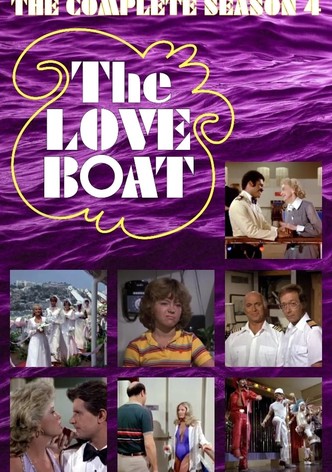
Retro Television Review: The Love Boat 4.23 “The Duel/Two For Julie/Aunt Hilly”


Welcome to Retro Television Reviews, a feature where we review some of our favorite and least favorite shows of the past!  On Wednesdays, I will be reviewing the original Love Boat, which aired on ABC from 1977 to 1986!  The series can be streamed on Paramount Plus!

This week, Hollywood royalty boards the Love Boat!

Episode 4.23 “The Duel/Two For Julie/Aunt Hilly”

(Dir by Ray Austin, originally aired on March 14th, 1981)

Who is Aunt Hilly?

She’s Olivia de Havilland!

And who is Aunt Hilly’s latest husband, Col. Von Ryker?

He’s Joseph Cotten, making his final screen appearance before retiring from acting!

Even for a show that was known for featuring stars from Hollywood’s Golden Age, de Havilland and Cotten are welcome additions to this episode of The Love Boat.  They bring a lot of class to the ship, both as themselves and as the characters that they’re playing.  It’s not just all of the wonderful Hollywood history that they bring with them.  It’s also that they both give charming performances, showing that they still had the screen presence that made them stars to begin with.

Hilly is Captain Stubing’s aunt, a wealthy woman who has devoted so much of her life to work that she missed out on spending much time with her family.  She wants to make up for the past by arranging for Vicki to attend an exclusive private school in Switzerland.  Captain Stubing is reluctant but ultimately, he agrees that it would be best for Vicki to be able to have friends her own age and to get a formal education as opposed to just receiving lessons from the occasionally mentioned but never-seen tutor who apparently lives on the Love Boat.

However, Col. Van Ryker knows that Vicki would be happier on the boat and that Hilly is just trying to deal with her own guilt over her strained relationship with her son, Conrad.  With the Colonel’s gentle help, Hilly realizes that it would be better for Vicki to stay with Captain Stubing.

Now, to be honest, I do kind of wonder if it’s a good idea for Vicki to live on the boat.  I mean, does she really have any friends outside of the members of the crew, all of whom are much older than her?  Personally, I think going to school is Switzerland and spending her summers on the Love Boat would have been a great idea.  But no matter!  This was a sweet story.  What I really appreciated is that, even though they were on opposite sides, both the Captain and the Aunt had the best of intentions and motivations.  It would have been easy to just portray Hilly as being a snob who thought living on a cruise ship was beneath the dignity of a Stubing.  Instead, she was a genuinely nice woman trying to do what she felt was the right thing.  Gavin MacLeod, Jill Whelan, Olivia de Havilland, and Joseph Cotten all did wonderful work with this story.

The other two stories were overshadowed by Cotten and de Havilland.  In the sillier of the two, Linda Cristal played a woman who tried to make her husband jealous by flirting with Doc Bricker.  Her husband (Alejandro Rey) reacted by challenging Doc to a duel.  Isaac and Gopher tried to convince the husband that Doc was an experienced and deadly duelist.  Again, it was just as silly as it sounds.

Meanwhile, Julie had two men (Ken Kercheval and Dack Rambo) hitting on her.  The two men were also competing to be the new vice president of Don Ameche’s company.  In the end, Julie remained single and good for her.

One silly story.  One boring story.  And one story that was so good that the other two stories didn’t matter.  This was a great cruise.

Retro Television Reviews: Fantasy Island 4.7 “The Invisible Woman/The Snowbird”


Welcome to Retro Television Reviews, a feature where we review some of our favorite and least favorite shows of the past!  On Tuesdays, I will be reviewing the original Fantasy Island, which ran on ABC from 1977 to 1986.  Almost the entire show is currently streaming is on Youtube, Daily Motion, and a few other sites.

Smiles, everyone, smiles!

Episode 4.7 “The Invisible Woman/The Snowbird”

(Dir by Don Weis, originally aired on December 6th, 1980)

This week’s trip to Fantasy Island is all about entertainers.

For instance, Ned Pringle (Douglas Barr) is not an entertainer but he wishes that he could be.  Instead, the handsome and athletic Ned is a popcorn salesman who works for a traveling circus.  He has a crush on a trapeze artist named Velda Ferrini (Pamela Sue Martin) but he feels that he won’t ever be able to talk her unless he too can become a trapeze-artist.

Mr. Roarke grants him his fantasy.  He hands Ned a magic pouch and has him climb up a magic ladder.  When Ned reaches the platform at the top, he suddenly discovers that he is now standing high above the ground.  Below him, the entire circus is waiting for him to audition.  Fortunately, as long as Ned has the pouch, there is nothing he can’t do.  He’s the world’s greatest acrobat and he is, of course, hired by the circus’s owner, Mr. Ferrini (Don Ameche).  Ferrini is the father of Velda and when he hires Ned, he does so under the condition that Ned not try to date his daughter.  Good luck with that, Ferrini!

Meanwhile, Velda’s older brother, Mario Ferrini (George Maharis), takes an interest in Ned’s career and he even starts to pressure Ned to attempt the same super dangerous quadruple summersault that led to Mario injuring his leg and having to drop out of the act.  Ned, however, realizes that Mario needs to do the summersault himself so that he can get back his confidence.  After a conversation with Mr. Roarke (who shows up swinging on the trapeze and wearing a white bodysuit!), Ned allows Mario to have the pouch.  Mario finally pulls off the quadruple summersault and he returns to the act.  Meanwhile, Ned realizes that he doesn’t have to be an acrobat to be worthy of Velda’s love and he instead becomes the circus’s new manager.

And good for all of them!  Ameche, Martin, Maharis, and Barr were all extremely likable in this story, though you do have to wonder what Maharis is going to do if he ever loses the magic pouch.  That said, the true stars of the story were the stunt crew.  It was pretty easy to spot everyone’s stunt double, which added to the fun of the story.  Ricardo Montalban’s stunt double, for instance, appeared to be about 20 years younger than him and blonde.

The episode’s other story deals with a veteran entertainer named Denny Palumbo (Dick Gautier).  Denny became a star doing a corny song-and-dance act with his wife, Trish (Neile Adams).  However, Denny and Trish got a divorce and their act broke up.  Denny is now engaged to Harriet (Elaine Joyce) and he is putting together a new act with two new dancers.  Trish’s fantasy is to become invisible so that she can make sure that Denny isn’t cheating on her.

“Boss!” Tattoo says, “Can you do that!?”

“It remains to be seen,” Roarke replies.

(Oh hey, I just got that!)

Just as Roarke gave Ned a magic pouch, he gives Harriet a magic potion that grants temporary invisibility.  When Harriet turns invisible, her clothes can still be seen and appear to be floating in mid-air.  This leads to her (in her invisible state) undressing in front of Tattoo and Roarke.  Tattoo’s eyes get especially wide as everything from Harriet’s dress to her underwear hits the floor.  In fact, Tattoo gets so distracted that Roarke snaps, “Tattoo!”

(Later, Tattoo deduces that Roarke can still see Harriet, even after she’s taken the potion and removed her clothes.  “Boss!” Tattoo gaps.  I’m a bit shocked, myself.  Mr. Roarke has always been such a gentleman in the past that I find it hard to believe that he would not have stepped out of the room or, at the very least, turned his back while Harriet undressed.)

Being invisible allows Harriet to spy on Denny.  It turns out that Denny is not cheating on her but invisible Harriet still deliberately ruins his rehearsal and causes the new dancers to quit.  Needing a partner, Denny turns to Trish, which upsets Harriet even though Harriet was the one who was secretly responsible for inspiring the other two dancers to quit in the first place.  Eventually, Harriet realizes that Denny and Trish are meant to be together but that’s okay because she also realizes that she’s meant to be with Denny’s manager, Monty (Sonny Bono, who apparently spent the early 80s living off whatever money he made from appearing on shows like The Love Boat and Fantasy Island).

This story suffered from the fact that all of Harriet’s problems could have been solved by Harriet not acting like an idiot.  As I’ve mentioned many times in the past, I am not a fan of the idiot plot.  Sonny Bono was likable as Monty but Denny and Harriet were so broadly drawn and performed that I mostly just wanted to Monty to totally get away from both of them.

This week’s trip to Fantasy Island was just silly.

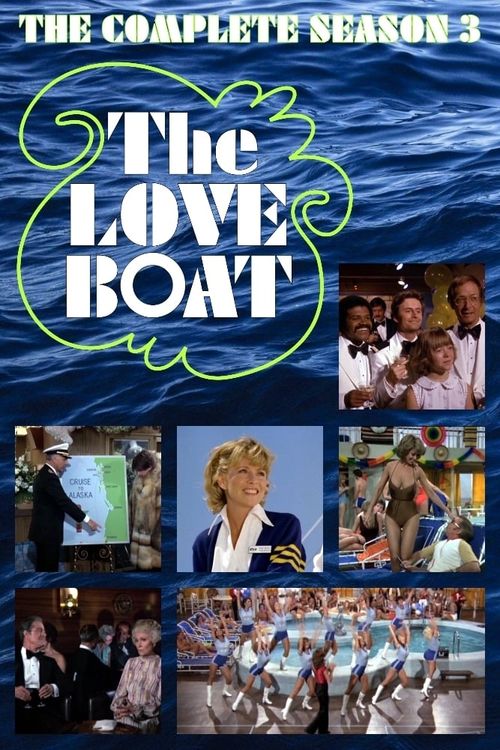
Retro Television Reviews: The Love Boat 3.6 “Gopher’s Greatest Hits/The Vacation/One Rose A Day”


Welcome to Retro Television Reviews, a feature where we review some of our favorite and least favorite shows of the past!  On Wednesdays, I will be reviewing the original Love Boat, which aired on ABC from 1977 to 1986!  The series can be streamed on Paramount Plus!

This week, Gopher sings!

Episode 3.6 “Gopher’s Greatest Hits/The Vacation/One Rose A Day”

(Dir by Alan Rafkin, originally aired on October 13th, 1979)

What a pleasant cruise this turned out to be!

Two sisters, Joan (Joanna Cassidy) and Olivia (Jaye P. Morgan), are apparently regulars on the boat.  They sail so often that Captain Stubing literally jumps for joy when he sees that they are once again on the ship.  Joan and Olivia always take the cruise together and usually, they have a wild time.  But this year, Olivia is shocked when Joan shows up with her husband, Byron (Conrad Janis)!  Byron is a bit uptight and not at all happy when he starts to hear stories about how wild his wife and sister-in-law have gotten in the past.  He assumes that Joan has cheated on him.  She hasn’t but Olivia has cheated on her husband.  In the end, Olivia continues to have fun and Joan decides that it’s time to settle down.  This story suffered a bit because Byron came across as being insufferably self-righteous but Joanna Cassidy and Jaye P. Morgan were believable as sisters.  As someone who has enjoyed a wild vacation or two with her sisters, I could relate.

Meanwhile, Janet Latham (Martha Scott) is taking her first vacation since the death of her husband.  Her florist, Henry (Don Ameche), is also on the cruise.  Every day, during their marriage, Janet’s husband would have Henry deliver a single white rose to Janet.  After her husband died, Henry continued to deliver the roses to Janet.  He allowed Janet to believe that her husband had arranged for her to continue to receive the daily roses but it turns out that Henry has been delivering them on his own because he’s fallen in love with her.  Janet does fall in love with Henry on the ship, though she fears that she’s betraying her husband’s memory.  Fortunately, by the end of the cruise, she’s ready to take another shot on love.  This story worked wonderfully, largely due to the sincere and heartfelt performances of Martha Scott and Don Ameche.  There was a tremendous amount of sincerity to their love story and it was impossible not to smile at the sight of them leaving the cruise together.

Finally, Julie has a problem!  The singer that she scheduled to perform in the Acapulco Lounge gets the mumps and has to cancel at the last minute.  Julie has to find a replacement.  Fortunately, it turns out that Gopher has a great singing voice.  He performs at the Lounge, wearing a pink tuxedo and acting like a drunk brat packer.  The audiences loves him.  The captain, once skeptical, applauds.  Gopher thinks that they love his singing but actually, they all think that he’s parodying a bad lounge act.  When the captain congratulates Gopher for being a brilliant comedian, the crestfallen Gopher says that he’s only going to sing in the shower from now on.  So, Julie arranges for a fake shower to be placed in the middle of the Acapulco Lounge so that Gopher can sing Danny Boy while Isaac holds a watering can over his head.  Again, the captain loves it.  This was undoubtedly a goofy storyline but goofiness was Fred Grandy’s strong suit and it’s hard not to smile at his over-the-top interpretation of Mack the Knife.

This was a good episode that really showed how much fun The Love Boat could be at its best.  From the sentimental Don Ameche/Martha Scott storyline to Fred Grandy dancing around the pool, this was an entertaining cruise.

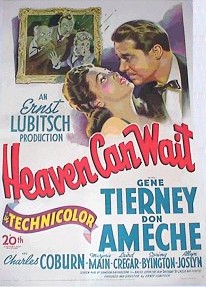
Cleaning Out The DVR #33: Heaven Can Wait (dir by Ernst Lubitsch)


(For those following at home, Lisa is attempting to clean out her DVR by watching and reviewing 38 films by the end of today!!!!!  Will she make it?  Keep following the site to find out!)

Heavencwaitposter

The 1943 film Heaven Can Wait opens with a 70 year-old man named Henry Van Cleve (Don Ameche) stepping into an opulent drawing room and having a conversation with a refined but menacing man known as His Excellency (Laird Cregar).  From their conversation, it quickly becomes obvious that Henry has recently died and His Excellency is in charge of Hell.  Most people who come to see His Excellency do so because they want to argue that they do not belong in Hell and they usually end up falling through a convenient trap door.  However, Henry is there to argue that, after living an enjoyable but dissolute life, he belongs in Hell.

Henry tells the story of his life.  He tells how he was born into great wealth and influenced by his down-to-Earth grandfather (Charles Coburn).  As a young man, he spent most of his time chasing after showgirls bur eventually, he met the beautiful and kind-hearted Martha (Gene Tierney).  He immediately fell in love with Martha but, unfortunately for him, she was engaged to his cousin (Allyn Joslyn).  Henry, however, used his considerable charm to convince her to elope with him.

(It helps, of course, that Henry’s cousin was totally and completely obnoxious, in the way that rival suitors often are in films like this.)

And, for 25 years, Henry was happy with Martha.  It took him a while to settle down and, at one point, Martha even left him as a result of his affairs.  However, they always got back together and Henry eventually did settle down, even going so far as to prevent his son from running off with a showgirl of his own.  It was only after Martha herself died that Henry, who always felt he didn’t deserve her love, returned to his old ways.

And, Henry argues, it’s because he was unworthy of his wife that he deserves to spend an eternity in Hell.  Does His Excellency agree?

Well, it would certainly be a depressing movie if he did.

One of the great things about TCM’s 31 Days of Oscar is that it gave me a chance to discover several films from director Ernst Lubitsch, films like The Smiling Lieutenant, The Love Parade, Ninotchka, and Heaven Can Wait.  Of those four Lubitsch films, Heaven Can Wait is probably the least substantial but it’s still an undeniably entertaining and nicely romantic film.  This is one of those films that you watch because the sets look wonderful, the costumes are to die for, and the performers are all pleasant to watch.  It’s pure entertainment, a crowd-pleaser in the best sense of the word.

In fact, tt was such a crowd-pleaser that it was nominated for best picture of the year.  However, it lost to the ultimate crowd-pleaser, Casablanca.