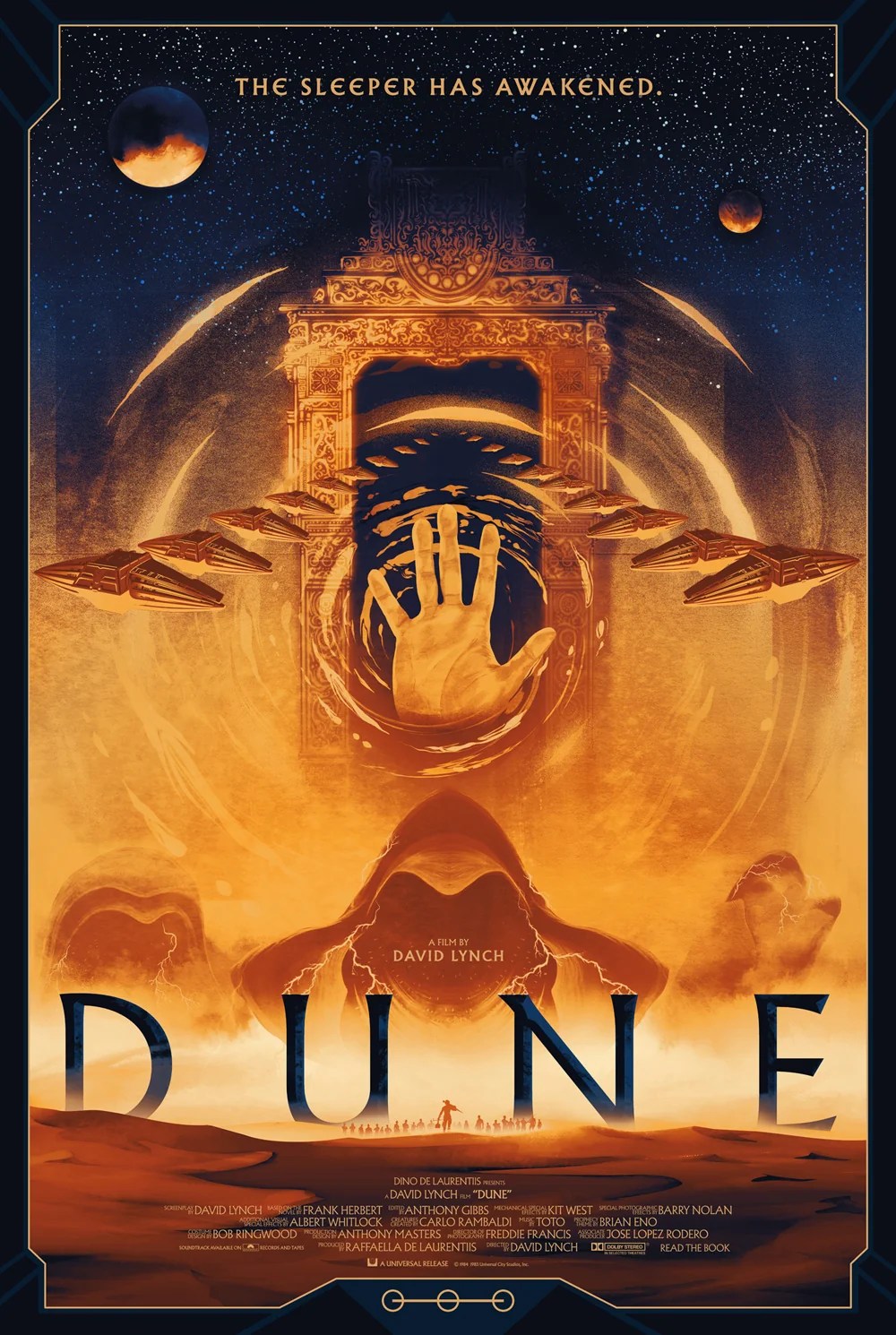
Review: Dune (dir. by David Lynch)


“The sleeper has awakened.” — Paul “Muad’Dib” Atreides

David Lynch’s Dune is one of those movies that somehow manages to be both a spectacular failure and a strangely hypnotic piece of cinema at the same time. It feels like a film willed into existence through pure creative tension: on one side, Frank Herbert’s dense, political, and spiritual sci‑fi novel; on the other, David Lynch’s surreal, psychological, dream‑logic sensibility. The result is a singular oddity—visually bold, dramatically uneven, and endlessly fascinating if you’re in the mood for something that feels more like a hallucination than a conventional space opera.

To call the adaptation ambitious is underselling it. After the collapse of Alejandro Jodorowsky’s infamous attempt to adapt Dune, the project eventually landed at Universal with producer Dino De Laurentiis, and Lynch—fresh off The Elephant Man—was brought in to turn Herbert’s galaxy‑spanning book into a two‑hour‑ish feature. On paper, it seems like inspired casting: Lynch had the visual imagination and emotional intensity to do something memorable with the material. But he was never a natural fit for streamlined blockbuster storytelling. His instincts live in mood, subconscious imagery, and uneasy psychological textures rather than clean plot mechanics. You can feel that clash all over the final film, and it’s part of what makes it so weirdly compelling.

Right from the opening, Dune doesn’t hold your hand. Princess Irulan’s floating head lays out a massive info‑dump about spice, the Imperium, and Arrakis that plays like someone reading you the glossary at the back of a sci‑fi novel. It’s dense, awkward, and kind of charming in its sincerity. The movie takes Herbert’s universe extremely seriously—no wink, no irony, no attempt to sand off the stranger edges. The Bene Gesserit, mentats, feudal houses, and prophecies are all presented straight, as if the audience will either keep up or be left behind. There’s something almost punk about that level of commitment.

Kyle MacLachlan, in his debut as Paul Atreides, is perfectly cast for Lynch’s take on the character. He’s got this earnest, slightly naive presence that gradually hardens as the story pushes him toward messiah status. Instead of leaning into a swashbuckling hero archetype, Lynch frames Paul’s evolution as something interior and dreamlike, almost like a spiritual awakening happening inside a hostile universe. Paul’s visions aren’t giant, crystal‑clear CGI prophecy sequences; they’re fragmented, flickering images, whispers, and flashes of desert and blood. You can feel Lynch trying to drag the sci‑fi epic into his own subconscious, even if the narrative doesn’t always keep up.

The supporting cast is packed with strong, sometimes delightfully bizarre performances. Francesca Annis gives Lady Jessica a sensual, haunted calm that fits the Bene Gesserit’s mix of discipline and manipulation. Jurgen Prochnow’s Duke Leto radiates dignified doom; he feels like a man who knows he’s walking into a trap but can’t step off the path. Then you get to the Harkonnens, where Lynch just lets his freak flag fly. Kenneth McMillan’s Baron is a grotesque comic‑book monster, oozing, cackling, floating on anti‑grav tech, and reveling in cruelty. It’s not subtle, but it is unforgettable. And of course Sting as Feyd‑Rautha, stalking around in barely‑there outfits and sneering like a rock star beamed in from another film entirely, just adds to the movie’s fever‑dream energy.

Visually, Dune is a feast and sometimes a bit of a choke. The production design leans into a kind of retro‑futurist baroque: cavernous sets, ornate technology, and spaces that feel less like functional environments and more like places out of a dark fantasy. Lynch and cinematographer Freddie Francis infuse everything with shadow, smoke, and texture, so even the quiet scenes feel heavy and loaded. The sandworms are huge, tactile, and worshipful in scale; the way they burst from the desert feels more like a religious manifestation than a monster attack. Even if you’re lost in the plot, the images stick with you—daggers, stillsuits, weirding whispers, blood on sand.

The sound and music do a ton of work in giving the film its identity. The score, primarily by Toto with contributions from Brian Eno, is this fusion of 80s rock sensibility and orchestral grandeur. It shouldn’t work, but it does; the main theme swells with tragic heroism, while other cues veer into eerie, synthy territory that matches Lynch’s off‑kilter tone. The sound design around the “weirding” abilities, the internal monologues, and the roar of the sandworms all help sell the world even when the script is sprinting past exposition. It’s one of those films where you might not fully grasp every detail, but the combined force of image and sound makes you feel like you’ve visited a real, deeply strange place.

The big structural problem, and the thing that most clearly separates Lynch’s adaptation from Denis Villeneuve’s two‑part version, is time and emphasis. Lynch is trying to cram the entire arc of Dune into a single film, and that means the plotting goes from methodical to breakneck halfway through. The first half lingers on the setup—Caladan, the move to Arrakis, the betrayal—while the second half rockets through Paul’s Fremen transformation, the guerrilla war, the sandworm riding, and the final confrontation. Subplots are hinted at and dropped, character arcs feel truncated, and the voiceover is forever trying to patch gaps the edits created. Themes like ecological transformation, the manipulation behind religious prophecy, and the long‑term horror of Paul’s rise are mostly reduced to gestures.

The best way to see Dune in Lynch’s version is actually through the extended cut, which adds a bit more context to certain scenes and lets the film breathe slightly more than the theatrical release. The theatrical cut is so aggressively compressed that pieces of motivation and setup just vanish, leaving the story feeling even more disjointed. The extended version restores some of the connective tissue—especially around Paul’s early time with the Fremen, the political maneuvering in the lead‑up to the final act, and the way certain characters orient themselves in the larger conflict. It doesn’t magically fix the studio‑driven structure or the inherent weirdness of Lynch’s choices, but it does make the film feel a little more complete, a little closer to the director’s original vision. It’s still messy, but less like a rushed homework assignment and more like a genuinely eccentric, if compromised, longform take on Herbert’s world.

Tonally, Lynch and Villeneuve are almost mirror images. Lynch’s film is cramped, loud in its weirdness, and often grotesque, playing like a baroque horror‑opera about destiny. Villeneuve’s is stately, slow‑burn, and solemn, more interested in the weight of empire, colonialism, and religious manipulation. Even their takes on Paul are distinct. In Lynch’s film, Paul ultimately plays more like a triumphant chosen one; whatever ambiguity is there gets overshadowed by the climactic victory and the literal act of making it rain as a grand, almost celebratory miracle. Villeneuve leans harder into the darker implications: Paul is framed as a potentially dangerous figure whose rise may unleash something terrible, and his two‑part arc emphasizes the holy war and fanaticism coalescing around him instead of treating his ascension as a clean win. Where Lynch’s ending lands somewhere between pulp myth and studio‑mandated uplift, Villeneuve’s execution feels closer to a tragedy about messianic power.

Knowing all that, Lynch’s Dune ends up feeling like a relic from an era when studios occasionally handed gigantic, unwieldy properties to filmmakers with intensely personal styles and just hoped for the best. It doesn’t “work” in a conventional plot sense, and if you’re coming to it after the sleek coherence of Villeneuve’s films, it can feel like a chaotic, cluttered alternate‑universe version of the same story. But that alternate universe has its own power. There’s a raw, handmade intensity to Lynch’s take—a sense that he’s trying to turn Dune into a waking dream about destiny, decay, and the seduction of power, even as the studio scissors are hacking away at his vision.

In the end, David Lynch’s Dune is a beautifully broken thing: a movie that fails as a straightforward adaptation but succeeds as a cinematic experience you can’t quite shake. Villeneuve gives you a clearer, more faithful, and philosophically aligned Dune, the one that explains itself and lets you sit with its implications. Lynch gives you the nightmare version, messy and compromised, but pulsing with strange life. If Villeneuve’s two‑part saga is the definitive modern telling, Lynch’s film—especially the extended cut—remains the haunting alternate path, a vision of Arrakis filtered through a very particular mind, sandblasted, grotesque, and unforgettable.
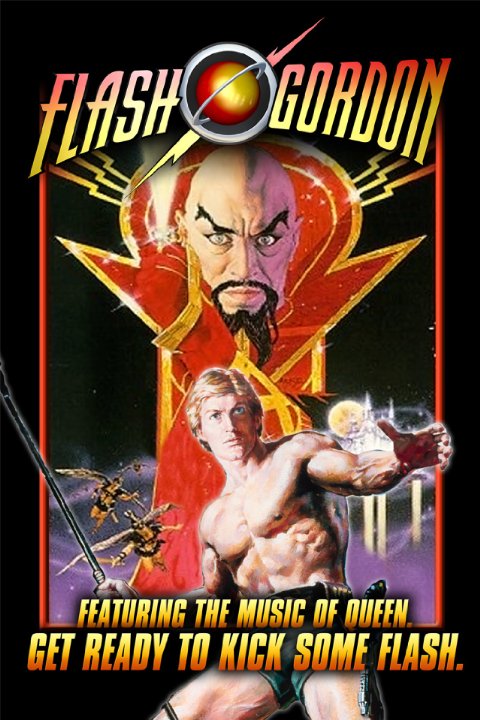
The Savior of the Universe: Flash Gordon (1980, directed by Mike Hodges)


Flash GordonLife on the planet Mongo is not easy.  Aided by Darth Vader wannabe Klytus (Peter Wyngarde) and the sadistic General Kala (Mariangela Melato), the evil Emperor Ming (Max Von Sydow) rules with an iron fist.  All of the citizens are heavily taxed and kept in a state of perpetual war in order to keep them from joining together and rebelling.  Those who attempt to defy Ming are executed.
There are many different races living on both Mongo and its moons. The Arborians, also known as the tree people, live in a jungle and are ruled by Prince Barin (Timothy Dalton).  Until Ming overthrew his father, Barin was the rightful heir to the throne of Mongo.  Barin is also one of the many lovers of Aura (Ornella Muti), Ming’s rebellious daughter.

Barin distrusts the Hawkmen, a group of winged barbarians.  Led by the boisterous Prince Vultan (the one and only Brian Blessed), the Hawkmen live in a palace that floats above Mongo.  Both Vultan and Barin share a desire to overthrow Ming but neither one of them can set aside their own dislike and distrust of each other.

Ming grows bored easily but Klytus has found him a new play thing, an obscure planet in the S-K system.  “The inhabitants,” Klytus says, “refer to it as the planet Earth.”

It all leads to this:

You may have been too busy listening to Queen’s theme song to notice (and I don’t blame you if you were) but I have always found it strange that, even though Ming had never heard of Earth before Klytus brought it to his attention, he still had a button labeled “Earthquake.”  Whenever I watch Flash Gordon, I wonder if I am the only one who has noticed this.

With Ming plaguing Earth with tornadoes, hurriances, and “hot hail,” it is up to three Earthlings to travel to Mongo  and defeat him.  Dr. Zarkov (Topol) is an eccentric scientist who was forced out of NASA because of his belief in Mongo.  Dale Arden (Melody Anderson) is a reporter.  And, finally, Flash Gordon (Sam J. Jones) is a professional athlete.  Because this movie is a fantasy, Flash Gordon is a superstar quarterback for the New York Jets.

The character of Flash Gordon was first introduced in a 1934 comic strip and was played by Buster Crabbe in several classic serials.  Among Flash’s many young fans was a future filmmaker named George Lucas, who would later cite Flash’s adventures as being a major inspiration for the Star Wars saga.  After the unprecedented success of Star Wars: A New Hope, it only made sense that someone would try to make a Flash Gordon film.

That someone was producer Dino De Laurentiis.  (Before writing the script for Star Wars, Lucas attempted to buy the rights for Flash Gordon from De Laurentiis.)  To write the script that would bring Flash into the 80s, De Laurentiis hired Lorenzo Semple, Jr.  Semple was best known for helping to create the 1960s version of Batman and he brought a similarly campy perspective to the character and story of Flash Gordon.  As a result, the film ended up with scenes like this one, where Flash interrupts one of Ming’s ceremonies with an impromptu football scrimmage:

It also led to Brian Blessed’s entire performance as Prince Vultan, which is especially famous for the way that Blessed delivered one line:

(That also makes for a great ringtone.)

Sam J. Jones and Melody Anderson often seem to be stranded by Semple’s script but Max Von Sydow, Topol, Brian Blessed, Peter Wyngarde, and Ornella Muti all get into the swing of things.  Seen today, Flash Gordon is entertaining but too intentionally campy for its own good.  On the positive side, the images still pop off the screen and the soundtrack sounds as great as ever.  When you listen to Queen’s theme song, you have no doubt that “he’ll save every one of us.”

As Flash Gordon himself put it after he saved the universe: “YEAAAAH!”

Yeah

Review: Conan the Barbarian (dir. by John Milius)


Khitan General: “Conan, what is best in life?”
Conan: “To crush your enemies, see them driven before you, and to hear the lamentations of their women!”

1982 premiered what has to be one of my favorite films ever. It was a film that was year’s in the making and had as one of it’s producers the eccentric and powerful Hollywood icon, Dino De Laurentiis. It also starred who was then a very much unknown Austrian bodybuilder-turned-actor in Arnold Schwarzenneger. To round out this unusual cast of characters producing this film would be the maverick screenwriter-director John Milius not to mention a young writer still fresh from Vietnam, Oliver Stone. During it’s production there were conflicts between producer and director as to the tone of the film right up to who should actually play the lead character. It’s a good thing that Milius was the ringmaster of this group of characters as his personality was able to steer things to what finally ended up as the film legions of fans have known and seen throughout the decades since it’s release. Conan the Barbarian was, and still is, a fantasy film of quality which still remains as action-packed and full of flights of fancy in the beginning of 2011 as it did when it premiered in 11982.

Milius and Stone adapted the stories of Robert E. Howard while adding their own flourishes to the iconic Cimmerian character. While many Howard purists were aghast at how these two writers had turned a character who was muscular but also athletic and lean into the hulking muscle-bound one Schwarzenneger inhabited the final result would silence most of these critics. The film kept the more outlandish backstory of Howard’s writing, but left enough to allow the film’s story and background to remain something out of Earth’s past prehistory. It was a film which was part origin tale for the title character, part coming of age film and part revenge story.

The film begins with a sequence narrated by iconic Asian-actor Mako as he tells of the beginnings of his liege and master Conan and the high adventures which would soon follow. Conan the Barbarian actually has little dialogue in the very beginning outside of that narration and a brief interlude between a young Conan and his father about the meaning of the “riddle of steel”. Most of the film’s beginning is quite silent in terms of dialogue. This didn’t matter as film composer Basil Poledouris’ symphonic score lent an air of the operatic to the first ten to fifteen minutes of the film. It’s here we’re introduced to James Earl Jones’ Atlantean-survivor and warlord in Thulsa Doom whose barband scours the land trying to find the meaning to the “riddle of steel”. The destruction of Conan’s village and people is the impetus which would drive the young Conan to stay alive through years of slavery, pit-fighting and banditry. He would have his revenge on Thulsa Doom and along the way he meets up and befriends two other thieves in Subotai (Gerry Lopez) and Valeria (Sandahl Bergman whose presence almost matches Schwarzenneger’s in intensity and confidence).

The rest of the film sees these three having the very tales of high adventures mentioned of in the film’s beginning narration and how an unfortunate, albeit succcesful robbery of a cult temple, leads Conan to the very thing he desires most and that’s to find Thulsa Doom. It’s here we get veteran actor Max Von Sydow as King Osric in a great scene as he tasks Conan and his companions to find and rescue his bewitched daughter from the clutches of Doom. In King Osric we see a character who may or may not be a glimpse into Conan’s future, but as Conan’s chronicler says later in the film that would be a tale told at another time.

Conan the Barbarian is a film that was able to balance both storytelling and action setpieces quite well that one never really gets distracted by the dialogue that at times came off clunky. Plus, what action setpieces they were to behold. From the initial raid by Doom and his men on Conan’s village right up to the final and climactic “Battle of the Mounds” where Doom and his men square off against Conan and his outnumbered friends in an ancient battlefield full of graveyard mounds. The film is quite bloody, but never truly in a gratuitous manner. Blood almost flows like what one would see in comic books. Conan is shown as an almost primal force of nature in his violence. In the end it’s what made the film such a success when it first premiered and decades since. It was Howard’s character (though changed somewhat in the adaptation) through and through and audiences young and old, male and female, would end up loving the film upon watching it.

This film would generate a sequel that had even more action and piled one even more of the fantastical elements of the Howard creation, but fans of the first film consider it of lesser quality though still somewhat entertaining. The film would become the breakout role for Arnold Schwarzenneger and catapult him into action-hero status that would make him one of the best-known and highest paid actor’s in Hollywood for two decades. It would also catapult him to such popularity that some would say it was one of the stepping stones which would earn him seven years as California’s governor at the turn of the new millenium.

In the end, Conan the Barbarian succeeds in giving it’s audience the very tales of myths and high adventures spoken of by Conan’s chronicler. It’s a testament to the work by Milius and Schwarzenneger couple with one of the most beloved and iconic film scores in film history by Basil Poledouris that Conan the Barbarian continues and remains one of the best films of it’s genre and one which helped spawn off not just a sequel but countless of grindhouse and exploitation copies and imitation both good and bad. The film also is a great in that it helped bring audiences to want to learn more about the character of Conan and as a lover of the written word the impact this film had on Howard’s legacy is the best compliment I can give about this film.

Dino De Laurentiis, R.I.P.


I read earlier that film producer Dino De Laurentiis died on Wednesday.  He was 91 years old and he either produced or helped to finance over a 150 movies.  He started his career with Federico Fellini and went on to produce two of the iconic pop art films of the 60s, Roger Vadim’s Barbarella and Mario Bava’s Danger: Diabolik.  Then in the 70s he went through the most infamous stage of his career when he produced several overblown “event” films like the 1976 remake of King Kong.  However, even while De Laurentiis was devoting his time and effort to critically reviled attempts at spectacle, he was also supporting the visions of independent directors like David Lynch.  In the 21st Century, De Laurentiis was probably best known for producing the Hannibal Lecter films.

De Laurentiis, born in Naples, was a Southern Italian and, not surprisingly, was one of those legendary, larger-than-life moguls who built his career walking on the thin line between the Mainstream and the Grindhouse.  Hollywood is run by people who try to be De Laurentiis but De Laurentiis was the real thing. 

Dino De Laurentiis, R.I.P.

(On a personal note, De Laurentiis produced one of my favorite films of all time, Bound.  And I’m a fourth-Southern Italian myself.  Southern Italians are the best.)