Retro Television Review: Welcome Back Kotter, 4.21 “Ooh Ooh, I Do: Part Two”


Welcome to Retro Television Reviews, a feature where we review some of our favorite and least favorite shows of the past!  On Saturdays, I will be reviewing Welcome Back Kotter, which ran on ABC  from 1975 to 1979.  The entire show can be purchased on Prime.
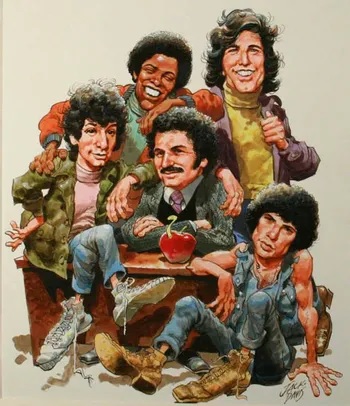
Wedding bells are ringing!

Episode 4.21 “Ooh Ooh, I Do: Part Two”

(Dir by Norman Abbott, originally aired on May 25th, 1979)

Horshack’s getting married!

For some reason, the Sweathogs throw him a bachelor party in Barbarino’s trashy apartment.  Barbarino isn’t there.  I assume he’s at work or maybe he finally moved back in with his family after realizing just how ugly and depressing his apartment was.  Seriously, I will never understand why a show would try to get viewers invested in such an ugly location.

Anyway, the bachelor party is a bust.  Epstein dresses up in drag and dances for Horshack.  The Sweathogs love it.  Horshack loves it.  But then the Sweathogs make a joke about how Horshack and Mary Johnson are going to be so poor that Mary is going to have to get a job washing bricks to support them.  Horshack realizes that they’re right.  He’s getting married in high school and he has absolutely zero marketable skills.  In fact, he’s such a weirdo that most people go out of their way to avoid him.  How is he going to support Mary?

Horshask freaks out and runs away.  After Mary shows them the note that Horshack left, in which he said that he was running away to become the type of man who could support her, the Sweathogs search all over Brooklyn for him.  Epstein goes to a Marine recruiting station.  Washington and Beau …. eh, I watched this show like 20 minutes ago and I’ve already forgotten what they did.  That’s how well-written this episode was.  Mary, however, knows that Horshack’s favorite movie is Wuthering Heights so she finds him at the local move theater.

They get married!  The ceremony is small and pathetic.  I don’t think a single member of Horshack’s family showed up.  Gabe does show up and, when the Sweathogs realize that Horshack needs a ring to give Mary, Gabe gives up his own wedding ring.  Julie approves.  They’re probably going to get divorced as soon as the show ends.

Gabe, who is usually portrayed as being very concerned with the future of his students, is totally cool with Horshack getting married while still a high school student.  At no point does he suggest that Horshack might be rushing into things or that a stunted manchild who can’t get a job might not be a good husband.  This was one of Kaplan’s rare appearance during the final season of the show but he doesn’t act much like the Mr. Kotter that we got to know over the previous three seasons.  It’s kind of like when Steve Carell came back for The Office finale and only said one line.  It just doesn’t feel right.

Apparently, this episode was meant to a backdoor pilot for a series that would have focused on Horshack and Mary.  I can’t imagine that working, though I would say that Mary and Horshack do look cute together at the end of the episode.

Speaking of endings, there are only two more episodes left!  Will the Sweathogs finally graduate?  We’ll find out!
Retro Television Reviews: Death Sentence (dir by E.W. Swackhamer)


Welcome to Retro Television Reviews, a feature where we review some of our favorite and least favorite shows of the past!  On Sundays, I will be reviewing the made-for-television movies that used to be a primetime mainstay.  Today’s film is 1974’s Death Sentence!  It  can be viewed on YouTube!

There’s been a murder!

A young woman has been strangled in her own home.  The nosy neighbor (Hope Summers) testifies that the woman often argued with her woman and that she heard the woman yelling on the night of the murder.  The husband, John Healy (Nick Nolte), is found in a neighborhood bar and, when he’s brought back to his house, his drunken reaction to seeing his dead wife doesn’t do much to keep him from looking totally guilty.

However, the viewer knows that John is innocent because the viewer has already seen that the woman was murdered by Don Davies (Laurence Luckinbill), the man with whom she was having an affair.  She demanded that he leave his wife for her and Don, realizing that his cheating was about to revealed, responded by strangling her.

Don’s wife is Susan Davies (Cloris Leachman), who knows that she and Don have been going through a rough patch but who certainly had no idea that Don was cheating on her.  Shortly after the murder, Susan is called up for jury duty.  She’s placed on the jury and told that she will be an important part of a major trial.  As a result, she and the other jurors will be sequestered in a hotel….

And who is the defendant in this trial?  John, of course!

As opposed to the other members of the jury, who are ready to convict John even before the first bit of testimony is heard, Susan pays attention to what is said in the courtroom.  She listens to Lubell (Alan Oppenheimer), the prosecutor.  She listens to Tanner (William Schallert), the defense attorney.  She comes to believe that John is innocent but will she be able to hold her own against the rest of the jury?  And will she ever figure out that the murder was actually committed by her husband?

It’s an intriguing premise, even if it is a bit far-fetched.  I mean, it really is an amazing coincidence that Susan just happened to end up on the jury for a case involving a murder that was actually committed by her husband.  However, this is a made-for-television movie and, as soon as “Produced by Aaron Spelling” appears on the screen, most viewers should be savvy enough to know what they’re getting into.  Instead, the main problem with the film is that it opens by showing us who the murderer is.  Therefore, there’s really zero suspense as to who actually committed the crime.  Instead, the viewer spends the entire movie waiting for Susan to catch up.  Since the majority of the film takes place in court, it’s a very talky film but there’s no joy to be found in paying close attention to every word said and picking up on the details that will allow you to solve the crime for yourself.  This is a case where the film spoils its biggest twist and, despite good performances from Leachman and Luckinbill, it’s a bit dull.

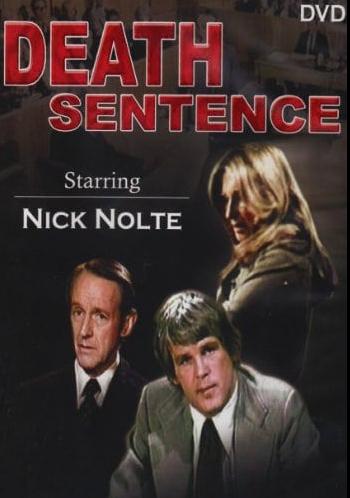
(Nick Nolte, for his part, spends most of the movie silently sitting in the courtroom.  He’s not bad and his look of anguish is believable but it’s hardly a starring role, regardless of what the film’s video packaging might otherwise claim.)

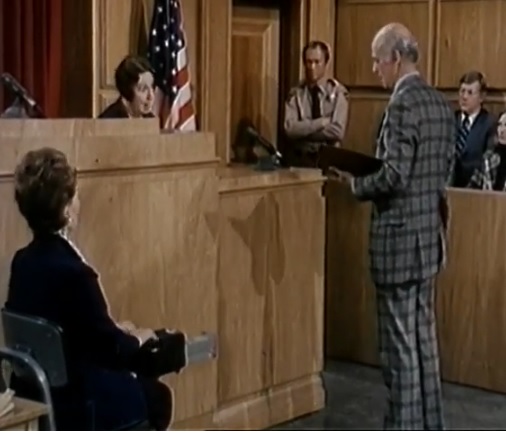
In the end, what I’ll mostly remember about Death Sentence were the atrocious fashion choices made by the prosecutor.  Seriously, would you trust a man wearing this suit?

Cleaning Out The DVR: Riot on Sunset Strip (dir Arthur Dreifuss)


(Hi there!  So, as you may know because I’ve been talking about it on this site all year, I have got way too much stuff on my DVR.  Seriously, I currently have 180 things recorded!  I’ve decided that, on February 1st, I am going to erase everything on the DVR, regardless of whether I’ve watched it or not.  So, that means that I’ve now have only have a month to clean out the DVR!  Will I make it?  Keep checking this site to find out!  I recorded the 1967 film, Riot on Sunset Strip, off of TCM on September 28th, 2017!)

“Dig that scene!”

That’s a line that’s heard more than once in Riot on Sunset Strip, a film that’s all about digging that scene.

In this case, the scene is Hollywood’s Sunset Strip in 1966.  All the kids are going to the clubs and dancing to that strange rock and roll music.  Protesters are walking up and down the sidewalk, carrying signs that carry radical messages like: “Be Nice” and “Make Peace.”  (As far as I could tell, no one had a “Join the Conversation” sign.)  Some of the so-called “long hairs” are wearing red armbands to show that they are a member of the counter-culture police force, determined to keep peace on the Strip.  Meanwhile, the real police are a constant presence.  There’s a 10 o’clock curfew for anyone under the age of 18 and if the cops catch you, you’re going to the station where your parents will be called and your mom will probably freak out over the length of your skirt.  The kids want the police to change their attitude.  The local business owners — the ones who don’t own a club and who all look like they might be related to Dwight Eisenhower — want the police to get even more aggressive.

Stuck in the middle of it all is the local police captain, Walt Lormier (Aldo Ray).  Sure, Walt might be a member of the establishment, with his neckties and his J. Edgar Hoover haircut.  But Walt knows that the kids aren’t all bad.  Sure, their music sounds like noise to him.  And some of the boys may wear their hair a little bit longer than Walt thinks they should.  (In some scenes, it’s easy to imagine Walt thinking, “That haircut would have gotten you shot if you’d been in my unit in Korea…”)  But mostly, Walt wants to keep peace.  He’s even willing to meet with one of the protesters and listen to his concerns.

“Are you in college?” Walt asks the protester.

“Third year,” the protester replies, “Straight A’s.”

Of course, what Walt doesn’t realize is that his own daughter, Andy (Mismy Farmer, before she relocated to Italy), is one of the kids who is hanging out on the strip!  Of course, it’s been a while since he’s seen Andy.  Walt is divorced from Andy’s mother and says he really isn’t even sure where either Andy or his ex-wife lives now.  Of course, we know that they’re living in a shack, one that has only one room and where wet clothes are hung from the ceiling so that they can dry.  Andy’s mom is always drunk.  Can you blame Andy for wanting to spend all of her time on the Strip?

Of course, not everyone on the Strip is as reasonable as a third year college student.  Some of the kids actually are bad.  One of them slips Andy LSD, which leads to Andy staring at her hand and then doing an interpretive dance at a house party.  After discovering that his drugged daughter has been raped, Walt attacks her three rapists, which leads to the riot promised by the title.  Being a good middle-of-the-road liberal, Walt realizes that he now has to make amends with the good kids but can he stop things before they get out of control?  After all, those protesters are already passing out signs…

Based on an actual event. Riot on Sunset Strip is a real time capsule of a film.  Regardless of whether the film itself is any good or not, it’s worth watching as just a reflection of the time in which it was made.  Like a lot of the “social problem” films made in the mid-60s, it deals with a very real issue and then resolutely refuses to come down on either side.  Older viewers could watch Mimsy Farmer freaking out on LSD and say, “See, that’s why we need a curfew!”  Younger viewers could look at Andy’s drunk mother and the parents picking up their children at the station and say, “See, that’s why we need to burn down the establishment and move to Cuba!”  In the end, the film declares that the kids are all right except for the ones that aren’t.  Ultimately, it’s all the parents’ fault except for the parents who aren’t at fault.

(That said, I imagine that any truly committed 60s revolutionary would have rolled their eyes at the way they were portrayed in the film.  The protesters and their signs automatically made me think about the infamous Kendall Jenner Pepsi commercial.)

Seen today, the main thing that I noticed about Riot on Sunset Strip is that all of the wild kids on the Strip looked more like missionaries than revolutionaries.  One of Andy’s friend’s did occasionally let his hair fall in his eyes but otherwise, they were an amazingly clean-cut group of delinquents, the type who, today, would probably get blocked by every member of Resistance Twitter because everyone would assume that they were actually undercover Russian bots.

(At the end of the film, a narrators informs us, “Soon, half the world’s population will be under 25 years of age.  What will happen to them?  Where will they go?”  The answer, of course, is that most of them will go to the suburbs.)

Today, it’s easy to roll your eyes at something like Riot on the Sunset Strip.  Our modern culture of snark almost demands that you do.  But, honestly, I enjoyed this film.  Watching it was like having my own little time machine.