Rancher Jeff Reynolds (Frank LaRue) used to be one of the good guys on the frontier but he’s recently changed. He fired all of his loyal ranch hands and instead hired a motely crew of outlaws. He’s buying up land and evicting the squatters who have been living there. About the only good thing he does is hire Lon Cardigan (Johnny Mack Brown) to be his new herd boss. Lon is engaged to Reynolds’s daughter, Bobbie (Claire Rochelle). With the help of Bobbie and comic relief cook Calico Haynes (Horace Murphy), Lon tries to figure out why Reynolds is now doing the bidding of the evil John Porter (Ed Cassidy).
The title is the most exciting thing about this movie, which is one of those old B-movies that puts the “creak” in creaky. There’s surprisingly little gunplay but there is a lot of horse riding. For a film that runs less than an hour, a surprising amount of it is just shots of people riding from one location to another. The horses’ hooves sound impressive on the soundtrack but it’s not exactly exciting. As always, Johnny Mack Brown is a convincing cowboy. It’s a good thing he looks like he knows what he’s doing when he’s riding a horse! The plot was standard B-western fluff. Johnny Mack Brown appeared in a ton of westerns and almost all of them seemed to feature the same range war. There are better Johnny Mack Brown movies out there. This one is for completists only.
In Mexico, two American cowboys, Johnny Darrel (Johnny Mack Brown) and Dick Martin (Julian Madison) join a poker game to try to win some money and help out their buddy, Oscar (Sid Saylor). When they discover that cantina owner Manuel Mendez (Ted Adams) has rigged the game, a fight breaks out. The lights turn off. In the darkness, several guns are fired. When the lights come back up, Dick is dead. Mendez convinces Johnny that he accidentally shot his friend in the fight. Guilt-stricken, Johnny tosses aside his guns and returns to Texas.
Johnny has sworn that he will never shoot another gun but when he’s hired to work at a ranch owned by Joan Williams (Claire Rochelle), he finds himself in the middle of a range war between Joan and Brace Stevens (Dick Curtis), with Mendez also making an unwelcome return to Johnny’s life. Even after Johnny discovers the truth about what happened that night at the cantina, he doesn’t pick up a gun. Instead, Johnny fights the bad guys with lassos and plates.
Guns In The Dark is only 54 minutes long and it features actors who will be familiar to any fan of the old B-westerns. Sidekcick Sid Saylor’s stuttering schtick gets old quickly but Johnny Mack Brown is as likable as always in Guns In The Dark and he comes across as being an authentic cowboy even when he’s not carrying a gun Given that this film features even more horse chases than the typical Johnny Mack Brown b-western, it’s good that Brown is so convincing. What isn’t convincing is how stupid Johnny Darrel is required to be in order for him to fall for Mendez’s lie in the first place. I appreciated the change of pace from Brown just using a gun to stop the bad guys but I wish the reason behind it had been more convincing. This isn’t one of Johnny Mack Brown’s more memorable westerns though, as always, it’s easy to see why he was one of the early stars of the genre.
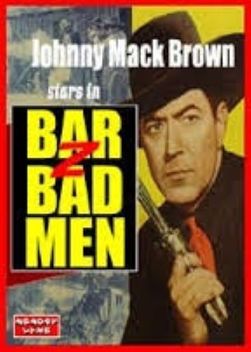
After getting kicked out of town for shooting the place up during a night of friendly fun, cowboy Jim Waters (Johnny Mack Brown) drops in on his old friend, rancher Ed Parks (Jack Rothwell). Ed has got a strange problem. There are cattle rustlers about but instead of stealing Ed’s cattle, they’re adding cattle to Ed’s herd. It’s an obvious scheme to try to create a feud between Ed and his neighbor, rancher Hamp Harvey (Frank LaRue). Before Jim and Ed can solve the problem, Ed is gunned down. Harvey is the number one suspect but Jim figures out the truth, that Harvey has been betrayed by one of his own employees and that all of this is a part of a scheme by Sig Bostell (Tom London) to take control of both ranches.
Bar-Z Bad Man is a B-western with a notably twisty plot as Bostell plays both sides against each other for his own benefit. As usual, Johnny Mack Brown makes for a good and convincing western hero. Whether he’s chasing someone on his horse or drawing his guns, Brown is always a convincing cowboy. What makes this film interesting is that it opens with Johnny Mack Brown engaging in the type of behavior that most B-western heroes would never think of doing. Shooting up the town and then getting exiled for his actions adds an element of redemption to Jim’s efforts to get to the bottom of Bostell’s schemes. Or it would if Jim ever really seemed to feel bad about shooting the town up. His excuse is that he was just having a good time. Try to get away with that in the real old west, Jim!
Bar-Z Bad Men is a good B-western for those who like the genre. The story is solid and Johnny Mack Brown is as convincing saving the west as he was shooting it up.
Missouri in 1864. The Civil War is raging and the state is divided between those who support the Union and those secretly support the Confederate guerillas led by Willian Quantrill (Ray Corrigan). The Union’s Major Baker (Jack Holt) is determined to track down rebel Bob Shelby (Jimmie Martin) and he enlists the Native American Chief Whitecloud (played by Chief Thundercloud) to help find him. Whitecloud has a personal vendetta against the Shelby family and, when he finds Bob, he executes him in cold blood. Bob’s sister, Jean Shelby (Ann Savage), is also a Confederate sympathizer and she seeks revenge. Complicating things is that Jean has fallen in love with Union Captain Fred Raymond (Alan Curtis).
One of the many B-westerns produced by Robert L. Lippert and directed by William Berke, Renegade Girl packs a lot of plot into just 65 minutes. The action is nonstop and fans of westerns will find all of the horse chases, gunfights, and threats of hanging that they could want. The main thing that distinguishes Renegade Girl from other B-westerns is the fierce performance of Ann Savage as Jean Shelby, a woman who will not stop until she gets her revenge. While the film’s portrayal of the Quantrill and Chief Whitecloud definitely goes against modern sensibilities, Ann Savage’s performance feels ahead of her time. No one is going to stand in Jean Shelby’s way.
Chief Thundercloud’s real name was reportedly Victor Daniels, though his past is shrouded in mystery. He claimed to be a Cherokee from Arizona, though he was listed as being Mexican on a marriage record that was filed before he started his film career. As Chief Thundercloud, he was a mainstay in westerns from the 30s to the time of his death in 1955. He was the first actor to play the Lone Ranger’s Tonto and he also played Geronimo in a 1939 Paramount film of the same name. His final film role was a posthumous appearance in John Ford’s The Searchers.
The 1944 film, Lady in the Death House, tells the tragic and faintly ridiculous story of Mary Kirk Logan (Jean Parker).
The daughter of a small-time criminal, Mary has spent most of her life trying to escape from her family’s legacy of crime. She’s even got a job, working at the same bank that her father once tried to rip off. Of course, at work, everyone knows her as Mary Kirk and they have no idea that her father was the infamous Tom Logan. If that information got out, Mary would lose her job and no longer be able to take care of herself or her younger sister, Suzy (Marcia Mae Jones).
One night, Mary is out on a date with a clumsy man who takes her out to a nightclub and manages to accidentally set Mary’s dress on fire. Luckily, Dr. Brad Braford (Douglas Fowley) is there, having a drink with his friend, the famous criminologist, Charles Finch (Lionel Atwill). Brad jumps into action, extinguishing the fire and saving Mary’s dress. It’s love at first sight.
There’s just one problem. Dr. Bradford is studying ways to bring the dead back to life and, in order to raise money for his research, he’s been working as the state’s executioner. When someone goes to the electric chair, Brad is the one who pulls the lever. Mary says that she can only marry Brad if he gives up his electrifying night job.
However, before Brad can turn in his letter of resignation, Mary is arrested for the murder of Willis Millen (Dick Curtis), a crook who once knew her father. Mary swears that she’s innocent but there are two eye witnesses who testify that they not only heard Mary and Willis fighting but that they also saw the shadow of someone hitting Willis over the head with a lamp. It doesn’t take long for the jury to reach a verdict:
I have to admit that, when this newspaper appeared on-screen, I was actually more curious about the “youth” who was arrested for stealing glitter off of campaign signs. However, for whatever reason, the film declines to follow up on that story. Instead, we watch as Mary goes to death row, with the knowledge that she is to die “at the hand of the man I love.”
However, there may still be hope! Charles thinks that Mary is innocent. Though there’s only 24 hours left before Brad is scheduled to execute Mary, Charles launches an investigation of his own. But even if Charles is able to find the evidence that exonerates Mary, will he be able to contact the governor in time? Or will Mary go to the chair?
Well, regardless of what happens, rest assured that this World War II-era film will end with an appeal for all movie goers to do the right thing and buy war bonds.
Lady in the Death House is an entertaining but fairly ludicrous little movie. I mean, realistically, having the executioner execute his own fiancée is a huge conflict of interest. It seems like they could have gotten a substitute executioner, if just for one night. But, if they did that, we wouldn’t get the melodramatic highlight of Mary announcing that she’s scheduled to be killed “by the hand of the man I love.”
Lady in the Death House provides a rare chance to see Lionel Atwill in a heroic role. The British actor played a countless number of mad scientists, killers, and Nazis before his premature death in 1946. (Atwill’s promising career was derailed in 1943, when he accused of hosting orgies at home and was subsequently convicted of perjury. That’s one reason why Atwill turned up in a “poverty row” feature like this one.) Atwill is convincing as Charles Finch. The same superior attitude that made him a good villain also makes him believable as the only person capable of figuring out who murdered Willis Millen.
Taking on its own terms, Lady in the Death House is a fun movie. If nothing else, it provides a lesson on how to get a message to the governor, even if no one’s quite sure where he is for the evening. That’s an important lesson to learn!
Bela Lugosi ( see yesterday’s post ) wasn’t the only horror icon who starred in a series of low-budget shockers. Boris Karloff signed a five picture deal with Columbia Pictures that was later dubbed the “Mad Doctor” series and, while several notches above Lugosi’s “Monogram Nine”, they were cookie-cutter flicks intended for the lower half of double feature bills. The first of these was THE MAN THEY COULD NOT HANG, which sets the tone for the films to follow.
Karloff plays Dr. Henry Savaard, inventor of a new surgical technique that requires the patient to die, then reviving him with a mechanical heart after performing the operation. This later became standard operating procedure during open-heart surgery, but back in 1939 was considered science fiction! Anyway, Savaard’s young assistant Bob agrees to go through the experimental procedure, but his girlfriend freaks out and calls the cops, claiming Savaard is about to murder…
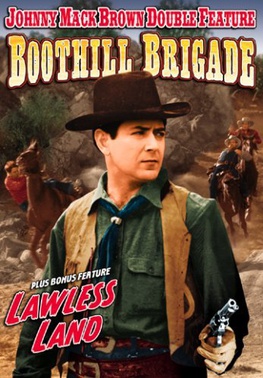 Rancher Jeff Reynolds (Frank LaRue) used to be one of the good guys on the frontier but he’s recently changed. He fired all of his loyal ranch hands and instead hired a motely crew of outlaws. He’s buying up land and evicting the squatters who have been living there. About the only good thing he does is hire Lon Cardigan (Johnny Mack Brown) to be his new herd boss. Lon is engaged to Reynolds’s daughter, Bobbie (Claire Rochelle). With the help of Bobbie and comic relief cook Calico Haynes (Horace Murphy), Lon tries to figure out why Reynolds is now doing the bidding of the evil John Porter (Ed Cassidy).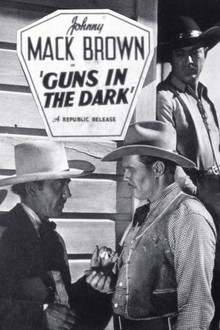


 Through the Shattered Lens