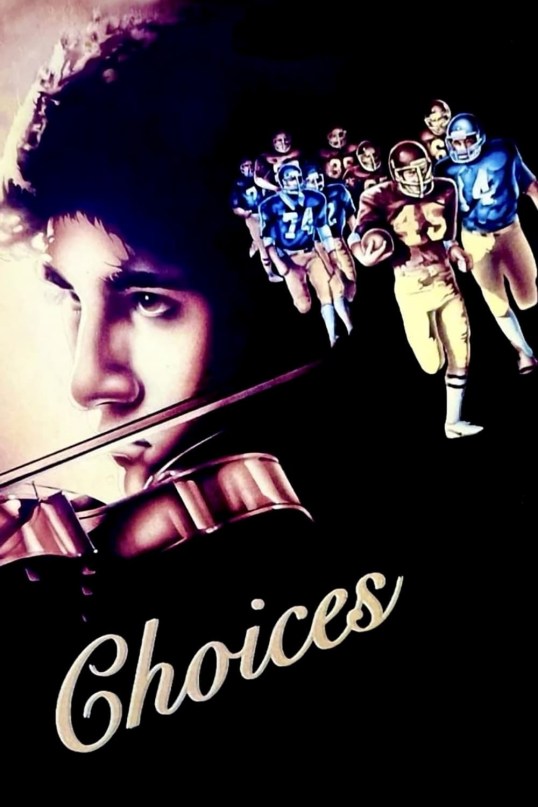
John Carluccio (Paul Carafotes) is the star running back on his high school football team until the district’s new chief doctor (Dennis Patrick) rules that John can no longer play because he’s partially deaf and wears a hearing aid. Coach Rizzo (Val Avery) protests but John is off the team. John stops hanging out with his squeaky clean best friend (William R. Moses) and instead becomes friends with the school delinquent (Stephen Nichols). John starts smoking pot and gets a bad attitude. Whenever anyone tries to help him or suggests that he can live a productive life even without football, John gets angry. Can his new girlfriend (Demi Moore) turn his life around?
I really wanted to feel bad for John and cheer him on as he fought to be allowed to play football but he was such a mopey character that it was hard. He acted like the rest of the team should have refused to play until he was allowed to rejoin them. It didn’t help that the new running back was just as good as John ever was. Eventually, John discovered that he loved music and Demi Moore but even all of that felt like it came out of nowhere. I know a lot of people who have had setbacks as bad as John’s who managed to get through them without treating everyone around them terribly.
Demi Moore is the big “name” here but she’s only in the movie for a few minutes. I recognized a few of the other actors. William R. Moses later played Ken Malansky in the Perry Mason movies and Stephen Nichols will always be Patch on Days of our Lives.
If you’re looking for football action, you won’t find it here. My choice, if I could do it again? Don’t watch.
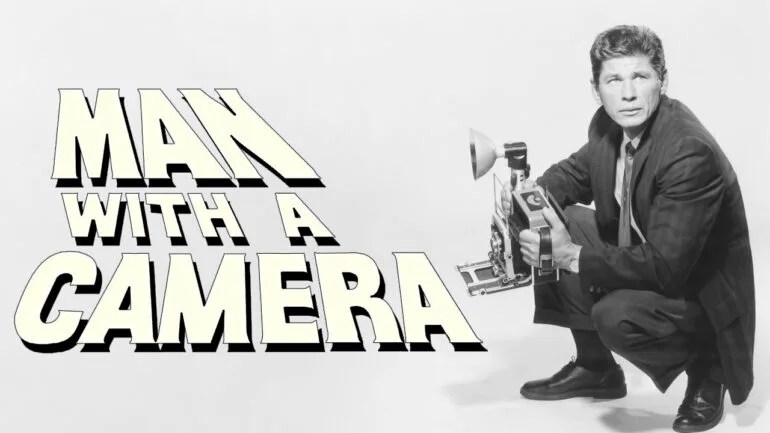
This episode opens with Mike Kovac (Charles Bronson) visiting an illegal gambling den operated by Walter Bradman (Dennis Patrick). Kovac takes a picture of Bradman with a small camera he’s placed inside of a cigarette lighter. You see, an honest lawyer named John Payson (Logan Field) is running for governor on a platform of shutting down these types of criminal establishments, and Kovac thought this might make for an interesting story in the current political environment. But Bradman catches him taking the picture, and just when it looks like he might forcibly take the camera and film from Kovac, Bradman decides to let him go. It seems that Bradman has bigger plans for Kovac as he happens to know that Kovac is going to the Payson’s household to take family pictures the very next day. Bradman has an inside person in the Payson household, his girlfriend Miss Hollis (Phyllis Avery), and he plans to steal the negatives. They will then use Miss Hollis’ ex-con dad Clyde Bosser (Addison Richards) to create fake composite pictures that pretend to show Payson in the gambling den and hanging out with women other than his wife. He’s hoping that a little blackmail might get Payson off his back, but as you might imagine with Mike Kovac on the case, the plan falls apart and nobody is safe!
“Turntable” is a solid episode of MAN WITH A CAMERA. There are several reasons I enjoyed it. The presence of Charles Bronson in the lead is always at the top of the list. His down-to-earth charisma anchors the series and this episode in such a way that there’s always something worth watching on screen. He does get to beat up a couple of guys and that’s very fun for me. Dennis Patrick is good as the den boss. He’s very confident and cocky until his plan starts falling apart. Once he begins to panic, things really start to get interesting. The story is also intriguing, as it deals with doctoring photos for nefarious purposes, a novel concept in 1958, but something that’s all too common these days. The composite pictures created as part of this episode are actually kind of funny to look at, and it makes you wonder how some of them could have fooled anyone! I’ve mentioned before that I like episodes where Kovac’s dad Anton (Ludwig Stossel) has an important part. In this episode, he helps his son put together an important piece of the puzzle so I liked that. On the negative side, I didn’t like the political angle. John Payson’s gubernatorial candidate is made to look like an angel, and we all know how that usually works out in the political arena. Honestly, I’m sick of politics in general, and I like to watch TV and movies to get away from that kind of stuff.
Overall, “Turntable” is a solid episode with an intriguing story, a few good performances, and a scene that actually caught me by surprise. That doesn’t happen very often!
Welcome to Retro Television Reviews, a feature where we review some of our favorite and least favorite shows of the past! On Tuesdays, I will be reviewing the original Fantasy Island, which ran on ABC from 1977 to 1986. The entire show is currently streaming on Tubi!
Smiles, everyone, smiles!
Episode 1.9 “Trouble, My Lovely/The Common Man”
(Directed by Cliff Bole, originally aired on April 1st, 1978)
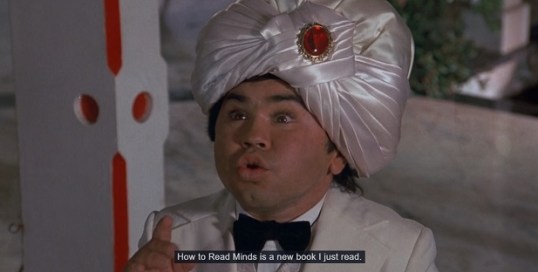
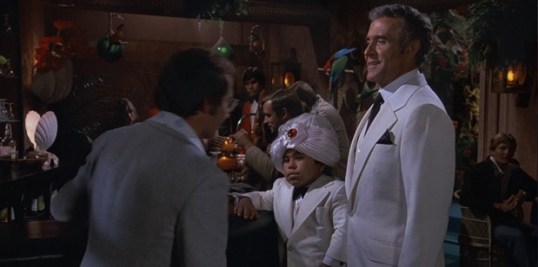
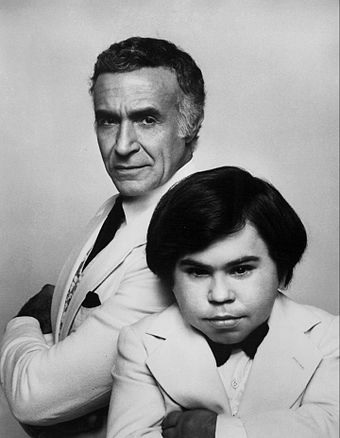
This week’s episode of Fantasy Island opens, as most of them do, with Mr. Roarke sharing a few words with Tattoo before they leave to meet the plane. This week, Roarke is surprised to find that Tattoo wearing a turban. Tattoo has decided that there is money to be made in being a phony mind reader.
Roarke shakes his head dismissively and then it’s off to meet the latest visitors to Fantasy Island. Unfortunately, the fantasies that follow are so boring that you’ll find yourself wishing that Roarke had spent more time talking to Tattoo.
Don Knotts plays a Stanley Schecktler, a claims adjustor who dreams of being a hard-boiled private investigator. He gets his wish and soon finds himself in a noirish version of Los Angeles. Stanley is hired by Ivy Chandler (Lynda Day George) to investigate the man who is blackmailing her daughter, Peggy (Pamela Jean Bryant). Like all good detectives, Stanley narrates the story.
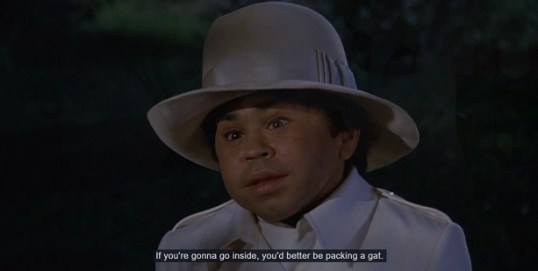
Eventually, Stanley finds himself investigating an actual murder! Mr. Roarke and Tattoo shows up to inform Stanley that his fantasy is potentially deadly. They offer to refund his money. (Tattoo says that he rarely ever refunds money so I guess Tattoo is the Island’s business manager. I know that’s been mentioned in a few previous episodes but I still find it hard to believe, considering how little respect Roarke seems to have for Tattoo.) Stanley, however, is determined to solve the murder. This leads to Tattoo, who has switched his turban for a fedora, giving Stanley one important piece of advice:
This fantasy had potential. What film lover hasn’t fantasized about being a character in a film noir? Unfortunately, the execution was lacking, with the majority of the comedic lines falling flat. Don Knotts has a few funny moments as the detective but the story itself never finds the right balance between comedy and noir.
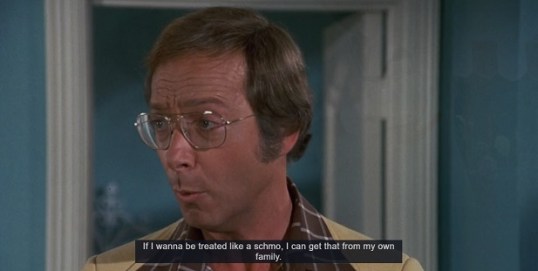
That said, at least there was an unexpected twist to the detective fantasy. The show’s other fantasy was not only lame but also kind of annoying. Bernie Kopell, who was so likable as Doc Bricker on The Love Boat, is far less likable as a wimpy family man who comes to Fantasy Island with one request. He wants Mr. Roarke to be a terrible host so that he can stand up to him and win the respect of his family. Seriously, that’s the entire fantasy!
Sorry, dude, but you deserve to get treated like a schmo for having pay thousands of dollar just to get your family to look up to you. This guy spent a lot of money to have a fantasy on Fantasy Island that he could get for free just by taking his family out to Denny’s and demanding to see the manager. Seriously, this whole fantasy was a bit pointless but at least Tattoo got to try out his mind reading tricks when he and Mr. Roarke came across the Kopell sitting at the bar.
Oh well! Not every fantasy can be a winner. Hopefully, next week will be better.
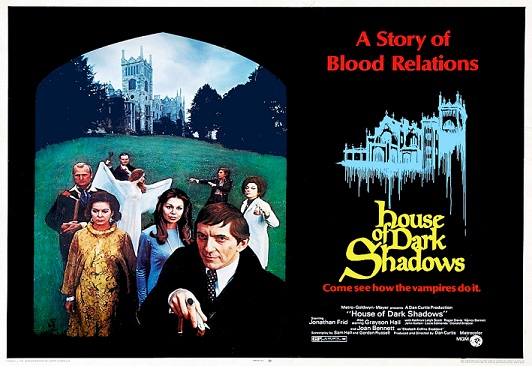
There’s a lot that you can say about this vampire film from 1970 but I think it can all be summed up with one word: relentless.
A lot of this is because House of Dark Shadows is a film adaptation of a daytime drama. Over the course of six sesons, Dark Shadows ran for a total of 1,220 episodes. That’s a lot of story to cram into a 97-minute film but director Dan Curtis does just that. The end result is an incredibly busy film and I mean that in the best way possible.
Seriously, there are so many twists and turns in this film’s plot that it’s difficult to even know where to begin. This is one of the most incident-filled horror films that I’ve ever seen. No sooner does one plotline resolve itself than another begins. Meanwhile, a surprisingly large cast wanders through the shadows and tries not to get transformed into a vampire. Most of them do not succeed.
See if you can keep all of this straight:
In Maine, a lowlife handyman named Willie (John Karlen, giving the film’s best performance) breaks into a mausoleum and approaches a coffin that’s covered with chains. Willie thinks that there’s a treasure hidden in the coffin but, after he removes the chains, he instead discovers that he’s stumbled across the home of a vampire! Barnabas Collin (Jonathan Frid, who perfectly combines old world manners with thinly veiled menace) has spent 175 years trapped in that coffin and now that he’s been released, he’s not in a very good mood.
Soon, Barnabas has introduced himself to his descendants (including Joan Bennett, as Elizabeth, the family matriarch) as a cousin from England. Everyone is impressed with Barnabas’s charm and courtly style. Of course, some people are a little bit skeptical. Prof. Stokes (Thayer David) notices that Barnabas doesn’t seem to know much about London while Dr. Hoffman (Grayson Hall) flat out accuses Barnabas of being a vampire. Barnabas admits that this is true but fear not! Dr. Hoffman’s fallen in love with him and wants to help cure him.
Meanwhile, everyone in town is growing concerned about all of the bloodless bodies that are showing up. They especially get worried after Elizabeth’s daughter, Carolyn (Nancy Barrett), dies and then promptly comes back to life, complete with her own set of fangs….
While the town concerns itself with what to do about Carolyn, Barnabas has fallen in love with a nanny named Maggie (Kathryn Leigh Scott), who he thinks is the reincarnation of his former lover. Unfortunately, Maggie already has a boyfriend named Jeff (Roger Davis) but when has the ever been a problem for a vampire? Far more of a problem than Jeff is the fact that Willie is also in love with Maggie and Dr. Hoffman is so jealous of Barnabas’s love for Maggie that she’s willing to inject him with a formula that causes him to transform into an elderly man….
And all that’s just in the first hour!
Needless to say, it all leads to one final, gore-filled confrontation. When I say that this film is gory, I mean just that. Blood isn’t just spilled in House of Dark Shadows. Instead, it flows like water busting out of a cracked dam. When Barnabas bites a victim, he doesn’t just leave two neat little puncture marks. Instead, he literally rips their neck to shreds. Just how savage Barnabas and Carolyn get in this film is one of the things that sets House of Dark Shadows apart from other vampire films. As opposed to the type of tragic figure who shows up in so many vampire films, Barnabas is ruthless, cruel, and unforgiving. He’s a genuinely frightening creation.
House of Dark Shadows is a chaotic movie but it’s also a lot of fun. This is one of those films that you watch in amazement as it just keeps going and going, piling on one incident after another. Does the film always make sense? No, but it doesn’t have to. Quickly paced and featuring nonstop gore and fog, the film has a dream-like feel to it. Curtis and the cast attack the material with such unbridled enthusiasm that it doesn’t matter if the plot occasionally doesn’t always add up or if the dialogue is occasionally a bit clumsy. It’s impossible not to get swept along with the film’s insanity.
Probably because of its television roots, House of Dark Shadows is often dismissed by critics. (I’ve never seen any old episodes of the show so I can’t say how the movie compares to it.) Well, those dismissive critics are wrong. House of Dark Shadows is one of my favorite vampire films and it’s definitely one that deserves to be rediscovered.
(And yes, it’s a helluva lot better than that movie that Tim Burton made with Johnny Depp….)
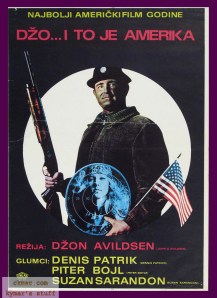
On Monday night, my movie before bedtime was an old one from 1970, John G. Avildsen’s Joe. Though Joe is an occasionally uneven and rather heavy-handed film, it’s also a brutally effective one that I haven’t been able to get out of my mind since watching it.
Joe opens with Melissa Compton (played by Susan Sarandon, in her film debut) and her boyfriend, Frank Russo (Patrick McDermott). It is quickly established that Melissa is a “rich girl” who has dropped out of society while Frank is a drug dealer. Frank, incidentally, is probably one of the least likable characters in the history of cinema. When we first meet Frank, he’s taking a bath but it makes no difference as the character just seems to covered in a permanent layer of grime. Both Frank and Melissa are also drug addicts.
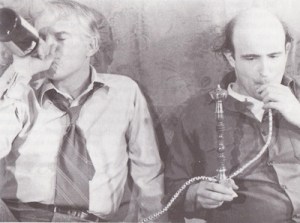
Patrick McDermott (left) and Susan Sarandon
When Melissa has a drug overdose and ends up in the hospital, Frank doesn’t really care but her father, advertising executive Bill Compton (Dennis Patrick) does. He promptly goes over to Frank’s apartment and after Frank taunts him by saying that Melissa “had a real hang-up about you,” Bill beats Frank to death in a fit of rage. Shaken by his actions, Bill goes to a neighborhood bar where he runs into a factory worker named Joe Curran (Peter Boyle). A drunken Joe rants about how much he would like to kill a hippie. Bill replies, “I just did.”
This leads to an odd relationship between the two men. While Bill originally fears that Joe wants to blackmail him, Joe appears to just want to be his friend. Soon, Joe is introducing Bill to his bowling league and Bill introduces Joe to his colleagues at the advertising firm. Bill and his wife even have a memorably awkward dinner with Joe and his wife. Bill’s wife worries that Joe might be dangerous but Bill smugly assures her that he is Joe’s hero.
Meanwhile, Melissa is released from the hospital and moves back in with her parents. One night, she hears them talking about how Bill killed Frank. Melissa flees from the apartment and when Bill chases after her, she shouts at him, “Are you going to kill me too!?” before disappearing into the New York night.
Searching for Melissa, Bill and Joe go to various hippie hangouts in Manhattan. Every hippie they meet tends to be dismissive of the suit-wearing Bill and the uneducated Joe. However, once Bill reveals that his car is full of drugs that he stole from Frank, the hippies are suddenly a lot more friendly. A group of hippies take Joe and Bill back to their apartment. At Bill’s insistence, both of the men smoke weed for the first time and then have sex with two of the hippie girls. While they’re busy doing it, the rest of the hippies steal their money and all of the drugs.
Suddenly, Joe takes charge of the situation, leaving Bill to watch helplessly as Joe repeatedly slaps one of the girls until she tells them where her friends have gone. (I’ve seen a lot of movies and I like to think that there’s little I can’t handle watching but the scene where Joe interrogates the girl was genuinely disturbing and I actually had a hard time watching it. This was largely due to the intensity of Boyle’s performance.) Joe drags Bill to the commune where the hippies live. Standing outside the house, as snow falls around them, Joe gets two hunting rifles out of his car and tosses one to Bill before the film reaches its inetivable conclusion.
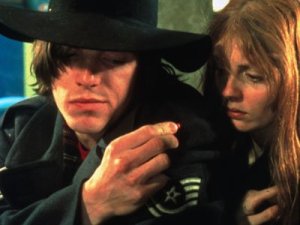
Joe With Friend
Like many films released in the early 70s, Joe is distinguished by a continually shifting tone. The film’s opening (which feature Susan Sarandon getting naked and then watching her disturbingly unhygienic boyfriend shooting up) feels almost like it’s composed of outtakes from some lost Andy Warhol Factory film while the scenes immediately following Melissa’s drug overdose feel like a melodramatic Lifetime special. After Bill kills Frank, the film briefly becomes a Hitchcockian thriller just to then segue into heavy-handed social satire as we watch the development of Joe and Bill’s unlikely, hate-fueled friendship. The awkward comedy continues for a while until, somewhat jarringly, Joe suddenly becomes a violent revenge film. While many films have been doomed by the lack of a consistent tone, it actually works here. Joe‘s odd mishmash of comedy, tragedy, and exploitation actually perfectly reflects the uncertain worldview and hidden fears of Bill Compton. Much as the audience is often times left uncertain whether they’re watching a comedy or a tragedy, Bill is a man who is no longer sure how to react to the world around him.
And make no doubt about it, Joe may be the title character but the film is truly about Bill Compton. It’s Bill’s repressed anger (and desire for his own daughter) that fuels the plot. As played by Dennis Patrick, Bill Compton is the type of smugly complacent figure whose outward confidence hides the fact that he’s been rendered impotent by the world changing around him. For the majority of the film, Bill looks down on both sides of the cultural divide, looking down on both his daughter’s hippie friends and his new blue-collar acquaintance Joe. (He assures his wife that Joe would never attempt to blackmail him because Joe “looks up” to him.) It’s only at the film’s conclusion that Bill realizes just how powerless he is to control anything. In those final scenes, Dennis Patrick’s face reveals what the audience has already figured out. By trying to place himself above it all, he’s left himself with nowhere to go.
Dennis Patrick (left) and Peter Boyle
That said, the film truly is dominated by Peter Boyle’s demonic performance as Joe. For much of the movie, Joe is a buffoonish figure (he even gets his own mocking theme song “Hey Joe” which plays as he wanders around his house and scratches his navel) and it’s sometimes hard not to feel like you’re watching a long-lost episode of Everybody Loves Raymond where Frank Barone remembers the time that he killed a lot of hippies. However, once Bill and Joe find themselves searching for Melissa among the hippies, Boyle slowly starts to pull back the layers and a new, far more threatening Joe emerges. By the end of the film, Joe has become a nightmarish figure and we’re forced to reconsider everything that we’ve previously assumed. By the film’s end, Joe almost seems to be a direct personification of Bill’s Id, a man who exists solely to force Bill to do what he’s always secretly wanted to do.*
When Joe was first released back in 1970, it apparently made a lot of money, generated a lot of controversy, and even managed to score an Oscar nomination for best original screenplay. Oscar nomination aside, Joe is the epitome of a well-made and effective exploitation film. While Joe and Bill are basically counter-culture nightmares of a murderous American establishment, the film’s hippies are portrayed as being so smug and so scummy that I’m not surprised to read that apparently audiences cheered once Joe and Bill started gunning them down. (Peter Boyle, however, was apparently so shocked that he swore he would never make another film that “glamorized violence.”) By embracing the best traditions of the grindhouse and attempting to appeal to both sides of the cultural divide in the crudest way possible, the filmmakers ended up making a film that, over 40 years later, somehow feels more honest than most of the other “generation gap” films of the 60s and 70s.
As any film lover knows, any film made between 1966 and 1978 tends to age terribly, to the extent that often times they’re impossible to take seriously when watched today. (And anyone who doubts me on this should track down films like R.P.M, Thank God It’s Friday, Skatetown U.S.A., Getting Straight, and Zabriskie Point.) However, watched today in our present age of Occupiers and Tea Partiers, Joe still feels relevent and, at times, downright prophetic.
—-
* In many ways, Joe Curran is a cruder, balder version of Tyler Durden.

 Through the Shattered Lens