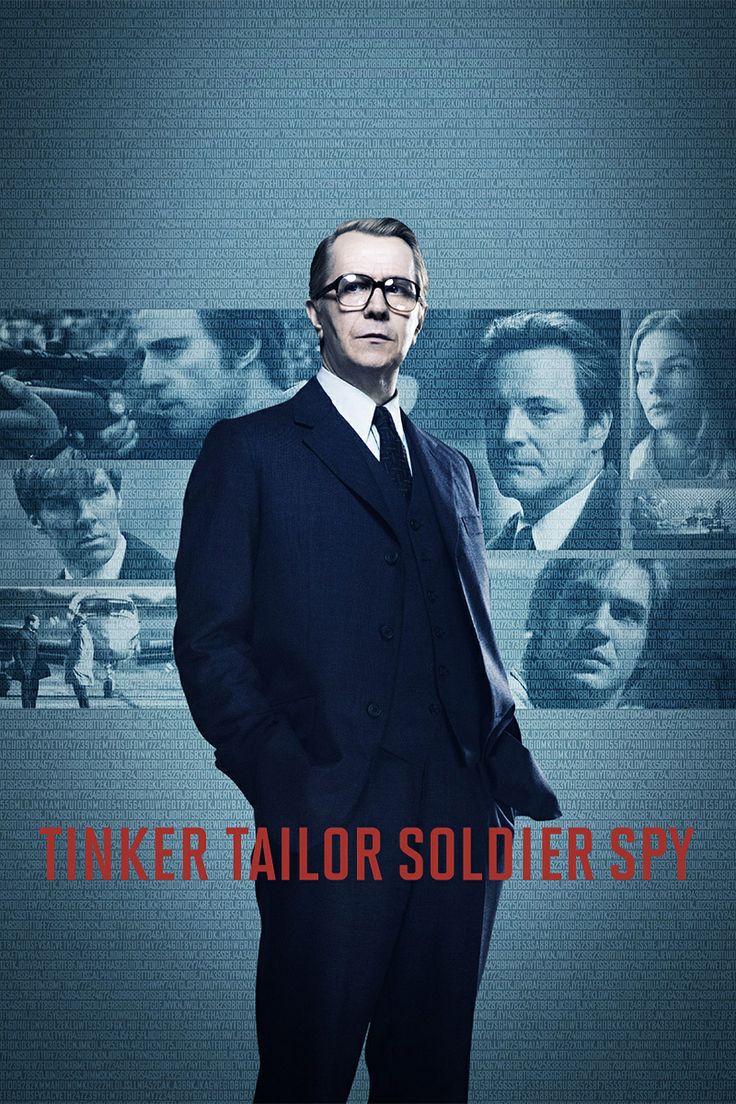
Review: Tinker Tailor Soldier Spy (dir. by Tomas Alfredson)


“We are not so very different, you and I.” — George Smiley

Tomas Alfredson’s Tinker Tailor Soldier Spy (2011) is a cold, coiled, and relentless march into the gray, rain-lashed corridors of British espionage—a film that exchanges Bond’s swagger for bureaucratic unease, where information is traded like poison and every conversation feels weaponized. The film is sheer confidence: so sure of itself, it expects you to keep up, get lost, and piece the puzzle together from the hushed fragments left in close-up reactions and glances across smoke-filled rooms. This is spy cinema not as spectacle, but as slow-burning existential puzzle.

A key element of the film’s mood is its distinctive brutalist aesthetic, which powerfully evokes the Cold War mentality not only behind the Iron Curtain but also in the West. Alfredson and cinematographer Hoyte van Hoytema immerse viewers in a London setting defined by greying, tired walls, bleak drizzle, and decaying interiors that feel as cold and institutional as the very espionage world they depict. This use of brutalism—with its bare concrete textures, utilitarian spaces, and sense of institutional decay—does more than create atmosphere; it visually projects the emotional and material exhaustion of a Britain entrenched in paranoia and internal rot. The characters seem physically and emotionally hemmed in by these spaces, reinforcing the film’s themes of secrecy, alienation, and moral corrosion.

There are no car chases or shootouts to speak of—just a masterclass in stillness where tension arises from precisely what remains unspoken. The film is closer to an autopsy than a thriller, dissecting the social and emotional costs of lives devoted to deception. It begins with a botched operation in Budapest—Jim Prideaux (Mark Strong), one of “the Circus’s” best agents, is captured in a tense, almost wordless scene that sets a tone of brooding unease. The fallout leads to a purge of the leadership, with Control (John Hurt) forced out and George Smiley (Gary Oldman), his quietly watchful confidant, retired—though soon to return for an unofficial mole hunt.

From there, the narrative unfolds elliptically, like a mosaic of recollections and betrayals, requiring viewers to assemble the truth from fractured glimpses. Gary Oldman’s Smiley is the film’s anchor—his performance a masterclass in minimalism and subtext. He’s the ultimate observer, haunted by decades of institutional compromises and personal betrayals.

The supporting cast is nothing short of exceptional, elevating the film through richly textured performances that bring vibrant life to an otherwise reserved script. Colin Firth as Bill Haydon delivers a quietly magnetic portrayal, his charm barely concealing the complexity beneath. Tom Hardy’s Ricki Tarr injects raw energy and restlessness, perfectly contrasting the film’s restrained atmosphere. Benedict Cumberbatch’s Peter Guillam is adept at conveying subtle shifts in allegiance and tension, his nuanced portrayal deepening the intrigue. John Hurt’s brief but potent presence as Control exudes weary gravitas, setting the tone for the murky world of espionage. Mark Strong as Jim Prideaux balances stoicism with vulnerable humanity, particularly in moments laden with pain and regret. Other supporting actors such as Ciarán Hinds, Toby Jones, and Kathy Burke contribute layered, compelling portrayals of individuals trapped within the machinery of the Circus. What binds these performances is a reliance on subtlety—expressing volumes through nuanced gestures and lingering silences, the cast anchors the complex narrative in a palpable human reality.

At its core, Tinker Tailor Soldier Spy is less a whodunnit than an exploration of institutional decay and emotional repression. The brutalist aesthetic mirrors this decline: just as the concrete and ochre walls close in on the agents, so too does the film reveal a Britain worn down by secrets and internal contradiction. Love and loyalty are liabilities in this world where everyone is alienated. The story’s emotional heart revolves around the search for a deeply embedded mole within the Circus—an elusive betrayal that shakes the organization to its core. The film carefully avoids easy reveals, maintaining a deliberate tension and exemplifying the emotional cost that the espionage game of the era had on everyone involved.

The film also explores themes of repressed queerness, class stratification, and misogyny, linking these to the numbing demands of espionage. The gloomy visuals and tightly controlled dialogue echo the emotional constraints on these men, underscoring that beneath the seemingly impenetrable exterior lies a fragile, fragile human cost.

This film is not an easy watch. Its elliptical storytelling, coded conversations, and subtle body language demand patience and multiple viewings. Yet that opacity is part of its power—uncertainty and not-knowing become central to the experience, enhanced by Alberto Iglesias’s restrained score and the claustrophobic mise-en-scène. Unlike many spy films, Tinker Tailor Soldier Spy is about process and detection, not action or glamour. Its cold, meticulous pacing trades on the cerebral seduction of uncovering hidden truths rather than adrenaline-fueled confrontations.

Ultimately, the film refuses easy resolutions. Though Smiley uncovers the mole and the Circus is superficially restored, there’s no real victory—only the acknowledgment of profound damage, both personal and institutional. The brutalist setting, with its unyielding, somber lines, stands as a perfect metaphor for this unresolved tension. Tinker Tailor Soldier Spy is a masterclass in unease and ambiguity, a film that stays with you because it reveals what you’ll never fully know about loyalty, betrayal, and the cost of secrets in a world where the line between friend and enemy is always blurred.
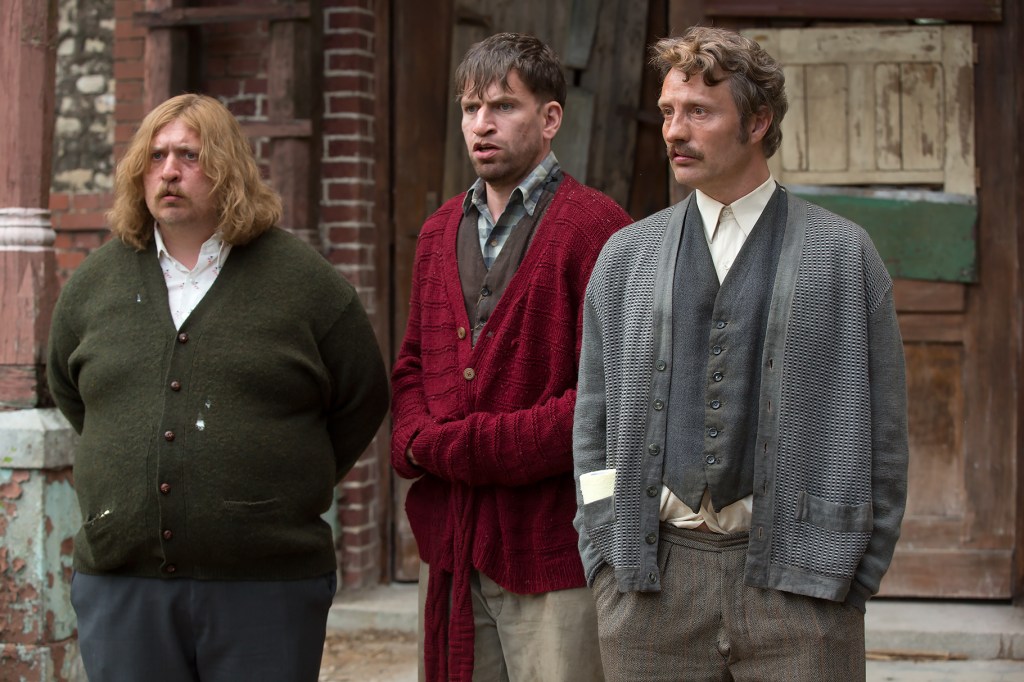
Brad reviews MEN & CHICKEN (2015), starring Mads Mikkelsen!


MEN & CHICKEN (2015) is the story of two estranged, and flat out strange, brothers, Gabriel (David Dencik) and Elias (Mads Mikkelsen), who find out a family secret when their father passes away. It turns out that their “dad” is not their biological father, so the two brothers head out to find their real one. They know he’s a reclusive scientist named Evelio Thanatos, and that he lives on a remote island. When they arrive on his island, they meet their three half-brothers Josef (Nicolas Bro), Gregor (Nikolaj Lie Kaas) and Franz (Soren Malling), who are some real weirdos, and who are prone to violently beat visitors in the head with heavy cookware and stuffed beavers. After taking a couple of beatings from their brothers, Gabriel and Elias are able to work their way into their family’s dilapidated mansion where they find that it is filled with chickens, pigs and a bull named Isak. This is a strange group, with each brother exhibiting certain physical abnormalities and odd behaviors. There’s something dark going on here… and why won’t their new brothers let Gabriel and Elias meet their dad, who apparently sleeps all day in an upstairs room? The remainder of the film deals with the brothers getting to know each other and discovering their family’s deep, dark, animalistic secrets!

I’ve presented a plot summary of MEN & CHICKEN above, but no summary can really do this film justice. It’s a film that has to be seen to be believed. The first thing I really noted about the film is its complete commitment to its weird tone and a twisted sense of humor. We meet Mikkelsen’s character Elias on the most awkward date ever, which he follows up by going to the bathroom and immediately masturbating. We soon learn that masturbating is just something he always has to do. The way his brother accepts the behavior as if it’s no different than him tying his shoes is odd and funny at the same time. There’s also a sight gag early in the film where Gabriel is watching from afar as his brother is being beaten repeatedly in the head by kitchen pots the size of bathtubs that made me laugh out loud. Of course, it’s meant to be funny, but the film’s visuals are also realistic enough that when we see Elias up close his face is a bloody mess! I haven’t watched a lot of Danish films in my life, but I’m starting to get a sense of just how twisted their senses of humor can get! Director and writer Anders Thomas Jensen is somehow able to balance the dark comedy of his setup, the strange nature of the characters he’s created, and the grotesque, horrific visuals that we see inside their family home in a way that’s both absurd and increasingly poignant as the film continues on. I’m so used to movies that follow the same plot points and formulas, but Jensen’s films are wildly unpredictable. You truly never know what you’re about to see next, to both good and bad effect, but it’s definitely not boring!

Mads Mikkelsen is incredible as brother Elias. This role could not possibly be farther away from his repressed badass in Jensen’s RIDERS OF JUSTICE, but you can’t take your eyes off of him. As odd and repulsive as his character can be, the actor’s instincts for absurd comedy are perfectly on display and he’s incredible. I also liked actor David Dencik as his brother Gabriel. His more “normal” character grounds the film as all sorts of craziness is going on around him. They complement each other well. I also recognized Nikolaj Lie Kaas and Nicolas Bro as two of the odd brothers, who were also in RIDERS OF JUSTICE. It’s fun seeing Jensen’s stock players in such unique and versatile performances.

After having now watched Jensen’s films MEN & CHICKEN and RIDERS OF JUSTICE, one of the things I’m picking up on is his ability to create an endearing “family” out of almost any kind of circumstances. These are some of the most strange and troubled people that you will ever see on screen, but beneath the perversity of it all, a theme emerges on the power and acceptance that can be experienced inside of a family, and, ultimately, on the nature of humanity itself. It may not be altogether realistic, but there’s an idealism and hope that resonates with me. 

As I wrap this up, let me just say that MEN & CHICKEN is not for everyone, so I can’t recommend it wholeheartedly. It goes to some deep, dark places in both its humor and the revelation of their dad’s disturbing scientific experiments. However, adventurous viewers with a perverse sense of humor and a willingness to follow a story wherever it may lead will be rewarded by this wholly unique film. A 25 year old me would have probably not been a fan, but 50+ year old me thinks it’s great!!

Film Review: The Snowman (dir by Tomas Alfredson)


So, I finally watched the 2018 thriller, The Snowman, and my main reaction to the film is that it featured a lot of snow.

That’s understandable, of course.  The film takes place in Norway and it’s called The Snowman so, naturally, I wasn’t expecting a lot of sunshine.  Still, after a while, the constant shots of the snow-covered landscape start to feel like almost some sort of an inside joke.  It’s almost as if the film is daring you to try to find one blade of grass in Norway.  Of course, the snow is important because the film’s about a serial killer who builds snowmen at the sites of his crimes.  They’re usually pretty big snowmen as well.  It’s hard not to be a little impressed by the fact that he could apparently make such impressive snowmen without anyone noticing.

Along with the snow, the other thing that I noticed about this movie is that apparently no one knows how to flip a light switch in Norway.  This is one of those films where every scene seems to take place in a dark room.  I found myself worrying about everyone’s eyesight and I was surprised the everyone in the film wasn’t wearing glasses.  I can only imagine how much strain that puts on the eyes when you’re constantly trying to read and look for clues in the dark.

Michael Fassbender plays Harry Hole, a Norwegian police inspector who may be troubled but still gets results!  He’s upset because his ex-girlfriend (Charlotte Gainsbourg) has a new boyfriend (Jonas Karlsson).  He’s also upset because his son (Michael Yates) doesn’t know that Harry is actually his father.  Or, at least, I think that Harry’s upset.  It’s hard to tell because Fassbender gives a performance that’s almost as cold as the snow covering the Norwegian ground.  Of course, he’s always watchable because he’s Fassbender.  But, overall, he doesn’t seem to be particularly invested in either the role or the film.

Harry and his new partner (Rebecca Ferguson) are investigating a missing person’s case, which quickly turns into a multiple murder mystery.  It turns out that the crimes are linked to a bunch of old murders, all of which were investigated by a detective named Gert Rafto (Val Kilmer).  Gert was troubled but he still got results!  Or, at least, Harry thinks that he may have gotten results.  Nine years ago, Rafto died under mysterious circumstances…

Now, I have to admit that when, 30 minutes into the film, the words “9 years earlier” flashed on the screen, I groaned a bit.  I mean, it seemed to me that the movie was already slow enough without tossing in a bunch of flashbacks.  However, I quickly came to look forward to those brief flashbacks, mostly because they featured Val Kilmer in total IDGAF mode.  Kilmer stumbles through the flashbacks, complete with messy hair and a look of genuine snarky bemusement on his face.  Kilmer gives such a weird and self-amused performance that his brief scenes are the highlight of the film.

Before it was released, The Snowman was hyped as a potential Oscar contender.  After the movie came out and got roasted by the critics, director Tomas Alfredson replied that the studio forced him to rush through the production and that 10 to 15% of the script went unfilmed.  Considering Alfredson’s superior work on Let The Right One In and Tinker, Tailor, Soldier, Spy, I’m inclined to give him the benefit of the doubt.  The film’s disjointed style would certainly seem to back up Alfredson’s claim that there was originally meant to be more to the film than actually ended up on the screen.

The Snowman is one of those films that doesn’t seem to be sure what it wants to be.  At times, it aspires to David Lynch-style surrealism while, at other times, it seems to be borrowing from the morally ambiguous crime films of Taylor Sheridan.  Ultimately, it’s a confused film that doesn’t seem to have much reason for existing.  At the same time, I’ve also been told that the Jo Nesbø novel upon which the movie is based is excellent.  The same author also wrote the novel that served as the basis for 2011’s Headhunters, which was pretty damn good.  So, read the book and ignore the film.