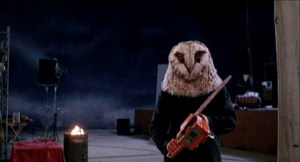
Warrior Queen (1987, directed by Chuck Vincent)


The place is Pompeii in the year 79 A.D.

One of the jewels of the Roman Empire, Pompeii is overseen by the decadent Clodius Flaucus (Donald Pleasence).  Despite the warning that the statues of the Temple of Jupiter have been crying salt and that a goat was recently born with the head of a human, Clodius refuses to believe that anything bad could happen to Pompeii.  (“I’d like to see the cow!” Clodius exclaims with  a laugh.)

In the arena, the gladiator Goliath (Marco Tullio Cau) throws deadly frisbees and demands slave girls as his reward for victory.  In the streets, all the women adore Marcus (Rick Hill) but he has eyes only for one of the new slaves, the comely virgin Vespa (Tally Chanel).  Vespa has been purchased by Berenice (Sybil Danning), a former mistress of Caesar who is secretly working to free the slaves.

Warrior Queen was directed by Chuck Vincent.  Vincent was a veteran of the adult film industry and was considered to be one of the best hardcore directors around.  His X-rated films were even positively written up in the New York Times.  In the 80s, he tried to go mainstream and ended up making movies like this one.  Produced by British B-movie impresario Harry Alan Towers and filmed largely in Italy, Warrior Queen was an attempt to capitalize on the minor sword-and-sorcery revival that followed the success of Conan the Barbarian.  There’s plenty of nudity and violence but there’s not much plot and the film feels much longer than its 70-minute run time.  When the volcano does erupt, it’s represented by stock footage and someone shaking the camera while filming the extras.  Pompeii has never looked so cheap.

The main attraction here is Sybil Danning and Donald Pleasence.  Pleasence gives it his all and earns however much he made for this movie.  Danning is only in a handful of scenes and can be seen yawning at several points in the movie.  I think she’s supposed to be the title character but she’s actually neither a warrior nor a queen.  Rick Hill (of Deathstalker fame) and Tally Chanel are at least appealing as the leads, even if Chanel looks more like a lost cheerleader than a Roman slave girl.

The main thing that I learned from watching this film is that the lava that hit Pompeii wasn’t actually that thick, wide, or deep and everyone should have been able to just hop over it and escape.  Anyone who died at Pompeii has no one but themselves to blame.
The TSL Grindhouse: Casablanca Express (dir by Sergio Martino)


First released in 1989, Casablanca Express takes place during World War II.

The three leaders of the Allied nations — Franklin D. Roosevelt, Joseph Stalin, and Winston Churchill — are scheduled to meet in Casablanca to plan the Allied strategy for the next phase of the war.  Churchill insists that he will take a train from Algiers to Casablanca, despite the danger that might put him in.  Even though everyone advises him against it, Churchill is determined.  He makes it clear that he will be traveling by train.

When Major Valmore (Jean Sorel), Colonel Bats (Donald Pleasence), and Maj. Gen. Williams (Glenn Ford) learn that the Germans are aware that Churchill will be on the train and that they will be sending their own intelligence agents to try to kidnap or even assassinate him, they assign three intelligence agents to travel with Churchill.  The agents are Alan Cooper (Jason Connery), Captain Franchetti (Francesco Quinn), and Lt. Lorna Fisher (Jinny Steffan) and they are under orders to do whatever is necessary to protect Churchill’s life.  Unfortunately, Cooper gets so busy chasing after a French double agent that he misses the train’s departure time.  When Otto van Tiblis (Manfred Lehmann) makes his move to take over the train, it falls to Franchetti and Lorna to stop him.  Despite their best efforts, they fail.  Now, it appears that Churchill’s only hope is that Cooper will not only be able to reach the train but also defeat the army of Germans who have taken it over.

Directed by Sergio Martino, Casablanca Express is an Italian film that owes quite a bit to the legacy of writers like Ian Fleming and Jack Higgins.  The plot to capture Churchill owes more than a bit to The Eagles Has Landed, right down to one of the film’s final twists and Donald Pleasence making a cameo appearance as an authority figure.  Alan Cooper is a combination of James Bond and Indiana Jones.  He’s just as comfortable in a suit and tie as he is riding a camel across the desert.  Sergio Martino was one of the best directors of Italian genre films.  He dabbled in everything, from giallo films to Hercules films to crime films to cannibal films to action films like this one.  As a filmmaker, he was efficient and quick to get to the point.  The action in Casablanca Express moves quickly.  In fact, it moves so quickly that the audience often doesn’t have time to consider all of the plot holes.  Martino knows better than to worry about authenticity.  That’s not the type of film that Casablanca Express is.

The film stars Jason Connery and Francesco Quinn, the sons of Sean Connery and Anthony Quinn.  They are both adequate in their roles, even though neither one of them has quite the screen presence of their famous fathers.  Jason Connery is handsome and he looks good in a suit and Francesco Quinn looks good throwing a punch.  That’s all that’s really required of them.  Personally, my favorite character was Lorna Fisher, who fought the Nazis by distracting them with her legs.  That would be my strategy as well so I’m glad to see that it worked here.

Casablanca Express was made at a time when the Italian film industry was going through a down period.  Hence, the budget is low and the film can sometimes seem a bit rushed.  But, all in all, it’s an entertaining B-action movie.

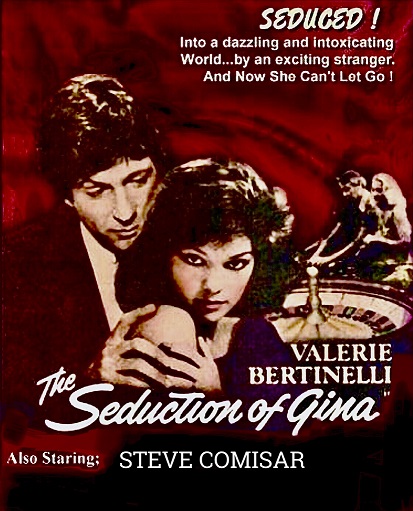
Retro Television Reviews: The Seduction of Gina (dir by Jerrold Freedman)


Welcome to Retro Television Reviews, a feature where we review some of our favorite and least favorite shows of the past!  On Sundays, I will be reviewing the made-for-television movies that used to be a primetime mainstay.  Today’s film is 1984’s The Seduction of Gina.  It  can be viewed on Tubi!

Gina (played by Valerie Bertinelli) is bored.

She’s a 20 year-old newlywed who spends her days going to college and her nights sitting in a tiny apartment and waiting for her husband, David (Fredric Lehne), to come home.  David is an intern at a hospital.  He works the nightshift and, as a result, he’s usually exhausted and not particularly communicative.  Unlike her husband, Gina comes from a wealthy family and she’s due to inherit a good deal of money as soon as she turns 21.  However, David stubbornly refuses to use any of Gina’s money to make either of their lives better.  He gets angry when Gina even mentions the possibility.  He’s prepared to spend the next ten years living in a crummy apartment and working terrible hours.  Once he establishes himself as a doctor, he says that he and Gina can start to think about starting a family.  Are you getting the feeling that David has control issues?  Because that’s definitely the feeling that I got from him.

Bored and frustrated, Gina turns to gambling.  Who can blame her?  Not only is it a way to make some money and bring some excitement into her life but it’s also something that she’s really good at!  She starts out just putting bets on horse races.  (The owner of a nearby bodega is also a bookie.)  She uses the money to buy a new television set, which David totally freaks out about.  Soon, Gina is sneaking off to Lake Tahoe.  While David works at the hospital, Gina hits the blackjack table and spins the roulette wheel.  She even attracts the eye of Keith Sindell (Michael Brandon), a handsome lawyer who loans her money and obviously has an interest in her that goes beyond card games.  Every morning, she jumps in her car and rushes back to San Francisco, arriving at her apartment before David gets home and lying to David about what she’s been doing all night.

It starts out well but this wouldn’t be a TV movie if there wasn’t a bit of drama.  Unfortunately, Gina’s luck starts to change and she soon finds herself in debt.  The owner of that bodega is a lot less nice when he’s demanding his money.  And Keith might be willing to cheat on his wife with her but he still expects her to pay back the money that he’s given her.  The world of gambling turns out to be harsh and unforgiving.  Gina is forced to find ways to get the money.  If that means lying to her husband, her father (played by Ed Lauter), and her accountant, so be it.  She might even have to — gasp! — get a job as a cocktail waitress!

It’s obvious from the start that Gina is going to get into trouble, or at least it’s obvious to everyone but Gina.  And really, isn’t that the way life is sometimes?  Usually, the only person who can’t see the walls closing in is the person who is about to get crushed.  The Seduction of Gina is melodramatic and predictable but Valerie Bertinelli is likable in the role of Gina and the scenes in casino are enjoyably gaudy and a little bit sordid.  It’s an entertaining movie, a Lifetime film that came out before Lifetime.  The film’s message is not to gamble but The Seduction of Gina makes winning look like so much fun that it probably inspired more people to hit the casinos than to stay at home and balance the checkbook.  In the classic DeMille fashion, this film offers both sin and a hint of salvation but it understands that sin is more entertaining to watch.

Italian Horror Showcase: Beyond Darkness (dir by Claudio Fragasso)


In 1981, The Evil Dead was released in Italy as La Casa.

In 1987, Evil Dead II was released in Italy as La Casa 2.

In 1988, La Casa 3 was released in Italy and retitled Ghosthouse for distribution in America and the UK.

That same year, La Casa 4 was also released in Italy and it was called Witchery in America.

And then, finally, 1990 saw the release of La Casa 5.

Directed by Claudio Fragasso (who, outside of Italy, is probably best known for directing Troll 2), La Casa 5 was also known as Beyond Darkness* and it was the third “unofficial” Italian sequel to Evil Dead.  Like both Ghosthouse and Witchery, it actually has nothing to do with any of the Evil Dead films.  Instead, it plays out more like a weird mix of Poltergeist and The Exorcist.

Let’s say that you’re an aging clergyman and you’re living in a house that appears to be haunted by the ghosts of several dead witches.  Despite your own faith, you haven’t been able to exorcise their evil spirits.  What should you do!?  When Rev. Jonathan (Steven Brown) finds himself in that situation, his solution is to sell the house to one of his former students, Rev. Peter (Gene LeBrock).  Jonathan figures that Peter’s faith is so strong that he’ll be able to exorcise the house in no time!  Of course, Jonathan doesn’t actually bother to tell Peter that the house is possessed by evil.  Instead, Jonathan just lets Peter and his family discover that on their own.

And discover that they do, as the house quickly reveals itself to be haunted.  Meat cleavers fly across rooms.  Radios make strange noises.  Dishes are shattered.  A strange group of black-shrouded women are spotted hanging around upstairs.  It might have something to do with the big black swan statute that’s sitting in the kid’s room.  Or maybe it has something to do with the strange light that’s streaming out of one of the closets.  Eventually, Peter’s son gets sucked into the netherworld and, when he returns, he’s not only possessed but he keeps trying to kidnap Peter’s daughter as well!

Despite being told to avoid him, Rev. Peter is eventually forced to turn to another of Rev. Jonathan’s students, Father George (David Brandon).  Ever since he was forced to spend time with a serial killer who ate children, George has been struggling with his faith.  Will George be strong enough to help Peter exorcise the demon that has possessed his son?

(Incidentally, Peter’s son is played by Micheal Stephenson, who also starred in Troll 2 and who more recently directed the documentary about that film, Best Worst Movie.)

Watch and find out what happens!  Or don’t.  Actually,if you’ve seen The Amityville Horror, The Exorcist, or Poltergeist, you’ll be able to guess everything that happens in this film.  Even the final twist has been borrowed from countless other horror films.  The presence of Claudio Fragasso in the director’s chair might tempt some to watch this in the expectation that it’ll be another “WTF!?” romp like Troll 2 but Beyond Darkness is actually pretty dull.

Beyond Darkness was the last Italian entry in the La Casa franchise but it was not the last La Casa film.  When the American horror film House II was released in Italy, it was retitled La Casa 6.  This was followed by La Casa 7, which was actually an American slasher film called The Horror Show.

And with that, the La Casa series finally ended.

* While we’re on the topic of titles, Beyond Darkness should not be confused with 1979’s brilliant Buio Omega, which was released in English-speaking territories as Beyond The Darkness and which was directed, under the pseudonym Joe D’Amato, by Aristide Massaccesi.

Horror Film Review: Delirium (dir by Lamberto Bava)


Delirium1987

“I warn you, the hate of a woman can be very bad!” 

— Dialogue from Delirium (1987

The 1987 Italian film Delirium is an odd combination of soapy melodrama and giallo horror.  Someone is murdering models and taking pictures of their corpses.  Some other people are plotting to take over a magazine.  Obscene phone calls are received.  Recorded taunts are heard.  Oh, and one unlucky model is attacked by a swarm of bees.

That’s right — Delirium is the first and probably the only giallo to feature bees used as a deadly weapon.

Gioia (Serena Grande) is a former prostitute-turned-model-turned-men’s-magazine-publisher.  When we first meet Gioia, she’s sitting out at her pool and watching a photo shoot.  Her neighbor — a teenage boy who is confined to a wheel chair — calls her.

“You make my member hard with desire!” he tells her, “It wants to penetrate your flower and explode!”

Gioia calmly tells him to stop bothering her and then hangs up on him.  And really, this scene pretty much establishes everything that we need to know about Gioia.  She is a successful businesswoman who is just as comfortable dealing with the pervert next door as she is making high power deals.  You think Donald Trump’s ruthless?  Well, he’s got nothing on Gioia!

The other thing that you notice about Gioia is that she has an extremely voluptuous figure.  There’s not a single scene that isn’t shot to emphasize that fact and yet, the unapologetic pride that Gioia (and actress Serena Grande) took in her body was actually very empowering and one of the better aspects of the film.  Far too often, movies associate being busty with either being stupid or slutty and women are told that they have to hide their figure to be taken seriously.  (Traditionally, in horror films, it seems like the bigger an actress’s cup size, the less likely she is to survive until the end of the film.)  Speaking as someone who shares Gioia’s struggle, I was happy to see a woman with big boobs being portrayed as both an intelligent businesswoman and a tough, strong survivor.

Gioia has more than just the pervert next door to deal with.  There’s also the fact that her models are being murdered and she’s receiving photos of their dead bodies in the mail.  Who is killing Gioia’s employees?  Could it be a rival publisher (played by Capucine)?  Could it be Gioia’s neurotic assistant (played by Daria Nicolodi)?  Could it be George Eastman, who plays Gioia’s former lover?  Actually, it’s made pretty clear that it’s not George Eastman, which is odd when you consider how many movies have featured Eastman as a killer.  (Eastman and Grandi also co-starred in the infamous cannibal epic Anthropophagus, in which Eastman was the killer and Grandi was the center of one of the most infamous scenes in the history of Italian horror.)  Or could the killer by the pervert next door?

As is typical of films in the giallo genre, most of the murders are filmed from the killer’s point of view.  What’s interesting is that, when the killer looks at his victims, he literally sees them as twisted monsters.  It’s a neat little technique that leads to scenes like this:

Delirium-1

Delirium was directed by Lamberto Bava, who has never quite gotten the attention that he deserves.  Despite the fact that he directed such classics as the two Demons films and A Blade In the Dark, I’ve always felt that Lamberto is often overshadowed by the achievements of his father, Mario Bava.  However, Lamberto Bava’s films are almost always entertaining when taken on their own terms.  Delirium may not reach the heights of A Blade In The Dark or even Demons but it’s still an entertaining giallo.  It’s perhaps not the film to use to introduce a newcomer to the genre but, those of us who are familiar with giallo, Delirium is an enjoyably crazed offering.

fotodigioia7

A Quickie With Lisa Marie: Stagefright (dir. by Michele Soavi)


Director Michele Soavi is probably best known for directing the last great Italian horror film, Dellamorte Dellamore.  However, his word in that film has been so praised that, to a certain extent, Soavi’s earlier horror films have been overshadowed.  This is a shame because Soavi was (and is) a great director and — before he temporarily retired from films in the mid-1990s — he directed four of the greatest Italian horror films ever made.  The first of these films (and Soavi’s directorial debut) was the 1987 slasher film Stagefright.

As written by Luigi Montefiore (who, as an actor, was better known as George Eastman), Stagefright’s basic story function almost as a parody of a stereotypical 80s slasher film.  On a dark and stormy night, an eg0-crazed, cocaine-addicted theatrical director (played by David Brandon) is running a rehearsal for his latest show, a campy musical about a fictional serial killer.  However, even as his cast performs fictional mayhem on stage, a real killer escapes from a nearby mental hospital and makes his way to the theater.  After the real killer murders the production’s wardrobe mistress, the director decides it would be a brilliant idea to rewrite his show to make it about the real killer.  Not realizing that the real killer has snuck into the building, the director secretly locks his cast inside the theater and forces them to rehearse his new show.  As you can probably guess, mayhem ensues and blood (a lot of blood) is spilled.

That the film worked (and continues to work over 20 years later) is a tribute to the talent of Michele Soavi.  Obviously understanding that he was working with a genre piece, Soavi embraced the expectations of the slasher film and then pushed those expectations as far as he could.  The end result is a film that works as both an old school slasher film and as a commentary, of sorts, on the genre as a whole.  Soavi’s camera prowls every corner of the film’s theater, creating an atmosphere of truly claustrophobic dread.  To me, the most effective thing about the film is that, for once, our victims actually do the smart thing.  They stick together and try to fight off the killer as a group.  And they end up failing miserably in a scene of horrific choas that shows Soavi at his best.

Soavi started his career as an actor and appeared in a countless number of Italian horror films in the late 70s and early 80s.  (For whatever reason, Soavi always seemed to be getting killed in some awful way…)  Perhaps that’s why, of all the great Italian horror directors, Soavi always seemed to have the best instincts when it came to casting.  For a slasher film, Stagefright is well-acted by a cast made up of horror regulars.  Barbara Cupisti is a properly likable protagonist in the role of “final girl” while the great Giovanni Lombardo Radice does good work in the small role of Brett, a flamboyantly gay actor.  However, the film is dominated by David Brandon who snorts cocaine and barks out orders as if the fate of the world depended upon it.

(Soavi, himself, appears in a small role as an ineffectual policeman who, while people are dying all around, is more concerned with whether or not anyone else agrees that he looks like James Dean.  And, it should be noted, there was a resemblance.)

As opposed to a lot of other directors involved with the Italian horror genre, Soavi had (and, I hope, still has) a genuine love of film and that love is obvious in his stylish direction here.  There’s something truly exhilarating about seeing a movie made by someone who is truly in love with the possibilities of film and, because of that love, has no fear of pushing genre “rules” to their  extreme.