Bonus Horror On The Lens: The Devil Bat (dir by Jean Yarborough)


Because today would have been Bela Lugosi’s birthday, it seems appropriate to showcase him in a bonus horror on the lens!

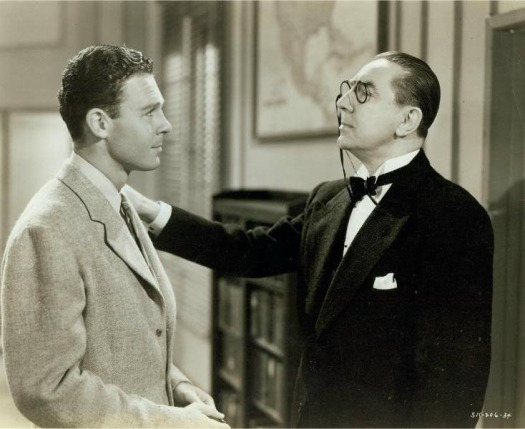
In the 1940 film, The Devil Bat, the owners of a company in the small town of Heathville are super-excited because they’re going to be given their head chemist, Dr. Paul Carruthers (Bela Lugosi), a bonus check of $5,000.  However, since Carruthers’s inventions have made millions for the company, he is offended by the small check and decides that the best way to handle this would be to sue in court and demand fair compensation …. just kidding!  Instead, Dr. Carruthers sends his army of giant bats to kill the families of his employers.

The Devil Bat was produced by Production Releasing Corporation, a poverty row studio that specialized in shooting quickly and cheaply.  Going from Universal to PRC was technically a step down for Lugosi but The Devil Bat is actually an excellent showcase for Lugosi and he gives one of his better non-Dracula performances as the embittered Dr. Carruthers.  Indeed, one can imagine that Lugosi, who played such a big role in putting Universal on the map, could relate to Carruthers and his bitterness over not being fairly rewarded for the work he did to make others wealthy.

Enjoy The Devil Bat, starring the great Bela Lugosi!

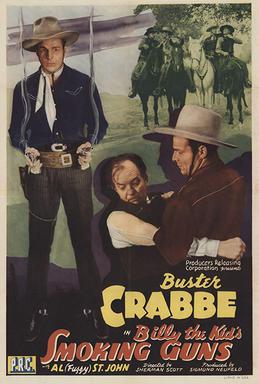
Billy The Kid’s Smoking Guns (1942, directed by Sam Newfield)


It’s a tale as old as time.  During the days when the west was wild, the U.S. Army is planning on setting up a new outpost near a town so the bad guys want to run all the ranchers off of their land so that they can be the ones to sell it.  Sheriff Carson (Ted Adams) is corrupt and working for the bad guys so the ranchers have to turn to Billy the Kid (Buster Crabbe) and his sidekicks, Jeff (Dave O’Brien) and Fuzzy (Al St. John) for help.  When Jeff is wounded in a fight, Fuzzy takes him to Doc Hagen (Milton Kibbee), little suspecting the doctor is actually the leader of the bad guys and using his medical practice to kill anyone who won’t give up their land!

Coming to us straight from Poverty Row, this B-western is interesting in that it seems to take a very cynical view of law enforcement.  Sheriff Carson is corrupt and Billy and his friends are running from the law themselves.  Buster Crabbe’s Billy the Kid films always kept it unclear why Billy was in trouble with the authorities.  Crabbe’s Billy the Kid always seemed to be the nicest guy in the west.  (Of course, Crabbe was also 33 and no longer seemed like he should have been known as “the Kid.”)  Eventually, the series was retconned and Buster Crabbe was no longer playing Billy the Kid but instead he was playing an upstanding citizen named Billy Carson.

Crabbe may not be a convincing outlaw but he is a convincing hero, which is all these films really required.  Billy the Kid’s Smoking Guns is a little bit interesting because of the character of Doc Hagen, whose occupation makes him a little more memorable than typical B-western bad guy.  The film is also interesting in that, for once, there’s no love interest.  Instead, it’s just men in hats shooting at each other.  That probably made the film’s youthful target audience happy.

The real-life Billy The Kid was killed when he was only 21 and after he had been an outlaw for only three years.  Buster Crabbe would g0 on to play Billy (or o some variation of Billy) until he was closing in on 40.


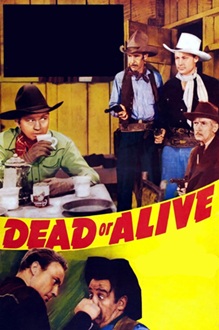
Dead Or Alive (1944, directed by Elmer Cifton)


In this Poverty Row western, the Texas Rangers, a trio of western do-gooders who appeared in a handful of films, are sent to a small town to stop the Yackey Gang, led by the town’s saloon keeper (Ray Bennett).

The Texas Rangers are led by Tex Haines (Tex Ritter), who is known as the Idaho Kid despite apparently being from Texas.  Tex goes undercover as a lawyer and tries to rally the community to stand up the Yackey Gang.  Tex also sings some songs because he’s a singing cowboy along with being a cowboy who can hold his own in bar brawl.  Maybe if he didn’t sing so much, there wouldn’t be as many brawls.  Dave Wyatt (Dave O’Brien) is the younger Ranger who goes undercover and joins that Yackey Gang.  Panhandle Perkins (Guy Wilkinson) is the comic relief, who loses a lot of money at Yackey’s casino but only to help Dave maintain his cover.  The film was an obvious rush job and the plot is far more difficult to follow than any 54-minute film should be.  The kids at the matinee probably enjoyed it, though.  It delivers exactly what fans of the old B-westerns expect, including Charles King as yet another villain.

Tex Ritter, who appeared in a lot of these films, was also the father of actor John Ritter.  In 1970, long after the days of the poverty row westerns, Tex Ritter ran for the Senate in Tennessee but he lost the primary.  If he had won, he would have been the Republican candidate against Al Gore’s father.  That would have been a battle for the ages.

Horror On The Lens: The Devil Bat (dir by Jean Yarborough)


In the 1940 film, The Devil Bat, the owners of a company in the small town of Heathville are super-excited because they’re going to be given their head chemist, Dr. Paul Carruthers (Bela Lugosi), a bonus check of $5,000.  However, since Carruthers’s inventions have made millions for the company, he is offended by the small check and decides that the best way to handle this would be to sue in court and demand fair compensation …. just kidding!  Instead, Dr. Carruthers sends his army of giant bats to kill the families of his employers.

The Devil Bat was produced by Production Releasing Corporation, a poverty row studio that specialized in shooting quickly and cheaply.  Going from Universal to PRC was technically a step down for Lugosi but The Devil Bat is actually an excellent showcase for Lugosi and he gives one of his better non-Dracula performances as the embittered Dr. Carruthers.  Indeed, one can imagine that Lugosi, who played such a big role in putting Universal on the map, could relate to Carruthers and his bitterness over not being fairly rewarded for the work he did to make others wealthy.

Enjoy The Devil Bat, starring the great Bela Lugosi!

Down Texas Way (1942, directed by Howard Bretherton)


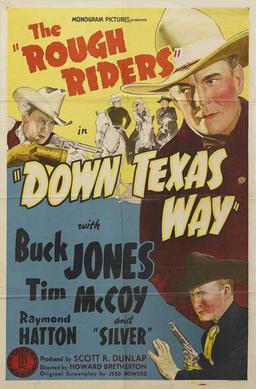
The sixth entry in the Rough Riders series finds Marshal Tim McCall (Tim McCoy) traveling from Wyoming to Texas so that he can help Sandy Hopkins (Raymond Hatton) celebrate his birthday.  When he arrives, he discovers that the birthday celebration is on hold because Sandy has been accused of murdering his best friend, John Dodge (Jack Daley).  Dodge was the richest man in town and the townspeople think that Sandy murdered him as a result of a disagreement over a card game.  What they don’t know is that Sandy and Dodge were only pretending to be mad at each other as a practical joke.

Dodge was really murdered by Bert Logan (Harry Woods), an outlaw who has hired an actress named Stella (Lois Austin) to pretend to be Dodge’s long-lost wife.  When all of Dodge’s property is given to Stella, Stella will then give it all to Dodge.  While Tim tries to keep the sheriff (Glenn Strange) from prosecuting Sandy, Marshal Buck Roberts (Buck Jones) goes undercover and infiltrates Logan’s gang.

After five previous films that just featured the Rough Riders talking about what their lives were like when they weren’t chasing outlaws, Down Texas Way shows us Sandy Hopkins’s life in Texas.  It’s about what you would expect.  Sandy likes to spend his time playing cards and hanging out in the lobby of his hotel.  It seems like an nice life, at least until Bert Logan tries to frame him for murder.  Luckily, the other Rough Riders are always there to have his back.  Down Texas Way is not one of the better Rough Riders films because Bert’s scheme never makes much sense but Hatton is relaxed and engaging and McCoy and Jones are their usual tough selves.  As with the previous film, the appeal of this Rough Riders film is the Rough Riders themselves and the way that they always stick together and have each other’s back.  That’s especially true in Down Texas Way, in which both Tim and Buck show that they’ll travel across several states if it means helping out a friend in a jam.

One final note, the town’s sheriff is named Trump, though I assume he’s no relation.  Glenn Strange, who played Sheriff Trump, would later play Frankenstein’s Monster in the last of the Universal horror movies.

Previous Rough Rider Reviews:

  1. Arizona Bound
  2. The Gunman From Bodie
  3. Forbidden Trails
  4. Below the Border
  5. Ghost Town

Forbidden Trails (1941, directed by Robert N. Bradbury)


Marshal Buck Roberts (Buck Jones) has finally retired after a long and a legendary career.  Two men who Buck arrested are not planning on allowing him to enjoy his retirement.  Having served their sentence for robbing a stagecoach, Fulton (Charles King) and Howard (Bud Osborne) are released from prison and head to Yucca City, Arizona.  They try to recruit their old partner, Jim Cramer (Dave O’Brien), into helping them get revenge on Buck but Cramer wants nothing to do with it.  He’s gone straight and is running his own general store with his fiancée, Mary (Christine McIntyre).  Cramer considers Buck to be a friend because Buck looked after Cramer’s children while Cramer was serving his sentence.

Fulton and Howard ambush Buck and nearly kill him.  With the help of his horse, Silver (of Lone Ranger fame), Buck is able to escape but he’s seriously injured.  His two fellow rough riders, Sandy Hopkins (Raymond Hatton) and Tim McCall (Tim McCoy), head down to Arizona to bring Fulton and Howard to justice.  (Sandy even rides away from his own wedding when he hears that Buck has been injured.)  While the Rough Riders search for Fulton and Howard, saloon owner Ed Nelson (Tris Coffin) works with the outlaws to steal a shipment of goods.

The third of the Rough Riders film, Forbidden Trails is memorable for acknowledging that the three Rough Riders were older than the most of the other contemporary western stars.  Buck Jones, Tim McCoy, and Raymond Hatton were all veteran stars who began their careers during the silent era and who transitioned to B-movies in the sound era.  At a time when their contemporaries were retiring, they were still appearing before the camera and riding the range.  Like the actor playing him, Buck Howard has reached the age when most people retire but he cannot escape his past.  Neither can Jim Cramer, who can’t live the law-abiding life that he desires as long as Fulton and Howard are free.  While Cramer has to escape from his former friends, Buck is lucky to have friends like McCall and Hopkins.  The movie showcases their loyalty and their friendship together and leaves no doubt that will never change, no matter how old the Rough Riders get.  Along with showcasing the friendship of its three stars, the movie is full of chases and gunfights.  The scene where Buck is ambushed is exiting and there’s also a good saloon shootout.  Jones and McCoy are as authentically western as ever.

Dave O’Brien and Christine McIntyre both appeared in the previous Rough Riders film but they’re playing different characters here.  Tris Coffin also played a similar crooked businessman in the first Rough Riders film, Arizona Bound.

Previous Rough Rider Reviews:

  1. Arizona Bound
  2. The Gunman From Bodie

Diamond Among the Coal: Bela Lugosi in BOWERY AT MIDNIGHT (Monogram 1942)


gary loggins's avatarcracked rear viewer


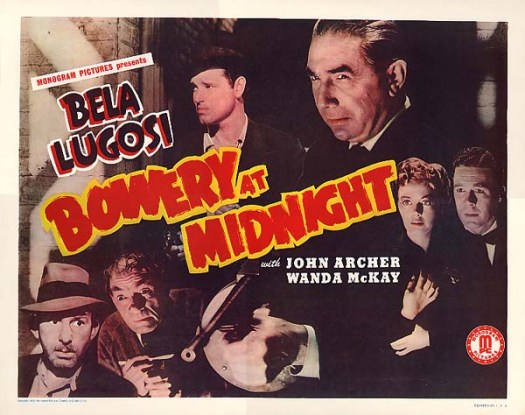
I’ve written about Bela Lugosi’s infamous ‘Monogram 9’ before, those ultra-cheap spectacles produced by the equally ultra-cheap Sam Katzman for low-budget Monogram Pictures. These films are all Grade Z schlock, redeemed only by Lugosi’s presence, giving his all no matter how ludicrous the scripts or cardboard the sets. BOWERY AT MIDNIGHT is a cut above; still schlock, but the pulpy premise is different from the rest, and Bela gives what’s probably his best performance out of the whole trashy bunch.

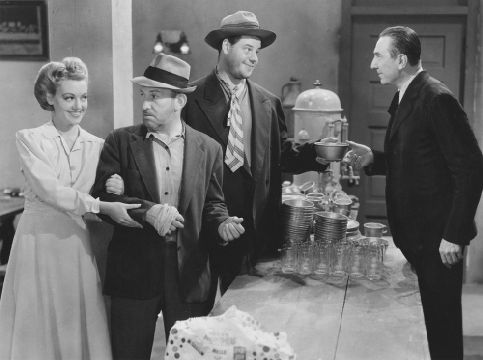
Lugosi plays kindly Karl Wagner, a benevolent soul who runs the Friendly Mission down on the Bowery. But wait – it’s all a front for recruiting down-on-their-luck criminals into Wagner’s gang of thieves. And when he’s done with them, he bumps them off and gives the corpses to ‘Doc’, a dope fiend ex-medico who uses the bodies for his own nefarious purposes!

But wait again! Wagner’s not really Wagner, he’s…

View original post 479 more words

The Fabulous Forties #38: The Devil Bat (dir by Jean Yarbrough)


1940_devil_bat_012

The 37th film in Mill Creek’s Fabulous Forties box set was 1940’s The Devil Bat, which Gary Loggins reviewed on this site back in October.  Since, for the most part, I agree with Gary’s review, I’m going to recommend that you go read it and then I’ll just add a few thoughts of my own.

The Devil Bat is usually described as being one of the films that Bela Lugosi made during his decline, even though he made it just a year after appearing in a supporting role in the Oscar-nominated Ninotchka.  Lugosi plays Dr. Paul Carruthers, a small-town chemist who uses radiation to create a gigantic bat that he unleashes on everyone who he feels has wronged him.  The bat targets anyone who makes the mistake of wearing an aftershave lotion that Carruthers has created.

I would argue that there is a hint of genius to be found within The Devil Bat.

First off, there’s the fact that the giant bat is so clearly fake that it actually becomes rather charming.  Wisely, the film makes no effort to convince you that the bat is real.  Whenever that big, fake bat is lowered in on a bunch of often-visible wires, it works as almost a Brechtian alienation device.  In much the same way that Godard used jump cuts in Breathless, Devil Bat uses that big, fake bat to remind the audience that they are watching a film.  As a result, the audience has no choice but to think about the conventions of the horror genre and how their own world view has been shaped by watching movies like Devil Bat.

The other hint of genius is the satirical masterstroke of casting Bela Lugosi as a small town chemist.  Lugosi remains Lugosi, regardless of what role he plays.  When the film’s characters accept, without even a second glance, that Bela Lugosi, with his thick accent and his theatrical acting style, is a humble suburbanite, the film becomes a perhaps inadvertent satire of American conformity.

Needless to say, Lugosi was always a far better actor than he has ever been given credit for being.  In The Devil Bat, he plays Dr. Carruthers with a weary sense of resignation.  Carruthers never becomes a standard evil villain.  Instead, he’s a man who has been so beaten down by life that he now see no other option beyond using a giant bat to kill those who he feels has betrayed him.  Much as he would in Ed Wood’s Bride of the Monster, Lugosi brings an almost redemptive sadness to his mad scientist.

The end result is that poor, misunderstood and underestimated Bela elevates the entire film.

db

The Fabulous Forties #33: Boys of the City (dir by Joseph H. Lewis)


Boysofthecity

The 33rd film in Mill Creek’s Fabulous Forties box set was 1940’s Boys of the City.

As a classic film lover, I have to admit that I groaned a bit when the opening credits announced that Boys of the City starred “East Side Kids.”  The East Side Kids were a group of actors who appeared in a number of B-movies from the 1930s through the 50s.  Many of the actors started out as members of the Dead End Kids and a few more were members of a group known as The Little Tough Guys.  In the 40s, they merged to become the East Side Kids and then eventually, once the East Side Kids started to hit their 30s, they became known as the Bowery Boys.  Their movies started out as tough and gritty melodramas but, by the time they were known as the Bowery Boys, they were making cartoonish comedies.  Occasionally, one of their films will show up on TCM.  Their early serious films (Dead End, Angels With Dirty Faces) remain watchable but, from what little I’ve seen of them, their later comedies appear to be damn near unbearable.

Boys of the City finds the East Side Kids in transition.  The kids still have an edge to them.  They are definitely portrayed as being juvenile delinquents who are walking a thin line between either a short life of crime or a long life of poverty.  But them film itself, while it may not be as cartoonish as the films that were to come in the future, is definitely a comedy.

Basically, the East Side Kids (Bobby Jordan, Leo Gorcey, Hal E. Chester, Frankie Burke, Sunshine Sammy, Donald Haines, David Gorcey, and Algy Williams) have been arrested for vandalism and are given a choice.  They can either go to juvenile hall or they can spend the summer at a camp in upstate New York.  Somewhat reluctantly (and hopefully remembering the unlucky fates of Humphrey Bogart in Dead End and James Cagney in Angels With Dirty Faces), the kids agree to go to the camp.

However, on the way to the camp, their car breaks down and they are forced to stay at the nearby home of a crooked judge (Forrest Taylor) until they can get the car repaired.  The judge, however, is killed and it’s up to the East Side Kids to solve the murder!  Was the judge killed by the gangsters that he was set to testify against?  Was he killed by his niece (Inna Gest)?  Or maybe it was his housekeeper, Agnes (Minerva Urecal, who appears to be parodying Judith Anderson’s performance in Rebecca)?  Or was he murdered by Knuckles (Dave O’Brien), who the judge wrongly sentenced to die and who, following his vindication and release from prison, has become a guardian to the East Side Kids?

Who knows?  Who cares?  I certainly didn’t.

Clocking in at 68 minutes, Boys of the City is a typical 1940s second feature.  Designed to keep audiences entertained without requiring them to think, Boys of the City moves quickly and adds up to nothing.  I know that there are some classic film lovers who can tell the difference between the various East Side Kids (or Dead End Kids or Bowery Boys or whatever you want to call them) but they all pretty much blended together for me.

Not surprisingly for a film made in 1940, Boys of the City is full of casual racism.  Sunshine Sammy plays an East Side Kid named Scruno.  As soon as Scruno sees the cemetery next to the house, his eyes go wide and he says, “G-g-g-ghosts!”  Apparently, that was very popular in the 40s but today, it’s impossible to watch without cringing.

Boys of the City has some interest as a time capsule but otherwise, it’s a film that is easily and happily forgotten about.

One Toke Over the Line: REEFER MADNESS (G & H Productions 1936)


gary loggins's avatarcracked rear viewer

reef1

I’m writing this post while battling a nasty case of the flu, so it’s probably going to be a short one. That’s okay though, because really, what can I say about REEFER MADNESS? It’s terrible filmmaking, and dull as dishwater. There are plot holes so wide you could drive a semi through them. This little exploitation number would’ve been long forgotten after making the rounds on the grindhouse and roadshow circuits, until it was rediscovered by the stoner crowd in the 70’s and turned into an ironic midnight cult movie.

reef2

The movie itself finds stodgy Dr. Carroll lecturing the local School-Parent Group to help “stamp out this frightful assassin of youth” marijuana. He recounts what happened when some kids got hooked on the stuff. Seems this gang of drug pushers were out to corrupt American youth by turning them on at an apartment run by no-goods Mae and Jack. Sweet Mary’s brother…

View original post 380 more words