Late Night Retro Television Review: Highway to Heaven 2.24 “Friends”


Welcome to Late Night Retro Television Reviews, a feature where we review some of our favorite and least favorite shows of the past!  On Thursdays, I will be reviewing Highway to Heaven, which aired on NBC from 1984 to 1989.  The entire show is currently streaming on Freevee and several other services!
This week, season 2 comes to an end!

Episode 2.24 “Friends”

(Dir by Michael Landon, originally aired on May 7th, 1986)

Jonathan and Mark have a new assignment.  They’re going to be working as substitute teachers.

“I don’t want to be a teacher!” Mark says.

It’s actually kind of interesting that Mark is never happy with any of the assignments that he and Jonathan are given.  It seems like almost every assignment involves making him do something that he doesn’t want to do and also humiliating him in the process.  In this episode, Mark not only has to be a teacher but he ends up teaching Sex Education.  We don’t actually see Mark teaching the class.  In fact, Mark is actually barely in this episode.  But we certainly do hear Mark complaining about having to do it.

This episode finds Jonathan reaching out to two troubled students.  Jack Mason (Darren Dalton) is only going to school because he likes playing on the baseball team and he’d like to win the state championship before his senior year ends.  Otherwise, Jack doesn’t care about his grades or even graduating.  He tells Jonathan that his father dropped out of school and he’s doing just fine.  Jack even suggests that he personally might drop out as soon as baseball season ends.

(Jack is apparently a good baseball player but he never mentions any desire to play professionally.  That would truly make him unique amongst high school jocks.  It would also suggest that Jack is realistic enough to realize how difficult it is to make it as a professional athlete.  Jonathan gives Jack a hard time about his attitude but Jack might be smarter than he seems.)

Because Jack is failing Algebra, Jonathan arranges for Jack to have a tutor.  Jonathan selects Jenny Bates (Judy Carmen) for the job.  Jenny is a lonely girl who is good at Algebra and insecure about being overweight.  She desperately just wants to have a friend but hardly anyone at the school is willing to talk to her.  Will she be able to help Jack improve his grades?  Will Jack finally realize that his father is struggling due to his lack of a high school diploma?  Will Jack’s bitchy girlfriend (Alexandra Powers) invite Judy to a party just so she can trick Judy into putting on a bathing suit so that she can be humiliated in front of everyone?  Will the episode end with Jack on the way to graduating and Judy finally having made a friend?  This is Highway to Heaven so I think you know the answer to all those questions.

“If I can pass Algebra,” Jack tells Judy, ‘you can lose weight!”

Now, that’s definitely not something that you would hear on a network television program today.  Not in today’s age of body positivity.  That said, let’s be honest.  Being overweight is not necessarily healthy and, just as no one should be ridiculed for being on the heavy side, no one should be shamed for trying to lose weight if that’s what they want (or need) to do.

This episode was a bit on the predictable side, but that’s actually one of the things that people tend to like about shows like Highway to Heaven.  Judy Carmen gave a poignant performance as Jenny.  Darren Dalton played Jack as being a bit of an arrogant knucklehead and that made all of the scenes in which Jonathan yelled at him feel extremely satisfying.  (I should note that I recently rewatched the original Red Dawn so I spent this entire episode thinking about how Dalton betrayed The Wolverines to the Russians.)  This episode featured Jonathan at his most stern and it was an interesting change-of-pace from the gentle technique that Jonathan usually uses during his missions.

With this episode, the second season ends.  It was a good season, overall.  The show can be corny and a bit mawkish but it’s all so earnest and sincere that it’s often impossible not to be somewhat moved by it.  Next week, we start season three!
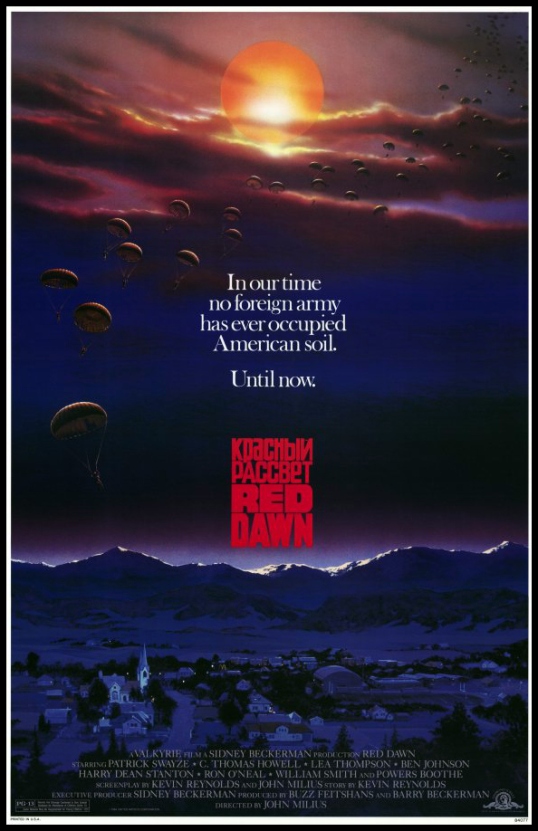
Scenes That I Love: The Traitor Scene From Red Dawn


The original Red Dawn doesn’t get as much credit as it deserves.

It’s often described as just being an anti-communist film but actually, it’s a lot more complex than that.  Yes, it’s about a group of teenagers who wage guerilla warfare against communist invaders.  But it’s also about how those teenagers lose their innocence as a result and how they all come to realize that war is not as simple as they thought it was.  The movie celebrates the Wolverines while also mourning that they were put in the position to have to risk and sacrifice their lives in the first place.

That’s what today’s scene that I love is all about.  After they are tracked down and attacked by a group of Russian soldiers, the Wolverines discover that one of the original members of the group visited his father in town and was forced to swallow a tracking device.  In this scene, the group is forced to deal with the reality of war.  The fact that the traitor was a friend to all of them and popular enough to be president of his class just adds to the difficulty of emotionally processing with his betrayal.  Patrick Swayze can’t bring himself to pull the trigger.  C. Thomas Howell, on the other hand, is so quick to shoot his former friend that you realize just how consumed by hate he has become.

Today’s scene was directed by the brilliant John Milius.

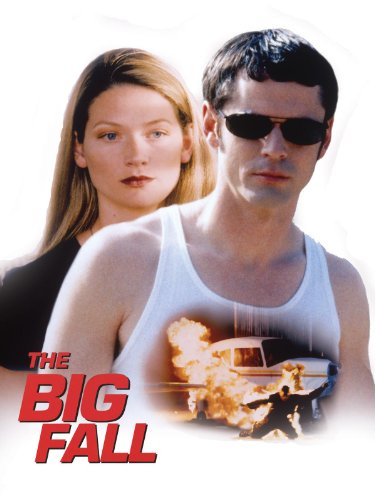
Cinemax Friday: The Big Fall (1997, directed by C. Thomas Howell)


Directed by C. Thomas Howell!?

You read that right!  After spending years as a straight-to-video mainstay, C. Thomas Howell finally stepped up from just starring in these films to directing one.  Of course, Howell still stars in The Big Fall as well as directing it.  What better way to make sure that your star takes your direction than by casting yourself in the lead role?  It makes sense.  The end result is a lot better than anyone would probably expect it to be.

Howell plays Blaise Rybeck, a self-described “private dick,” who works in modern Los Angeles with his protege (Sam Seder) and his secretary (Kathy Griffin, whose role is thankfully small).  Rybeck talks and dresses like a hard-boiled, 1940s P.I., right down to wearing a trench coat and a fedora while delivering his lines in a Bogart-style rasp.  The decor of his office is straight from the 40s as well.  Despite this, the movie takes place in modern times, with people using cell phones and bungee jumping off of bridges.  That no one comments on how out-of-time Rybeck seems to be indicates that Howell knew exactly what he was doing with his directorial debut.  The Big Fall is a tone perfect send-up of the neo-noirs that Howell spent most of the 90s appearing in.  His direction shows far more wit than you might expect from the star of Soul Man.

Rybeck is hired by sultry Emma Roussell (Sophie Ward) to find her brother.  It turns out that her brother has gotten involved with a bunch of extreme sports-obsessed bungee jumpers.  (This film attempts to do for bungee jumping what Point Break did for surfing and it actually succeed because the bungee jumping scenes are pretty damn cool.)  It all has to do with a criminal named Axe Roosevelt, played by the great Jeff Kober.  Of course, it also turns out that there’s more to Emma than meets the eye because this is a noir and there always is.

As a director, Howell does a good job of spoofing the material while still playing it straight enough that the movie doesn’t just become one big inside joke.  Jeff Kober and Titus Welliver are great as the bad guys, Sophie Ward is sexy as the femme fatale, and C. Thomas Howell keeps things moving both in front of and behind the camera.  This is an unexpected straight-to-video gem.

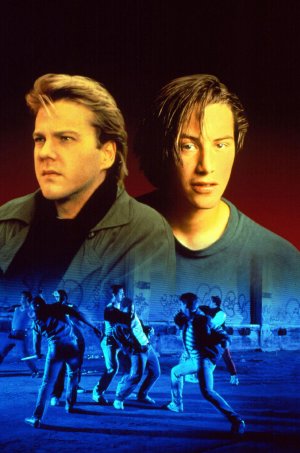
Back to School Part II #21: Brotherhood of Justice (dir by Charles Braverman)


Brotherhood_of_Justice_FilmPoster

For my next back to school review, I want to take a look at one of the best films that you’ve probably never heard of, the 1986 made-for-TV film Brotherhood Justice!

Brotherhood of Justice takes place at a California high school.  It’s a school that is pretty much ruled by the football team and the divide between the children of the upper and the working class is often violently apparent.  After several acts of violence, drug dealing, and vandalism, the school’s principal (Joe Spano) is left with a choice.  He can either hire full-time security guards and turn his school into an armed camp or he can meet with the most popular seniors and ask them to do their part to maintain order at the school.

He goes with the latter option.

At first, quarterback Derek (Keanu Reeves) is excited about doing his part to make the school a better place.  He and his friends quickly form the Brotherhood of Justice and make out a list of trouble makers.  At first, Derek and his friends are just roughing up drug dealers and demanding that all students show some school pride.  (In order to maintain their anonymity, they all wear masks to hide their faces.  However, no effort is made to disguise anyone’s voice, which means that this film takes place in a world where no one can recognize the voice of Keanu Reeves.)  However, things quickly escalate.  One member of the Brotherhood — Les (Billy Zane) — is especially enthusiastic and he has a thing for knives.

Meanwhile, Derek is having issues with his girlfriend, Christie (Lori Loughlin).  Christie, who is apparently incapable of recognizing her boyfriend’s voice whenever he’s wearing a mask, thinks that the Brotherhood is idiotic.  Christie also has a new job as a waitress and one of her co-workers is Victor (Kiefer Sutherland).  Victor obviously likes Christie and he also bravely stands up to the Brotherhood when they try to harass a student who is named Pasty.  (I kid you not.)

When Derek grows disillusioned with the Brotherhood, they decide that the situation with Christie must be distracting him.  So, they decide to blow up Victor’s car…

It’s all in the name of justice!

Obviously, one of the best things about Brotherhood of Justice is that it’s a chance to see Neo and Jack Bauer compete over Aunt Becky while Cal Hockley plays with a switch blade in the background.  (Oddly enough, Derek’s younger brother is played by Danny Nucci, who later appeared with Zane in Titanic.)  But there’s more to Brotherhood of Justice than just the curiosity value of the cast.

That plot hole about the voices aside, Brotherhood of Justice is actually a really good movie and one that everyone should watch.  If anything, it’s even more relevant today than it probably was when it was originally made.  It’s easy to be dismissive of the self-righteous and judgmental Brotherhood but actually, how different are they from the outrage brigade who show up everyday on twitter?  When the Brotherhood demands that everyone follow the rules and love their school, how different are they from those assholes who, today, claim that anyone who disagrees with the president or questions the moral authority of the government is somehow guilty of treason?  If the Brotherhood existed today, they would be cyberbullying and doxxing anyone who they felt had failed to say or think the right thing.

Let’s face it — we currently live in a fascist culture.  In its own modest but important way, Brotherhood of Justice is one of those films that can tell us why.

And you can watch it below!

http://www.youtube.com/watch?v=0L1x2XI1t-I


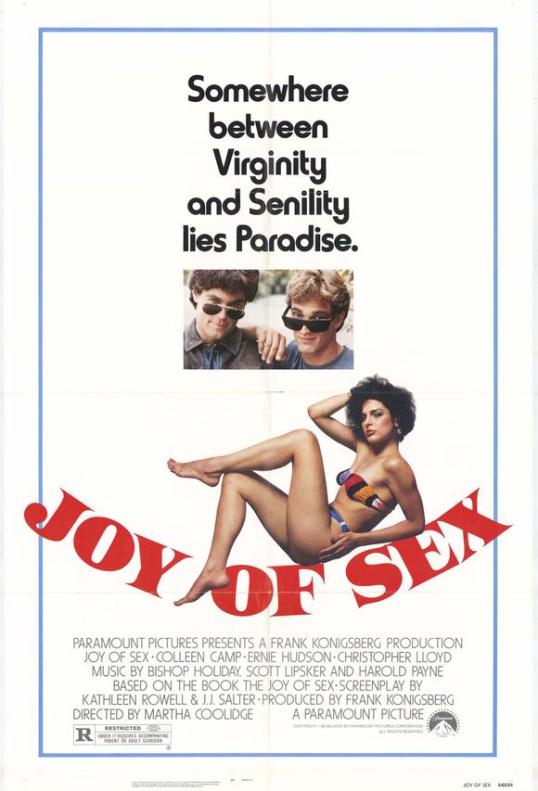
Back to School Part II #15: Joy of Sex (dir by Martha Coolidge)


Joy_of_Sex_Movie_Poster

Let’s say one positive thing about the 1984 “comedy” Joy of Sex.

The tag line on the poster: “Somewhere between virginity and senility, lies paradise,” is brilliant.  Whoever came up with it deserves a lot of credit because it sounds a lot better than anything that’s actually heard in the movie.

Let’s say something else good at Joy of Sex.  The two stars of the movie — Cameron Dye and Michelle Meyrink — both gave good and likable performances, even if their characters got a little bit annoying at times.  (Then again, just about everyone in Joy of Sex gets annoying.)  Also, there’s a subplot about an undercover cop (played by Colleen Camp) that predates 21 Jump Street and which occasionally shows off a few hints of genuine wit.

Otherwise, this is probably one of the worst of the 80s teen comedies that I’ll be reviewing for this series of Back to School reviews.  Joy of Sex is officially credited as being an adaptation of a sex manual that was popular back in the 70s.  According to the imdb and Wikipedia, Joy of Sex went through a rather tortured development.  At one point, it was going to be an anthology film, starring John Belushi and co-produced by National Lampoon.  However, Belushi died of a drug overdose, National Lampoon abandoned the project, and the final film turned out to be another high school film.  Imagine Fast Time At Ridgemont High … but really, really bad.

Leslie Hindenberg (Michelle Meyrink) is a student at Richard Nixon High School.  She’s the daughter of the school’s phys ed coach (Christopher Lloyd, playing what was probably meant to be the Belushi role) and, as a result, she is viewed as being untouchable, even by the sex-crazed boys of Nixon High.  The problem is that Leslie has recently discovered a mole on chest and is convinced that she has skin cancer.  Believing that she only has 6 weeks to live, Leslie sets out on a mission to lose his virginity.  However, she wants to lose it to the perfect guy and there aren’t many of those at her school.  (Can you really afford to be picky when you’ve only got 6 weeks to live?)  Add to that, everyone’s terrified of the coach…

Leslie’s lab partner is Alan (Cameron Dye), who is a nice guy.  He not only has a huge crush on Leslie but he’s also desperate to lose his virginity as well!  Problem solved, right?  Well, no.  See, Alan has been led astray by the new girl in school.  Liz (Colleen Camp) is tough, outspoken, and no-nonsense.  As soon as she shows up in school, she lets everyone know that she’s obsessed with two things — sex and drugs.  In fact, she’s especially interested in drugs…

A lot of students, of course, are suspicious of Liz.  She seems to be older than everyone else and speak in out-of-date slang.  “Could she be a narc?” some students wonder.  Well, actually, she is.  She is working undercover at Nixon High and is convinced that Alan knows who is supplying drugs to all of the students.  And, it must be said, that Colleen Camp really throws herself into the role.  As happens with most of the film’s subplots, the undercover narc storyline doesn’t really go anywhere but at least Camp made the effort.

Meanwhile, Leslie’s best friend has been kicked out of school because she’s pregnant.  Leslie approaches a local reporter, hoping to convince him to do a story about what’s happened.  And, while getting her best friend back into school, Leslie starts to wonder if maybe she’s found the right man to take her virginity…

(But wait!  We know she’s meant to be with Alan!  So, surely, the reporter will turn out to be a sleaze, right?)

But that’s not all!  Someone is running around the school and using superglue to play pranks.  Who could it be?  Will the crazy principle (Ernie Hudson) be able to maintain order until the big dance?  And will the portrayal of the school’s frequently confused foreign exchange student manage to get any more racist?

And what about Tom Pittman (Robert Prescott)?  Pittman is the most popular guy in school.  Pittman doesn’t really do a lot.  To make an undeserved comparison to Animal House, he’s kind of the Bluto character, just not as interesting.  Whereas Bluto smashed guitars and beer cans and gave inspiration speeches, Pittman tries to light his farts on fire and is something of a bully.  (There is a kinda funny scene where he’s suddenly nice to Leslie and everyone’s shocked.)  The most memorable thing about Pittman is that he wears thick black glasses which are held together by tape.  So, if nothing else, Joy of Sex is important chapter in the history of myopia in film.

Anyway, Joy of Sex has remarkably little joy and next to no sex.  I imagine that were riots in the theaters after this movie came out, as thousands of angry teenagers chanted, “We want joy!  We want sex!  When do we want them!?  NOW!”

There were a lot of great teen films released in the 80s.  Joy of Sex is not one of them.

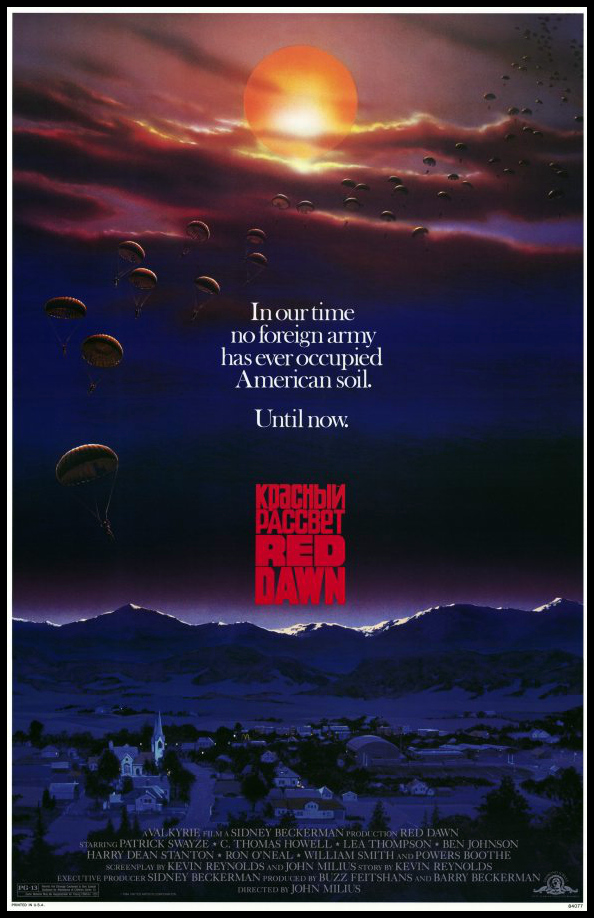
Review: Red Dawn (dir. by John Milius)


“I don’t know. Two toughest kids on the block I guess. Sooner or later they’re going to fight.”

[guilty pleasure]

Anyone who grew up during the 1980’s would say that some of the best action films were made and release during this decade. I won’t disagree with them and probably would agree to a certain point. This was the decade when action films evolved from the realism of the 70’s to the excess and ultra-violence of the 80’s. This was the decade which ushered in such action heroes as Schwarzenegger, Stallone and Willis. It was also the decade which released one of the most violent films ever released by a major motion picture studio. It’s a film that has been remembered through the prism of nostalgia. I speak of the 1984 war film by John Milius simply titled Red Dawn.

John Milius is one of those filmmakers who never conformed to the stereotype of liberal Hollywood. He was an unabashed Republican (though he considers himself more of a Zen anarchist) in a liberal studio system who happened to have written some of the most revered films of the 1970’s (Jeremiah Johnson, Apocalypse Now, Dirty Harry). He came up with a follow-up to his hugely successful Conan the Barbarian in the form of a war film set in current times (mid-80’s) America that he called Red Dawn. It was a story which takes an alternate history of the Cold War where Soviet forces and it’s allies launch a successful preemptive invasion of the United States. Before people think that this was the idea born of a conservative, warmongering mind it’s been documented that Milius’ inspiration for this film was a real Pentagon hypothetical exercise of what would happen if the Soviet Union conducted a conventional invasion of the United States and how the government and it’s population would react and resist such an occupying force. The  story would finally get it’s final treatment with major input from screenwrtier Kevin Reynolds’ own story which added a certain Lord of the Flies vibe to the group of teenagers who form the bulk of the film’s cast.

The film actually starts off with an impressive sequence of your typical Midwestern high school day with students seated in their classrooms. One moment this Rockwellian image gets a surprise from soldiers parachuting in the field outside the school. Thus we have the beginning of the Soviet invasion with one of the teachers being gunned down for trying to peacefully interact with the airborne troopers. The rest of the film is about a group of highschoolers led by senior Jed Eckert (Patrick Swayze) and his younger brother Matt (Charlie Sheen) as they flee with a handful of their classmates the massacre at their school and soon their whole town as well.

Red Dawn uses the first half of the film to show the confusion and chaos created by the sudden appearance of foreign soldiers on America soil attacking civilians and, soon enough, whatever American military response that manages to react in the area. We’re put in the shoes of Jed and his band of teenagers as they try to survive the roving bands of Soviet and Cuban soldiers patrolling the plains and countryside surrounding their hometown of Calumet, Colorado. We see American civilians packed into re-education camps and rumors of KGB secret police making certain troublemakers disappear and worst. It’s the America Cold War nightmare scenario where the Soviet Evil Empire has taken a foothold on US soil and the government and military nowhere in sight to help it’s population.

The second half of the film solves this scenario by arming the teenagers led by Jed into a sort of teen guerrila force using their school’s mascot as their rallying cry. It’s the shouts of “Wolverines!” which has become part of American pop-culture as we get to see these teenagers conduct hit-and-run strikes on enemy patrols and forward bases while at the same time arming those they free from camps. It’s during this part of the film where the violence gets ramped up to an almost ridiculous level. It’s no wonder that for almost two decades this film would be considered by Guinness World Records as the most violent film ever put on the big-screen. Milius and his filmmaking crew do not skimp on the use of blood squibs as Jed and his ragtag band of teen fighters gun down Soviets, Nicaraguans and Cuban soldiers by the score every minute during a long montage in the middle of the film.

Red Dawn in terms of storytelling is actually quite good in the grand scheme of the narrative being told, but even through the prism of nostalgia and rose-tinted glasses the characters in the film get the short-end of the stick. With the exception of Swayze’s eldest teen Jed as leader of the Wolverines the rest of the band’s teenage characters look like your typical casting call stereotypes who fill in the required roles in any ensemble cast. There’s Darren Dalton as the high school class president jealous of the group’s leader Jed, but unable to act on it. We have C. Thomas Howell as Robert the mousy one when the film begins who becomes a hardened and cold-hearted killer as the film goes on. Everyone fits in neatly to their assigned role and noen of the young actors (at the time) bring much to their characters.

This film continues to be remembered fondly by it’s fans both new and old because of the “what-if” scenario being played out on the screen. I would say that if there ever was a pure American film I would think Red Dawn manages to fit the bill. It’s a film which highlights the so-called individualism and can-do attitude Americans see for themselves. How it’s up to each individual to fight to protect their loved ones and for what is theirs. Some have called this film as a conservative’s wet-dream, but I rather think it’s a film that should appeal more to Libertarians as it focuses on individual liberties and self-preservation when the government and military tasked to protect them have failed.

John Milius has always been a maverick in Hollywood and his unpopular political beliefs have kept him from doing more work in the film industry, but one cannot deny the fact that he made one of the most iconic films of the 1980’s. Whether one agreed with the film’s politics and thought it to be a good film or not was irrelevent. Red Dawn has become part of American pop-culture and will continue to be a major example of the excess of 80’s action filmmaking for good or ill. Plus, even the most liberal people I know find the basic story of fighting to protect the nation from invaders something that feeds their innermost fantasy of playing the good guys fighting the good fight. Red Dawn is a great example of the underdog film that just happens to have teenagers kicking Soviet military ass.