Review: Hostage (dir. by Florent Siri)


The five years or so has seen the rise of several new directors from France who’ve made quite a splash with their Hollywood debuts. There’s Alejandro Aja with Haute Tension (or Switchblade Romance/High Tension) who brought back the late 70’s early 80’s sensibilities of what constitutes a good slasher, exploitation film. Then there’s Jean-Francois Richet whose 2005 remake of John Carpenter’s early classic, Assault on Precinct 13 surprised quite a bit in the industry. Neither film made too much in terms of box-office, but they did show that a new wave of genre directors may not be coming out of the US but from France of all places. Another name to add to this list is Florent Siri and his first major Hollywood project Hostage shows that he has the style and skills to make it in Hollywood.

Hostage
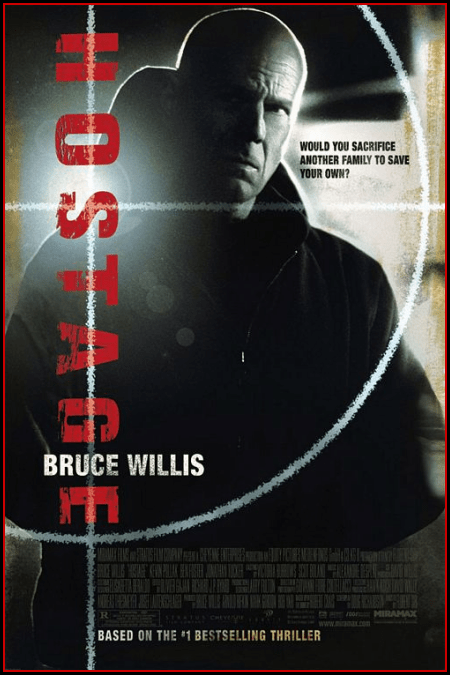
is another Bruce Willis vehicle that was adapted by Doug Richardson (wrote the screenplay for Die Hard 2) from Robert Crais’ novel. Hostage is a very good thriller with a unique twist to the hostage-theme. Willis’ character is a burn-out ex-L.A. SWAT prime hostage negotiator whose last major case quickly ended up in the death of suspect and hostages. We next see him as chief of police of a small, Northern California community where low-crime is the norm. We soon find out that his peace of mind and guilt from his last case may have eased since taking this new job, but his family life has suffered as a consequence. All of the peace and tranquility is quickly shattered as a trio of local teen hoodlums break into the opulent home of one Walter Smith (played by Kevin Pollak). What is originally an attempt to steal one of the Smith’s expensive rides turn into a hostage situation as mistakes after mistakes are made by the teens.

From this moment on Hostage would’ve turned into a by-the-numbers hostage thriller, but Richardson’s screenplay ratchets things up by forcing Willis’ character back into the negotiator’s role as shadowy character who remain hooded and faceless throughout the film kidnap his wife and daughter. It would seem that these individuals want something from the Smith’s home and would kill Willis’ character’s family to achieve their goals. The situation does get a bit convoluted at times and the final reel of the film ends just too nicely after what everyone goes through the first two-third’s of the film.

The character development in the film were done well enough to give each individual a specific motivation and enough backstory to explain why they ended up in the situation they’ve gotten themselves into. Willis’ performance in Hostage was actually one of better ones in the last couple years. The weariness he gives off during the film was more due to his character’s state of mind rather than Willis phoning in his performance. I would dare say that his role as Chief of Police Jeff Talley was his best in the last five years or so. The other performance that stands out has to be Ben Foster as the teen sociopath Mars. Foster’s performance straddles the line between being comedic and over-the-top and could’ve landed on either side. What we get instead is one creepy individual who almost becomes the boogeyman of the film. In fact, the last twenty minutes of Hostage makes Mars into a slasher-film type character who can’t seem to die.

The real star of the film has to be Florent Siri’s direction and sense of style. From the very first frame all the way to the last, Siri gives Hostage the classic 70’s and 80’s Italian giallo look and feel. Siri’s use of bright primary colors in conjuction with the earthy, desaturated look of the film reminds me of some of the best work of Argento, Bava and Fulci. In particular, Siri’s film owes alot of its look to films such as Tenebrae, The Bird with the Crystal Plumage, and The Psychic. Certain scenes, especially the penultimate climax in the Smith home, take on an almost dreamlike quality. Siri’s homage to the classic gialli even gives Hostage some sequences that would comfortably fit in a 70’s slasher film.

Florent Siri’s Hostage is not a perfect film and at times its increasing tension without any form of release can be unbearable to some people, but it succeeds well enough as a thriller. It also shows that Siri knows his craft well and instead of mimicking and cloning scenes from the gialli he’s fond of, he emulates and adds his own brushstrokes. The film is not for everyone and some people may find the story convoluted if not dull at times, but for me the film works well overall. Siri is one director that people should keep an eye on.

My Top Ten Books About The Movies


I love movies and I love books so I guess it would stand to reason that I love books about movies the most of all.  (I also love movies about books but there are far fewer of those, unfortunately.)  Below are my personal favorites.  I’m not necessarily saying that these are the ten greatest film books ever written.  I’m just saying that they’re the ones that I’m always happy to know are waiting for me at home.

10) Soon To Be A Major Motion Picture by Theodore Gershuny — This is one of the great finds of mine my life.  I found this in a used bookstore and I bought it mostly because it only cost a dollar. Only later did I discover that I had found one of the greatest nonfiction books about the shooting of a movie ever written!  Gershuny was present during the filming of a movie called Rosebud in the early 70s.   I’ve never seen Rosebud but, as Gershuny admits, it was a critical disaster that managed to lose a ton of money.  The book provides a fascinating wealth of backstage gossip as well as memorable portraits of director Otto Preminger and actors Robert Mitchum (who was originally cast in the lead role), Peter O’Toole (who took over after Mitchum walked off the set), and Isabelle Huppert.   If nothing else, this book should be read for the scene where O’Toole beats up critic Kenneth Tynan.

9) Suspects by David Thomson — A study of American cinema noir   disguised as a novel, Suspects imagines what would happen if George Bailey from It’s a Wonderful Life fell in love with Laura from the movie of the same name.  Well, apparently it would lead to Sunset Boulevard’s Norma Desmond having an affair with Chinatown’s Noah Cross and to one of George’s sons, sensitive little Travis, getting a job in New York City as a Taxi Driver.  And that’s just a small sampling of what happens in this glorious mindfuck of a novel.

8 ) Profondo Argento by Alan Jones — Long-time fan Alan Jones examines each of Dario Argento’s films (even Argento’s obscure historical comedy The Five Days of Milan) and proceeds to celebrate and (in many cases) defend Argento’s career.  Jones also interviews and profiles several of Argento’s most frequent collaborators — Daria Nicolodi, Asia and Fiore Argento, Simon Boswell, Claudio Simonetti, Keith Emerson, George Romero, Lamberto Bava, Michele Soavi, and many others.  Jones’ sympathetic yet humorous profile of Luigi Cozzi is priceless.

7)  Spaghetti Nightmares by Luca Palmerini — Spaghetti Nightmares is a collection of interviews conducted with such Italian filmmakers as Dario Argento, Ruggero Deodato, Umberto Lenzi, Lucio Fulci, and others.  Among the non-Italians interviewed are Tom Savini (who, as always, comes across as appealingly  unhinged) and David Warbeck.  (Sadly, both Warbeck and Fulci would die shortly after being interviewed.)  What makes this interesting is that, for once, Argento, Fulci, et al. are actually being interviewed by a fellow countryman as opposed to an American accompanied by a translator.  As such, the subsequent interviews turn out to be some of the most revealing on record.

6) Sleazoid Express by Bill Landis and Michelle Clifford — Landis and Clifford’s book is both a history and a defense of the old grindhouse theaters of New York City.  Along with describing, in loving and memorable detail, some of New York’s most infamous grindhouses, they also write about some of the more popular movies to play at each theater.  Along the way, they also offer up revealing profiles of such legendary figures as David Hess and Mike and Roberta Findley.  Reading this book truly made me mourn the fact that if I ever did find myself in New York City, I won’t be able to hit the old grindhouse circuit.

5) Beyond Terror: The Films of Lucio Fulci by Stephen Thrower — Fulci has always been a terribly underrated director and, indeed, it’s easy to understand because, in many ways, he made movies with the specific aim of alienating and outraging his audience.  It requires a brave soul to take Fulci on his own terms and fortunately, Stephen Thrower appears to be one.  Along with the expected chapters on Fulci’s Beyond Trilogy and on Zombi 2, Thrower also devotes a lot of space to Fulci’s lesser known works.  Did you know, for instance, that before he became the godfather of gore, Fulci specialized in making comedies?  Or that he also directed two very popular adaptations of White Fang?  Thrower also examines Fulci’s often forgotten westerns as well as his postapocalyptic sci-fi films.  And, best of all, Thrower offers up a defense of the infamous New York Ripper that, when I read it, actually forced me to consider that oft-maligned film in a new light.  That said, Thrower does admit to being as confused by Manhattan Baby as everyone else.

4) Immoral Tales by Cathal Tohill and Pete Toombs — Tohill and Toombs offer an overview of European “shock” cinema and some of the genre’s better known masters.  The book contains perhaps the best critical examination of the work of Jean Rollin ever written.  The authors also examine the work of Jesus Franco and several others.  This is a great book that reminds us that the Italians aren’t the only ones who can make a great exploitation film.

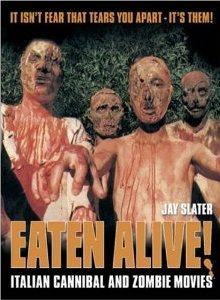
3) Eaten Alive by Jay Slater — This book offers an overview of the Italian film industry’s legendary cannibal and zombie boom.  Along with reviewing every Italian movie to feature even the slightest hint of cannibalism or the living dead (this is one of the few books on Italian cinema that discusses both Pasolini and Lucio Fulci as equals), Eaten Alive also features some very revealing interviews with such iconic figures as Catriona MacColl, Ian McCullough, and especially Giovanni Lombardo Radice.  Radice, in fact, also contributes a memorable “guest” review of one of the movies featured in the book.  (“What a piece of shit!” the review begins.)  Memorable reviews are also contributed by Troma film founder Lloyd Kaufman who brilliantly (and correctly) argues that Cannibal Holocaust is one of the greatest films ever made and Ramsey Campbell who hilariously destroys Umberto Lenzi’s infamous Nightmare City.

2) The Book of the Dead by Jamie Russell — If, like all good people, you love zombies then you simply must do whatever it takes to own a copy of this book.  Starting with such early masterpieces as White Zombie and I Walked With A Zombie, Russell proceeds to cover every subsequent zombie film up through George Romero’s Land of the Dead.  Russell offers up some of the best commentaries ever written on Romero’s Dead films, Fuci’s Beyond Trilogy, Rollin’s Living Dead Girl, and Spain’s Blind Dead films.   The pièce de résistance, however, is an appendix where Russell describes and reviews literally ever zombie film ever made.

1)  All The Colors Of the Dark by Tim Lucas  — This is it.  This is the Holy Grail of All Film Books.  If you’ve ever asked yourself if any book is worth paying close to 300 dollars, now you have your answer.  This one is.  Tim Lucas offers up the most complete biography of director Mario Bava ever written.  In fact, this may be the most complete biography of any director ever written!  Lucas examines not only Bava’s life but also every single movie that Bava was ever in any way connected to, whether as a director or as a cameraman or as the guy in charge of the special effects.  This is 1,128 pages all devoted to nothing but the movies.  This is the type of book that makes me thankful to be alive and I owe a huge debt of gratitude to Tim Lucas for writing it.

Review: Zombie (dir. by Lucio Fulci)


1979 saw the release of a film titled Zombi 2. It was suppose to be an unofficial sequel to Romero’s own Dawn of the Dead which was released in Italy under the title of Zombi. many thought this pseudo-sequel was a way to cash-in on the success of Romero’s film in Italy. This wasn’t true for the fact that it’s director and producers had already been working on their own zombie film as Romero started on Dawn of the Dead. It was by coincidence that both were released within the same year and in order to try and tie the two films together their titles reflected it.

Lucio Fulci’s Zombi 2 (or just plain Zombie in the US) has no connection whatsoever with Romero’s own Dawn of the Dead except for the zombies and the rules governing their destruction. This is not to say that Fulci’s Zombi 2 wasn’t good. In fact, I would say that Zombi 2 was, and still a great horror movie that’s been unfairly compared with Romero’s ultimate zombie classic. The two films tell different type of stories even when sharing similar plot devices and rules. Where Romero used the backdrop of the zombie epidemic as a damning visual commentary on the growing consumerism culture in the United States, Fulci’s film eschews any such social observations and goes for pure horror instead.

Zombi 2 helped begin the Italian cinema’s love of zombie movies and Fulci’s film still stands as the best of the lot. Starring Tisa Farrow as Ann, the daughter of a missing doctor working in the Carribean, and Ian McCulloch as reporter Peter West who helps Ann try to solve the mystery of her father’s disappearance in one of the Carribean Islands. The only clue they have being the mysterious reappearance of a boat belong to Ann’s father. A drifting yacht which, when inspected by NY Harbor Patrol, a disfigured, obese man violently attacks one of the patrolmen before falling overboard into the city harbor. From that moment on, Ann and Peter head off to her father’s last location on the Carribean island of Matool. Once on Matool, Ann and Peter discover that one of her father’s colleagues, a Dr. Manard, has been trying to solve the mysterious disease, or curse as the native islanders call it, which her father became afflicted with. A disease which seem to kill those it infects and then return them to life to attack the living.

These two are soon joined by a vacationing couple who seem to have arrived on Matool at the worst time. Ann and Peter soon enlist the aid of Brian and Susan, but before they could solve the island’s deadly mystery the island’s dead, both past and recent, rise up from their resting place and doom the remaining inhabitants. One sequence involving these zombies has gone down in horror history as one of the most cringe-inducing scenes on film. It involves the torturously slow sequence where a woman’s head is dragged forward toward a door splinter aimed directly at the woman’s eye. This gore-sequence in addition to the scenes of the zombies attacking and feeding on the visiting Westerners and the remaining living islanders were very well done and all due to make-up FX master Giannetto de Rossi. There’s even a spectacular sequence where a zombie tries to attack and feed on a live shark. Even to this day I still marvel at whichever stuntman volunteered for that action shot.

Zombi 2 has been called a dumbed down attempt to capitalize on Dawn of the Dead. I wholeheartedly disagree with this obeservation. Zombi 2 was never meant to be socially relevant, but one whose only goal was the scare, disgust and disturb its audience with scenes of extreme violence and gore. In this respect Fulci succeeded with the final cut of Zombi 2. The acting itself was very well done considering that half the cast spoke in English as their natural language while the other half were saying their lines in Italian. The dubbing of the Italian-spoken lines were done particularly well. A rarity when it comes to dubbed films.

The final few minutes of Zombi 2 where the Matool survivors make it back to New York through its harbor makes for a great ending. With a city radio station recounting the growing zombie crisis which seemed to have begun while Ann and Peter were on Matool, the final shot of zombies walking on the pedestrian level of the Brooklyn Bridge with cars below them seeming to be rushing out of the city to escape the crisis still makes for a haunting scene. Lucio Fulci’s Zombi 2 might not have been the iconic, cultural and societal masterpiece that was Romero’s Dawn of the Dead, but it more than holds its own when seen as a pure horror film.