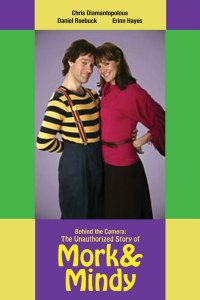
A Movie A Day #225: Behind The Camera: The Unauthorized Story of Mork & Mindy (2005, directed by Neil Fearnley)


The year is 1978.  A television producer named Garry Marshall (Daniel Roebuck) teaches America how to laugh again by casting Pam Dawber (Erinn Hayes) and a hyperactive stand-up comedian named Robin Williams (Chris Diamantopoulos) in a sitcom about an alien struggling to understand humanity.  Despite constant network interference, the show makes Robin a star but, with stardom, comes all the usual temptations: lust, gluttony, greed, pride, envy, wrath, and John Belushi.

The Behind The Camera films, which all dramatized the behind the scenes drama of old television shows, were briefly a big thing in the mid-aughts.  Because they were lousy, they never got good reviews but they did get good ratings from nostalgia-starved baby boomers and gen xers.  I think The Unauthorized Mork & Mindy Story was the last one produced.  It probably would have been better if there had been any sort of drama going on behind-the-scenes of Mork & Mindy but, according to this movie, everyone got along swimmingly.  Williams may get hooked on cocaine but the film squarely puts the blame for that on John Belushi.  The script, which was obviously written with one eye on avoiding getting sued, is sanitized of anything that could have reflected badly on anyone who was still alive when the movie aired.

Stuck with unenviable task of having to play one of the most famous people in the world, Chris Diamantopoulos was not terrible as Robin Williams.  Considering how sanitized the script was, not terrible is probably the best that could be hoped for.  There was not much of a physical resemblance but Diamantopoulos nailed the voice and some of the mannerisms.  Erinn Hayes looks like Pam Dawber but, just as in the actual show, the movie gives her the short end of the stick and focuses on Williams.

For aficionados of bad television, this is mostly memorable for Daniel Roebuck’s absolutely terrible performance as Garry Marshall and a scene in which Williams is heckled in a comedy club but an overweight man who steps out of the shadows and announces that he’s John Belushi!  Roebuck’s performance as Garry Marshall begins and end with his attempt to impersonate Marshall’s familiar voice.  He was much better cast as Jay Leno in The Night Shift.  As for Belushi , since he was not around to sue or otherwise defend himself, the movie goes all out to portray Belushi (who was played by Tyler Labine) as being an almost demonic influence on Williams.   The film’s portrayal of Belushi is even worse and probably more inaccurate than Wired and that’s saying something!

To quote Mork himself: Shazbot!  This movie is full of it.
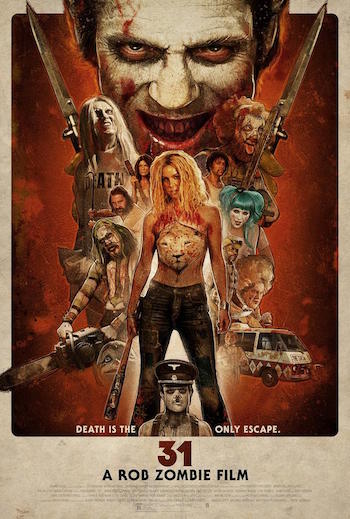
The TSL’s Daily Horror Grindhouse: 31 (dir by Rob Zombie)


31_film_poster

Are you scared of clowns?  Sure, you are.  All good people fear clowns.  However, if you somehow do not find clowns to be frightening, you may change your mind after seeing Rob Zombie’s latest film, 31.

Of course, that’s assuming that you actually see 31.  31 is not a film for everyone.  In fact, if you’re not a fan of Rob Zombie or his style of horror, you should probably stay miles away from 31.  Bloody, intense, violent, and occasionally rather nihilistic, 31 is perhaps the Rob Zombiest of all the films that Rob Zombie has ever made.

However, if you’re a fan of extreme horror, you’ll appreciate 31.  It may not always be easy to take but then again, that’s kind of the point.

The film takes place in the 70s, which means that it has a really kickass soundtrack.  A group of carnival workers are driving across the desert in a van when they are attacked and kidnapped.  They find themselves in a dark building, being lectured by three people who are dressed like 18th century French aristocrats.  The leader of the aristocrats (played by Malcolm McDowell) informs them that they are going to playing a game called 31.  For the next twelve hours, they will be locked away in a maze.  They will be hunted by five murderous clowns.

Yes, you read that right.  Not just one murderous clowns — FIVE!  (Even worse, a sixth bonus clown eventually joins the game.)

If they can survive for 12 hours, they win.  What do they win?  Other than freedom, the film is never particular clear on this point.  The motives of the aristocrats remain a mystery for the majority of the film.  Are they just sadists, are they perhaps devote fans of The Purge who were so disappointed with Election Year that they decided to recreate the second film on their own, or is there some bigger reason behind this game of 31?  The film leaves the question for us to answer.

The rest of the film is a collection of progressively more violent fights between the carnival workers and the clowns.  For the most part, the carnival workers are all likable and you don’t want to see any of them harmed.  The clowns, meanwhile, are just about the freakiest collection of killers that you’ve ever seen.  When one of them is cornered, he pathetically begs, “We’re all pawns!  We don’t want to do this!” but you never quite believe him.  The deadliest of the clowns is Doom-Head (Richard Brake) and his evil smirk will give you nightmares.

31 is an incredibly intense film and it’s definitely not for the faint of heart.  Everything from the acting to the set design to the costumes to David Daniel’s stark cinematography comes together to make 31 into a harrowing horror film.  If you can’t stand Zombie’s trademark mayhem, I would suggest avoiding 31.  However, if you’re a fan of Zombie’s films, you’ll find 31 to be perhaps the purest distillation of his artistic vision.

Back to School #43: River’s Edge (dir by Tim Hunter)


In his film guide, Heavy Metal Movies, Mike McPadden describes the disturbing 1987 teen crime drama River’s Edge as being “666 Candles“.  It’s a perfect description because River’s Edge appears to not only be taking place in a different socio-economic setting than Sixteen Candles and The Breakfast Club but perhaps on a different planet as well.

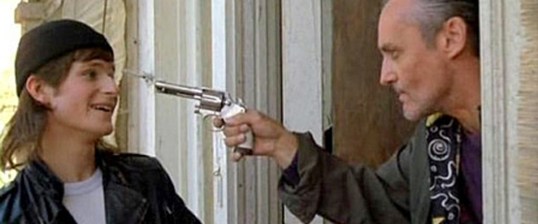
River’s Edge opens with a close-up of a dead and naked teenage girl lying on the edge of a dirty, polluted river and it gets darker from there.  The dead girl was the girlfriend of the hulking John Tollet (Daniel Roebuck, playing a character who is miles away from his role in Cavegirl).  As John explains to his friends, he strangled her for no particular reason.  His friends, meanwhile, respond with detachment.  Their unofficial leader, the hyperactive Layne (Crispin Glover), insists that since nothing can be done about the dead girl, their number one concern now has to be to keep John from getting caught.  While Layne arranges for John to hide out with a one-legged drug dealer named Feck (Dennis Hopper), two of John’s friends, Matt and Clarissa (played by Keanu Reeves and Ione Skye), consider whether or not they should go to the police.  Oddly enough, John really doesn’t seem to care one way or the other.

Seriously, River’s Edge is one dark film.  If it were made today, River’s Edge would probably be directed by someone like Larry Clark and, in many ways, it feels like a distant cousin to Clark’s Bully.  The teenagers in River’s Edge live in a world with little-to-no adult supervision.  Matt’s mom is more concerned with whether or not Matt has been stealing her weed than with the fact that Matt might be covering up a murder.  The local high school teacher is a former hippie who won’t shut up about how much better his generation was compared to every other generation.  In fact, the only adult with any sort of moral code is Feck and he’s usually too busy dancing with a sex doll to really be of much help.  It’s a world where no one has been raised to value their own lives so why should they care about a dead girl laying out on the banks of the river?

The film features good performances from Keanu Reeves, Ione Skye, and Daniel Roebuck but really, the entire movie is stolen by Crispin Glover and Dennis Hopper.  In the role of Layne, Glover is a manic wonder, speaking quickly and gesturing even when he isn’t making a point.  When Layne first shows up, he seems like he’s just overly loyal to his friend John but, as the film progresses, it becomes more apparent that he’s less concerned about protecting John and more interested in ordering other people to do it.  For Layne, protecting John is ultimately about maintaining power over Matt, Clarissa, and the rest of their friends.

As for Dennis Hopper — well, this is one of those films that you should show to anyone who says that Hopper wasn’t a great actor.  The role of a one-legged drug dealer who lives with a sex doll sound like exactly the type of role that would lead Hopper to going totally over-the-top.  Instead, Hopper gave a surprisingly subtle and intelligent performance and, as a result, he provided this film with the moral center that it very much needs.

Glover and Hopper


Back to School #38: Cavegirl (dir by David Oliver)


cavegirl5

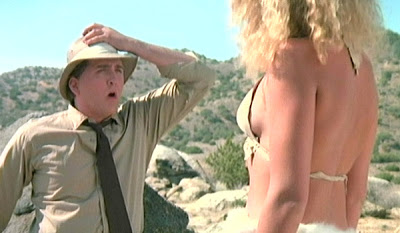
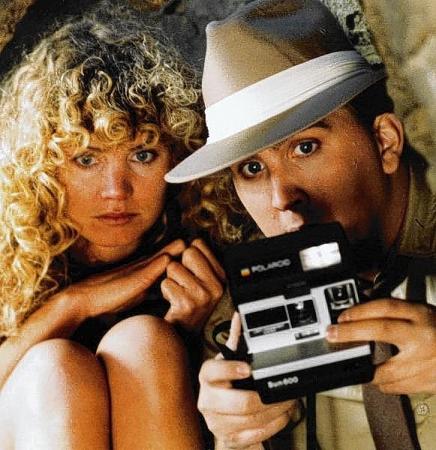
Believe it or not, Back to the Future was not the only film released in 1985 that dealt with a high school senior taking a trip through time and ending up in the distant past.  There was also Cavegirl, which tells the story of Rex (Daniel Roebuck), a nerdy science student who, during a field trip, finds himself transported back to prehistoric times.  It’s there that he meets the title character, the cheerful and friendly Eba (Cindy Ann Thompson).  Eba likes Rex and Rex like Eba.  The only problem is that Eba can’t speak a word of English and Rex can’t get a moment along with her without being interrupted by various cavemen.

Perhaps not surprisingly, this film was distributed by Crown International Pictures.

CIP_LogoOne thing that I always find interesting about the various high school films that were released by Crown International is that the schools always look so ugly.  That’s certainly the case in Cavegirl.  It’s not just that the school’s lay-out is boring.  (Apparently, nobody put much effort into designing high schools in the 70s and 80s.)  It’s just that the school itself looks dirty, as if all of the custodians are on strike.  When, at the beginning of the film, you see Rex walking through the school, you just know that the entire building probably reeks of stale air, rotting food, and decaying rodents.  (In fact, it looks like it might be the same school from The Pom Pom Girls.)  No wonder Rex doesn’t seem to mind being sent into the past!

And speaking of Rex, he’s played by Daniel Roebuck.  Roebuck actually gives a pretty good performance in this film, bringing a lot of conviction to some incredibly silly lines.  But the best thing about seeing Daniel Roebuck in this film is know that, decades later, he would play the ill-fated Leslie Arzt on Lost.  Arzt only appeared in a handful of episodes but every time he did appear, he was whining about something and petulantly demanding to be included in whatever the main characters were doing.  When they finally did allow Arzt to tag along with them, he mishandled some dynamite and blew up.  (Leading to the classic line: “You’ve got some Arzt on you…”)  Arzt may have only been created so that the creators could blow him up but Roebuck gave such a memorably fussy performance in the role that, even after exploding, he retained a following among the show’s many fans.  In Cavegirl, Roebuck gives a similarly fussy performance and, as a result, the entire film feels like it could be called “Leslie Arzt: The Early Years.”

As for Cavegirl itself, it’s definitely a crude film, in both execution and much of the content.  There’s about as much humor based on bodily fuctions as you expect to see in a film like this and there were a few such scenes that I choose to look away from until they were over with.  But, at the same time, it’s ultimately a surprisingly likable film.  That’s largely due to Daniel Roebuck and Cindy Thompson.  They both have a very likable chemistry and Thompson gives such an enthusiastic performance that you can forgive a lot of the film’s weaker moments.

Is Cavegirl as good as Back to the Future?

Well, no.

But, as far as low-budget 80s teen comedies are concerned, it works.

mc-cavegirl-jpg-20140228


Review: Bubba Ho-Tep (dir. by Don Coscarelli)


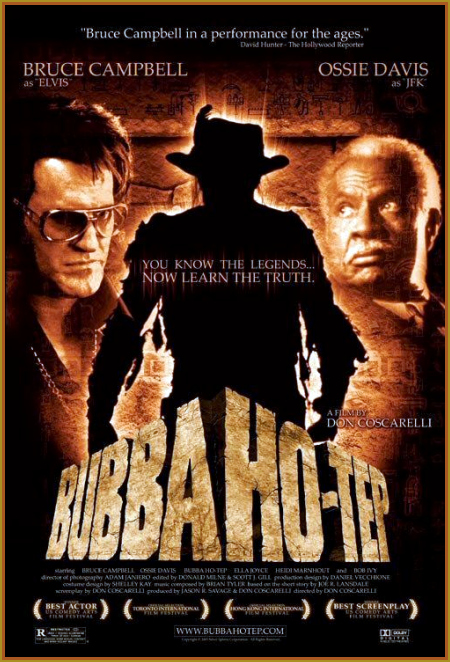
Bubba Ho-Tep was one of those film projects which just screamed out “can’t lose” the moment it the people who were going to be attached to it were announced. I mean for people who grew up watching horror movies and other such fun things during the 80’s would know of the name Don Coscarelli. His Phantasm franchise scared and creeped out a large number of young kids and teenagers as they grew up during the 1980’s. Author Joe R. Landale is not as well-known for the unread but he also brings big smiles to people who also like their stories to be full of quirky humor, dry sarcastic wit in addition to pulp-style horror and thrills. But the major coup this film had which made all genre fans suddenly smile and grin like fools has to be hearing that genre-veteran and B-movie extraordinaire Bruce Campbell taking on the role of an aging Elvis Presley.

The movie was released in very limited screens in the summer of 2002. In fact, the movie really only got shown during the summer genre film festivals which dealt with genre movies like horror, sci-fi and other so-called low-brow genre projects which the more elitist film goers tend to shun. Luckily I wasn’t too elitist enough to be able to find Bubba Ho-Tep playing in the San Francisco Film Festival. To say that what I saw was pure cheesy fun would do the film a disservice. While it’s true that the film had it’s moment of horror, I mean it is a movie about a soul-sucking Egyptian Mummy let-loose in a Texas retirement home. What I was surprised to see as I watched through Bubba Ho-Tep was just how much more than a cheesy B-movie horror flick it turned out to be.

The film pretty much brings up the scenario of how it would be if the real Elvis Presley was still alive, in his 70’s and wasting away in a Texas retirement home. That the Elvis Presley who passed away sitting on a toilet at Graceland was actually an impostor who switched places with the real Elvis after the genuine article decided all the fame, groupies and excessiveness of being The King was just too much and wanted a break from it all. So, the real Elvis lost his chance to switch back with his double and thus ended up forgotten in a Texas retirement home where the employees and caregiver treat him like a child and don’t believe him when he tells them he is the real deal. To make matters worse he now has to deal with a cowboy hat and boots wearing Egyptian mummy whose sole source of nourishment are the souls of the old retirees who inhabit the retirement home. The way the mummy sucks the souls from its victims become a running joke within the film. Let’s just say it doesn’t try sucking the souls out through the old folks’ mouth or nose.

Bruce Campbell has always been a mainstay of the B-movie scene. His popularity as being “The Man” who has inhabited such iconic cult characters such as Ashley “Ash” Williams of Evil Dead fame has made him a well-known actor to genre fans everywhere. Campbell could’ve easily hammed it up in the role of the aging Elvis Presley in Bubba Ho-Tep. No one would’ve faulted him for such an over-the-top performance, but instead of going that route he instead plays the role with such an understated and subtle style which made the character more human and sympathetic. Campbell’s nuanced performance also turned a horror-comedy into something more sentimental and sad. Bubba Ho-Tep had turned into a horror-comedy which had a unique and sympathetic look at how the elderly have been treated and seen more as nuisances and less than human. It doesn’t help that their cries for help once the mummy targets them for feeding fall on deaf ears as those hired to help them consider their pleas as the senile ramblings of someone whose mental facilities have long left them.

Campbell’s performance as “The King” was supported quite well by the great, late Ossie Davis whose role as an elderly black man who thinks he’s John F. Kennedy brings new meaning to the film cliche: buddy movie. Davis’ character truly believes that he was and is President Kennedy who was turned black through some conspiracy by Lyndon B. Johnson to save his life. At first, we the audience are in on the joke but due to Davis’ wonderful performance we begin to believe that he may be right. If cowboy-attired Egyptian mummies and an aging Elvis look real why not him. The interplay between Campbell and Davis makes for some great acting and comedy. Without these two men the film would’ve been relegated to the direct-to-video level of filmmaking. Instead what we get is a wonderfully crafted film which despite its pedigree still became one of the better films of 2002.

Don Coscarelli does a fine job of balancing the scenes of comedy and horror with poignancy without ending up with a film that’s too maudlin for its own good. It’s a good sign that one of the 80’s master genre directors has found a nice project to show that he hasn’t lost the edge and skill when it comes to making genre movies. He has also shown with Bubba Ho-Tep that one can have a horror-comedy without drowning it in gore (which this movie had a surprisingly little of) and juvenile slapstick. Even joke sequences involving aging Elvis’ penis with it’s unidentifiable growth made for genuine laughs instead of laugh for laughs sake. The same goes for the double entendre from JFK involving his Ding Dong snack. I think with anyone else at the helm of this picture the movie would’ve fallen either too much into gorehound territory on one side or inane slapstick comedy on the other end.

In the end, Bubba Ho-Tep was one of those rare little genre gems which transcends its genre pedigree and beginnings without meaning to. Like I said with the convergence of Coscarelli, Lansdale, and Campbell making the project happen this was one little movie that was bound to not fail. I highly recommend this movie to anyone who hasn’t seen it. Despite it’s silly sounding title the movie is more than just the sum of its cover.