The TSL’s Grindhouse: A Bullet For Pretty Boy (dir by Larry Buchanan)


By most accounts, Charles A. Floyd — better known by the nickname “Pretty Boy” Floyd — was one of the nicer of the Depression-era outlaws.  Though he robbed his share of banks, he was usually described as being rather polite and sensible while he did so.  He didn’t steal from the poor.  While he did kill a few men, they were all law enforcement officers who were also shooting at him.  And while that may not sound like a good thing, with murder being murder and all, it’s still a marked contrast to Bonnie and Clyde, who were known for being as deliberately violent as possible.  Pretty Boy Floyd reportedly had a strong dislike for Bonnie and Clyde and even told his relatives in Oklahoma not to help the Barrow Gang hide from the police.

The most violent thing that Floyd was ever accused of was taking part in the killing of four law enforcement officers in Kansas City.  (This was the so-called Kansas City Massacre.)  Since one of the victims was an FBI Agent, Floyd quickly became public enemy number one and was eventually gunned down in a cornfield in Ohio.  (Some accounts say that Floyd was initially only wounded and was executed by the FBI after he surrendered.)  Most modern historians agree that Floyd was not involved in the Kansas City Massacre.  Even after he had been shot and told that he was dying, Floyd reportedly vehemently denied having had any involvement in what happened in Kansas City.  In the view of most historians, Pretty Boy Floyd was a polite country boy who just happened to rob banks.

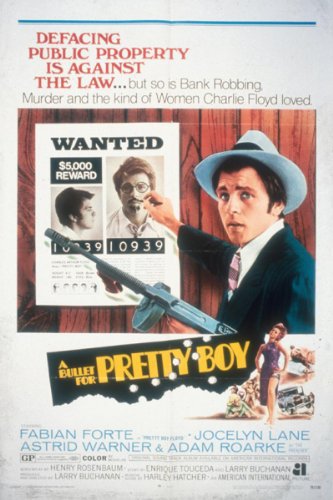
That’s certainly the way that he’s portrayed in the 1970 film, A Bullet For Pretty Boy.  Though this low-budget movie from Texas-born filmmaker Larry Buchanan opens with a title card telling us that we’re about to see a true story, it’s highly fictionalized.  Singer Fabian Forte plays Charles A. Floyd, who goes from getting married to going to jail on a manslaughter conviction in record time.  (It was all because someone was making trouble at the wedding reception so really, you can’t blame Floyd for anything that happened.)  Floyd is supposed to serve six years but he decides to break out after only serving three and a half.  Again, you really can’t blame Floyd for doing that.  No one wants to work on a chain gang.  Eventually, Floyd ends up hanging out at a brothel, where he falls in with a gang of bank robbers and a prostitute named Betty (Jocelyn Lane) ends up falling for him.  After several bank robberies and gunfights, Floyd ends up working with an outlaw named Preacher (Adam Roarke).  Everyone does not live happily ever after.

While watching A Bullet For Pretty Boy, it’s pretty easy to see the influence of the 1967 film, Bonnie and Clyde.  There’s a lot of sudden bursts of violence (though never quite as bloody as the violence from Bonnie and Clyde) and the film is clearly on the side of Pretty Boy Floyd as opposed to the cops trying to catch him.  However, whereas Bonnie and Clyde presented its title characters as being rebels against the establishment, A Bullet For Pretty Boy is content to portray Floyd as just being someone who ended up in a bad set of circumstances and who did what he felt he had to do to survive.  As played by Forte, Floyd is good at robbing banks but he doesn’t seem to really enjoy doing it.  That, of course, is a polite way of saying that Fabian Forte is credible but slightly boring in the lead role.  He’s likable enough but he’s not exactly compelling and he often finds himself overshadowed by more energetic performers like Adam Roarke.

That said, I enjoyed A Bullet For Pretty Boy.  Certainly, this film is better than the typical Larry Buchanan film.  There aren’t any slow spots and the film does a good job of capturing the feeling and atmosphere of rural Texas and Oklahoma.  (Undoubtedly it helped that the film was directed by a Texan who actually knew something about the communities that he was portraying.)  The shoot outs and the bank robberies are just well-staged enough to hold your attention and that’s really the main thing that one can ask from a film like this.  A Bullet From Pretty Boy doesn’t exactly make a lasting impression but it’s entertaining enough while you’re watching it.
The TSL’s Grindhouse: The Murder of Nicole Brown Simpson (dir by Daniel Farrands)


Last year, I was one of the few people willing to defend The Haunting of Sharon Tate, which I felt was an effective film despite its rather icky premise.  I thought that the film managed to maintain a compelling atmosphere of dread and I also thought that, though somewhat miscast, Hilary Duff gave a good performance in the lead role.  Finally, I felt that, despite the exploitative nature of the film, the film was firmly on the side of Sharon Tate and the other victims of the Manson Family.  Though the title may have been offensive, the film itself was better than it had any right to be.

I really can’t say the same for The Murder of Nicole Brown Simpson, which is from the same production team as The Haunting of Sharon Tate and which imagines the final days in the life of another famous homicide victim.  Mena Suvari stars as Nicole Brown Simpson, the ex-wife of football player OJ Simpson (played, in a hyperactive manner, by Gene Freeman).  The film follows Nicole as she deals not only with her abusive ex-husband but also with shady friends like Faye Resnick (Taryn Manning) and slightly less-disreputable friends like Kris Jenner (Agnes Bruckner).

In the film, Nicole also has a short-lived affair with a handsome but unstable drifter named Glen Rogers (Nick Stahl).  In real life, Glen Rogers is currently incarcerated in Florida, where he awaits execution for a series of murders.  Rogers has confessed to killing people all across the country, though there’s some doubt as to whether or not Rogers was being honest when he did so.  (Rogers later recanted the confession.)  Rogers’s brother has claimed that Glen confessed to murdering Nicole Simpson and Adam Goldman, saying that he was actually hired to do so by OJ Simpson.  (Technically, Glen Rogers said that Simpson hired him to steal some jewelry but also gave him permission to kill Nicole if he felt that it was necessary.)  The film presents Rogers’s story as being fact, complete with a scene of OJ meeting with Glen shortly before the murders occur.

Other than making the case that Glen Rogers murdered Nicole and Ron, the majority of the film is just Mena Suvari walking around Los Angeles and talking to her friends about how she has a feeling that something terrible is going to happen.  Whereas The Haunting of Sharon Tate was willing to challenge the audience’s expectations by, at least briefly, changing history and presenting an alternate version of what could have happened that day in 1969, The Murder of Nicole Brown Simpson is pretty much a grim march towards death, with each scene bringing the audience closer and close to the night of the actual murderers.  If the film actually presented Nicole as being a fully-realized character as opposed to just a doomed victim, the story’s fatalistic atmosphere would work on an existential level but since the film doesn’t seem to care about who Nicole was before she died, it all just feels very sleazy.

Towards the end of the film, there’s an odd scene where an unseen force suddenly starts to violently throw Nicole across her bedroom, sending her against the walls and, at one point, pinning her to the ceiling.  It’s a weird scene because it comes out of nowhere and it’s never explained whether it really happened or if Nicole was imagining being attacked.  It doesn’t belong in this film and yet, it’s also the only moment when this film feels in any way unpredictable.  Is the film trying to suggest that death, as a paranormal entity, was stalking her even before the night of her murder or was the scene just tossed in to liven up what is otherwise a rather slowly paced movie?  Who knows?  Again, if the film had really explored the issue of whether or not fate is predetermined and inevitable, it would have made for a far more interesting story than the rush job that this film appears to have been.

Mena Suvari and Nick Stahl are two actors who probably deserve better than this.  Stahl is especially effective as the creepy but handsome Glen Rogers.  Visually, the film is full of Hollywood glamour and ominous shadows.  It’s not a bad-looking film, at all.  Technically, The Murder of Nicole Brown Simpson is well-made but, at the same time, it’s all just so astoundingly pointless.  The memory of Nicole Simpson deserved better.


6 Trailers For 6 Films That Still Scare Lisa


I love horror movies but, unfortunately, many of them tend to get a bit less scary upon repeat viewings.  Once you already know where the vampire is going to be hiding or who the werewolf is going to attack next, it becomes a bit more difficult to fall under in the film’s chilling spell.

So, on this Halloween, I’m going to do a very special edition of Lisa Marie’s Favorite Grindhouse and Exploitation Film Trailers.  Here are six trailers for six films that still scare me, even after repeat viewings:

Invasion of the Body Snatchers (1956)

To be honest, all of the Body Snatcher films scare me, even the really bad ones.  Invasion of the Body Snatchers deals not only with the horror of conformity but also the horror of knowing what’s going on but being helpless to stop it.

The Exorcist (1973)

Maybe it’s because of my Catholic background but, despite the fact that it’s been endlessly imitated, this film scares me every time that I see it.  I think a lot of it has to do with the documentary approach that William Friedkin takes to the material.

Shock (1977)

Mario Bava’s final film gets me every time.  Even though I now know how many of the big scares were actually pulled off, this movie still makes me jump.  In this film, Daria Nicolodi gives the best performance of her legendary career.

The Shining (1980)

Agck!  Those little girls!  That elevator full of blood!  The way Wendy kept interrupting Jack while he was trying to write!

Sinister (2012)

Sinister gave me nightmares the first time that I saw it and it still does.  That ending.  AGCK!

The Conjuring (2013)

This is definitely one of the best haunted house films to come out over the past ten years.  This film is scary because you actually care about the family in the house.  They’re not just disposable victims.  Also holding up well is The Conjuring 2.

Happy Halloween!

“Happy Halloween!”

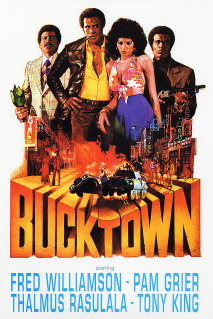
The TSL’s Grindhouse: Bucktown (dir by Arthur Marks)


Welcome to the town of Buchanan!

It’s a small Southern town, popularly known as Bucktown.  It’s a town where you can literally get anything, as long as you know who to pay off.  Upon arriving, don’t be surprised if a little kid approaches you and asks you what you’re looking for.  He can get it for you.  That kid had connections!

The population of Buchanan is almost entirely African-American but all of the cops are white.  Under the leadership of the redneck police chief (Art Lund), the cops have turned Buchanan into their own private kingdom.  If you want to do anything in Buchanan, you have to be ready to pay the cops for protection.  Refuse and you’ll get arrested.  Continue to refuse and you’ll probably end up getting shot.

Obviously, someone needs to clean up Buchanan?  But who!?

How about Duke Johnson (Fred Williamson)?  Duke’s brother owned the hottest nightclub in Bucktown, Club Alabama.  Or, at least he did until he announced he wasn’t going to pay anymore protection and he ended up getting gunned down by the cops.  When Duke arrives in town, he thinks that he’s just going to stay long enough to attend the funeral and sell his brother’s bar.  However, when Duke find out that he has to wait 60 days until he can sell the bar, he decides to stick around.  Not only does he move in with his brother’s former lover, Aretha (Pam Grier), but also reopens the Club Alabama.

Soon, the cops are coming around and demanding their share.  However, they quickly discover that no one tells Duke Johnson what to do.  Like all good action heroes, Duke has friends all over the country.  He places a call to Roy (Thalmus Rasulala) and soon, Roy, TJ (Tony King), and Hambone (Carl Weathers) show up in Bucktown.  They quickly wipe out the corrupt police force.  The local citizens are so happy that they make Roy the new police chief and his men the new police force.

Unfortunately, that turns out to be a mistake.  Apparently, giving some totally random dude complete and total authority to enforce the law in whatever he sees fit isn’t always the best way to handle things.  Roy and his men quickly become just as corrupt as the old redneck policemen.  The only thing protecting Duke is his friendship with Roy but even that is endangered when T.J. decides that he wants Aretha for himself.  T.J. decides to turn Roy and Duke against each other.  It all eventually leads to an epic fist fight, with the winner earning the right to remain in Bucktown…

(Of course, you may be wondering why anyone would want to remain in Bucktown as the place is kind of a dump, regardless of who’s in charge.)

Released in 1975, Bucktown is a pretty basic action film but I liked it because it appealed to all of my anti-authoritarian impulses.  There have been so many movies about what it takes to clean up a town but there haven’t been many made about what actually happens after all of the corrupt cops and greedy businessmen have been kicked out.  Thalmus Rusulala was great as the charismatic but dangerous Roy and Tony King, a favorite of Italian exploitation fans everywhere, was an effective villain.  Pam Grier doesn’t get to do much but she does the best with what she’s provided.  Of course, the entire film is dominated by Fred Williamson, who may not have been a great actor but who had an undeniable screen presence.  Williamson struts through the film like the hero of stylish Spaghetti western.

Bucktown is an entertaining 70s action film.  Though it doesn’t deeply explore any of the issues that it raises, it still deserves some credit for raising them.  If nothing else, it’s a film that shows why Fred Williamson retains a cult following to this day.