4 Shots From Horror History: The 1900s


This October, I’m going to be doing something a little bit different with my contribution to 4 Shots From 4 Films.  I’m going to be taking a little chronological tour of the history of horror cinema, moving from decade to decade.

Today, we look at the 1900s.

4 Shots From 4 Films

Bluebeard (1901, dir by Georges Méliès)

Bluebeard (1901, dir by Georges Méliès)

The Monster (1903, dir by Georges Méliès)

The Monster (1903, dir by Georges Méliès)

Satan At Play (1907, dir by Segundo de Chomón)

Satan At Play (1907, dir by Segundo de Chomón)

The Sealed Room (1909, dir by D.W. Griffith)

The Sealed Room (1909, dir by D.W. Griffith)

Horror on the Lens: The Avenging Conscience (dir by D.W. Griffith)


Hi there and welcome to October!  This is our favorite time of the year here at the Shattered Lens because October is our annual horrorthon!  For the past several years (seriously, we’ve been doing this for a while), we have celebrated every October by reviewing and showing some of our favorite horror movies, shows, books, and music.  That’s a tradition that I’m looking forward to helping to continue this year.

This year, we’re getting things started with a movie that has been called “the first American horror film.”  In 1914, D.W. Griffith released The Avenging Conscience, a melodrama that was based on Edgar Allan Poe’s The Tell-Tale Heart and Annabel Lee.  In this film, The Nephew (Henry B. Walthall) falls in love with the Sweetheart (Blanche Sweet).  However, the Uncle (Spottiswoode Aiken) is opposed to the relationship, mostly because the Sweetheart is a “common” woman.  Despite having been raised by the Uncle, the Nephew snaps and murders him.  The Nephew then finds himself tortured not just by his own guilt and fear but also by vivid hallucinations.  This is a film that invites us to come for the murder and stay for the reminder that “Thou Shalt Not Kill.”

Like a lot of the films of the silent era, it will require a bit of patience on the part of modern viewers.  It takes a while to get going but the surreal imagery and Henry B. Walthall’s increasingly unhinged performance make it worth sticking with.  If nothing else, the film’s historical significance makes it one worthy to be seen by all serious horror fans.

Enjoy!

4 Shots From Horror History: Bluebeard, The Monster, Satan At Play, The Sealed Room


This October, I’m going to be doing something a little bit different with my contribution to 4 Shots From 4 Films.  I’m going to be taking a little chronological tour of the history of horror cinema, moving from decade to decade.

Today, we look at the 1900s.

4 Shots From 4 Films

Bluebeard (1901, dir by Georges Méliès)

Bluebeard (1901, dir by Georges Méliès)

The Monster (1903, dir by Georges Méliès)

The Monster (1903, dir by Georges Méliès)

Satan At Play (1907, dir by Segundo de Chomón)

Satan At Play (1907, dir by Segundo de Chomón)

The Sealed Room (1909, dir by D.W. Griffith)

The Sealed Room (1909, dir by D.W. Griffith)

The Seventh Annual Academy Awards: 1920


Over on Through the Shattered Lens Presents the Oscars, we are reimagining Oscar history, one year at a time. Today, we take a look at 1920. Prohibition goes into effect, women finally get the right to vote, Harding is elected President, D.W. Griffith finally gets some recognition, and Fatty Arbuckle is the most popular man in Hollywood!

Lisa Marie Bowman's avatarThrough the Shattered Lens Presents The Oscars

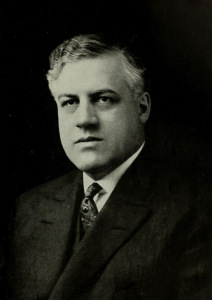
William S. Hart, the Third President of AMPAS William S. Hart, the Third President of AMPAS

1920 was a year of many changes.

On January 16th, the 18th Amendment went into effect and prohibition became the law of the land.  Suddenly, it was illegal to transport and sell alcohol in the United States.  As social reformers rejoiced, the government grew and ordinary citizens started to hoard whatever liquor they had.  (Selling alcohol was illegal but drinking it was not.)  Perhaps the people happiest about prohibition were the gangsters who now had a totally new market to exploit.

On August 26th, the 19th amendment to the U.S. Constitution passed and, finally, all women were granted the right to vote.  And it came not a minute too late because it was time for the United States to elect a new president.  Weary after the nonstop drama of  8 years of Woodrow Wilson, the American electorate turned to Warren…

View original post 1,342 more words

The Sixth Annual Academy Awards: 1919


At the 1919 Academy Awards, Evelyn Preer makes history, Harry Houdini is rewarded for playing himself, and Bolshevism goes on trial!

Jedadiah Leland's avatarThrough the Shattered Lens Presents The Oscars

Attorney General A. Mitchell Palmer Attorney General A. Mitchell Palmer

In 1919, as the Spanish Flu continued to infect and kill millions, the world tried to recover from World War I.  After spending six months at the Paris Peace Conference, President Woodrow Wilson returned to the U.S. and launched an ultimately unsuccessful campaign to bring the United States into the newly formed League of Nations.  On September 25th, while barnstorming across the nation in support of the League, a physically exhausted Wilson collapsed and never truly recovered.  On October 2nd, a stroke left him partially paralyzed and blind in one eye.

Even before Wilson’s physical collapse, the U.S. population had reason to feel uncertain about the future.  On January 6th, the wildly popular Theodore Roosevelt died in his sleep.  Before his death, Roosevelt had been widely expected to run for President in 1920 and hopefully return the U.S. to the peace and prosperity…

View original post 1,108 more words

The Fifth Annual Academy Awards: 1918


Over on Through the Shattered Lens Presents the Oscars, we are continuing to reimagine Oscar history, one year at a time! Today, we take a look at the year 1918. World War I ended, the Spanish Flu wiped out 5% of the world’s population, and the Academy embraced Tarzan of the Apes!

Lisa Marie Bowman's avatarThrough the Shattered Lens Presents The Oscars

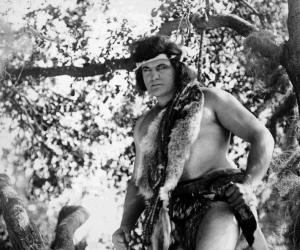
A scene from Tarzan of The Apes A scene from Tarzan of The Apes

1918 was a year of dominated by war and pestilence.  As the world seemed to be intent on destroying itself, both the Academy and American filmgoers embraced escapism.

Overseas, the Great War continued to drag on.  With no end to the fighting in sight, there were fears that the American public would turn against the war and their elected leaders would withdraw American soldiers from the fighting.  The British government, realizing the potential of film as a propaganda tool, contacted director D.W. Griffith and offered to help him make a film.  The end result was Hearts of the World, an epic war film that starred Lillian Gish as a French girl who struggles to survive and find true love as the Germans raid her village.

Though Gish would later say that Griffith was displeased with the pro-war tone of Hearts Of The World

View original post 1,357 more words

The Third Annual Academy Awards: 1916


Over on Through the Shattered Lens Presidents the Oscars, Jedadiah Leland and I have been reimagining Oscar history, one year at a time! Today, we take a look at 1916, the year of Thomas H. Ince, Civilization, and Intolerance!

Lisa Marie Bowman's avatarThrough the Shattered Lens Presents The Oscars

Thomas H. Ince, the 2nd President of AMPAS Thomas H. Ince, the 2nd President of AMPAS

In the long history of the Academy of Motion Picture Arts and Sciences, 1916 was dominated by one man: Thomas H. Ince.

Today, Ince is a largely forgotten figure and his many accomplishments have been overshadowed by the mysterious and potentially sordid circumstances of his death in 1924.  However, in 1916, Ince was one of the most popular figures working in the film industry.  He was the first producer to build his own studio in California and, with D.W. Griffith and Academy President Mack Sennett, founded the Triangle Motion Picture Company.  When, following the 2nd Academy Awards ceremony, Sennett announced the he would not be running for a second term as president of the AMPAS, Ince was the obvious choice to replace him.

As President, Ince immediately launched a recruiting drive to bring more industry professionals into the organization…

View original post 1,487 more words

The Second Annual Academy Awards: 1915


Continuing to reimagine Oscar history one year at a time, LMB and I take a look at what 1915 could have been.

Jedadiah Leland's avatarThrough the Shattered Lens Presents The Oscars

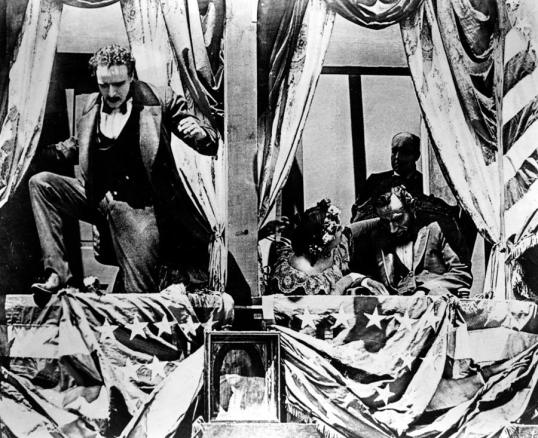
John Wilkes Booth (Raoul Walsh) flees after shooting Abraham Lincoln in D.W. Griffith's Birth Of A Nation John Wilkes Booth (Raoul Walsh) flees after shooting Abraham Lincoln in D.W. Griffith’s Birth Of A Nation

The second annual Academy Awards were handed out on January 20th, 1916.  For the second and final time, the ceremony took place in the Empire Room of the Waldorf Hotel in New York City.  Just as in the previous year, the awards were handed out after dinner and a speech from Academy President Mack Sennett.  Again, the winners were announced before the actual ceremony and were given certificates of achievement.  According to contemporary reports, the winners who were present all gave brief acceptance speeches but nobody bothered to record what anyone said.

As in the previous year, winners were selected by a jury of distinguished citizens.  The 1915 jury consisted of:

  1. Harry Chandler, businessman
  2. Owen McAleer, former mayor of Los Angeles, California
  3. Ellery Sedgwick, publisher of…

View original post 794 more words

Embracing the Melodrama Part II #4: The Struggle (dir by D.W. Griffith)


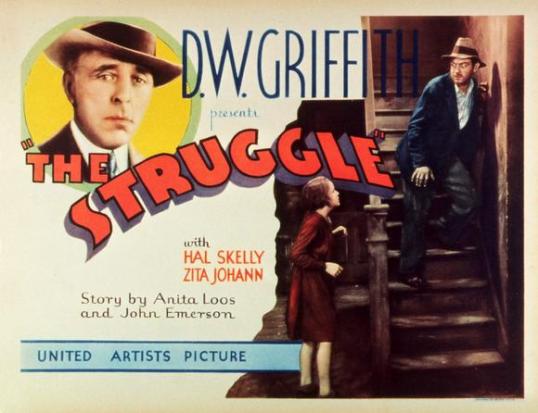
The Struggle

Like a lot of the films directed by cinematic pioneer D.W. Griffith, the 1931 film The Struggle is currently available on Netflix.  As a result of his direction of the film Birth of the A Nation, Griffith is a controversial historical figure but it cannot be denied that he was one of the most ambitious, talented, and innovative of the silent filmmakers.  Unfortunately, like a lot of the great figures of silent film, he did not survive the transition to sound.  Griffith directed two sound films.  Abraham Lincoln is overly theatrical while The Struggle … well, bleh.

The Struggle tells the story of a married couple whose marriage is threatened by the husband’s alcoholism.  Florrie (Zita Johann) only agrees to marry Jimmie (Hal Skelly) on the condition that he stop drinking.  And, for several years, Jimmie doesn’t touch a drop of liquor.  But, under pressure at work and struggling to support his family, Jimmie finally breaks down, steps into a speakeasy (this film was made during prohibition), and has a drink.  Soon, Jimmie is a full-blown alcoholic, wandering the streets of New York while little school children shout, “He’s a beggin’ bum!” at him.  Will Jimmie’s life be turned around as the result of hearing a sermon the radio?  Or will he just keep drinking himself to death?

This was the last film on which Griffith was credited as being director.  (Reportedly, he was an uncredited co-director on San Francisco.)  It’s obviously a heart-felt work but, outside of the harrowing shot-on-location scenes of the unshaven Jimmie stumbling down the streets of the Bronx, the film is too overly theatrical and the performances are too stiff and unconvincing to really work.  Griffith was still a visual stylist but, watching The Struggle, it’s obvious that he never learned how to work with speaking actors.  As well, dialogue that would have worked on a title card came across as being over-the-top and preachy when actually uttered aloud.

That said, The Struggle has some interesting historic value, especially for those of us who tend to take the Libertarian point of view when it comes to the war on drugs.  The Struggle opens with a scene that is set at a garden party in 1911.  We listen to various conversations being held at each table.  Two people debate whether the Biograph Girl is named Mary Pickford or Mary Packard.  A man declares that Woodrow Wilson will never be President because he’s a college professor.  (This is all the 1931 equivalent of that scene in Titanic where Billy Zane says that a painting was done by “Somebody Picasso.  I’m sure nothing will ever become of him….”)  Suddenly, scandal hits the garden party as it’s discovered that a woman has had too much to drink and is now drunk.  Everyone at the party, on their own, shuns the woman and she is properly shamed.

The film jumps forward to 1923.  Prohibition is now the law of the land and we find ourselves in a speakeasy.  The thing that we immediately notice is that there are a lot more people in the speakeasy than were at that garden party and every single one of them is drunk.  And, since liquor in now illegal, it’s no longer being bought from safe and trustworthy sources.  Instead, it’s now being brewed in a back room.  One bootlegger holds up a bottle of prohibition liquor and announces it to be poison before then sending it out to be drunk by the Jimmies of the world.

The film’s point, of course, is that community is a lot better when it comes to policing itself than the government is.  The Struggle may not be a great film but it certainly has the right message.

Shattered Politics #1: Abraham Lincoln (dir by D.W. Griffith)


Unlike just about everyone else that I know, I am about as apolitical as you can get.

Oh, don’t get me wrong.  I always vote.  I believe in …. stuff.  Occasionally, I get angry about the state of the world. Why I’ll have you know that when I first registered to vote, I was really, really excited and I even sat down and researched every single person who was running for President.  (And, of course, I decided I would support John Edwards because he had good hair.  But then I changed my mind and ended up voting for Charles Jay, the candidate of the Personal Choice Party.)  But, for whatever reason, current events have never become the obsession for me that they are for some people.  You’ll never catch me posting a political meme or sagely agreeing with an activist on Facebook.  It’s just not for me.

(On the plus side, this has allowed me to have friends with many diverse viewpoints and generally lead a happy life.)

At the same time, I’m also fascinated by history and history is often the story of politics and politicians.  As a result, I’m far more interested in past affairs than I am in current affairs.  I can spend hours talking about the election of 1876 but I could hardly care less who is elected in 2016.  I know my political history well enough not to worry about the political present.

Perhaps that explains why, despite my indifference to politics, I tend to enjoy political movies.  And that leads us to my latest review series here at the Shattered Lens.  Over the next two weeks, I will be reviewing, in chronological order, 94 films about politics and politicians.  It’s a little something I call Shattered Politics.

(For some previous examples of what I mean by review series, check out Lisa’s Homestate Reviews, Lisa Goes Back To College, Netflix Noir, 44 Days of Paranoia, Embracing the MelodramaBack To School, and, of course, Lisa’s Marie’s Favorite Grindhouse and Exploitation Film Trailers!)
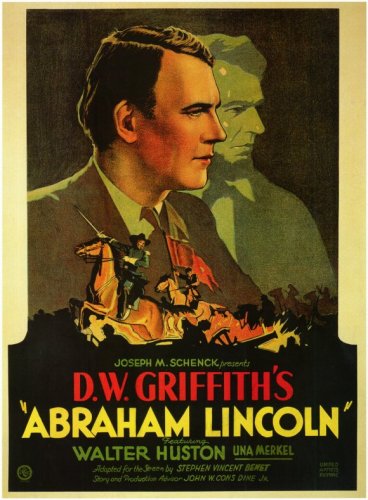
abraham-lincoln-movie-poster-1930-1020198617


We start things off with a film from 1930.  One of only two sounds films to be directed by cinematic pioneer D.W. Griffith, Abraham Lincoln is — as you might guess from the title — a 90 minute biopic about the 16th President of the United States.  It tells the same basic story as Lincoln, just in a lot less time and with Walter Huston playing the title role.  The film opens in 1809 with his birth then speeds forward to detail his tragic love affair with Ann Rutledge (played by Una Merkel) and his subsequent marriage to Mary Todd (Kay Hammond).  We get a snippet of the Lincoln-Douglas debates and then, just as quickly, Abe is President, the country plunges into civil war, and an alcoholic actor named John Wilkes Booth (Ian Keith) is meeting with disreputable looking men in a shadowy bar and making shadowy plans.

Any honest review of this version of Lincoln’s life needs to deal with the obvious.  Abraham Lincoln was released 84 years ago, at a time when the film industry was still struggling to make the transition from silent to sound film.  In other words, the film is stiff, stagey, and full of actors who alternate between shouting their dialogue and delivering their lines through nervously clinched teeth.  This is essentially a silent film — complete with overdramatic title cards and heavy-handed symbolism — that just happens to feature some very awkwardly delivered dialogue.  Walter Huston is occasionally effective as Lincoln but, just as often, he’s not.

However, Abraham Lincoln is fascinating to watch from a historical point of view.  It helps if you know a little something about director D.W. Griffith.  Almost all of the narrative techniques that we now take for granted were originally introduced to cinema by D.W. Griffith and many of them were introduced in his controversial 1915 epic, The Birth of a Nation.  

Of course, Griffith’s legacy is problematic precisely because of The Birth of a Nation.  An epic look at the Civil War, Birth not only featured white actors in black face menacing Lillian Gish but also ended with the Ku Klux Klan heroically riding to the rescue.  That even viewers in 1915 were critical of the film’s racism and overly pro-Confederate sentiments should tell you something about just how extreme the film truly was.

(That said, one huge fan of the film was U.S. President and aspiring dictator Woodrow Wilson.)

By most accounts, Griffith was stunned by the negative reaction to The Birth of a Nation and several of his subsequent films (most famously, Intolerance) were meant to answer his critics.

That’s what makes the opening scenes of Abraham Lincoln all the more interesting.  The film opens in 1809 with a shot of a ship on the ocean.  We catch a glimpse of the Africans chained in the lower decks.  Two white slave traders are seen carrying a dead body to the side of the ship and tossing it overboard.

We cut to Virginia, where we see a group of slave owners complaining about how the North is harming them financially by trying to end the slave trade.  One of the men says that the only man who could have kept the north and south united is dead.  The camera pans up to a picture of George Washington.

Then, the scene cuts to Boston.  A group of northerners sit around a table and talk about how slavery is harming the north economically and therefore, it has to end.  One of the northerners says that the only man who could have kept north and south united is dead.  Again, the camera pans up to a picture of George Washington.

And, it’s a wonderfully effective sequence, one that not only reveals the economic reasons behind most wars but one which also reveals the cruelty, inhumanity, and pure evil of slavery.  (That said, when the film later shows us a glimpse of life in the Confederacy, Griffith does include a couple of slaves cheerfully dancing in the background.)

And, as awkward as the scenes involving dialogue are (the less said about the scenes between Walter Huston and Una Merkel, the better), Griffith does occasionally show the visual flair that was his trademark.  One excellent sequence involves soldier after soldier lining up, one after the other and each of them staring straight into the camera as they prepare to go to war.  When the film concentrates on scenes of men marching across the countryside, it actually works.

Then again, you may just want to see the film for the chance to hear one extra, when asked the identity of a man giving a fiery speech, awkwardly explain, “That’s the actor, John Wilkes Booth.  Not much of an actor but he’s got a way with the ladies!”

It’s really up to you.
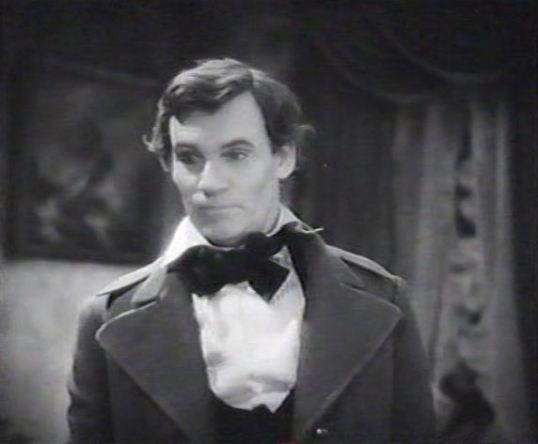
Walter Huston as Abraham Lincoln

Walter Huston as Abraham Lincoln