October Positivity: The Moment After (dir by Wes Llewellyn)


1999’s The Moment After opens with the world in a panic.  Millions of people have suddenly vanished into thin air, leaving only their clothes and their loved ones behind.  On a news program, three expects are brought in to discuss what might have happened.  A New Age-y woman argues that “Mother Earth” is eliminating overpopulation.  A wild-eyed man argues that people have been abducted by UFOs.  And finally, a man with a neatly trimmed beard argues that it’s the rapture.  The bearded man is dismissed as being a crank.

Two FBI agents — Adam Riley (David A.R. White) and Charles Baker (Kevin Downes) — are assigned to investigate the disappearances.  Charles is himself shaken because he knew a few people who disappeared.  As they drive around the city and talk to people, they hear the same story.  People who went to church regularly and were Christian vanished while their less faithful loved ones watched.  Adam comes to suspect that there might be something to the Rapture Theory.  Charles, bitter because his wife recently suffered a miscarriage, has no time for it.

As often happens in a crisis, the government grows heavy-handed and sinister.  The President announced that he’s going to follow the lead of Europe and “suggest” that everyone get a chip implanted in their hand.  Charles gets the chip without hesitation.  Adam keeps finding excuses to put it off, even though he’s mandated to get one as a federal employee.  With the country turning into an authoritarian dystopia, Charles and Adam are assigned to track down a renegade preacher (Brad Heller), who is telling his followers not to get chipped.

Stories about the end time have always been popular when it comes to faith-based films.  A lot of that is because the Book of Revelations is written in such a way that there’s a lot of different ways that one can interpret it.  As a result, it’s always interesting to see how “the mark of the Beast,” will be represented in these films.  Sometimes, it’s a tattoo.  Sometimes, it’s an invisible mark that only demons can see.  In this one, it’s a chip that works as a credit card.  And while it’s easy to scoff at this film’s conspiracy theories and the shots of people staring at their palms, some of us still remember how, during the COVID lockdowns, there were more than a few people in positions of influence who argued that the citizenry shouldn’t be allowed in stores or restaurants or anywhere else unless they could show proof they had gotten the vaccine and kept up with the boosters.  There were even some who said that the National Guard should go door-to-door and force the shot on people.  (For the record, I did get the vaccine but, when I started hearing about monthly boosters and all that other stuff, I decided that one shot was more than enough for me.)  There is definitely an authoritarian impulse out there, one that comes out whenever there’s a crisis.  One reason why films like this one continue to find an audience is because real-life governments often behave like the dictatorship portrayed in The Moment After.  Of course, in the movie, everyone can at least say they were influenced by the Devil.  In real life, it just comes down to pettiness and a need to tell other people what to do.

As for The Moment After, it’s a low-budget but fairly well-done thriller, one that keeps the preaching to a minimum and doesn’t feature a lot of the problematic elements that one tends to find in movies like this.  White and Downes both give effective performances.  It avoids the histrionics that tend to define a lot of other apocalyptic films.  This is not a film that’s going to convert anyone but it does a good enough job creating an atmosphere of paranoia and growing dread that it works as a thriller.

October Positivity: The Wager (dir by Judson Pearce Morgan)


In 2007’s The Wager, Randy Travis plays Michael Steele, an Oscar-nominated actor who….

Stop laughing, that’s not nice.

Okay, I’ll be the first to admit that Randy Travis is not exactly the first person that I would cast as an Oscar-nominated actor.  And, I’ll also be the first to admit that having Randy Travis act in this film makes it even harder to believe him as someone who could someday be nominated for an Oscar.  A lot of country music stars have tried their hand at acting and most of them have been able to survive on the basis of their own authenticity.  But there’s nothing authentic about Travis’s performance here.  Even when he picks up a guitar and sings a song about the difficulties that he’s facing, he’s not convincing.  In this, it’s not so much that Travis is a stiff actor as he just seems to evaporate whenever he’s on screen.

As for the film, Michael Steele is an actor who is known for his strong faith and his refusal to do sex scenes.  When a director (Bronson Pinchot) throws a fit over Steele’s refusal to shoot once such scene, Steele says that he’ll do the scene but only if it’s followed by a scene in which his co-star has to deal with being a single mother.  OUCH!  Michael Steele seems like he’s fun at parties….

(Apparently, it doesn’t occur to Michael that his character could wear a condom.)

Wait a minute.  This guy has the same name as that jackass who is always on the news talking about how he’s a Republican who thinks everyone should vote for the Democrats.  I wonder if that’s intentional.  Anyway….

Michael Steele’s career has had its up and downs.  His recent divorce from Annie (Nancy Stafford) has damaged his family friendly image.  But his Oscar nomination and the fact that he’s expected to win has once again made the world’s most popular star.  But then — scandal!  A tabloid photographer snaps a picture of Michael talking to a young actress at his house.  In the background, a little kid watches.  Now, the kid is a part of the Big Brother program and Michael was just trying to help the younger woman with her career but it doesn’t matter.  Soon, Michael finds himself being portrayed as being some sort of pervert.  When he punches a photographer, he finds himself getting arrested — RIGHT IN FRONT OF HIS CHURCH!

Now, as you may have guessed, this is yet another retelling of the story of Job, with Michael having his faith tested by one disaster after another.  He doesn’t lose his faith and, as a result, he wins both an Oscar and he also becomes a hero when he rescues the kid from the Big Brother program from his abusive stepfather.  Anyone who thinks that God wouldn’t have a hand in who wins an Oscar obviously did not listen to Will Smith’s acceptance speech.

The Wager is a film that would probably not be made today.  Today, you’re not likely to see a socially conservative, faith-based film where a successful actor is wrongly accused of being a pervert.  Then again, you also probably wouldn’t see a politically liberal film in which a successful white male actor was wrong accused of being an abuser, not in today’s cultural climate.  On both the Left and the Right, attitudes towards Hollywood have changed.  Beyond the film’s political and cultural subtext, its portrait of the Oscars as being the most important event of the year also feels rather old-fashioned.  I imagine it felt old-fashioned in 2007 as well….

Then again, this is a film in which Randy Travis plays the best actor of his generation so perhaps it’s best not to take any of it too seriously.  The miscasting of Travis pretty much sabotages the movie from the start but, on the positive side, Bronon Pinchot is amusing as a bitchy director and Jude Ciccolella has a few good scenes as Michael’s supportive agent.  Give those men an Oscar!

October Positivity: Time Changer (dir by Rich Christiano)


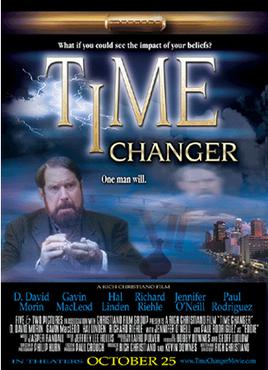
The 2002 movie, Time Changer, tells the story of Russell Carlisle (D. David Morin).  Russell is a bible professor who has written a book called The Changing Times.  The Changing Times encourages everyone to live a good, moral life but it doesn’t specifically state that they should live a good, moral life because Jesus says so.  Dr. Norris Anderson (Gavin MacLeod) argues that the book will actually not lead people to become better but will instead lead them away from Christianity by convincing them that all they have to do is be nice.  Carlisle disagrees.

Luckily, Anderson just happens to have a time machine in his basement!  When Russell comes over to discuss the book, Anderson suggests that Russell go into the future and see just how changed the world has become.  Mostly to humor Anderson, Russell agrees and steps into the machine.

And suddenly, Russell Calirlise is in the year 2002!

What does Russell discover?  He learns that even movies about good people still feature things that he finds objectionable.  He discovers that even people who go to church don’t always live a perfect life.  In 1890, Russell was shocked to learn that the divorce rate was 5% so you can only imagine how he reacts when he goes to 2002 and continually runs into people who talk about their ex-wives.  Russell also gets upset when he hears some teenage girls talking about sneaking out of the house and going on an unchaperoned date.  The horrors!

To be honest, there’s been a lot of movies that have told similar stories to Time Changer.  Someone from the past comes to the “present,” and is shocked to discover how much the world has changed.  Time Changer is unique that it’s totally on Russell’s side and essentially argues that we would all be better off if we still embraced the culture of the 1890s.  If that sounds a bit preachy, that’s because it is a bit preachy.  Interestingly enough, the film has no trouble having Russell explain how he, as someone from 1890, feels about dating, entertainment, and honesty but it leaves out how an 1890 man like Russell would have viewed women or people of color.  Russell is shocked by the casual use of bad language but, conveniently for the film’s efforts to make him a sympathetic character, he doesn’t raise an eyebrow at suddenly finding himself in a multiracial society.  It’s easy to argue for a return to 1890 morality when you ignore everything that was bad about the 1890s.

That said, the film has a few intentionally amusing moments, even if they’re exactly the type of moments that you would expect to see in a film about time travel.  (For example, Russell finds himself fascinated by a light switch.)  D. David Morin gives a likable performance Russell and the scene where Anderson hurriedly explains how time travel works as a nice little satire of the genre.  It’s far too preachy to really be effective but Time Changer is not a total waste of time.  That said, I would far rather live in 2022 than 1890.