Today’s scene that I love comes from Lucio Fulci’s 1981 masterpiece, The Beyond.
Liza (Catriona MacColl) meets the mysterious Emily (Cinzia Monreale) on one of Louisiana’s famous bridges to nowhere. This scene is Fulci at his most dream-like.
Today’s scene that I love comes from Lucio Fulci’s 1981 masterpiece, The Beyond.
Liza (Catriona MacColl) meets the mysterious Emily (Cinzia Monreale) on one of Louisiana’s famous bridges to nowhere. This scene is Fulci at his most dream-like.
The Stendhal Syndrome is a real thing.
First noted by the author Stendhal, Stendhal Syndrome is something that happens when one is confronted by a sight that they never expected to see in person. Usually, it’s a work of great art that triggers the condition and the viewer becomes so overwhelmed by the sight of it that they’re left disorientated and even dizzy. People have reported it happening while visiting museums or historical cities. Recently, a few teenagers made the news when they claimed to have felt the syndrome’s symptoms while at a Taylor Swift concert.
I know that it’s a real thing because I’ve actually experienced Stendhal Syndrome. I was in Florence, the summer after I graduated from high school. One minute, I was fine and even feeling a little bratty, as one does when they’re 18 and they have their entire future ahead of them. But then I looked up at the sky and I saw the skyline of Florence, with its mix of the ancient and the modern and I suddenly became aware that I was in one of the oldest cities in the world and that I was standing on a street that had existed for centuries and I was looking at buildings and statues and paintings that most people would never get a chance to see in person and suddenly, the entire world seemed to be spinning around me. I had to actually sit down for a few minutes to catch my breath because I was so overwhelmed with emotion. My sisters assumed I was having an asthma attack but, even then, I understood that I was feeling something far different. At that moment, history become very real for me and I understood that I existed in the same universe as every great artist and writer. We were all a part of the same existence.
Dario Argento’s 1996 film, The Stendhal Syndrome, also takes place in Florence and features Asia Argento as Anna Mani, a police detective who is sent to the city to capture a serial killer. When Anna visits a museum, she is overwhelmed by what she sees. When she looks at Botticelli’s The Birth of Venus, she hears the wind that blows Venus’s hair. When she views Bruegel’s Landscapes With The Fall Of Icarus she, perhaps significantly, becomes Icarus and flies through the air before crashing into the water below, where she shares a passionate kiss with a fish. In the museum, Anna faints. She drops her purse, giving Alfredo Grossi (Thomas Kretschmann) time to not only steal her gun but also the key to her hotel room.
Dazed and not even sure of who she is, Anna returns to her hotel. A copy of Rembrandt’s The Night Watch turns into a doorway, which she steps through. Finding herself on a rainy city street, Anna is reminded that she’s a detective and that she’s in Florence to catch a vicious killer. When Anna steps back into her room, she discovers that she’s not alone. Alfredo grabs her, rapes her, and abducts her. Anna manages to escape and runs through the streets of Florence while a naked and blood-covered Alfredo screams in the night, which is one of the most disturbing scenes that Dario Argento has ever given us. Alfredo continues to stalk Anna while Anna goes through some changes herself, buying a blonde wig and pursuing a relationship with a French art student (Julien Lambroschini).
The Stendhal Syndrome was the first of Argento’s film to feature CGI, not just in the scenes in which Anna enters the paintings but also in scenes where were literally follow the pills that she’s taken down her throat and where a bullet is seen to enter the face of one of Alfredo’s victims. (Alfredo looks through the resulting bullet holes and winks at Anna on the other other side.) Sometimes, the CGI is effective and sometimes it’s a bit too cartoonish for its own good. At its most effective, the CGI inspires us to wonder if Anna is seeing reality or if she’s still trapped in her Stendhal Syndrome-inspired fantasy world. The scene where disturbing graffiti comes to life may not exactly look real but it’s still undeniably effective. At other times, the special effects just come across as being a bit self-indulgent on Argento’s part.
The film is at its best when it concentrates on the cat-and-mouse game between Anna and Alfredo. As played by Thomas Kretschmann, Alfredo is one of the most terrifying characters to ever appear in an Argento film, a handsome and seemingly charming man who is actually fueled by pure evil and hate. Alfredo is a villain who takes a definite pride in his ability to hide his true nature from the rest of the world. At first, Anna seems almost too physically frail and emotionally open to be believable as a police detective but she soon proves herself to be far tougher than anyone realizes. Anna, it turns out, has secrets of her own. Shot roughly around the same time that Asia Argento was being victimized by Harvey Weinstein, the scenes where Alfredo attacks Anna are difficult to watch, as they should be. Dario Argento took a lot of criticism (particularly from his former partner, Daria Nicolodi) for casting his daughter in a role where she is assaulted but the film itself is fully on Anna’s side.
The second half of the film loses its way a bit, though I can’t go into too much details without spoiling the plot. Several of the first half’s intriguing ideas are abandoned. Asia Argento gives a strong performance during the second half of the film, one that features some of her bravest and most revealing work. That said, despite the strength of Asia’s performance, many of Anna’s actions still don’t make sense no matter how much the film tries to convince us that they do. That said, the final scenes still carries an impact.
In the end, the film uses Stendhal Syndrome as a gimmick. If you want to see a realistic film about Stendhal Syndrome, you’re probably out of luck because it’s not a condition that’s easy to capture cinematically. But, as a thriller, The Stendhal Syndrome holds up well. This is an uneven film but ultimately, what does work outweighs what doesn’t.
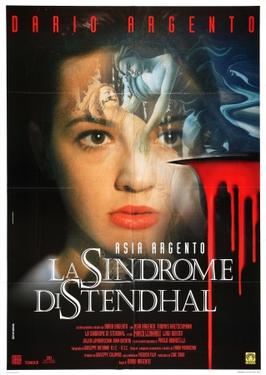
The (Reviewed) Films of Dario Argento:
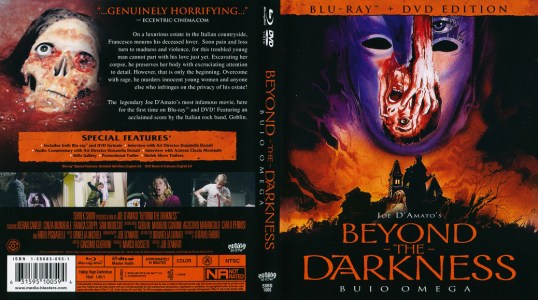
An odd film, this one is.
Now, me, I absolutely love Beyond the Darkness. However, this 1979 Italian film is definitely not for everyone and I’m always very careful about recommending it. At it’s heart, it’s a story about a man named Frank Wyler (Kieran Canter) who is so in love with Anna Volkl (Cinzia Monreale, who Italian horror fans will immediately recognize from her iconic role as Emily in Lucio Fulci’s The Beyond) that he won’t even allow death to keep them apart. At the same time, the film contains scenes of cannibalism, gore, and nudity (poor Cinzia Monreale had to spent the majority of the movie naked and pretending not to breathe) that were so graphic that the film was actually banned in several countries. Did I mention that Frank’s a taxidermist? If you’ve ever wanted to see a film about how messy taxidermy can be, I guess this would be the one to go with.
Frank is a young man who has inherited a villa in the country. He lives there with Iris (Franca Stoppi), the servant who has literally raised him from his birth. Frank is a handsome but strange man, one who spends most his time locked away in his garage and stuffing dead animals. (Before anyone panics, there’s no animal cruelty to be witnessed in this film. Though there is a bit of human cruelty….) Frank is in love with Anna but Anna has recently been taken ill. She’s in the hospital, where the doctor’s simply cannot figure out what’s wrong with her. Could it have something to do with the voodoo curse that the jealous Irish has placed on her?
When Anna finally dies, Iris is convinced that she’ll have Frank to herself but Frank has other ideas. After the funeral, Frank promptly digs Anna back up and then takes her body back to his garage. Unfortunately, along the way, an obnoxious hitchhiker (played by Lucia D’Elia) decides that Frank’s going to give her a ride. The hitchhiker ends up passing out in Frank’s van.
So, here Frank is. All he wants to do is stuff his dead girlfriend. But he’s got this obnoxious hitchhiker running around the garage and knocking over buckets of intestines! Frank kills the hitchhiker and Iris, despite being disgusted by the fact that Frank has insisted on bringing Anna home, helps him dispose of the hitchhiker’s body. The problem’s solved, except for the fact that Frank is now becoming obsessed with cannibalism….
Okay, it’s a weird film and it only gets weirder from there. As I said, it’s definitely not a film for everyone and there’s certain scenes that would be incredibly offensive if not for the fact that the film is so well-directed and Canter, Monreale, and Stoppi are all so well-cast and give such sincere performances that you can’t help but get caught up in the film’s storyline. Frank may be a spoiled, cannibalistic murderer and Anna might be dead but their love for each other is so sincere that you can’t help but feel for both of them. Director Aristide Massaccesi (who was usually credited under the name Joe D’Amato) creates an ominous and gothic atmosphere while Goblin provides a pulsating and moody score that perfectly mirror Frank’s descent into madness (Admittedly, Frank doesn’t have far to descend.) Massaccesi often said that he only made the film to gross people out but an accidental success is a success nonetheless.

Lisa has written in detail how much she enjoys Fulci’s The Beyond. From it’s Lovecraftian themes of otherworldly dangers to Fulci’s stylistic choice of focusing on characters’ eyes and blindness.
Others also love how Fulci is able to combine not just the grand guignol sequences that his films have become famous (or infamous depending on how one judges horror films) with an ethereal look to the visuals that borders the line between being dream-like and nightmarish.
This particular scene doesn’t have that grand guignol panache of Fulci’s more dynamic scenes, but it does give a hint to the desolation and etheric sense one feels seeing that empty causeway with just Liza driving on it then suddenly seeing Emily and her guide dog just standing there at the lane divider.
While I have always had a boyhood crush when it comes to Catriona McColl, I must admit that Cinzia Monreale was quite beautiful in this film even with the weird contacts she wore to show her as having being blinded by what she saw in the beyond.
David Lynch reportedly once described Eraserhead as being a “dream of dark and disturbing things” and the same description can easily be applied to Lucio Fulci’s 1981 masterpiece, The Beyond.
The second part of Fulci’s Beyond trilogy, The Beyond sits between City of the Living Dead and The House By The Cemetery. With its portrayal of naive humans getting an unwanted look at the inexplicable reality that hides just a little beyond ours, it’s a film that very much calls to the mind the work of H.P. Lovecraft. While insanity was often the punishment for gaining knowledge of Cthulhu and the Great Old Ones, the punishment for discovering the Beyond often seems to be blindness.
(Ocular damage was one of Fulci’s trademarks. Starting with Zombi 2, almost every Fulci film seemed to feature someone losing an eye. In The Beyond, a plumber played by Giovanni De Nova loses an eye while wandering about a flooded basement and, over the course of the narrative, several character are rendered blind, making them incapable of seeing the true horror of what they’re experiencing. Fulci struggled with diabetes and the threat of blindness runs through almost all of his horror films.)

The Beyond starts with a striking, sepia-toned sequence that’s set in the year 1927. While a young woman named Emily (played Cinzia Monreale) reads from a book, a mob attacks a painter named Schweik. They believe Schweik to be a warlock and they view his grotesque paintings as being proof. (In many ways, the mob is comparable to the critics who insisted on judging Fulci solely based on the subject matter of his films while ignoring the skill with which Fulci directed them.) Schweik is tortured and left crucified in the basement of the Seven Doors Hotel in New Orleans, Louisiana.
Jump forward 54 years. A woman named Liza (Catriona MacColl, who appeared in different roles in all three of the Beyond films) has inherited the long-closed Seven Doors Hotel and she’s moved down to New Orleans to reopen it. Unfortunately, her efforts to renovate the place aren’t going smoothly. It’s been one disaster after another, almost as if someone or something is trying to keep her from reopening the place. The latest was the flooded basement and the plumber who lost both his eye and his life. Of course, Liza would probably be even more concerned if she knew just what exactly it was that attacked the plumber in the first place.

While driving down one of Louisiana’s many bridges to nowhere, Liza is forced to come to a stop when she sees a blind woman and her guide dog standing in front of her car. The woman is Emily, who doesn’t appear to have aged at all since we last saw her. Emily is now blind. She tells Liza that her hotel was once home to an evil warlock and she warns her to stay out Room 36.
Meanwhile, the plumber’s wife and his daughter visit the plumber’s corpse in the morgue. This not only leads to the plumber and several other dead people coming to life but it also leads to an accident with a beaker of acid that was, for some reason, sitting on a desk. Soon, the daughter is blind herself. On the plus side, all of the drama at the hospital does give Liza a chance to meet Dr. John McCabe (played by the always welcome David Warbeck).
Fulci never got much credit for his work with actors. (Some of that, of course, is due to the fact that most of Fulci’s film were atrociously dubbed for overseas release.) However, The Beyond is definitely one of the best-acted of all of his films. In fact, one reason why we stick with the film even when things start to get really, really weird is because we genuinely like Liza and John. Warbeck and MacColl had a lot of chemistry and, in the midst of all the mayhem, they created two very real characters. Cinzia Monreale is also impressive in the role of Emily. Fulci made good use of her other-worldly beauty and Monreale keeps us wondering whether Emily is trying to help of Liza or if she has a secret agenda of her own.

(Towards the end of the film, during a zombie siege, there’s a scene where John and Liza get in an elevator and, as the doors close, Warbeck tries to reload a gun by forcing a bullet down the gun’s barrel. MacColl sees what he’s doing and breaks character, laughing as the doors close. The Italian crew apparently did not realize that Warbeck was playing a joke because this was the take that they used in the film. Needless to say, it temporarily takes you out of the film and yet it’s such a charming moment that you can’t help but love it. It’s nice to see that with all the grotesque insanity going on around them, Warbeck and MacColl were having fun.)
The Beyond gets progressively more bizarre as it continues. It doesn’t take long for Fulci to abandon any pretense of traditional narrative and the film soon becomes a collection of vaguely connected, increasingly surreal set pieces. A man goes to a library and ends up getting eaten by an army of spiders. Ghouls suddenly roam through the hallways of the hospital. Yet another person loses an eye, this time to a loose nail. Another relatively minor character suddenly has a hole in her head. A chase through the hospital’s basement leads to the characters somehow finding themselves back in the hotel. And finally, we go to the Beyond….

This is going to be heresy to some but, as much as I appreciate it, The Beyond is actually not my favorite Fulci film. Overall, Zombi 2 is my favorite and, as far as the trilogy goes, I actually prefer The House By The Cemetery. That said, The Beyond is the film that best exemplifies Fulci’s cinematic philosophy. Fulci called it pure cinema, the idea that if your visuals are strong and properly edited together, the audience will use them to supply their own narrative. That’s certainly the case in The Beyond. A lot happens in The Beyond and it’s not always clear how everything’s related. But since every scene is full of Fulci’s trademark style, the viewers builds the necessary connections in their own mind. The end result is a film that, perhaps more than any other Fulci film, capture the feel of having a dream. It’s not a film that will be appreciated by everyone. Fulci’s work rarely is. Still, for fans of Italian horror, The Beyond is one of the key films.
Fulci followed The Beyond with one of his best-known movies, The House By The Cemetery. I’ll look at that film tomorrow.

Mary and Roberto Vivaldi (played by Lubka Lenzi and Pascal Persiano) would appear to have a perfect life, perhaps because they do. They’re young. They’re attractive. They’re in love. They’re rich. They have a really nice house and they have two children, a boy and a girl. What could go wrong, right?
Well, they could come home from a party and discover that their house is being burglarized. And the burglar could then proceed to graphically and viscously murder them, smashing in Robert’s head and, since this is a Lucio Fulci film, popping out Mary’s eye. In fact, the opening murder is so graphic and so disturbing that it’s somewhat surprising to learn that this movie was made for television.
Of course, what’s even stranger is that the rest of the film is oddly tame, particularly for a Fulci film. Perhaps they only had enough money in the budget for one graphic gore scene.
Anyway, the parents are now dead and the children are now orphans. At the funeral, the children shock everyone by playing and laughing. However, a few seconds later, they’re standing over the grave and crying. Some people would call this an inconsistency but I think it’s the most realistic part of the film. When you lose someone who you love, you do strange things. There is no one proper way to grieve. As someone who suffered through his share of personal tragedy, this was something that Fulci probably understood.
The parents may be dead but they’re not gone! Instead, they’re haunting the house. The children are overjoyed but their new guardian, Aunt Marcia (Cinzia Monreale, who was Emily in Fulci’s The Beyond) is not. Marcia freaks out upon realizing that the house is haunted and it certainly doesn’t help that she’s attacked by a gigantic fly in the attic. Her husband, the incredibly dense Carlo (Jean Christophe Bretigniere), doesn’t think anything strange is happening. Still, Carlo does agree that it would be a good idea to sell the house and move the children elsewhere.
Nope! The parents have no intention of letting that happen! Of course, the dead parents main concern to kill the man who killed them but, once he’s dead (it doesn’t take that long), they’re free to spend their time pushing a real estate agent down a flight of stairs, harassing Marcia and Carlo and eventually causing an exorcist’s hand to melt.
If you’re getting the feeling that both the dead parents and the living children are pretty obnoxious, that’s because they are. I mean, it’s one thing to not want to be separated. That’s something we can all relate to. It’s another thing to melt a man’s hand and then laugh about it. Add to that, neither Marcia nor Carlo come across as being particularly villainous. It’s not like they’re planning on murdering the kids for their inheritance or sending them to a Dickensian orphanage or anything like that. They just want the kids to stop conducting black magic ceremonies and they want to live in a house that isn’t haunted. No matter how much sympathy you may have for the parents or the kids, it’s hard to deny that Marcia and Carlo aren’t being all that unreasonable.
(It also doesn’t help that the film ends with the suggestion that the dead parents can stay with the kids regardless of whether the house is sold or not.)
And yet, I can’t help but like The Sweet House of Horrors. Even though it doesn’t make much sense and it’s hampered by a low-budget (just check out the floating flames that represent the dead parents), there’s a sincerity to The Sweet House of Horrors. The parents really do seem to love their obnoxious children and the film actually does provide some insight regarding the way that children use imagination to deal with grief. Like many of his later film, The Sweet House of Horrors is hit-and-miss but Lucio Fulci still comes up with a few good visuals, suggesting that his heart may have been in this film in a way that it wasn’t in some of the other films he made during the final years of his storied career. Just the fact that The Sweet House of Horrors tells such an openly sentimental story makes it unique in Fulci’s filmography.
The Sweet House of Horrors cannot be compared to such Fulci classics as The Beyond, The House By The Cemetery, The Black Cat, or Zombi 2. But still, it’s an interesting little film and provides a hint that, even during his decline, Fulci still possessed some of the talent that made his earlier films so iconic.

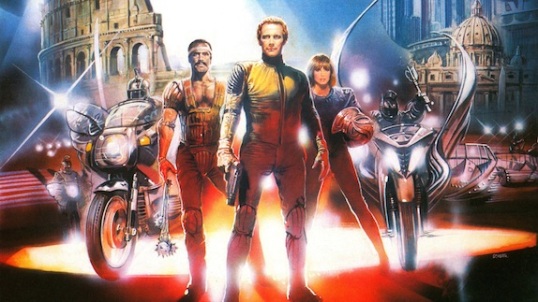
Before The Hunger Games…
Before The Purge…
There was…oh wait, does this sound familiar? Did you just read those two lines and get hit by a sudden feeling of déjà vu? Well, that might be because I used those exact same lines to start my review of the 1965 Italian sci-fi film, The Tenth Victim.
They’re still applicable for this review though. In many ways, the 1984 film Warriors of the Year 2072 (a.k.a. The New Gladiators) is a loose remake of The Tenth Victim. (I imagine some critics would say it’s more of a rip-off than a remake. What you label it will probably depend on how much tolerance you have for Italian exploitation films in general.) Of course, Warriors of the Year 2072 draws inspiration from more than just The Tenth Victim. A Clockwork Orange, Escape From New York, the Mad Max films, Blade Runner; bits and pieces from all of them show up here.
Even if you didn’t already know it, you might be able to guess that this film was directed by Lucio Fulci. The film features Fulci regulars Al Cliver (of Zombi 2 fame) and Howard Ross (of New York Ripper fame) in supporting roles. Cinzia Monreale, who had her throat ripped apart in Fulci’s The Beyond, appears in a cameo in which she again has her throat ripped apart. (Actually, she just hallucinates having her throat ripped apart and is seen alive afterward, as if Fulci himself is saying, “See, it’s all just film trickery. Nobody really gets hurt in my movies.”) Finally, and most obviously, a character graphically loses an eye. It’s simply not a Fulci film without some sort of graphic ocular trauma.
The film also features a theme that would show up in a lot of Fulci’s post-New York Ripper works. Warriors of the Year 2072 is about the role of violent entertainment in both maintaining and destroying society. Which is not to say that the film really has that much to say about it. Thematically, Warriors of the Year 2072 is all surface level but those themes are still present.
As for the film itself, it takes place in the year 2072, so at least the title is being honest with us. The world is now run by competing television networks. The American television network has the highest rated show: Kill Bike, in which men on motorcycles battle to the death. Cortez (Claudio Cassinelli), the program director for Rome-based WBS-TV, is ordered by the station’s owner, the mysterious Sam, to come up with a program that will be more popular than Kill Bike. At first, Cortez tries to put on a show called The Danger Game, where people are forced to hallucinate dying in violent ways. When that show fails to beat Kill Bike, Cortez decided to just rip-off Kill Bike…
And let’s just stop a moment to point out the obvious. Neither The Danger Game nor Kill Bike would feel at all out-of-place on television today. Remember Fear Factor? How different is The Danger Game from that old show?
Anyway, Cortez’s new show is basically Kill Bike with a twist. The motorcycle combat will now take place in the Roman coliseum and the contestants will all be convicted murderers awaiting execution. Fortunately, the very popular star of Kill Bike — Drake (Jared Martin) — has recently been convicted of murder! It’s convenient how that worked out…
As we discover through the magic of slow motion flashbacks, Drake was returning home one night when he discovered that his wife had been murdered by three young men who all appeared to be doing a bad impersonation of Malcolm McDowell in A Clockwork Orange. The three men were then murdered and Drake was convicted. However, Drake insists that he’s innocent and, even when confronted by laughing hallucinations of the three men, he refuses to attack them.
Could it be that someone is framing Drake? Of course! But why…
Well, before we find out the answer to that, we watch as Drake is brought to the coliseum and is trained in gladiatorial battle. He immediately makes an enemy out of the head guard, the sadistic Raven (Howard Ross, who is hilariously over-the-top). He also bonds with the other gladiators, one of whom is named Abdul. Abdul is played by Fred Williamson, largely because it’s not a mid-80s Italian sci-fi dystopia without Fred Williamson.
Warriors of The Year 2072 cannot compare to Fulci at his best. This is no Zombi 2 or The House By The Cemetery. At the same time, it’s definitely better than most of the films that Fulci made after The New York Ripper. Fulci was a supreme stylist and, as a result, Warriors of the Year 2072 is always watchable. Even when you don’t have the slightest idea what’s going on, you still can’t quite bring yourself to look away. Yes, the special effects are nothing special. And yes, it’s obvious that futuristic Rome was just a miniature set. But the cheapness of the film gives it an odd charm. It’s the cheapest future imaginable and somehow, it actually feels appropriate. Why do we always assume the future will be sleek and shiny? Maybe it’ll look like cardboard, like in Warriors Of The Year 2072!
Warriors of the Year 2072 is a campy, frequently silly, and oddly entertaining look at the future of the human race. If you’re a Fulci fan or a lover of Italian exploitation cinema, track it down.
Hi there! It’s Saturday morning — are you still with us? If you’re not, don’t worry. You have all day to get raptured. Until then, here’s the second part of this weekend’s edition of Lisa Marie’s Favorite Grindhouse and Exploitation Trailers.
(And if you haven’t read part one, it’s right here.)
Anyway, let’s waste no more time because who knows how long we’ve got left.
7) Requiem for a Vampire (1971)
Seeing as this could very well be the last things that I ever post or that you ever read pre-Rapture, there’s no way I can’t start things out without including this trailer for Jean Rollin’s unique, twisted, and very French vampire fairy tale, Requiem for a Vampire. One thing to note here is that when this film was released in the U.S., the American distributor felt the need to emphasize that the two girls were virgins and even went so far as to retitle the film Caged Virgins. However, the original French print of this film makes no reference to whether or not the girls are virgins and, despite all that happens to them in the film, the girls themselves are never presented as being helpless. Whenever I feel the need to explain the difference between American culture and French culture, this is one of the examples I always cite.
8 ) Kenner (1969)
Jim Brown is Kenner! And that’s about all I really know about this film. Well, that and small bundles of heroin are worth millions…
9) The Three Dimensions of Greta (1973)
I was recently reading about 3-D Sex and Zen: Extreme Ecstasy, a movie from Hong Kong that is apparently setting box office records because it’s being advertised as the first 3-D pornographic film. And, as the linked article shows, a lot of people are reporting that claim as fact. And they’re wrong. 3-D Sex and Zen might be the first recent 3-D porn film but it’s hardly the first. There was a spate of 3-D porn films in the mid-70s and one of my favorite trailers (which I can’t post here because 1) it’s too explict and 2) I can’t remember the title of the film) features a stereotypical, curly-haired, guy with a mustache type of porno actor going, “Soon, my giant schlong with be hanging right over the head of that redhead in the 3rd seat in the backrow.” And of course, I was all like, “Oh my God, can he see me through the screen!?” Anyway, the 3 Dimensions of Greta was a part of this wave. This is another one of those trailers that will probably be yanked off YouTube in a few more days (assuming there isn’t a Rapture first).
(By the way, why were so many porno films made about girls named Greta? I mean, was that name a turn-on? Were the films of the 70s exclusively made by guys named Hansel? Seriously, boys are weird.)
10) The Violent Professionals (1973)
They’re violent alright! Before the Italian exploitation industry devoted itself to cannibals and zombies, they devoted themselves to ripping off The French Connection and The Godfather. This film from Sergio Martino actually features Don Barzini himself, Richard Conte.
If I didn’t tell you this film was from 1968, you’d guess it just from watching the trailer. The soundtrack was done by George Harrison. Though this film was certainly not designed to be an exploitation film in the way most of the other films featured here were, it definitely is one.
Can you believe I went this long without featuring the trailer for Lucio Fulci’s best known (after Zombi 2) film? Well, I love Fulci, I love this film, and I was waiting for the right occasion to feature this trailer. And the end of the possible end of the world seemed like the right time. Anyway, this is one of those love it or hate it films (and I know that one of our regular readers is not a huge fan of this film but I love him anyway). At his best, director Lucio Fulci made some of the most visually stunning and dramatically incoherent films ever and never was that more apparent than with the Beyond. Out of the film’s cast, Catriona MacColl plays one of the few strong women to ever appear in a Fulci film while David Warbeck (a personal fave of mine) is the perfect hero. My favorite performance in the film (and a lot of this has to do with the fact that she co-starred in one of my favorite movies ever, Beyond the Darkness) is given by Cinzia Monreale, who plays the blind Emily.
And so there you go. If you do get raptured later today, thank you for reading. It’s been a pleasure telling you about the films I love and hopefully, someday, we’ll all meet in the beyond.
And if, as I suspect, there is no rapture today, I look forward to sharing even more.
Ciao!
 Through the Shattered Lens