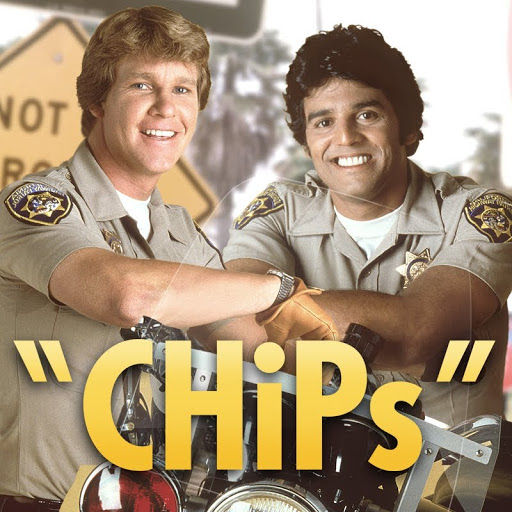
Welcome to Late Night Retro Television Reviews, a feature where we review some of our favorite and least favorite shows of the past! On Mondays, I will be reviewing CHiPs, which ran on NBC from 1977 to 1983. The entire show is currently streaming on Prime!
This week …. hey, what is this!?
Episode 5.12 “Mitchell & Woods”
(Dir by Bernard L. Kowalski, originally aired on December 18th, 1981)
When an old high school friend of Michell’s is murdered, Mitchell and Woods uncover a male prostitution ring. Along with bringing the guilty to justice, they also help Chickee (Pamela Susan Shoop) find the courage to leave her abusive relationship….
No, there’s not much motorcycle action. No, there’s no slow motion car crashes. Yes, this is an episode of CHiPs. Well, kind of.
It’s actually a backdoor pilot for a show about Mitchell and Woods. Ponch and Baker show up at the start of the show to wish Mitchell and Woods luck. Ponch and Baker return halfway through the show so that Ponch can tell Mitchell and Woods about an informant named Avrom (Tony Burton). And, finally, Ponch and Baker return at the end of the episode and give our erstwhile detectives a parking ticket.
Backdoor pilots at the worst! You’re all prepared to spend 40 minutes with people you know and suddenly, a bunch of new folks show up and start demanding your attention. It doesn’t help that Mitchell & Woods is a terrible pilot and I’m not really surprised that it didn’t become an actual series. Can Mitchell and Woods prove that woman can be good detectives? Will they ever impress their new boss (Paul Gale)? I don’t really know the characters so I don’t care.
I swear, they could have at least brought back Caitlyn Jenner for this episode.
Welcome to Late Night Retro Television Reviews, a feature where we review some of our favorite and least favorite shows of the past! On Mondays, I will be reviewing CHiPs, which ran on NBC from 1977 to 1983. The entire show is currently streaming on Prime!
This week, Ponch continues to train Melanie and Paula.
Episode 4.15 “Ponch’s Angels: Part Two”
(Dir by John Florea, originally aired on March 1st, 1981)
We pick up where we stopped last week. A man and his girlfriend are stealing purses and wallets at the marina. Three escaped convicts are in a deserted house and digging for buried treasure. Ponch and Jon are having to train two new motorcycle cops, Paula (Barbara Stock) and Melanie (Trisha Townsend). When last we checked in, Ponch was kissing Melanie. This episode opens with Ponch telling Melanie that they can never kiss again.
Ponch and Baker continue to train Paula and Melanie. Ponch decides to switch with Baker. He trains Paula while Baker works with Melanie. But then almost the entire highway patrol comes down with the flu and, when Baker is put in charge while Getraer recovers at home, Ponch finds himself to work with both Paula and Melanie. Once again, it’s all on Ponch because it’s The Ponch Show!
It’s all a bit exhausting to try to keep up with, to be honest. Ponch and Baker spend this episode wondering whether or not women actually could handle being motorcycle cops. Baker especially seems to be confused at the idea of a woman driving a motorcycle. One gets the feeling that Ponch is just mad because he knows he’ll get fired if he tries to make a move on either woman. Almost this entire episode is made up of Ponch trying to keep track of who is riding with who.
Luckily, Paula and Melanie prove themselves by catching the purse snatchers and also helping to catch the escaped convicts. Good for them! At the end of the opposite, they toss their motorcycle helmets in the air and leap for joy. The picture freezes while Ponch and Baker have a good laugh.
I was not surprised to read that this episode was meant to be a backdoor pilot for a Paula/Melanie show. Stock and Townsend were both likable and they acted well opposite each other so I could actually imagine them starring in a fairly entertaining series. It didn’t happen, though. Maybe the network felt that Ponch and Jon didn’t need the competition.
Welcome to Late Night Retro Television Reviews, a feature where we review some of our favorite and least favorite shows of the past! On Mondays, I will be reviewing CHiPs, which ran on NBC from 1977 to 1983. The entire show is currently streaming on Prime!
This week, Ponch protests having to do his job.
Episode 4.14 “Ponch’s Angels: Part 1”
(Dir by John Florea, originally aired on February 28th, 1981)
It’s a busy week for the Highway Patrol! The marina is full of tourists and carnival-goers. A group of escaped convicts are trying to get out of town. A man and his partner are stealing purses. But all of that pales in comparison to what Jon and Ponch are having to do.
Jon and Ponch are having to train rookies!
Even worse, from their perspective …. the rookies are women!
Ponch protests when he’s given the assignment to train enthusiastic and blonde Melanie Mitchell (Trisha Townsend). He tells Getraer that Melanie is attractive and that Getraer knows what happens when Ponch gets around attractive women. Getraer replies that he wants Ponch to train Melanie precisely because Ponch has so many girlfriends. A man with many girlfriends will be less likely to be tempted. Okay, Getraer, that’s interesting logic….
And it turns out that Getraer doesn’t know what he’s talking about because this episode ends with Ponch and Melania passionately locking lips. “TO BE CONTINUED” flashes on the screen so I guess we’ll get to the disciplinary hearing and the subsequent lawsuit next week.
As for Jon, he trains Paula Woods (Barbara Stock), who is as cool and reasonable as Melanie is enthusiastic and impulsive. Paula tries to flirt with Jon but Jon keeps it all business because Jon is capable of actually doing his job in a professional manner.
What’s odd about this episode is that it’s called Ponch’s Angels, even though Ponch is only training one of the new motorcycle cops. This season, even the episode titles were all about erasing Jon Baker!
Anyway, as I mentioned, this is the first part of a two-parter. Apparently, this episode was actually a backdoor pilot for a series that would have focused on Melanie and Paula and it’s easy to see that Melanie was created to be another Ponch while Paula was created to be a female Jon. Next week, we’ll see if Paula and Melanie can make use of the lessons they were taught by Jon and Ponch.
Many years ago in Southern Oregon, I had a conversation with friends about some of our favorite films growing up. Movies like The Goonies, The Dark Crystal, Watership Down and The Secret of Nimh were all on the list, as well as Disney’s Tron. In our excitement for all these movies, we ended up renting the films from a local video store to relive our childhood. While the nostalgia was nice, we all ended falling asleep halfway through Tron, despite our love for it.
I guess one’s enjoyment of Tron is based on how it’s viewed. I caught the film two years ago at the Museum of the Moving Image, in 70MM. The first thing that caught my attention was the film grain. I’ve grown so used to the clarity of digital film presented in 4K that I couldn’t help but catch the little flicks and “cigarette burns” in at the start. This was life before digital, and it was beautiful to revisit. In a theatre, the film’s 96 minutes blazed by for me. The early 1980s was basically made up of bike rides and video arcades. The little boedga on the corner of my block back home even had a few arcade machines in the front of the store in the first half of the 80s. The Bodega’s still there, the arcade’s now a deli/hot meal area. Times can and do change.
Tron is the story of Kevin Flynn (Jeff Bridges, Bad Times at the El Royale), a former employee at Encom, a major computing and videogame company. Encom’s made some wonderful strides in technology as of late, by 1980’s standards. Encom performs special matter tests in a specialized lab, while the programmers grind away code in their cubicles. All of their work is overseen by the Master Control Program, an operating system of sorts. Granted, the workforce at Encom isn’t too pleased about having the MCP monitor their applications. Alan Bradley (Bruce Boxleitner, Kuffs) and Lori Baines (Cindy Morgan, Caddyshack) also have programs and projects of their own that are being culled. Alan’s program, Tron (also played by Boxleitner) is of particular interest to the MCP, as it acts an a security threat that could bring some serious problems. Kevin tries to hack his way into Encom with the use of a program he created called Clu (also Bridges), but the MCP and the Senior Vice President of Encom, Ed Dillinger (David Warner, The Omen, Teenage Mutant Ninja Turtles II: The Secret of the Ooze) keep Flynn at bay. When Alan and Lori discover what Flynn’s up to, they confront him at his arcade, where he explains that he was the actual creator of Encom’s top games. He only needs the data as proof. This leads to the team breaking into Encom, where the MCP digitizes Flynn and brings him into the computer world. Can Flynn escape and help liberate the programs enslaved by the MCP and its henchman, Sark (both also played by Warner)? Can Flynn find the proof to exonerate him? And just who is this Tron fellow, anyway?
The plot for Tron inside the machine becomes a bit theological. The programs believe in the Users, and that they were each created for a particular purpose. From Ram (Dan Shor, Bill & Ted’s Excellent Adventure) being an Actuarial Program to Tron being a defense against the MCP, it’s kind of interesting once Flynn shows up. As a User, he doesn’t have much more power than a program, save that he can’t really be derezzed and that he can mimic the neon glow of anyone he touched. I always thought they could have given him something cooler to do, though for 1982, repurposing machines does have some benefits. The story slows down a bit in the middle, feeling like it’s somewhat unsure of itself, but picks up in the final act with Tron vs. Sark and the MVP. Though Flynn is important to the outcome, he’s more like Big Trouble in Little China’s Jack Burton, kind of just watching this happen around him. He does have his moments, though.
When I was little, my dad owned a Commodore 64 and a Floppy Disk Drive. He would regularly pick up magazines like Byte! to catch up on new innovations. In most of these magazines, they’d have a program that you could enter in at home to create various effects like making a balloon fly across your screen. Those programs were usually written over a number of pages with hundreds of lines of code. For Tron, there were 3 teams dedicated for the Visual Effects. According to the behind the scenes documentary on the disc, Information International Inc., known as Triple-I, was brought in to handle the major work along with Mathematic Applications Group Inc. (MAGI), who director Steven Lisberger worked for at one point early in his career. Digital Effects of New York handled some of the responsible for some of the original CGI work used in Michael Crichton’s Westworld (considered one of the first CGI movie uses ever) and it’s sequel, Futureworld. For the time, the effects were groundbreaking. Mind you, most of this was all before we ever hit the 8-bit era of Nintendo, the Commodore Amiga or even the high resolution arcade games of Sega’s heyday like Space Harrier, Outrun or Afterburner. In an actual arcade in 1982 had games like Q-Bert or Dig Dug with the kind of graphics you’d never see on home systems.
Kevin Flynn (Jeff Bridges) and others (including a young Michael Dudikoff to his right) watch Tron fight for the users. This would inspire Dudikoff to become an American Ninja.
The designs for the look and feel of the computer world came from Lisberger himself, with a bit of assistance from both futurist Syd Mead and legendary artist Jean “Mobius” Giraud. Both men were extremely popular. Mead was the equivalent of Apple’s former Chief Design Officer Jony Ive, having created the “V’ger” model for Star Trek:The Motion Picture. Ironically, Mead’s work (both on the set design and the flying cars) would be seen by audiences watching Ridley Scott’s Blade Runner just a month shy of Tron’s release. Having worked on Alien years prior, Giraud helped to design and inspire both the clothing and some of the vehicles, such as the weird cradle for Dumont (Bernard Hughes, The Lost Boys) and the Light Cycles.
A film dealing with computers needed a composer familiar with electronic music.It seemed fitting that Wendy Carlos(A Clockwork Orange, The Shining) took on the challenge. Having built a computer at 14, Carlos’ love for music over the years lead her (with Robert Moog) to help develop the Moog synthesizer system. The Moog would go on to be used by Kraftwerk, Giorgio Mororder, Nine Inch Nails, The Prodigy Daft Punk and even J Dilla, among others. The Tron Soundtrack was a mix of orchestra, choir and electronic music. Although the sound may not be as dark and digital as Daft Punk’s score for Tron: Legacy, I felt it worked for the time and moves well with the film. In addition to Carlos’ score, Journey wrote the song “Only Solutions” for the film, which also happens to be a line uttered by Kevin Flynn.
Overall, Tron is one of those movies I can happily rewatch without much in the way of expectation. I enjoy it for its place in Sci-Fi cinema, and the memories it awakens. I don’t think Disney ever fully recognized the full potential of where they could take the story, though the animated Tron: Uprising was a great part of the saga. I’m just hoping Tron: Ares doesn’t stray too far from the fold.
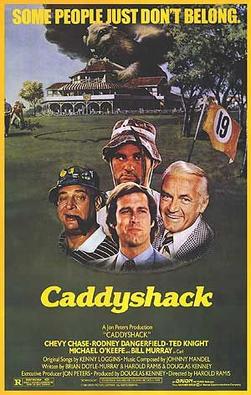
Whenever I think about Caddyshack, which is one of the funniest moves ever made, I think first of the Gopher, burrowing across the course and dancing to the music.
I then think about Bill Murray, playing the demented groundskeeper and growing his own special grass that you can both play golf on and smoke afterwards.
I remember Rodney Dangerfield dancing on the green while Ted Knight throws a fit. This was the first film that I ever saw Rodney Dangerfield in. “It looks good on you, though,” was one of those simple lines that Rodney could turn into a classic.
I remember Ted Knight, appearing in one of his few film roles, and saying, “Well, we’re waiting!” and drawing out every single word.
I remember the scene in the pool. You know which one I’m talking about.
I remember Chevy Chase, back when he was still funny.
Then I remember how Rodney Dangerfield’s classic last line, “We’re all going to get laid,” was changed to “We’re all going to take a shower!” for television. Why the censors thought that sounded less dirty than the original, I’ll never know.
I remember the Bishop getting struck by lightning while playing the best game of his life.
And, of course, I remember Cindy Morgan as Lacy Underall.
I remember so many classic moments and funny lines that I’m always surprised when I rewatch the movie and discover that it’s not really about the Gopher, Bill Murray, Rodney Dangerfield, Chevy Chase, or even Lacy Underall. Instead, the main character in the movie is Danny Noonan (Michael O’Keefe), a teenage caddy at Bushwood Country Club who wants to win a scholarship so he can go to college and avoid having to work in the lumber yard with his father (Albert Salmi). Danny has a friendly rivalry with caddy Tony D’Annuzio (Scott Colomby) and is dating Maggie (Sarah Holcomb). Danny has to decide whether to ally himself with the snobs (led by Ted Knight) or the slobs (led by Rodney Dangerfield).
Caddyshack was originally envisioned as being Danny’s story but, once filming started, Harold Ramis (making his directorial debut) realized that the comedic characters were actually more interesting. The movie went from being a straight-forward coming-of-age story to an almost plotless collection of gags and jokes, with both Bill Murray and Rodney Dangerfield improvising the majority of their dialogue and the Gopher emerging as the film’s true star. That was bad news for the younger actors playing the caddies, who all found their roles greatly reduced in the film’s final cut but that was good news for audiences. Caddyshack may not have much of a narrative structure but it does have some of the funniest people who ever lived at the peak of their powers.
Despite a legendarily troubled production, Caddyshack was a huge success with audiences and eventually, the critics came around as well. Harold Ramis always said that he had a hard time watching it because all he could see were the mistakes that he made. All audiences could see, though, was a hilariously funny movie that continues to bring people joy to this day.
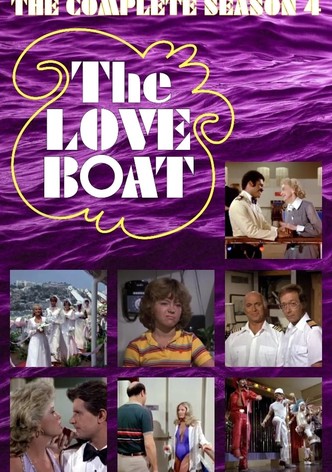
Welcome to Retro Television Reviews, a feature where we review some of our favorite and least favorite shows of the past! On Wednesdays, I will be reviewing the original Love Boat, which aired on ABC from 1977 to 1986! The series can be streamed on Paramount Plus!
It’s time for another cruise on …. THE LOVE BOAT!
Episode 4.21 “Clothes Make The Girl/Black Sheep/Hometown Girl”
(Dir by Earl Bellamy, originally aired on February 28th, 1981)
This week’s cruise is all about money!
For instance, in this episode, we learn that Doc Bricker is from a small town called Cedar Flats. Doc was the head of a committee that raised the money necessary to send Mike Lucas (Randy Powell) to medical school so that Mike could return home and serve as the town doctor. However, when Mike boards the cruise with his fiancée, Tracy (Cindy Morgan), it turns out that he has some bad news. Tracy’s wealthy father has offered Mike a job working at a Park Avenue clinic in Manhattan. Mike is planning on taking the job because of the money and the fact that Tracy doesn’t want to live in a small town. Unfortunately, that will leave Cedar Flats without a doctor.
Doc Bricker, showing that he actually is a man of integrity despite also being a walking HR nightmare, decides that he has no choice but to return to Cedar Flats and serve as their doctor until someone can be found to replace him. He asks Captain Stubing for a six-month leave of absence. Stubing agrees but warns that the cruise line might hire someone to take Doc’s place.
Meanwhile, Suzy Marshall (Kyle Aletter) is excited because it appears that her daughter, Anne (Lee Meriwether), has attracted the attention of a wealthy man named Jonathan (Larry Breeding). Little do they know that Jonathan is actually just Johnny, the ship’s valet. Johnny is wearing another passenger’s clothes and pretending to be rich.
At one point, Johnny takes Anne back to his cabin, making this the first episode to show us what a low-level employee’s cabin looks like. It’s small and cramped and located at the bottom the boat, which means it’ll be the first to flood if The Love Boat ever hits an iceberg. It’s also mentioned that Johnny is not allowed to eat in the main dining room with the passengers. I have to admit that it’s all a bit disillusioning. Apparently, the Love Boat is a terrible place to work!
Finally, a passenger named Donald Gray (Robert Ginty) tells the Captain that he works for the Secret Service. He is on the Love Boat because he hopes to capture a notorious counterfeiter. But what will happen when that counterfeiter turns out to be Jesse (Demond Wilson), Issac’s ne’er-do-well uncle who claims to have turned a new leaf? Poor Isaac!
Well, don’t worry. Everything works out:
1) Mike realizes that he has to honor his commitment to Cedar Flats and, after talking to her father, Cindy realizes that she loves Mike enough that she can be happy in a small town. (Cindy’s father says some very dismissive things about Cedar Flats but it turns out that he was only doing that to get Mike so outraged that he would have no choice but to return home. He was doing it as a favor to Doc Bricker. Can you imagine if that plan didn’t work? What if Mike just said, “You’re right! New York, here we come!”)
2) Anne learns the truth when she sees Johnny in his valet uniform. Luckily, she doesn’t care.
3) It turns out that Donald is actually a criminal who is masquerading as a treasury agent and Uncle Jesse is an undercover government agent! Isaac is happy to learn this but also agrees to keep Jesse’s secret. “You’re my favorite nephew,” Uncle Jesse replies. Awwwww!
This was an okay cruise. The guest stars weren’t particularly interesting but Bernie Kopell and Ted Lange both got an opportunity to show what they could do when given a real storyline to deal with. Kopell especially deserves a lot of credit for showing that humanity that lurked underneath Doc’s carefree surface. This episode kept me entertained and I enjoyed the scenery. Really, what else can you ask for from The Love Boat?



 Through the Shattered Lens