2009’s Public Enemies is a portrait of the battle for the soul and imagination of America.
The films take place during the Great Depression. With Americans struggling to pay their bills and many citizens out-of-work and feeling desperate, a new breed of folk hero has emerged. Men like my distant relative Pretty Boy Floyd (Channing Tatum) and Alvin Karpis (Giovanni Ribisi) may be criminals who make their living by robbing banks but, to a nation of angry people who feel like they’ve been forgotten by the government and betrayed by the wealthy, they’re rebels who are challenging the system. They are viewed as being modern-day Robin Hoods, even though very few of them actually bother to give the money that they steal back to the poor.
John Dillinger (Johnny Depp) is perhaps the most famous of the criminals who have been declared a “public enemy” by the FBI. The handsome and charismatic Dillinger becomes almost a living legend, the man who cannot be captured by law enforcement. He becomes a folk hero but with the twist that his own death seems inevitable. Dillinger lives by his own set of rules and the press loves him even as they hungrily anticipate his violent end.
Pursuing Dillinger and the other so-called public enemies is a young FBI agent named Melvin Purvis (Christian Bale). Purvis’s job is not only to capture or eliminate men like Dillinger. It’s also to somehow figure out a way to replace them in the public’s imagination. Through the use of what was then-considered to be revolutionary techniques (like fingerprinting and phone taps), Purvis tracks down one public enemy after another and soon, he’s becoming as much of a folk hero as the people that he’s pursuing. If Dillinger and his cohorts represent the ultimate rebellion against an ineffectual system, Purvis and his success suggest that maybe the system actually can get something accomplished. Unfortunately, for Purvis, he not only has to deal with the challenge of capturing Dillinger but also with the growing jealousy of his publicity-hungry boss, J. Edgar Hoover (Billy Crudup). As is typical of the heroes of Michael Mann’s film, Dillinger and Purvis may be on different sides of the law but they have more in common than they realize. Neither one can trust the people that they’re working with.
I remember that I was really excited about Public Enemies when it was first released in 2009. I’m fascinated by the Depression-era outlaws and Dillinger’s story is certainly an interesting one. (I’ve always enjoyed the theory that Dillinger faked his death, even though I don’t believe it for a second.) Michael Mann seemed like the perfect director for the material and Johnny Depp seemed like ideal casting. I have to admit that I was a little bit disappointed in the film itself, which was poorly paced and stuck so closely to the facts of the case that it led me to realize that Dillinger will always be more interesting as a legend than an actual person. (I’ll concede that was probably the film’s point.) There were moments of brilliance in the film. The scene where Dillinger escaped from custody was wonderfully done. Stephen Graham’s unhinged performance as Baby Face Nelson was excellent. Johnny Depp had the right look for Dillinger but I have to admit that I found myself a little bit bored with Christian Bale’s Melvin Purvis.
Looking back today, though, the film feels almost prophetic. That may seem like an odd thing to say about a film set in the past but Public Enemies portrait of an America caught between celebrating the rule of law and the excitement of rebellion feels very relevant to what’s happening today. In retrospect, Public Enemies is a portrait of the contradiction at the heart of America, a country with a culture of both rebellion and loyal patriotism. Public Enemies portrays a battle the continues to this day.
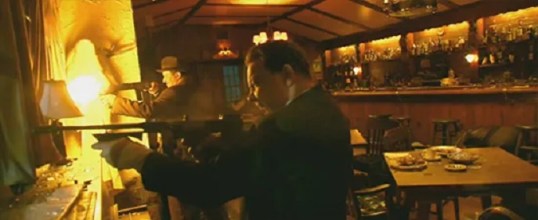
Public Enemies (2009, dir by Michael Mann, DP: Dante Spinotti)
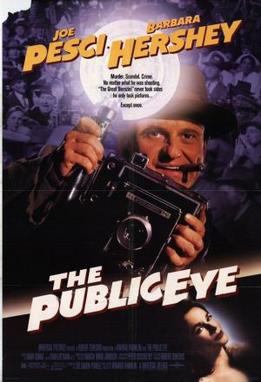 New York in the 1940s. Leon “Bernzy” Bernstein (Joe Pesci) is nearly a legend in the city, a freelance news photographer with a police radio in his car and a darkroom in his trunk. Bernzy is a solitary man who lives for his work, the type who has many acquaintances but few friends. He gets the pictures that no one else can get but his dream of seeing a book published of his photographs seems to be unattainable. As more than one snobbish publisher tells him, tabloid photographs are not art.
 Through the Shattered Lens