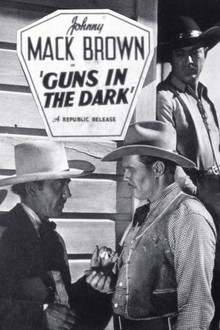
Guns In The Dark (1937, directed by Sam Newfield)


In Mexico, two American cowboys, Johnny Darrel (Johnny Mack Brown) and Dick Martin (Julian Madison) join a poker game to try to win some money and help out their buddy, Oscar (Sid Saylor).  When they discover that cantina owner Manuel Mendez (Ted Adams) has rigged the game, a fight breaks out.  The lights turn off.  In the darkness, several guns are fired.  When the lights come back up, Dick is dead.  Mendez convinces Johnny that he accidentally shot his friend in the fight.  Guilt-stricken, Johnny tosses aside his guns and returns to Texas.

Johnny has sworn that he will never shoot another gun but when he’s hired to work at a ranch owned by Joan Williams (Claire Rochelle), he finds himself in the middle of a range war between Joan and Brace Stevens (Dick Curtis), with Mendez also making an unwelcome return to Johnny’s life.  Even after Johnny discovers the truth about what happened that night at the cantina, he doesn’t pick up a gun.  Instead, Johnny fights the bad guys with lassos and plates.

Guns In The Dark is only 54 minutes long and it features actors who will be familiar to any fan of the old B-westerns.  Sidekcick Sid Saylor’s stuttering schtick gets old quickly but Johnny Mack Brown is as likable as always in Guns In The Dark and he comes across as being an authentic cowboy even when he’s not carrying a gun  Given that this film features even more horse chases than the typical Johnny Mack Brown b-western, it’s good that Brown is so convincing.  What isn’t convincing is how stupid Johnny Darrel is required to be in order for him to fall for Mendez’s lie in the first place.  I appreciated the change of pace from Brown just using a gun to stop the bad guys but I wish the reason behind it had been more convincing.  This isn’t one of Johnny Mack Brown’s more memorable westerns though, as always, it’s easy to see why he was one of the early stars of the genre.


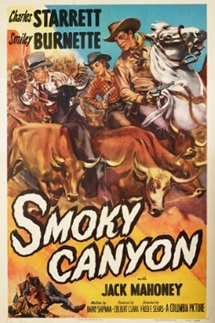
Smoky Canyon (1952, directed by Fred Sears)


There’s a $2500 dollar reward out for the masked bandit known as the Durango Kid but little do the residents of Timber Rock know that the Kid is actually Steve Brent (Charles Starrett), a Treasury agent who puts on a mask whenever he needs to go undercover and discover what the bad guys are doing.

A range war has broken out between the sheep farmers led by Jack Mahoney (Jock Mahoney) and the cattlemen led by Carl Buckley (Tristram Coffin).  To broker a peace and discover which side is the most to blame, Brent works for the cattlemen while the Durango Kid sides with the sheepmen.  It turns out that Buckley’s to blame here.  He’s using the war to thin out his cattle so that an Eastern beef syndicate can keep prices high.  When Mahoney gets too close to the truth, he is framed for the murder of Mr. Woodstock and it’s up to the Durango Kid to prove that Mahoney is innocent.  Meanwhile, Carl wants to blow up an entire mountain so that it will really thin out his cattle herd.

This is a typical Durango Kid movie, entertaining if you like B-westerns and probably boring if they’re not your thing.  It has all the usual gunfights, horse chases, and dynamite explosions that are promised by every Durango Kid film.  Starrett was always one of the most convincing cowboys on screen, even if his use of the Durango Kid alter ego didn’t always make sense.  All the usual members of the Durango stock company show up, all playing different characters than they did in the previous Durango Kid film.  Mahoney gets to play one of the good guys for once and his spirited girlfriend is played by the lovely Dani Sue Nolan.  Smiley Burnett shows up to provide comic relief.  This time, he’s a singing tour guide.  He sings a song called It’s Got To Get Better.  Let’s hope so.

Roaring Rangers (1946, directed by Ray Nazarro)


Another frontier town is in trouble.

Sherriff Jeff Conner (Jack Rockwell) is having trouble ridding his town of outlaws so his son, Larry, (Mickey Kuhn) writes a letter to his hero to ask for help.  He addresses the letter to “Durango Kid, Texas.”  That’s all it takes for Steve Randall (Charles Starrett) and his sidekick, Smiley Burnette, to show up in town.

Steve and Smiley apply to be deputies but Sheriff Conner explains that someone is circulating a petition to get him fired.  Steve dresses up as the Durango Kid and pressures the citizens to give the Sheriff another chance.  Realizing that the Durango Kid is making them look bad, the outlaws decide to dress up one of their own as Durango and make the Kid look bad.  With the town turning on Durango, will Durango and Smiley be able to save Sheriff Conner from an assassination attempt?

This Durango Kid film is different from the rest of the series in that, for once, Steve is hired to be a deputy instead of a sheriff.  This really is Sheriff Conner’s story, as he tries to win the respect of the town and keep its citizens safe, even while his own brother (Ed Cassidy) is working with the outlaws.  There are all the usual horse chase and shootouts but this time, Durango and Smiley are mostly around to provide support to a man who is trying to do the right thing.  B-western fans will enjoy it.

Smiley sings a few songs, as always.  This time, musical accompaniment is provided by Merle Travis and his Bronco Busters.

Lawless Empire (1945, directed by Vernon Keays)


For years, outlaws have controlled the frontier town of Dusty Gulch but now their power is threatened by the homesteaders who are moving into the area.  Led by the crusading Rev. Tex Harding, the homesteaders are being progress and reform to the frontier.

Duke (Ethan Laidlaw) and his gang have launched a campaign of intimidation against the new arrivals.  Luckily, the Durango Kid (Charles Starrett) rides into town to protect the homesteaders.  Duke’s boss, businessman Blaze Howard (John Calvert), decides that the town needs a sheriff to go after the Kid.  Blaze offers the job to newcomer Steve Ranson, not realizing that Steve is not only the Durango Kid but also the brother of the former sheriff, who was murdered by Blaze’s men.

Lawless Empire is one of the few Durango Kid films not to feature Smiley Burnette as Durango’s sidekick.  Instead, Durango rides into town with Bob Wills and his Texas Playboys and, while Willis does perform a song or two, there’s still considerable less singing than in the films that featured Burnette.  The role of comic relief is provided by Dub Taylor in the role of Cannonball.  Cannonball gets a job sweeping up Blaze’s saloon and he feeds whatever information he learns back to Durango.  When Blaze figures out what’s going on, he deliberately supplies Cannonball with bad information but it doesn’t make any difference.  The Durango Kid is always one step ahead of the bad guys.

Lawless Empire is a little more serious than the other Durango Kid films.  Steve is not only trying to clean up the town but he’s also seeking to avenge his brother so there’s not as much room for as much comedy as usual.  Lawless Empire does have all of the usual gunfights and horse chases and the film gets off to an exciting start with Durango making his first appearance with his gun already drawn so that he can disarm Duke and his men.  Even without Smiley around to help him out, Durango brings law to a lawless empire.


Gunning For Vengeance (1946, directed by Ray Nazarro)


Steve Landry (Charles Starrett) rides into another town and is once again named the new sheriff.  Luckily, Steve’s old friend Smiley Burnette is working as the town’s blacksmith.  Steve makes Smiley his deputy and then sets about trying to break up a gang of cattle rustlers.  When Steve learns that his jurisdiction does not extend beyond the city limits, he dons the disguise of his alter ego, The Durango Kid, to go after the outlaws.

Has Steve met his match in Belle (Phyllis Adair), the saloon owner who is the secret leader of the outlaws?  She notices that The Durango Kid’s boot tracks are the same as Steve’s boot tracks.  I’m surprised that no one has ever noticed that before.  Steve went through a lot of trouble to disguise himself as Durango but he never bothered to change his boots.

This entry in the Durango Kid series features a lot of Smiley Burnette so your enjoyment on the film will depend on how much tolerance you have for Smiley’s songs and his style of humor.  Each film featured Smiley being followed around by a different group of musicians.  In this one, Smiley is accompanied by The Trailsman.  When Smiley accidentally locks himself in a jail cell, the Trailsman stand on the other side of the bars and sing a song about how Smiley can’t get out of the cell.  Smiley does eventually get out but, later on, he’s knocked out cold during an attempted jail break.  Smiley’s not much of a help in this one.

This has all of the typical Durango Kid elements, including the stock footage of the stampeding cattle that appeared in nearly all of his films.  There’s another saloon fight and a gunfight towards the end.  Durango rides out of town alone, leaving Smiley behind, but we know they’ll soon be reunited in another adventure.

Streets of Ghost Town (1950, directed by Ray Nazarro)


Years ago, Bill Donner (George Cheseboro) double-crossed the other members of the Selby Gang and ran off with all of their stolen gold.  Now, Donner is blind and half-crazy.  When he says that he hid the gold in the ghost town of Shadeville, the Durango Kid (Charles Starrett), Smiley Burnette, and Sheriff Dodge (Stanley Andrews) ride off to find it.

Shadeville is long abandoned and, as the three men spend the night in a deserted saloon, Smiley is worried about ghosts.  The Durango Kid tells the story of the first time he met the Selby Gang.  The next morning, they discover that they are not the only ones who have come to Shadeville to look for the gold.

Like many of the later Durango Kid movies, Streets of Ghost Town is mostly made up of stock footage to Starrett’s earlier films.  This was a cost-cutting technique on the part of Columbia Pictures but it actually works because the flashbacks were always to the horse chases and the gunfights that the audience came to see in the first place.  In the days before home video and cable, those scenes were probably still new to many of the people sitting in the theater.

Starrett always made for a good hero and Smiley Burnett’s comic relief never took away from the films’s storylines.  This outing features a great scene where Durango shoots a skull in the dark just to let anyone watching him know that he’s a good shot.  I also enjoyed George Cheseboro’s manic performance as a man who really loves his gold.  Despite all of the stock footage, Streets of Ghost Town is still an above average Durango Kid film, predictable but entertaining if you’re a fan of the genre.