Hi there! Welcome to the first edition of Lisa Marie’s Favorite Grindhouse and Exploitation Trailers for 2011. All 6 of our trailers in this edition are Italian. And, as always, most of them should be watched with caution and definitely not watched at work. (Also, I wouldn’t be surprised if Youtube yanked one or two of them offline within a week or so. So, watch while you can.)
This is actually one of Umberto Lenzi’s not that terrible movies. Which doesn’t mean it’s good. Just means that it’s not that terrible. This is the movie in which Lenzi manages to turn the Jonestown Massacre into a cannibal film. Ivan Rassimov, who looks like a Russian Charlton Heston, plays Jim Jones. Also, you might recognize the music because it ended up being used in about a 100 different Italian exploitation trailers.
One of the most misleading titles of all time as Warhol had very little to do with this film beyond lending Paul Morrissey and Joe Dallesandro. This is better known as Flesh For Frankenstien. The trailer really doesn’t do justice to the movie but I had to include it because, even if it’s not my favorite trailer, it’s a classic exploitation trailer in just the shameless way that Andy Warhol’s name is used to sell the film.
Believe it or not, this movie is actually a lot of fun. One of the stars is apparently a gay porn star but I’ve never been able to figure out who he’s playing in the film.
I had to finish out this all-Italian edition with a little Lucio Fulci. And I had to go with Murderock because it features a lot of dancing. The trailer is also memorable for revealing the identity of the killer.
Sometimes, you have to be careful which films you choose to watch over the course of the day.
Such as, last Friday night, I heard the news that Jill Clayburgh had died and I ended up watching An Unmarried Woman. This, along with the fact that I also watched the Black Swan trailer, led to me dancing around the house in my underwear, en pointe in bare feet, and doing a half-assed pirouette in the living room. And I felt pretty proud of myself until I woke up Saturday morning and my ankle (which I don’t think has ever properly healed from the day, seven years ago, that I fell down a flight of stairs and broke it in two places) literally felt like it was on fire. That was my body’s way of saying, “You ain’t living in a movie, bitch. Deal with it.”
So, come Sunday, I decided to play it safe by watching something that I was sure wouldn’t lead to any imitative behavior on my part. Since I had previously reviewed Earthquake on this site, I decided that I would devote some time to the movies that started the entire 1970s disaster movie genre — Airport. Watching Airport led to me watching Airport’s three sequels.
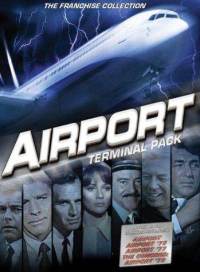
I was able to do this largely because I own the Airport Terminal Pack, a two-disk DVD collection that contains all four of the Airport films and nothing else. There’s no special features or commentary tracks. That’s probably a good thing because these films are so extremely mainstream that I doubt the commentary tracks would be all that interesting except to people who love “Me and Jennings Lang had the same lawyer…” style stories.
The movies are a mixed bag of ’70s sexism, mainstream greed, and casts that were described as being “all-star” despite the fact that they featured very few stars. They’re all worth watching as time capsules of a past time. Some of them are just more worthy than others.
Below are my thoughts on each individual film in the collection…
Airport (directed by George Seaton)
First released in 1970, Airport was nominated for 10 Academy Awards (including best picture), broke box office records, and started the whole 70s disaster movie trend. It also has to be one of the most boring, borderline unwatchable movies ever made. The fact that I managed to sit through the whole thing should be taken as proof that I’m either truly dedicated to watching movies or I’m just insane. Take your pick.
Anyway, the film is painstakingly detailed account of the every day operations of an airport. Yeah, sounds like a lot of fun, doesn’t it? Burt Lancaster runs the airport. His brother-in-law Dean Martin flies airplanes. Both of them have mistresses but we’re told that’s okay because Lancaster’s wife expects him to talk to her and Martin’s wife is cool with him fucking around as long as he comes home at night. I would be tempted to say that this is a result of the film having been made in 1969 and released in 1970 but actually, it’s just an introduction to the sexual politics of the typical disaster film. Men save the day while women get in the way. And if you think things have changed, I’d suggest you watch a little film calledf 2012…
The only interesting thing about the film is that Lancaster’s mistress is played by Jean Seberg who, ten years earlier, had helped change film history by co-starring in Jean-Luc Godard’s classic film Breathless. Nine years later, after years of being hounded by the American press and the FBI for her radical politics, Seberg committed suicide.
Airport 1975 (directed by Jack Smight)
As opposed to its predecessor, Airport 1975 is actually a lot of fun in its campy, silly way. This is the one where a small private plane (flown by Dana Andrews, the star of the wonderful film noir Laura) collides with a commercial airliner. The entire flight crew is taken out and head stewardess Karen Black has to pilot the plane despite the fact that she’s obviously cross-eyed. Luckily, since Black is a stewardess, she has a pilot boyfriend who is played by Charlton Heston. Heston talks her through the entire flight despite the fact that she was earlier seen trying to pressure him into not treating her like an idiot. Anyway, Heston does his usual clench-jaw thing and if you need a drinking game to go with your bad movie, just take a shot every time Heston calls Black “honey.” You’ll be drunk before the plane lands.
There’s some other stuff going on in this movie (for instance, Gloria Swanson appears as “herself” and doesn’t mention Sunset Boulevard or Joseph Kennedy once!) but really, all you need to know is that this is the film where Karen Black acts up a storm and random characters keep saying, “The stewardess is flying the plane!?”
Odd trivia fact: Airport 1975 was released in 1974.
Airport ’77 (directed by Jerry Jameson)
In Airport ’77, a group of art thieves attempt to hijack an airplane which, of course, leads to the airplane crashing into the ocean and somehow sinking down to the ocean’s floor without splitting apart. The crash survivors have to try to figure out how to get to the surface of the water before they run out of oxygen.
In this case, our resident sexist pilot is Jack Lemmon who has a really ugly mustache. He wants to marry head stewardess Brenda Vaccarro. Vaccarro doesn’t understand why they have to get married to which Lemmon responds, “Because I want a wife and kids!” The film also gives us Lee Grant as a woman who is married to Christopher Lee but who is having an affair with another man. She also drinks a lot and dares to get angry when she realizes that the airplane is underwater. While this sort of behavior is acceptable from Dean Martin, Charlton Heston, and Jack Lemmon, the film punishes Lee Grant by drowning her in the final minutes.
Technically, Airport ’77 is probably the best of the Airport films. The cast does a pretty good job with all the melodrama, the film doesn’t drag, and a few of the scenes manage to generate something resembling human emotion. (For instance, when the blind piano player died, I had a tear in one of my freaky, mismatched eyes.) Unfortunately, the movie’s almost too good. It’s not a lot of fun. Everyone plays their roles straight so the silly plot never quite descends into camp and the key to a good disaster film is always camp. This film also has the largest body count of the series, with most of the cast dead by the end of the movie. (And, incidentally, this film did nothing to help me with my fear of water…)
The Concorde: Airport ’79 (directed by David Lowell Rich)
The last Airport movie is also the strangest. Some people have claimed that this film was meant to be a satire of the previous Airport films. I can understand the argument because you look at film like Concorde and you say, “This must be a joke!” However, the problem with this theory is that there are moments of obvious “intentional” humor in this film (i.e., J.J. from Good Times smokes weed in the plane’s bathroom, another passenger has to go to the bathroom whenever she gets nervous) and none of them show any evidence of the type of wit and outlook necessary to come up with anything this silly on purpose. Add to that, the film’s story is credited to Jennings Lang, a studio executive. Studio execs do not take chances. (Plus, the actual script was written by Eric Roth, who went on to write the amazingly humorless The Curious Case of Benjamin Button).
No, this film is meant to be taken seriously and oh my God, where do I start?
Our pilots are George Kennedy and Alain Delon. The head stewardess (and naturally, Delon’s girlfiend) is played by Sylvia “Emanuelle” Kristel who, at one point, says, “You pilots are such men!” “Hey, they don’t call it a cockpit for nothing, honey,” Kennedy replies.
Meanwhile, Robert Wagner is trying to destroy the Concorde because one of the passengers is his girlfriend who has proof that Wagner has been selling weapons to America’s enemies. So, he attempts to blow the plane up with a guided missile and when that fails, he sends a couple of fighter planes after them. Kennedy responds by opening up the cockpit window — while breaking the sound barrier mind you — and firing a flare gun at their pursuers.
After this, there’s stop over in Paris where Delon arranges for Kennedy to sleep with a prostitute who assures Kennedy that he made love “just like a happy fish.”
The next day, everyone returns to the exact same Concorde — despite the fact that just a day earlier they’d nearly been blown up by a squadron of fighter planes — and take off on the second leg of the flight. Let me repeat that just to make sure that we all understand what this film is asking us to believe. After nearly getting blown up by a mysterious squad of fighter planes, everybody shows up the next morning to get on the exact same plane.
Oh, and it never occurs to Wagner’s ex-girlfriend that Wagner might have something to do with all of this.
Now sad to say, Concorde is the one of those films that’s a lot more fun to talk about than to actually watch. It should be a lot more fun in its badness than it actually is. Still, the movie has just enough camp appeal to make it fun in a “what the fuck…” sorta way.
And that’s how the Airport series comes to an end.
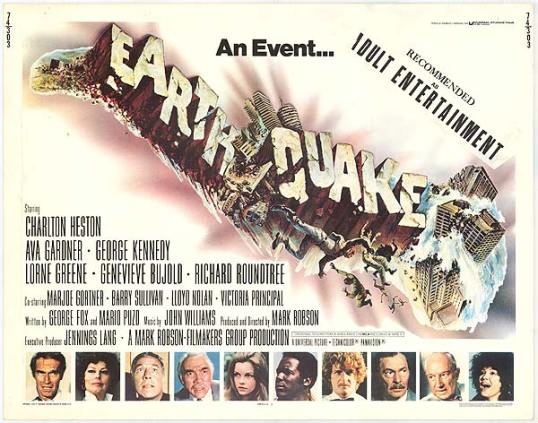
Since it’s impossible for me to talk about anything without somehow relating it to a movie, I guess it makes sense that my reaction to San Francisco winning the World Series was to write a review of the award-winning, 1974 disaster film Earthquake. If the Rangers had won, I would have been obligated to write up a review of No Country For Old Men.
So, Earthquake is one of those movies from the 70s in which a large group of different characters had to deal with some sort of cataclysmic disaster that could, in theory, have happened in reality as well as up on the movie screen. There were apparently about 2,000,000 of these films made between 1970 and 1980 and they all had titles like Hurricane, Tornado, Big Fire, Asbestos, Flash Flood, Lava Flow, Khardashian, Avalanche, and, of course, Earthquake. These movies always featured an “all-star” cast of people that nobody had ever actually heard of and I guess part of the fun was trying to guess who would survive and who would die. Apparently, they were the 1970s version of Dancing With The Stars. Call it Dying With Celebrities.
Earthquake is one of best known of these films. Apparently, it made a lot of money in 1974 and it won Academy Awards for its earthquake effects. Bleh. Whatever. Have you ever really sat down and looked at a list of the movies that have won at least one Academy Award since they first started handing those things out? Earthquake is like a 6 hour movie and Los Angeles doesn’t start shaking until halfway through. The Earthquake itself only lasts for 15 minutes and it’s kind of impressive to watch but it’s 15 minutes out of 360.
Before the earthquake hits, we get to meet the usual cross-section of humanity. Charlton Heston is an architect who is married to Ava Gardner who is the daughter of Heston’s boss, who is played by an actor named Lorne Greene who appears to be younger than either Heston or Gardner. Heston has a mistress who is played by Genevieve Bujold who is really pretty, sweet, and boring. Gardner is none of these things but she is a foul-mouthed alcoholic who fakes suicide attempts so I was pretty much on her side as far as the whole love triangle is concerned. After the Earthquake, Heston and Greene and a bunch of accident-prone extras are stuck in the ruins of sky scraper. Heston grimaces a lot in this film but you know what? Say what you will about Charlton Heston’s politics or his clenched-teeth acting style, the man knew how to wear an ascot.
While Heston is torn between Gardner and Bujold (a plot development that reportedly inspired the famous Sartre play No Exit), Richard Roundtree just wants to jump over stuff on his motorcycle. That’s right — John Shaft is in this movie and we can dig it. He’s a professional daredevil. He’s also a surprisingly dull actor. Who would have guessed that, without a theme song playing, Shaft would turn out to be so boring? Still, there’s a really cool scene where Roundtree tries to ride his motorcycle through Los Angeles in the middle of the earthquake and the film is worth watching for his all-flare stunt daredevil costume if nothing else. Plus, Roundtree’s playing a character named Miles here and I like that name.
There’s another subplot. It involves George Kennedy as a blue-collar cop who does what he has to do to try to maintain the peace before and after the Earthquake. Bleh. I mean, Kennedy actually gives a pretty good performance and he’s probably the most likable character in the film but seriously — Bleh.
And finally, this collection of humanity is rounded out by an aspiring actress (played by actress Victoria Principal who, four years earlier, had made history by being the first woman to successfully seduce actor Anthony Perkins and no, I don’t want to go into how I know that) and the psychopathic grocery store manager who is obsessed with her. The grocery store manager is played by former child evangelist and 70s exploitation icon Marjoe Gortner. Much as in the later film Starcrash, Gortner projects a remarkably unlikable vibe that works well for his character. He also has a really bad perm and a mustache and his performance is so sublimely bad that it’s actually pretty good. As for Principal, her character here is apparently the owner of 1974’s most ginormous afro and, like most women in the 70s, really should have considered wearing a bra. It’s hard to really judge Principal’s performance because any time she’s on-screen, you just start thinking, “Oh my God, she had sex with Norman Bates but somehow, she thinks she’s too good for Marjoe Gortner?”
These are the characters that we follow as Los Angeles is destroyed on-screen. None of them are really much more than cardboard cut outs but there’s something oddly comforting about how shallow and predictable they all are. Add to that, most of them end up dead so if you do dislike them, you’ll find a lot to enjoy. You’ll especially enjoy the film’s final few moments unless, like me, you can’t swim and you’re terrified of drowning. If you’re like me, that scene might give you nightmares.
Flawed as it may be, I still have to recommend this movie as 1) a time capsule and 2) as a quintessential piece of American camp. Every line of dialogue, every performance, every image, and every scene in Earthquake simply screams 1974. I guess the best way to look at Earthquake is to think about it as if the movie’s a time machine. You might not like where the machine takes you but you’re still going to get into the damn thing and, once you find yourself stuck in Iowa in the year 1835, you’ll find someway to force yourself to be entertained because otherwise, you’re just hanging out in Iowa in 1835.
“There are things in this world that go beyond human understanding.”
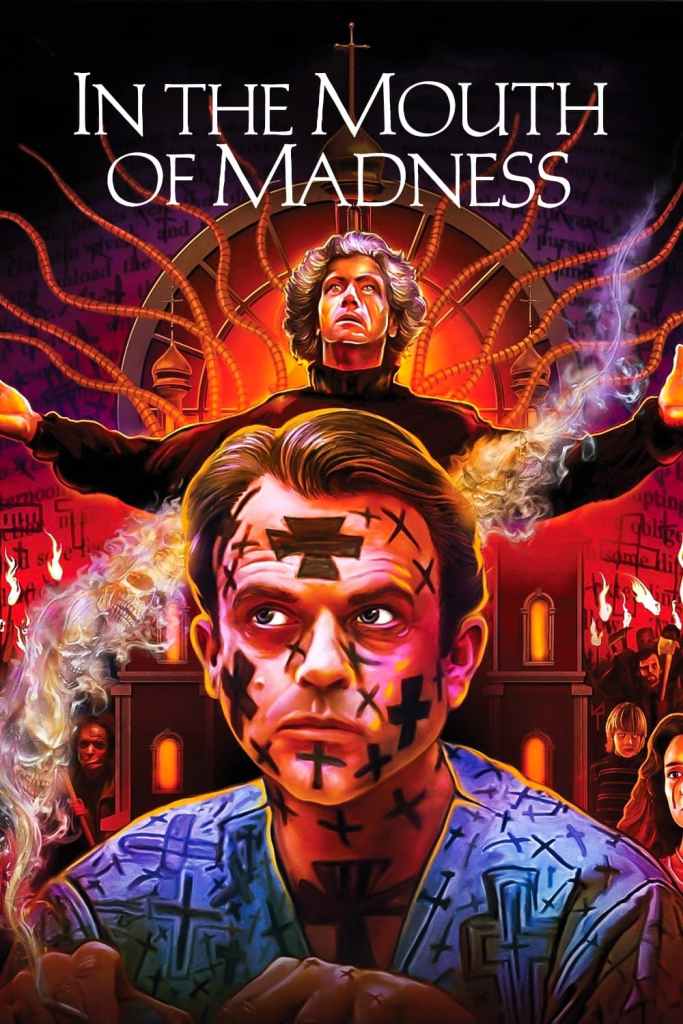
John Carpenter’s reputation as one of the great American horror directors rests on his ability to merge the cinematic with the philosophical—to craft films that stay frightening not because of what they show, but because of what they suggest. Yet by the early 1990s, Carpenter’s once unshakable relationship with audiences had weakened. His influence remained undeniable, but several of his later films seemed to miss the spark that defined Halloween, The Fog, or The Thing. Then arrived In the Mouth of Madness (1995), a work that signaled a late creative resurgence. It paid intelligent homage to two pillars of horror literature—Stephen King and H. P. Lovecraft—while offering a disturbing reflection on authorship, sanity, and the power of belief. The film reasserted Carpenter’s command not only over frightening imagery but also over the psychological territory that underpins enduring horror.
At a narrative level, In the Mouth of Madness follows John Trent (Sam Neill), an insurance investigator known for exposing fraud and deception. His skepticism becomes both his strength and undoing. Trent is hired by publishing executive Jackson Harglow (played by the legendary Charlton Heston) to locate Sutter Cane, a best-selling horror novelist whose disappearance threatens both the company’s finances and the stability of Cane’s obsessed fanbase. Every sign points to something far stranger than a publicity stunt. Cane’s readers are exhibiting troubling behavior, as though the author’s new book has triggered more than just entertainment—it has become contagion.
Carpenter crafts Trent’s descent into uncertainty with meticulous pacing. At first, Neill’s character regards the assignment as routine, dismissing the hysteria surrounding Cane’s novels as marketing excess. But when his investigation hints that the locations and events in Cane’s fiction may correspond to real places and real disturbances, the film begins to twist the rational into the uncanny. The story’s sense of unreality builds with deliberate restraint—incidents grow progressively stranger, but never so overt that Trent can confidently identify what’s madness and what’s truth. Carpenter thrives on this ambiguity, pulling both protagonist and viewer into an atmosphere where logic erodes and fiction itself seems to rewrite reality.
Accompanying Trent on his search is Linda Styles (Julie Carmen), the publisher’s editor assigned to ensure the investigation runs smoothly. While her performance has sometimes been considered subdued, Styles functions as the audience’s second perspective: observant, mildly skeptical, and gradually aware that the world around her no longer behaves according to its former rules. Carpenter positions her as a necessary counterpoint to Trent’s brittle rationalism, highlighting the conflict between recognizing patterns and succumbing to fear. As they move closer to locating Cane, their surroundings take on the familiar haunted quality of an archetypal New England town—Hobb’s End—built from the shared DNA of King’s Castle Rock and Lovecraft’s Arkham. The town becomes more than setting; it is a physical embodiment of literary influence and psychological instability.
The choice of Sam Neill proves essential to the film’s success. His trademark combination of intelligence and emotional vulnerability allows Trent’s transformation from calculating skeptic to disoriented seeker to feel natural rather than theatrical. Few actors could portray a man so evidently rational who nonetheless finds himself seduced by forces his disciplined mind cannot resist. Neill’s body language carries much of the horror; his expressions shift between dry disbelief and quiet terror, suggesting that intellect offers no protection once perception itself begins to betray you. Carpenter exploits this performance with close framing and asymmetric compositions, visually trapping Trent in spaces that subtly curve or distort. The director’s technical command ensures that even ordinary scenes seem charged with quiet wrongness.
While In the Mouth of Madness never references the mythos of Lovecraft by name, its influence saturates the film. Lovecraft’s hallmark—cosmic indifference—exists here not through tentacled gods but through the crumbling borders between fiction and the human mind. The suggestion is that the very act of creating and consuming stories might awaken something ancient and uncontrollable. When Trent confronts the nature of Cane’s work, Carpenter’s direction avoids overstatement. Instead of grand confrontations, he conveys horror through disorientation—the feeling that language, images, and even memory are slipping toward incoherence. Reality itself becomes a character, unstable and untrustworthy.
Jürgen Prochnow’s portrayal of Sutter Cane adds another layer of unease. His calm, confident manner diverges from standard portrayals of deranged genius. Prochnow makes Cane unnerving precisely because he appears so certain of his vision. The author views himself not as a mere storyteller but as a conduit, claiming that what he writes merely reveals a preexisting truth. Through him, Carpenter explores a potent question that haunts all creators: does imagination serve human purpose, or is it an independent force that uses human minds as tools? Cane’s conviction blurs that line, turning the creative process into possession. To audiences familiar with the concept of “mad artists” in literature, his belief offers both fascination and dread.
Carpenter imbues this theme with visual invention. The cinematography and set design combine the mundane with the surreal—painted walls pulse, corridors bend, horizons vanish. Rather than relying on excessive gore or digital spectacle, the director emphasizes textures and shadows, creating optical unease rather than overt shock. The town of Hobb’s End seems perpetually detached from time, its streets looping back on themselves. By employing low, creeping camera movements and deliberate color desaturation, Carpenter evokes a dreamscape decaying from within. The film’s sound design—especially Carpenter’s own pulsating score, co-composed with Jim Lang—heightens that tension with rhythmic basslines reminiscent of a heartbeat slowing to a stop. Every technical choice reinforces the narrative’s central sensation: uncertainty.
Michael De Luca’s screenplay deserves particular credit for its clever structure. The film is framed as a story told from inside an asylum, immediately hinting that the perspective may be unreliable. This framing allows Carpenter to shift between psychological thriller and cosmic horror without losing cohesion. As viewers, we are made complicit in Trent’s investigation but warned not to trust his perceptions. The resulting experience is disorienting yet coherent—a cinematic maze where each turn feels inevitable once taken. The writing never lingers long on exposition, instead suggesting connections through implication and repetition. In this way, De Luca’s script succeeds in translating Lovecraftian dread into visual terms: a fear of knowledge itself.
Very few directors have managed this particular tone as successfully. Lovecraft’s fiction often resists cinematic adaptation precisely because its greatest horror lies in what cannot be shown. In the Mouth of Madness solves this problem by making the act of storytelling itself the subject of terror. By focusing on an author whose imagination reshapes reality, Carpenter transforms literary horror into filmic language. In doing so, he edges close to achieving what decades of other attempts had failed to capture—a true Lovecraftian mood rendered on screen, grounded not in spectacle but in existential dislocation.
Despite its craftsmanship and intelligence, In the Mouth of Madness struggled at the box office upon release. Its ambiguity, self-reflexivity, and intellectual leanings proved challenging for mid-1990s audiences who expected more conventional scares. Yet over time, the film’s reputation has flourished. Today, it is often regarded as the concluding entry in Carpenter’s loosely connected “Apocalypse Trilogy,” following The Thing (1982) and Prince of Darkness (1987). All three films share a fascination with humanity confronting forces it cannot comprehend—scientific, metaphysical, or divine. In each, Carpenter presents apocalypse not as fiery destruction but as revelation: the moment when human understanding collapses under greater cosmic truth. That philosophical core links these works across more than a decade of filmmaking.
Revisiting In the Mouth of Madness now, one is struck by how prophetic it feels. Its concerns about cultural contagion and media-induced madness anticipate contemporary conversations surrounding viral misinformation, fandom extremism, and the blurring between online identity and reality. The “disease” in the film—ideas that rewrite perception—mirrors our present anxiety about the stories and images that shape collective belief. Carpenter’s horror, always grounded in social awareness, here expands into a warning about a world unable to distinguish narrative invention from lived experience.
Even limited in budget, Carpenter demonstrates confident control of visual tone and rhythm. His filmmaking reminds viewers that suggestion often unsettles more deeply than spectacle. Rather than overwhelming audiences with jump scares, he leads them through gradual disintegration, where each logical step seems to justify the next until coherence itself fractures. The film invites reflection rather than relief, leaving viewers haunted by the possibility that the boundaries between art and life are far thinner than comfort allows.
While Carpenter would go on to direct more films after 1995, In the Mouth of Madness stands as one of his last profoundly accomplished achievements. It encapsulates the elements that made his earlier works enduring: tight pacing, minimalist storytelling, and ideas that resonate beneath genre tropes. The film’s legacy continues among filmmakers who explore metafictional or cosmic horror, from Guillermo del Toro’s long-sought adaptation of At the Mountains of Madness (a feat that may never come to fruition outside of concept art and videos) to the psychological labyrinths of contemporary horror auteurs. Though Carpenter’s film never directly adapts Lovecraft, it succeeds where many literal adaptations fail—by preserving the essence of incomprehensible terror rather than translating it into spectacle.
Ultimately, In the Mouth of Madness remains a rare horror film that asks not just what we fear, but why we need fear in the first place. Its central notion—that imagination itself can undo reality—strikes at the heart of storytelling. Carpenter’s mastery lies in letting that idea linger long after the credits roll. What begins as an investigation grows into a philosophical nightmare, compelling viewers to question how much of their world is built from collective belief. In that sense, the film transcends its genre to become one of Carpenter’s most unsettling reflections on human perception. Decades later, its message still resonates: the stories we consume may shape us more profoundly than we realize.
 Through the Shattered Lens