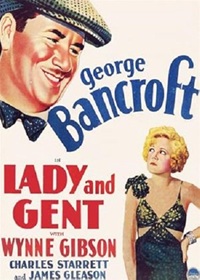
When veteran prize fighter Stag Bailey (George Bancroft) gets cocky and doesn’t bother to properly train for the big fight, he is knocked out by a young up-and-comer named Buzz Kinney (John Wayne). Stag’s manager, Pin (James Gleason), had all of his money riding on Stag winning. Now broke and with the mob after him, Pin tries to steal the cash from the boxing arena and ends up getting shot by a security guard. Stag and his girlfriend, Puff (Wynne Gibson), take in Pin’s young son, Ted, and they devote themselves to raising him. Years later, Ted (Charles Starrett) wants to become a prizefighter but Stag and Puff, who know what years of getting punched in the head can do to someone, try to convince him to go to college instead.
This boxing film is of interest to western fans because of some of the faces in the cast. This was an early John Wayne role and he’s only seen in the ring and then in one brief scene where he confronts Stag and Puff in a bar. Wayne still plays an important role, though, because Buzz’s transformation from being a fresh-faced boxer to being a bitter, punch-drunk bully serves as a warning for what waits for Ted if his adoptive parents can’t keep him out of the fight game. Charles Starrett, of course, would go on to find greater fame as the Durango Kid.
Otherwise, Lady and Gent is a standard pre-code melodrama. It’s a little more realistic than some of the other boxing films that came out in the 30s. Boxing is portrayed as a dirty business that leaves its participants with struggles that all of the prize money in the world can’t make up for. Puff sacrifices her carefree life to raise Ted but it’s worth it in the end. You can tell this was a pre-code film because Stag and Puff are a couple but they only decide to get married so they can adopt Ted.
George Bancroft was a star in the late 20s and early 30s but eventually, he transitioned to character parts. He retired from acting 1942 and became a full-time rancher. One of his final films was 1939’s Stagecoach, starring his Lady and Gent co-star, John Wayne.
Katharine Hepburn was famous for both her relationship with Spencer Tracy and the films that she made with him. They were such frequent co-stars and so associated with each other that “Hepburn-Tracy” became a film genre in and of itself, one that promised a bit of comedy, a bit of drama, and some sharp-witted romance. That said, I have to admit that one of my favorite of Katharine Hepburn’s film is one that she made not with Spencer Tracy but instead with Fred MacMurray. Alice Adams is a Tracy-Hepburn film without Tracy.
First released in 1935 and based on a novel by Booth Tarkington (who was quite a big deal back in the day even if, like Arrowsmith‘s Sinclair Lewis, he’s somewhat forgotten today), Alice Adams stars Hepburn as the title character. Alice is the daughter of Virgil Adams (Fred Stone) and his wife, who is only referred to as being Mrs. Adams (Anne Shoemaker). Virgil is a sickly man who has worked as a clerk at a glue factory for several years. Despite living in a rather large house and having a maid named Malena (Hatti McDaniel), the Adams family is not wealthy. However, Mrs. Adams desperately wants the family to be rich and Alice carries herself with the airs of a wealthy woman, despite the fact that everyone in town knows that she’s not. Alice love her family and is loyal to them, even if her younger brother (Frank Albertson, who later played Sam “Hee Haw” Wainwright in It’s A Wonderful Life) appears to be addicted to gambling and her mother is constantly browbeating her father for not being more ambitious. Her family may embarrass her but we know she wouldn’t trade them for all the money in the world. That’s why we like Alice, even if she does sometimes act like a snob.
However, when Alice meets and falls for the wealthy Arthur Russell (Fred MacMurray), she lies about her social background and tries to present herself as being just as rich as him. When she invites Arthur and his parents to her house for a dinner party, she frantically tries to keep up the charade of being wealthy. Meanwhile, Virgil finds himself wrongly accused of stealing from his boss (Charley Grapewin) and, as a result, the family’s financial future is put in jeopardy.
Alice Adams is a mix of screwball comedy and social drama. On the one hand, Alice’s desperate attempts to throw the perfect party are frequently very funny. Katharine Hepburn was always at her best when she played a flighty character and the contrast between Alice’s sophisticated airs and Alice’s actual personality makes me laugh every time that I watch the film. At the same time, there’s a definite undercurrent of melancholy to the film. Alice and her mother are both so desperate to be rich that they’ve both been blinded to just how wonderful their lives really are. Alice may like Arthur and Arthur definitely likes Alice but one never forgets that a part of Alice’s attraction to Arthur is that Arthur can give her the life to which she aspires.
Alice Adams features one of Hepburn’s best performances and it’s a rare Hepburn performance to which anyone watching should be able to relate. At some point in our lives, we’ve all felt like Alice. We’ve all been Alice, even if we don’t want to admit it. Fred MacMurray’s natural likability serves him well as Arthur. He comes across like a genuinely nice guy and we definitely want him and Alice to end up together.
Alice Adams was nominated for Best Picture but it lost to a much bigger production, Mutiny on the Bounty. Bette Davis beat Katharine Hepburn for Best Actress. Davis later said that she felt Hepburn should have won.
Brazos Kane (Randolph Scott) is a legendary gunfighter who has more notches on his gunbelt then he can count. His reputation is so fearsome that he can’t even enter a town without having to worry about someone drawing a gun on him in an attempt to make a name for themselves. When he’s forced to shoot his own best friend when the latter tries to outdraw him, Brazos says that he’s had enough. He tosses aside his guns and he heads to the home of his friend, Bob Tyrell. Brazos says he’s going to retire from gunfighting and just “ride the range.”
When Brazos reaches Bob’s cabin, he discovers that Bob has been murdered. When Brazos rides to the nearby Banner ranch to report the crime, he’s arrested and accused of shooting Bob. When it’s pointed out that Brazos doesn’t have a gun, corrupt Deputy Yount (Grant Withers) says that Brazos most have tossed it in the creek after he shot Bob.
With the help of Bob’s employer, a rancher named Inslip (Charley Grapewin), Brazos narrowly avoids getting hung. Both Yount and the sheriff (Charles Kemper) encourage Brazos to leave town but Brazos isn’t going anywhere until he gets justice for Bob. His investigation leads to him getting involved with two sisters (Dorothy Hart and Barbara Britton) and a young cowhand named Johnny (John Miles), who wants to become a famous gunslinger. It also leads Bob into conflict with Bard Macky (Bruce Cabot) and Hen Orcutt (Forrest Tucker), who are both determined to run Brazos out of town. Brazos finds himself tempted to go back on his word and pick up his guns yet again.
Based on a novel by Zane Grey, Gunfighters is a surprisingly mature and multi-layered western. Brazos’s refusal to carry a gun and his genuine dislike of violence makes him a far more interesting protagonist than the typical B-western hero and Randolph Scott, one of the best of the cowboy actors, is appropriately world-weary in the role. The villains are also written and played with an unexpected amount of depth, with Bruce Cabot the stand-out as Bard Macky.
Gunfighters is full of good scenes. The opening sequence, featuring the pivotal gunfight between Brazos and his best friend, is excellently directed and captures how quickly violence can erupt in the old west. Later, when Brazos first meets Johnny, the younger man is engaged in target practice and talking about how a man named Brazos Kane murdered Johnny’s best friend. Johnny is practicing so he can kill Brazos himself. Without revealing his identity, Kane gives Johnny a few pointers on how to draw and aim his gun. It’s only after Johnny has perfected the quick draw that Kane laconically introduces himself and explains that he had nothing to do with Bob’s death. Later, in a powerfully acted scene, Kane explains to Johnny just what exactly it means to be a famous gunfighter and to know that everyone you see is a potential threat.
Directed by George Waggner, Gunfighters is an intelligent and well-acted western and one of Radolph Scott’s best.
(With the Oscars scheduled to be awarded on March 4th, I have decided to review at least one Oscar-nominated film a day. These films could be nominees or they could be winners. They could be from this year’s Oscars or they could be a previous year’s nominee! We’ll see how things play out. Today, I take a look at the 1940 best picture nominee, The Grapes of Wrath!)
How dark can one mainstream Hollywood film from 1940 possibly be?
Watch The Grapes of Wrath to find out.
Based on the novel by John Steinbeck and directed by John Ford, The Grapes of Wrath tells the story of the Joad family and their efforts to neither get sent to prison nor starve to death during the Great Depression. When they lose their farm in Oklahoma, they head for California. Pa Joad (Russell Simpson) has a flyer that says someone is looking for men and women to work as pickers out west. The 12 members of the Joad Family load all of their possessions into a dilapidated old truck and they hit the road. It quickly becomes apparent that they’re not the only family basing all of their hopes on the vague promises offered up by that flyer. No matter how much Pa may claim different, it’s obvious that California is not going to be the promised land and that not all the members of the family are going to survive the trip.
Tom Joad (Henry Fonda) is the oldest of the Joad sons. He’s just been released from prison and he’s killed in the past. Having been in prison during the start of the Great Depression, Tom doesn’t realize how bad things truly are until he arrives home and sees someone he grew up with using a tractor to knock down a house. (It’s just business, of course. The owners of the house can’t pay their bills so the house gets destroyed.) The film’s story is largely told through Tom’s eyes and Henry Fonda gives a sympathetic performance, one the gets the audience to empathize with and relate to a character who is a total outsider.
As for the rest of the Joad Family, Ma (Jane Darwell) is the glue who holds them together and who refuses to allow them to surrender to despair. (And yet even Ma is forced to make some tough choices when the starving children of one work camp ask her to share her family’s meal with them.) Rosasharan (Dorris Bowdon) is pregnant while Grandpa (Charley Grapewin) is too sickly for the trip but doesn’t have anywhere else to go. And then there’s Casy (John Carradine), the former preacher turned labor organizer. Casy is not blood-related but he soon becomes a member of the family.
The Joads have a healthy distrust of the police and other authority figures and that turns out to be a good thing because there aren’t many good cops to be found between Oklahoma and California. Instead, the police merely serve to protect the rich from the poor. Whenever the workers talk about forming a union and demanding more than 5 cents per box for their hard work, the police are there to break heads and arrest any troublemakers on trumped up charges. Whenever a town decides that they don’t want any “Okies” entering the town and “stealing” jobs, the police are there to block the roads.
The Grapes of Wrath provides a portrait of the rough edges of America, the places and the people who were being ignored in 1940 and who are still too often ignored today. John Ford may not be the first director that comes to mind when you think of “film noir” but that’s exactly what The Grapes of Wrath feels like. During the night scenes, desperate faces emerge from the darkness while menacing figures lurk in the shadows. When the sun does rise, the black-and-white images are so harsh that you almost wish the moon would return. The same western landscape that Ford celebrated in his westerns emerges as a wasteland in The Grapes of Wrath. The American frontier is full of distrust, anger, greed, and ultimately starvation. (Reportedly, the film was often shown in the Soviet Union as a portrait of the failure of America and capitalism. However, it was discovered that Soviet citizens were amazed that, in America, even a family as poor as the Joads could still afford a car. The Grapes of Wrath was promptly banned after that.) John Ford is often thought of as being a sentimental director but there’s little beauty or hope to be found in the images of The Grapes of Wrath. (Just compare the way The Grapes of Wrath treats poverty to the way Ford portrayed it in How Green Was My Valley.) Instead, the film’s only hint of optimism comes from the unbreakable familial bond that holds the Joads together.
As dark as it may be, the film is nowhere near as pessimistic as the original novel. The novel ends with a stillborn baby and a stranger starving to death in a barn. The film doesn’t go quite that far and, in fact, offers up some deus ex machina in the form of a sympathetic government bureaucrat. (Apparently, authority figures weren’t bad as long as they worked for the federal government.) That the book is darker than the movie is not surprising. John Steinbeck was a socialist while John Ford was a Republican with a weakness for FDR. That said, even though the film does end on a more hopeful note than the novel, you still never quite buy that things are ever going to get better for anyone in the movie. You want things to get better but, deep down, you know it’s not going to happen. Tom says that he’s going to fight for a better world and Fonda’s delivers the line with such passion that you want him to succeed even if you know he probably won’t. Ma Joad says the people will never be defeated and, again, you briefly believe her even if there’s not much evidence to back her up.
Even when viewed today, The Grapes of Wrath is still a powerful film and I can only guess what it must have been like to see the film in 1940, when the Great Depression was still going on and people like the Joads were still making the journey to California. Not surprisingly, it was nominated for best picture of 1940, though it lost to Alfred Hitchcock’s Rebecca.
(For those following at home, Lisa is attempting to clean out her DVR by watching and reviewing 38 films by the end of this Friday. Will she make it? Keep following the site to find out!)
In the 1936 comedy Libeled Lady, tabloid newspaper editor Warren Haggerty (Spencer Tracy) has a problem. His newspaper has just published a story accusing wealthy heiress Connie Allenbury (Myrna Loy) of being the other woman in a scandalous divorce. The problem is that Connie was not the “other woman” and she is now suing the newspaper for $5,000,000.
“5 million dollars!” an astonished Warren declares, “nobody has that type of money!”
(It was 1936, after all.)
However, Warren has a plan and, since this is a screwball comedy, it’s an unneccesarily complicated plan. He hires a former reporter, the suave Bill Chandler (William Powell, the suavest man alive in the 30s) to meet with Connie. Warren believes that there’s no way that Connie won’t fall in love with Bill. (Perhaps Warren had recently seen The Thin Man…) Once Connie does fall in love, Warren will arrange for Bill’s wife to catch the two of them together. In order to avoid the scandal, Connie will drop the suit.
The problem is that Bill isn’t married. However, Warren has a solution for that as well. Warren arranges for Bill to marry Warren’s fiancée, Gladys (Jean Harlow). Gladys is not happy about the arrangement but goes along with it because, despite his behavior, she truly loves Warren and Warren promises her that the marriage will only last for 6 weeks.
(When the minister says that he hopes he’ll be invited to the new couple’s silver anniversary, Gladys replies, “It better be in six weeks.”)
And, at first, things go as planned. Bill meets Connie on a luxury cruise and she quickly falls in love with him. However, Bill finds himself falling in love with her too. Soon, he no longer wants to frame her. However, that’s not the only complication. Finally fed up with Warren’s behavior, Gladys has started to think that maybe it would be better to be married to Bill. Soon, she decides that she has no intention of getting a divorce…
Libeled Lady is a minor but enjoyable screwball comedy. The plot is thoroughly implausible but, fortunately, William Powell was one of those actors who could get you to believe almost anything. As anyone who has seen any of the Thin Man films can tell you, Powell and Myrna Loy had great chemistry together. Spencer Tracy seems a little uncomfortable with the role of Warren but Jean Harlow is a lot of fun as Gladys. She doesn’t have a big role but, at the same time, you can still understand why she was such a huge star and why her tragic death a year later was such a shock.
(At the time the movie was made, Harlow was dating William Powell. She wanted to play Connie but MGM was determined to repeat the formula of previous William Powell/Myrna Loy comedies and Harlow settled for the secondary role of Gladys.)
As enjoyable as the film is, it still does seem a bit strange that it was nominated for best picture. It lost the Oscar to The Great Ziegfeld, another MGM film that starred William Powell and Myrna Loy.
(For those following at home, Lisa is attempting to clean out her DVR by watching and reviewing 38 films by this Friday. Will she make it? Keep following the site to find out!)
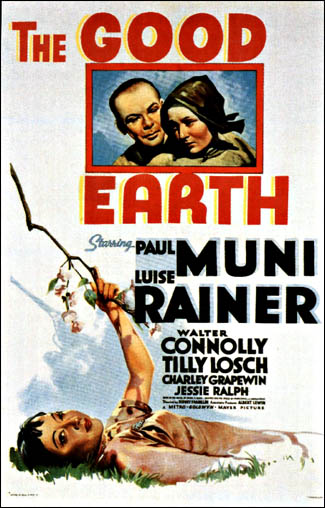
The 1937 film The Good Earth is a strange one.
It’s a big, epic film about life in China in the years before World War I. It opens with a poor farmer named Wang (Paul Muni) marrying a servant girl named O-Lan (Luise Rainer). O-Lan is quiet but strong and, with her support, Wang eventually starts to prosper. He buys land and they have children. Together, Wang and O-Lan manage to survive both famine and a political upheaval. In fact, it’s China’s volatile politics that occasionally allow the family to survive. When a revolutionary mob loots a mansion, O-Lan joins in just long enough to come across a bag of diamonds that the Wang uses to eventually buy the biggest house in town. Once he’s become wealthy and complacent, Wang ends up taking on a younger, second wife (Tilly Losch) and O-Lan finds herself competing for his attention. Ultimately, it’s only when Wang is again forced to tend to the Earth that he understands what is really important.
So, here’s the weird thing about The Good Earth. It’s a film about China. It covers several years of Chinese history and the story itself is rooted in Chinese culture. All of the characters are meant to be Chinese. When the movie was filmed, China was at war with Japan so it’s not surprising that the film was shot in California. But what is interesting (though not really surprising when you consider the history of Hollywood) is that there are very few Chinese people in the cast and none of them play any of the major roles.
Instead, Wang was played by Austria-born, Chicago-raised Paul Muni. O-Lan was played by German Luise Rainer. Wang’s comic relief uncle was played by American character actor Walter Connolly while his father was played by a former vaudeville star from Ohio named Charley Grapewin. All of the actors are heavily made up so that they’ll look Chinese but none of them act or sound Chinese. It makes for a very strange viewing experience.
And it’s a bit unfortunate because there are some very good scenes in The Good Earth. Technically, it’s a very strong film. Towards the end, there’s a locust invasion that is still thrilling to watch. The sets look great. The costumes look great. If you’re a history nerd like me, the story has the potential to be interesting. But, whenever you start to get sucked into the film’s story, Wang starts to speak and sounds totally like a guy from Chicago and it takes you out of the movie. The uneven mix of quality and miscast actors makes for a rather disjointed viewing experience.
As a big epic, it’s probably not surprising that The Good Earth was nominated for best picture. However, it lost to another Paul Muni film, The Life of Emile Zola.
For the last few days, I’ve been desperately trying to clean out my DVR. Ever since this year began, I have been obsessively recording movies and now, I suddenly find myself with just a few hours of space left! Now, I know that the simple solution would be to just start erasing stuff but that’s just not the way I do things. I recorded that stuff so you better believe I’m going to watch and review every single minute of it!
Last night, I did a quick count and discovered that I have 38 movies to watch before I can officially declare the DVR to have been “cleaned out.” While that may sound like a lot, it’s not if you consider that — by watching and reviewing 4 movies a day — I can have the whole job done by the end of the next week! That’s my plan and my challenge to myself. Can I watch and review 38 movies in 10 days?
Let’s find out!
So, I started things out by watching the 1937 film, Captains Courageous.Captains Courageous was aired on TCM as a part of their 31 Days of Oscar. Not only was Captains Courageous nominated for best picture but it won Spencer Tracy his first Oscar. Tracy was one of the quintessential American actors so it’s interesting to note that he won his first Oscar for playing a Portuguese fisherman who speaks in exaggeratedly broken English.
Spencer Tracy may have won the Oscar for Best Actor but his role is really a supporting one. Instead, Captains Courageous is about an extremely spoiled, obnoxious, and annoying 15 year-old named Harvey Cheyne (Freddie Bartholomew). From the minute that Harvey first appears on screen, it’s difficult to like him. The son of a rich businessman (Melvyn Douglas), Harvey is hated by everyone. His family’s butler rolls his eyes whenever Harvey calls for him. His classmates (and, of course, Harvey attends a snooty private school) want nothing to do with him. When his father takes him on a trans-Atlantic cruise, even the sailors seem like they want to toss him overboard.
However, before they get a chance to give him one quick shove over the railing, Harvey does their job for them. He falls overboard and he nearly drowns before being rescued by a fisherman named Manuel (Spencer Tracy). Manuel takes him back to the fishing schooner, where that ship’s captain (Lionel Barrymore) refuses to believe that Harvey is rich. Since the rest of the crew quickly decides that they dislike Harvey as much as everyone else does, the captain saves Harvey from being thrown back overboard by “hiring” him as a fisherman. And, of course, the captain makes Manuel responsible for him.
Though initially hostile, Harvey and Manuel slowly start to bond. Harvey learns about the importance of hard work and starts to grow up. And, eventually, it all leads to tragedy. That’s just how things work in the movies.
As you can probably guess from the plot description above, there’s not a subtle moment to be found in Captains Courageous but, as is so often the case with 1930s Hollywood, that’s actually what makes the film appealing. Captains Courageous wears its sentiment on its sleeve and it makes for an interesting contrast to the more cynical films of today. While it takes a while to get used to seeing Spencer Tracy giving such a theatrical performance, he does eventually win you over. Freddie Bartholomew is vulnerable enough to you can forgive his character for being so obnoxious. Meanwhile, Lionel Barrymore and Mevlyn Douglas are well-cast in their supporting roles and, if you keep an eye open, you’ll see everyone from John Carradine to a young Mickey Rooney working on the schooner. Ultimately, Captains Courageous is a well-made and likable coming-of-age film that still holds up today.
 When veteran prize fighter Stag Bailey (George Bancroft) gets cocky and doesn’t bother to properly train for the big fight, he is knocked out by a young up-and-comer named Buzz Kinney (John Wayne). Stag’s manager, Pin (James Gleason), had all of his money riding on Stag winning. Now broke and with the mob after him, Pin tries to steal the cash from the boxing arena and ends up getting shot by a security guard. Stag and his girlfriend, Puff (Wynne Gibson), take in Pin’s young son, Ted, and they devote themselves to raising him. Years later, Ted (Charles Starrett) wants to become a prizefighter but Stag and Puff, who know what years of getting punched in the head can do to someone, try to convince him to go to college instead.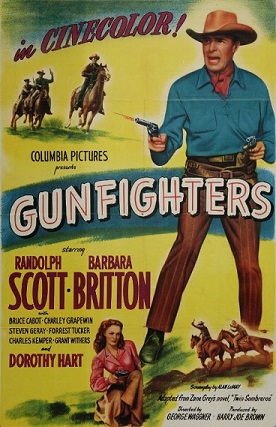


 Through the Shattered Lens