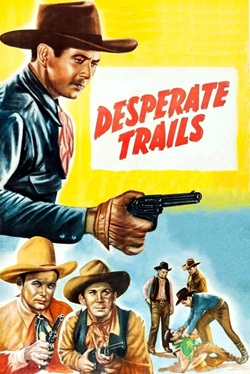
Desperate Trails (1939, directed by Albert Ray)


The frontier town of Denton has become lawless, plagued by murders, robberies, and cattle rustling.  The town’s sheriff (Russell Simpson) just cannot seem to bring peace to the streets.  That’s because the sheriff is secretly responsible for all the crime.  He’s working in cahoots with the town banker (Clarence Wilson) and he’s sets his sights on taking over a ranch owned by Frances Robinson.  As was so often the case with B-westerns, it all comes down to stealing someone else’s land.

The federal government sends Marshal Johnny Mack Brown to bring some order to the town.  Working undercover, Brown gets hired as Robinson’s ranch and he quickly chases off all of the bad ranchhands,  He brings his friend, singing cowboy Bob Baker, onboard to work as the ranch foreman.  With Fuzzy Knight providing comic relief, Brown sets out to thwart the next stagecoach robbery and to expose the evildoers of Denton.

This was the first western that Brown made with Universal Pictures.  Bob Baker, who had previously been the star of the studio’s B-westerns, was demoted to second lead and, eventually, he quit making films for Universal all together.  Unlike Baker, who was angry at being demoted, Fuzzy Knight was always happy to provide sidekick duty and would go on to co-star in all of Brown’s Universal westerns.  From the start, Brown and Knight had the chemistry that made them a good B-movie team.

Desperate Trails is a typical B-western but, as always, Brown elevates things with his performance.  From the minute that Brown rides into town, he screams authenticity.  He’s pretty tough in this film, which includes a scene where he coolly takes care of a gang of outlaws with just one rifle.  The best performance here comes from Russell Simpson, who gets angrier and angrier as the film goes on and all of his plans fall apart.

For fans of the B-western genre, Desperate Trails has a lot of entertainment to offer.
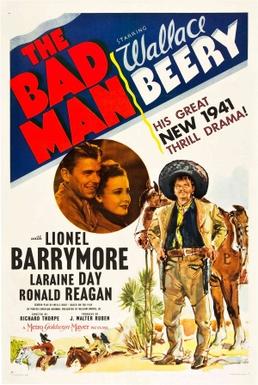
The Bad Man (1941, directed by Richard Thorpe)


Gil Jones (Ronald Reagan) lives on a ranch with his cantankerous uncle, Henry (Lionel Barrymore).  After their cattle are stolen by the notorious bandit Pancho Lopez (Wallace Beery), Gil and Henry are faced with the prospect of losing their ranch.  Banker Jasper Hardy (Henry Travers) wants to foreclose on Henry and take over the ranch but a businessman named Morgan Pell (Tom Conway) shows up and offers to pay the then-huge sum of $20,000 for the land.  Accompanying Morgan is his wife, Lucia (Laraine Day).  Lucia was Gil’s childhood love and Morgan fears that Lucia still loves Gil more than him.  Also in the mix is Gil’s comic relief best friend (Chill Wills), who has a crush on Hardy’s daughter (Nydia Westman).  Negotiations are interrupted when the flamboyant Lopez and his men return to the ranch and take everyone, but Gil, hostage.

This sepia-toned film is based on a stage play, one that had already been filmed twice.  It was Ronald Reagan’s first film for MGM and, when Reagan was running for President, he quipped that if he could survive acting opposite Wallace Beery and Lionel Barrymore than he could survive negotiating with Leonid Brezhnev.  The role of Gil is a typical Ronald Reagan role.  He’s good-natured and dependable and a little boring.  Because he once saved Lopez’s life, Lopez is willing to help him out with his problems.  Reagan is not bad in the role but he is overshadowed by Barrymore and Beery, two veteran actors who chew the scenery with gusto here.  Berry speaks in an exaggerated and not at all convincing Mexican accent while Barrymore bellows all of his lines.  Gil has so many different people yelling at him that it’s impossible not to feel sorry for him.  Morgan has ulterior motives for offering to buy the land and Tom Conway is a convincing villain.  Lopez helps out Gil and her uncle, saving not only their land but also plotting to bring Gil and Lucia back together.  It’s a stage bound mix of drama and comedy that doesn’t really work, though Beery and Barrymore are amusing and Ronald Reagan shows why he was cast in so many best friend roles.

Whether you’ll enjoy it will probably depend on how you feel about the cast because they’re really the only reason to watch.  If you’re a fan of Barrymore, Beery, or Reagan the film might work for you.  If you’re not, this stagey 70-minute western is probably not for you.

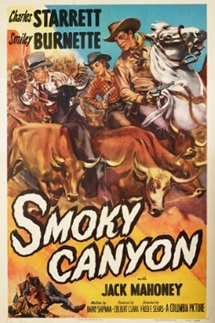
Smoky Canyon (1952, directed by Fred Sears)


There’s a $2500 dollar reward out for the masked bandit known as the Durango Kid but little do the residents of Timber Rock know that the Kid is actually Steve Brent (Charles Starrett), a Treasury agent who puts on a mask whenever he needs to go undercover and discover what the bad guys are doing.

A range war has broken out between the sheep farmers led by Jack Mahoney (Jock Mahoney) and the cattlemen led by Carl Buckley (Tristram Coffin).  To broker a peace and discover which side is the most to blame, Brent works for the cattlemen while the Durango Kid sides with the sheepmen.  It turns out that Buckley’s to blame here.  He’s using the war to thin out his cattle so that an Eastern beef syndicate can keep prices high.  When Mahoney gets too close to the truth, he is framed for the murder of Mr. Woodstock and it’s up to the Durango Kid to prove that Mahoney is innocent.  Meanwhile, Carl wants to blow up an entire mountain so that it will really thin out his cattle herd.

This is a typical Durango Kid movie, entertaining if you like B-westerns and probably boring if they’re not your thing.  It has all the usual gunfights, horse chases, and dynamite explosions that are promised by every Durango Kid film.  Starrett was always one of the most convincing cowboys on screen, even if his use of the Durango Kid alter ego didn’t always make sense.  All the usual members of the Durango stock company show up, all playing different characters than they did in the previous Durango Kid film.  Mahoney gets to play one of the good guys for once and his spirited girlfriend is played by the lovely Dani Sue Nolan.  Smiley Burnett shows up to provide comic relief.  This time, he’s a singing tour guide.  He sings a song called It’s Got To Get Better.  Let’s hope so.

Horror Film Review: The Mummy’s Curse (dir by Leslie Goodwins)


When last we checked in with Kharis the Mummy, he was running into a swamp in Massachusetts, carrying the reincarnation of Princess Ananka with him.  Chasing after him were the standard towns people with torches and guns.  It’s not a Universal horror film without angry villagers, even if the movie itself is taking place in Mapleton, Massachusetts.

Upon entering the swamp, both Kharis and Ananka sunk under the water, traumatizing Ananka’s boyfriend but apparently bringing Kharis’s reign of terror to an end.

Well, not so fast!

The 1944 film, The Mummy’s Curse, opens with the townspeople talking about how Kharis continues to haunt the old swamp, so much so that most of the locals refuse to work in the swamp.  Oddly enough, though, the townspeople are suddenly a mix of Cajuns and gypsies.  (The film even opens with a gypsy woman singing a song in a bar.)  The swamp has now become a bayou.  We are repeatedly told that the film is taking place in the same location as the previous Mummy films but suddenly, that location has changed from Massachusetts to Louisiana.

As for the plot of The Mummy’s Curse, it all centers around the swamp.  The Southern Engineering Company (and that really doesn’t sound like a Massachusetts company) is draining the swamp.  The locals are worried that draining the swamp will bring back the curse of the mummy.  Two representatives from the Scripps Museum show up and announce that they want to search the drained swamp for the remains of the mummies.  Dr. James Halsey (Dennis Moore) is typical of the archeologists who tend to show up in these Mummy films.  Meanwhile, his associate is Dr. Ilzor Zandeeb (Peter Coe) who — surprise! — is that latest Egyptian high priest to come to America to try to recover the bodies of Kharis and Princess Ananka.

Ananka (Virginia Christie) is the first to emerge from the swamp, though she has no memory of who she is.  When she is discovered on the side of the road by Prof. Halsey and his love interest, Betty (Kay Harding), they allow her to stay at their camp on the edge of the swamp.  Everyone is really impressed by the fact that this amnesiac knows so much about ancient Egypt.  Eventually, Kharis (Lon Chaney, Jr., again tightly wrapped in bandages) eventually emerges from the swamp as well, determined to protect Ananka.

The Mummy’s Curse was the final film to feature Lon Chaney, Jr. as Kharis.  Unfortunately, it’s pretty forgettable and certainly not a satisfying conclusion to the story of one of Universal’s original monsters.  A good deal of the film’s 60-minute running time is taking up with flashbacks to previous Mummy films and it seems like it takes forever for Kharis to actually get around to spreading the usual mummy mayhem.  Though it may be too much to ask for too much continuity from these films, the sudden switch from Massachusetts to Lousiana is distracting for those of us who have actually invested the time to watch the previous Mummy films.  One gets the feeling that, by the time this film went into production, no one involved really cared that much about poor Kharis and his never-ending mission to protect his princess.

Previous Universal Horror Reviews:

  1. Dracula (1931)
  2. Dracula (Spanish Language Version) (1931)
  3. Frankenstein (1931)
  4. Island of Lost Souls (1932)
  5. The Mummy (1932)
  6. The Invisible Man (1933)
  7. The Bride of Frankenstein (1935)
  8. Dracula’s Daughter (1936)
  9. Son of Frankenstein (1939)
  10. Black Friday (1940)
  11. The Invisible Man Returns (1940)
  12. The Mummy’s Hand (1940)
  13. The Wolf Man (1941)
  14. Ghost of Frankenstein (1942)
  15. Invisible Agent (1942)
  16. The Mummy’s Tomb (1942)
  17. Frankenstein Meets The Wolf Man (1943)
  18. Son of Dracula (1943)
  19. House of Frankenstein (1944)
  20. The Invisible Man’s Revenge (1944)
  21. The Mummy’s Ghost (1944)
  22. House of Dracula (1945) 
  23. Creature From The Black Lagoon (1954)

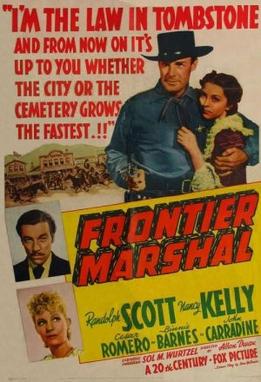
Frontier Marshal (1939, directed by Allan Dwan)


When Wyatt Earp (Randolph Scott) arrives in the town of Tombstone, he takes the law in his own hands by preventing a local outlaw named Indian Charlie (Charles Stevens) from destroying the saloon owned by Ben Carter (John Carradine).  For his trouble, Earp is beaten up by Carter’s men.  Earp, however, does get a  job as the town’s new marshal.

After some initial weariness, Wyatt befriends an alcoholic dentist and gunfighter named Doc Holliday (Cesar Romero).  While Earp keeps the peace in Tombstone, Doc is torn between two women, dancehall girl Jerry (Binnie Barnes) and his ex-girlfriend, Sarah (Nancy Kelly).

With Carter and his man planning on robbing a payroll train and also kidnapping frontier performer, Eddie Foy (played by the real Foy’s son, Eddie Foy, Jr.), it is only a matter of time before Earp takes on Carter at the legendary O.K. Corral.

Frontier Marshal was only the second sound film to be made about Wyatt Earp’s time in Tombstone and it was the first to use Earp’s name.  (In the first film version of the story, also called Frontier Marshal, Earp’s name was changed to Michael Wyatt.)  This was because Wyatt’s widow was offended by some of the material that was included in the biography that served as the basis for Frontier Marshal and threatened to sue anyone who wanted to make a movie out of it.  In order to get her permission to make the film, 20th Century Fox agreed that no reference would be made to Wyatt’s marriage in the film.  Mrs. Earp ended up suing anyways.  20th Century Fox settled.

As for the film, it’s in no way historically accurate and it pales in comparison to My Darling Clementine, Gunfight at the O.K. Corral, Tombstone, and the Star Trek episode where Kirk, Spock, and McCoy thought they were in the old west.  It is, however, better than The Gunfighters episode of Dr. Who.  Randolph Scott is convincing as an upright and law-abiding Wyatt Earp, quite a contrast to the real Wyatt.  The movie though is stolen by Cesar Romero, who plays Doc Holliday as being pathologically self-destructive.  Cesar Romero is not necessarily the first name that comes to mind when you think of a great western actor but he’s very convincing here.  John Carradine is a perfect villain and keep an eye out for Lon Chaney, Jr. as one of his henchmen.  Unfortunately, the final gunfight feels rushed and, for all the build up, it isn’t as exciting as it should be.  Frontier Marshal will mostly be of interest to those curious to see how Doc Holliday, Wyatt Earp, Tombstone and the Gunfight at the O.K. Corral were portrayed in films before they became a sacrosanct part of the mythology of the Old West.

Frontier Marshal was later remade, as My Darling Clementine, by John Ford.  Ward Bond, who played Morgan Earp in Ford’s film, plays the original town marshal in Frontier Marshal.  Charles Stevens, who plays Indian Charlie in Frontier Marshal, was often falsely described by the Hollywood publicity mill as being the real-life grandson of Geronimo.  He also appeared in My Darling Clementine, once again playing the role of Indian Charlie.  It was one of the nearly 200 films he made before he died in 1964.