Lisa Marie Reviews An Oscar Nominee: In Old Chicago (dir by Henry King)


One of the ten films to be nominated for Best Picture of 1937, In Old Chicago tells the story of the O’Leary family.

When we first meet the O’Learys, they’re riding across the Illinois frontier in a covered wagon.  After patriarch Patrick O’Leary (J. Anthony Hughes) is killed in a freak accident, Hazel O’Leary (Alice Brady) decides to settle in the bustling town of Chicago.  Hazel and her three sons build a life for themselves in a poor, largely Irish neighborhood known as the Patch.  Hazel makes a living as a laundress and soon, her home is big enough for her to take in a cow named Daisy.  Better not put that lantern too close to Daisy, Mrs. O’Leary….

As for the O’Leary boys, they all build a life of their own in 19th century Chicago.

Free-spirited Dion (Tyrone Power) hangs out in the saloon owned by sinister Gil Warren (Brian Donlevy) and, to his mother’s consternation, he falls for a singer named Belle (Alice Faye).  Eventually, Dion and Belle open up their own saloon and go into competition with Warren.  Dion soon emerges as one of the leaders of the Patch, a rogue with a charming smile and zero ethics but a total love for his family.

The youngest, Bob (Tom Brown), falls in love with a German immigrant named Gretchen (June Storey).  Bob asks Gretchen to marry him while Mrs. O’Leary’s cow stares straight at camera.

Finally, the oldest of the O’Leary boys is Jack (Don Ameche).  Jack become a crusading lawyer and eventually, he runs for mayor on a reform ticket.  With Dion’s help, Jack is able to defeat Gil Warren.  But now that Jack is mayor, he immediately sets his sights on tearing down the Patch and, in his words, “starting over.”

In Old Chicago has a two-hour running time and a lot happens in those two hours.  Not only is there all the drama between the brothers but also there’s a handful of production numbers featuring Alice Faye.  (Considering that she’s performing at a saloon in the slums of Chicago, it’s impressive that Belle can put on such an elaborate show.)  Of course, anyone with a knowledge of history knows that every minute of In Old Chicago is building up to the moment when Mrs. O’Leary’s cow kicks over that lantern and all the wooden buildings in Chicago go up in flames.  In Old Chicago is an early disaster movie and, talented cast aside, the main reason that anyone will be watching will be for the recreation of the Great Chicago Fire.  As flames roar around them and cattle stampede through the streets, hundreds of extras run for their lives.  As Alice Brady, Tom Brown, and Alice Faye stare off to the horizon, the city of Chicago explodes in front of them.  Even today, the scenes of the city on fire are impressive.

As for the rest of the film, I enjoyed the melodramatic excess of it all.  The stars weren’t exactly the most dynamic actors of the 1930s but Tyrone Power and Don Ameche were both handsome and likable enough to carry the film and it’s easy to see why In Old Chicago was, at the time of its production, the most expensive film ever made.  It’s a big film, with ornate sets, hundreds of extras, and elaborate production numbers.  It’s entertaining, even though I did occasionally find myself growing impatient as I waited for the fire to finally start burning.

One thing this film is not is historically accurate.  Not only is it now generally agreed that Mrs. O’Leary’s cow was innocent of starting the fire but Mrs. O’Leary’s son was never mayor of Chicago.  It is true that Chicago caught fire in 1871 and that the mayor turned to General Philip Sheridan (played here by Sidney Blackmer) for help in both putting out the fire and keeping order in the streets.  For the most part, though, In Old Chicago is total fiction.  That didn’t bother me but then again, I don’t live in Chicago.

In Old Chicago was nominated for Best Picture of the Year but lost to The Life of Emile Zola.  However, Alice Brady won the Oscar for Best Supporting Actress.

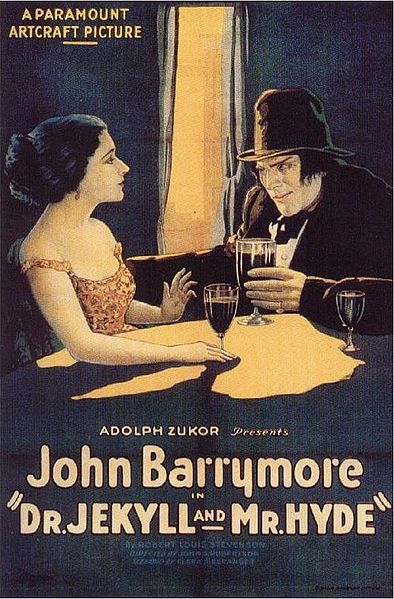
Horror on the Lens: Dr. Jekyll and Mr. Hyde (dir by John S. Robertson)


394px-Dr_Jekyll_and_Mr_Hyde_1920_poster

Ever since the birth of film, Robert Louis Stevenson’s Dr. Jekyll and Mr. Hyde has been a popular subject for adaptation.  Not only does the classic story of a good doctor who unleashes his evil instinct via potion serve as a potent metaphor for everything from sexual repression to drug addiction, but the dual role of Dr. Jekyll and Mr. Hyde has provides an excellent opportunity for an actor to show off.

The first film adaptation of Dr. Jekyll and Mr. Hyde is believed to have been made in 1908.  Two more version followed in 1912 and 1913 and then, suddenly, 1920 saw three different film versions.

The best known of the 1920 version is our film for today.  This version is best remembered for John Barrymore’s powerful performance in the title role but it also holds up remarkably well as a work of cinematic horror.

Horror on the Lens: Dr. Jekyll and Mr. Hyde (dir by John S. Robertson)


394px-Dr_Jekyll_and_Mr_Hyde_1920_poster

Ever since the birth of film, Robert Louis Stevenson’s Dr. Jekyll and Mr. Hyde has been a popular subject for adaptation.  Not only does the classic story of a good doctor who unleashes his evil instinct via potion serve as a potent metaphor for everything from sexual repression to drug addiction, but the dual role of Dr. Jekyll and Mr. Hyde has provides an excellent opportunity for an actor to show off.

The first film adaptation of Dr. Jekyll and Mr. Hyde is believed to have been made in 1908.  Two more version followed in 1912 and 1913 and then, suddenly, 1920 saw three different film versions.

The best known of the 1920 version is our film for today.  This version is best remembered for John Barrymore’s powerful performance in the title role but it also holds up remarkably well as a work of cinematic horror.

Horror on the Lens: Dr. Jekyll and Mr. Hyde (dir by John S. Robertson)


394px-Dr_Jekyll_and_Mr_Hyde_1920_poster

Ever since the birth of film, Robert Louis Stevenson’s Dr. Jekyll and Mr. Hyde has been a popular subject for adaptation.  Not only does the classic story of a good doctor who unleashes his evil instinct via potion serve as a potent metaphor for everything from sexual repression to drug addiction, but the dual role of Dr. Jekyll and Mr. Hyde has provides an excellent opportunity for an actor to show off.

The first film adaptation of Dr. Jekyll and Mr. Hyde is believed to have been made in 1908.  Two more version followed in 1912 and 1913 and then, suddenly, 1920 saw three different film versions.

The best known of the 1920 version is our film for today.  This version is best remembered for John Barrymore’s powerful performance in the title role but it also holds up remarkably well as a work of cinematic horror.

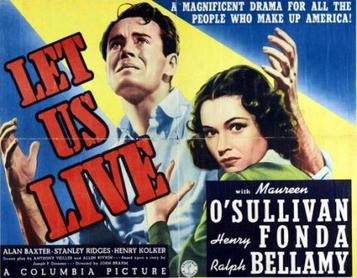
Cleaning Out The DVR: Let Us Live! (dir by John Brahm)


In the 1939 film, Let Us Live!, Henry Fonda plays Brick Tennant.  Brick is a poor but honest taxi driver who has always lived a law-abiding life and who is looking forward to marrying waitress named Mary Roberts (Maureen O’Sullivan).  However, when a taxi is used as a getaway car in a violent robbery that leaves a policeman dead, Brick finds that he’s a suspect.

At first, Brick isn’t too worried.  It turns out that every taxi driver in Boston is apparently being considered a suspect.  Brick is just 1 out of 120.  However, when the police bring Brick in to take part in a lineup, one of the witnesses insists that Brick and his friend, Joe Linden (Alan Baxter), were involved in the robbery.  Despite the fact that Brick and Mary were at a church, planning their wedding, during the robbery, Brick and Joe are arrested and put on trial for murder.  Despite Brick’s initial faith in the system, he and Joe are convicted and sentenced to die.

On death row, Brick faces the inhumane reality of American justice.  He watches as other prisoners slowly lose their mind as a result of neglect and abuse.  He watches as another prisoner drops dead in front of him, to the indifference of the guards.  Even when Mary tells him that she’s still looking for evidence that will exonerate him, Brick says that he no longer cares.  The state of Massachusetts is determined to kill him and he doesn’t believe that there’s any way stop them.  As Mary puts it, Brick is now dead inside.

Still, Mary continued to investigate.  Helping her is a police detective named Everett (Ralph Bellamy).  Everett comes to realize that two innocent men are sitting on Death Row but will he and Mary be able to find the real culprits before the state executes Brick and Joe?

While watching Let Us Live, I found it impossible not to compare the film to The Wrong Man, another film in which Henry Fonda played an innocent man being railroaded by the system.  Both The Wrong Man and Let Us Live were based on a true stories, though Let Us Live takes considerably more liberty with its source material than The Wong Man does.  Whereas The Wrong Man is a docudrama that’s full of moody atmosphere courtesy of director Alfred Hitchcock, Let Us Live is much more of a fast-paced, melodramatic B-move.

That said, Let Us Live! is still a definitely effective look at how an innocent man can be railroaded by a system that’s often more concerned with getting a quick conviction than actually searching for the truth.  Sadly, the issues that Let Us Live deals with are just as relevant today as they were in 1939.  The film’s power comes from Henry Fonda’s performance as Brick.  It’s truly heart-breaking to watch Brick go from being a cheerful optimist to a man who has been so broken down by American justice that he can’t even bring himself to celebrate the news that he might be released.  The film ends on a grim note, a reminder that some damage cannot be undone.

Let Us Live! is another good but obscure film that I discovered through TCM.  Keep an eye out for it!

Horror on the Lens: Dr. Jekyll and Mr. Hyde (dir by John S. Robertson)


394px-Dr_Jekyll_and_Mr_Hyde_1920_poster

Ever since the birth of film, Robert Louis Stevenson’s Dr. Jekyll and Mr. Hyde has been a popular subject for adaptation.  Not only does the classic story of a good doctor who unleashes his evil instinct via potion serve as a potent metaphor for everything from sexual repression to drug addiction, but the dual role of Dr. Jekyll and Mr. Hyde has provides an excellent opportunity for an actor to show off.

The first film adaptation of Dr. Jekyll and Mr. Hyde is believed to have been made in 1908.  Two more version followed in 1912 and 1913 and then, suddenly, 1920 saw three different film versions.

The best known of the 1920 version is our film for today.  This version is best remembered for John Barrymore’s powerful performance in the title role but it also holds up remarkably well as a work of cinematic horror.

30 Days of Noir #10: Roses are Red (dir by James Tinling)


As the 1947 film, Roses Are Red, begins, Robert A. Thorne (Don Castle) has just been elected to the office of district attorney.

Now, being the horror fan that I am, the thing that I immediately noticed was that the new district attorney had the exact same name as the character played by Gregory Peck in The Omen.  However, Roses Are Red has nothing to do with the son of Satan or the end of the world.  Instead, it’s just a briskly paced tale of swapped identity.

Robert A. Thorne is not just a brilliant lawyer.  He’s also an example of that rare breed, an honest politician.  He ran on a platform of reform and that’s what he’s intending to pursue now that he’s been elected.  As he tells his girlfriend, journalist Martha McCormick (Peggy Knudsen), cleaning up this country isn’t going to be easy but he’s determined to do it.  And the first step is going to be taking down the local mob boss, Jim Locke (Edward Keane).

The wheelchair-bound Jim Locke is a man who prefers to stay in the safety of his penthouse, where he can feed his fish and give orders to his subordinates, all of whom have names like Duke (Charles McGraw), Knuckle (Jeff Chandler), Buster (Paul Guilfoyle), and Ace (Douglas Fowley).  However, his man on the police force, Lt. Rocky Wall (Joe Sawyer), has warned him that this new district attorney might not respond to usual combination of bribes and intimidation.  That’s not good news because there are men who might be willing to testify against Locke in return for a shorter prison sentence.

However, things start to look up when none other than Robert A. Thorne shows up at Locke’s penthouse and says that the honesty bit was all a sham and that he wants to be on Locke’s payroll.  However, Locke soon figures out that he’s not talking to Thorne.  Instead, he’s talking to Don Carney (also played by Don Castle), a career criminal who has recently been released from prison and who just happens to look exactly like Robert Thorne!

Locke and Don come up with a plan that seems foolproof.  What if Knuckle kidnaps Thorne and holds him hostage for a few days?  During that time, Don can study Thorne and learn how to perfectly imitate all of his movements and expressions.  Once the two men are absolutely indistinguishable, Knuckle will murder Thorne and then Don will take his place.

Knuckle manages to kidnap Thorne with absolutely no trouble.  The police, under the prodding of Lt. Wall, announce that Thorne has obviously run off to avoid dealing with the local gangsters.  Don starts the process of studying Thorne but it turns out that the district attorney has a few tricks of his own….

With a running time of only 67 minutes, Roses are Red doesn’t waste any time jumping into its somewhat implausible plot.  Fortunately, the film is so short and quickly paced that most viewers won’t really have time to worry about whether or not the film’s plot actually makes any sense.  This is an entertaining, low-budget film noir, featuring a host of memorable performances and all of the hard-boiled dialogue that you could hope for.  Don Castle does a good job playing both the sleazy Don Carney and the upright Robert A. Thorne.  History nerds like me will immediately notice that, with his mustache and his slicked back hair, Castle bears a distinct resemblance to former Manhattan D.A. and two-time presidential candidate, Thomas E. Dewey.

All in all, Roses are Red is an enjoyable film for fans of old school gangster noir.  Check it out below:


30 Days of Noir #7: The Sniper (dir by Edward Dmytryk)


Halfway through the chilling 1952 film, The Sniper, there’s a scene in which a woman is seen standing on the rooftop of a San Francisco apartment building.  She’s nonchalantly hanging laundry.  When she steps to the side, we suddenly see that there’s a man standing on the next rooftop over.  And he’s holding a rifle.

Fortunately, in this case, the man is a policeman.  He’s one of several cops who have been ordered to stand on rooftops with their weapons drawn and to keep an eye on the city below.  There’s a killer on the loose and the city is demanding that the police capture him.  And yet, even with a city that’s caught in the grip of fear and even with heavily armed men watching everything going on in the streets, life goes on.  People go to bars.  People go to work. Couples stroll in the park.  And one woman hangs her laundry to dry on the rooftop of an apartment building.

Suddenly, the policeman spots someone on another rooftop, a man who isn’t supposed to be there.  He’s a young guy, carrying what looks like a rifle.  The police quickly rush to the rooftop where they arrest the young man.  Have they caught the sniper who has been terrorizing San Francisco?

The police think that they have their man but we know that they don’t.  We know that the sniper is a guy named Eddie Miller (Arthur Franz).  Eddie is a delivery man.  He’s handsome but, from the minute we first see him, we can tell that there’s something off about him.  He stumbles through life, keeping his head down and rarely speaking to anyone.  The few times he does attempt to smile, it’s painfully awkward.  He’s someone who is struggling to convince the people of San Francisco that he’s one of them but the more he tries, the more of an outsider he seems to be.  In fact, the only time that we see Eddie truly happy is when he goes to a carnival and comes across a dunk tank.  Over and over again, he throws a baseball and cause the woman inside to be submerged in cold water.

At first, Eddie tries to deal with his bad thoughts by deliberately burning his hand on an electric stove.  When he goes to the emergency room, he asks the attending doctor why he would do something like that but the doctor is soon distracted by another patient.  With his hand bandaged, Eddie goes on a shooting spree, targeting brunette women.

This dark film is fairly evenly divided, between Eddie, the cops that are trying to catch him, and the psychiatrist who tries to explain him.  Not surprisingly, the cops, led by the appropriately named Lt. Kafka (Adolphe Menjou), aren’t particularly interested in what makes the sniper tick.  They just want to get him off the street.  However, Dr. James Kent (Richard Kiley) is convinced that the only way to stop not only this killer but others is to understand what’s going on inside of his mind.  The differences between Kafka and Kent’s approaches are most obvious in a scene in which every registered sex offender in San Francisco is paraded into a squad room full of jeering cops.  While the detectives taunt the offenders that they know, the offender that they don’t know prepares to kill yet again.

The Sniper was directed by Edward Dmytryk, who previously directed the Oscar-nominated (and superficially similar) Crossfire.  This was Dmytryk’s first film after his career was temporarily derailed by his refusal to testify before the House Unamerican Activities Committee.  (He later changed his mind and named names while testifying about his time as a member of the Community Party.)  Interestingly enough, top-billed Adolphe Menjou was one of the leaders of the anti-communist Motion Picture Alliance for the Preservation of American Ideals, a prominent supporter of the blacklist that Dmytryk had narrowly escaped.

Filmed in a black-and-white, documentary style, The Sniper is a chilling and disturbing film.  When Eddie stalks through the city at night, the dark shadows that he casts against the walls of empty alleyways and closed storefronts serve to remind us that men like Eddie could be lurking anywhere, unseen and unknown.  During the day scenes, the harshly bright lighting reminds us of just how vulnerable we are.  If the night provides too many places to hide, the day provides too few.  Arthur Franz gives a disturbingly credible performance as Eddie.  While he plays Eddie as being obviously troubled, he also suggests how someone like Eddie has managed to survive without getting exposed.  Menjou is properly cynical as the world weary Kafka while Richard Kiley brings some needed passion and anger to the film’s most talky scenes.  The film ends on a note of melancholy ambiguity, leaving it to us to make up our own mind about how to deal with the Eddie Millers of the world.

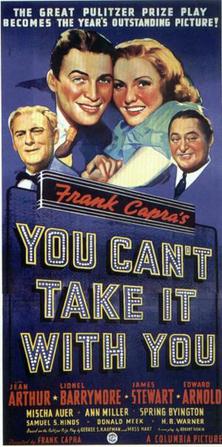
Lisa Reviews An Oscar Winner: You Can’t Take It With You (dir by Frank Capra)


(With the Oscars scheduled to be awarded on March 4th, I have decided to review at least one Oscar-nominated film a day.  These films could be nominees or they could be winners.  They could be from this year’s Oscars or they could be a previous year’s nominee!  We’ll see how things play out.  Today, I take a look at the 1938 best picture winner, You Can’t Take It With You!)

“You can’t take it with you.”

If there’s any one belief that defines the worldview of Martin Vanderhof (Lionel Barrymore), it’s this.  It doesn’t matter how much money you make in your life.  It doesn’t matter how successful you are at business or anything else.  The fact of the matter is that, when your time is up, you won’t be able to take any of that stuff with you.  Instead, Grandpa Vanderhof (as he’s called by his large family) believes that the most important thing to do during your lifetime is to make friends and pursue what you’re truly interested in.

Vanderhof has another belief, one that particularly appealed to be me.  He has never paid income tax.  He doesn’t see the point of giving money to the government when he doesn’t feel that they’ll make good use of it.  When an outraged IRS agent (Charles Lane) stops by Vanderhof’s sprawling house and demands that Vanderhof pay his taxes, Vanderhof refuses.  When the IRS man argues that the income tax is necessary to pay for the Presidency, the Congress, and the Supreme Court, Vanderhof offers to give him five dollars.  “Hell yeah!” I shouted at the TV.  With an attitude like that, Vanderhof should have moved down here to Texas.  We would have elected him governor.

Grandpa Vanderhof is the head of a large and cheerfully eccentric family, all of whom live together under the same roof.  Penny (Spring Byington) writes novels because, years ago, a typewriter was accidentally delivered to the house.  Her husband, Paul (Samuel S. Hinds), has a basement full of fireworks.  Essie (Ann Miller) loves to dance and spends almost the entire movie twirling from room to room.  Her husband, Ed (Dub Taylor), is a xylophone player.

Of course, it’s not just family living in the Vanderhof House.  There’s also Potap Kolenkhov (Mischa Auer), a Russian who is “teaching” Essie how to dance.  There’s Rheba the maid (Lillian Yarbo) and Donald (Eddie Anderson) the handyman.  Actually, the house appears to be open to just about anyone who wants to stay.

And then there’s Penny’s daughter, Alice (Jean Arthur).  Alice is the most “normal” member of the family.  She has just become engaged to Tony Kirby (James Stewart) and she is still trying to figure out how to introduce Tony’s stuffy parents (Edward Arnold and Mary Forbes) to her eccentric family.  What she and Tony don’t know is that Mr. Kirby is currently trying to buy up all the houses that are near a competitor’s factory.  Only one homeowner has refused to sell.  The name of that homeowner?  Martin “Grandpa” Vanderhof.

It all leads, of course, to one chaotic dinner party, one lively night in jail, and a huge fireworks display.  It also leads to true love, which is nice.  Jimmy Stewart and Jean Arthur are even more adorable here than they were in Mr. Smith Goes To Washington.

Based on a Pulitzer-winning play by George S. Kaufman, You Can’t Take It With You was the second comedy to win the Oscar for Best Picture.  The first comedy to win was 1934’s It Happened One Night.  It’s probably not coincidence that both of these films were directed by Frank Capra.

Seen today, You Can’t Take It With You seems a bit slight for an Oscar winner.  Grandpa Vanerhof is a lovable eccentric.  Tony’s father is a stuffy businessman.  Hmmm … I wonder whose philosophy is going to be victorious at the end of the movie?  Still, predictability aside, it’s a delightfully enjoyable film.  While it never quite escape its stage origins, it features wonderful performances from all the usual members of the Capra stock company.  James Stewart and Jean Arthur are a charming couple while Lionel Barrymore gives a performance that is so warmly likable that it’s hard to imagine that, just 9 years later, he would be so perfectly cast as the heartless Mr. Potter in It’s A Wonderful Life.  Of course, my favorite member of the member was Essie, mostly because I also like to dance from room to room.  While it’s hard to justify awarding it Best Picture over The Adventures of Robin Hood and Grand Illusion, You Can’t Take It With You is still a wonderfully fun movie.

It’ll make you smile and laugh.  Who can’t appreciate that?

http://www.youtube.com/watch?v=0WY9RAroTS0


Horror Film Review: Strange Invaders (dir by Michael Laughlin)


In 1983, two years after the release of Strange Behavior, director Michael Laughlin and Bill Condon teamed up for another “strange” film.  Like their previous collaboration, this film was a combination of horror, science fiction, and satire.

The title of their latest collaboration?

Strange Invaders.

Strange Invaders opens in the 1950s, in a small, all-American town in Illinois.  Innocent children play in the street.  Clean-cut men stop off at the local diner and talk to the waitress (Fiona Lewis, the scientist from Strange Behavior).  Two teenagers (played by the stars of Strange Behavior, Dan Shor and Dey Young) sit in a car and listen to forbidden rock’n’roll music.  A lengthy title crawl informs us that, in the 1950s, Americans were happy and they were only worried about three things: communists, Elvis, and UFOs.  On schedule, a gigantic UFO suddenly appears over the town.

Twenty-five years later, mild-mannered Prof. Charles Bigelow (Paul Le Mat) teaches at a university and wonders just what exactly is going on with his ex-wife, Margaret (Diana Scarwid).  In order to attend her mother’s funeral, Margaret returned to the small Illinois town where she grew up.  When she doesn’t return, Charles decides to go to the town himself.  However, once he arrives, he discovers that the town appears to still be stuck in the 50s.  The townspeople are all polite but strangely unemotional and secretive.  Charles immediately suspects that something strange is happening.  When the towns people suddenly start shooting laser beams from their eyes, Charles realizes that they must be aliens!

Fleeing from the town, Charles checks all the newspapers for any reports of an alien invasion.  The only story he finds is in a cheap tabloid, The National Informer.  The author of the story, Betty Walker (Nancy Allen), claims that she just made the story up but Charles is convinced that she may have accidentally told the truth.  At first, Betty dismisses Charles as being crazy.  But then she’s visited by an Avon lady who looks just like the waitress from the small town and who can shoot laser beams.

Teaming up, Charles and Betty investigate the aliens and try to figure out just what exactly they’re doing on Earth.  It’s an investigation that leads them to not only a shadowy government operative (Louise Fletcher) but also a man (Michael Lerner) who claims that, years ago, he helplessly watched as his family was destroyed by aliens.

Like Strange Behavior, Strange Invaders is a … well, a strange film.  I have to admit that I prefer Behavior to Invaders.  The satire in Strange Invaders is a bit too heavy-handed and Paul Le Mat is not as strong a lead as Michael Murphy was in the first film.  I was a lot more impressed with Nancy Allen’s performance, if just because I related to both her skepticism and her sudden excitement to discover that her fake news might actually be real news.  I also liked Micheal Lerner, so much so that I almost wish that he and Le Mat had switched roles.  Finally, I have to say that Diana Scarwid’s performance was so bizarre that I’m not sure if she was brilliant or if she was terrible.  For her character, that worked well.

Strange Invaders gets better as it goes along.  At the start of the film, there are some parts that drag but the finale is genuinely exciting and clever.  If the film starts as a parody of 1950s alien invasion films, it ends as a satire of Spielbergian positivity.  It’s an uneven film but, ultimately, worth the time to watch.