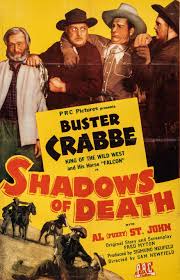
Shadows of Death (1945, directed by Sam Newfield)


After a railroad agent is murdered and his map of the future locations of the railroad is stolen, Billy Carson (Buster Crabbe) rides into a frontier town and searches for the guilty party.  Fortunately, for Billy, his best Fuzzy Q. Jones is the mayor, the sheriff, and the town barber!  Unfortunately, local gunslinger Clay Kincaid (Eddie Hall) wants to make a name for himself by taking on the famous Billy Carson.  Corrupt businessman Landreau (Charles King) encourages Clay by lying to him and telling him that Bully is planning on stealing Clay’s girl, Babs (Dona Dax).
A standard Poverty Row western, Shadows of Death was made by the same crew and cast who were involved with most of Buster Crabbe’s Billy The Kid films.  I’m not sure if Billy Carson is meant to be the same character as Billy the Kid, though.  Billy the Kid always had bounty hunters after him but Billy Carson works for the railroad.  However, it would be strange if Fuzzy Q. Jones just happened to be the favored sidekick of two gunslingers who just happen to both be named Billy.  Along with Fuzzy’s vaudeville style comedy, one thing that audiences could always take for granted was that Charles King would play the villain in these movies and Frank Ellis would always be his henchman.  I always wonder if audiences in the 40s noticed that Charles King’s businessman and Frank Ellis’s gunslinger always returned from the dead with every B-western that came out.

My favorite scene in this one is Billy bursting into Landreau’s office, just for Landreau to say that he expects visitors to knock.  Billy pauses long enough to knock on the door before getting down to the business of frontier justice.

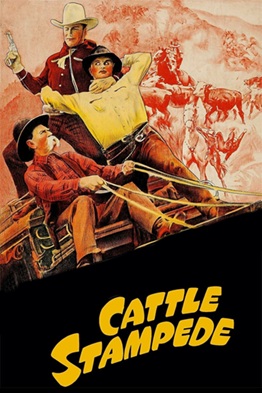
Cattle Stampede (1943, directed by Sam Newfield)


Billy the Kid (Buster Crabbe), that western do-gooder who has been framed for crimes that he didn’t commit, narrowly escapes being captured by a group of bounty hunters.  To thank the man who helped him and his sidekick, Fuzzy Q. Jones (Al  St. John), escape, Billy agrees to help the man’s family make a cattle drive.  It turns out that local ranchers are being targeted by rustlers who cause the cattle to stampede and then buy up what’s left of the herd at a discount.  Even though Mary Dawson (Frances Gladwin) doesn’t trust Billy and initially suspects him of being one of the rustlers, Billy and Fuzzy take over the cattle drive and protect the family from Coulter (Glenn Strange) and Elkins (Frank Ellis).  They even prove their worth by rescuing Mary after she’s kidnapped by the villains.

This is one of the many Poverty Row westerns to feature Billy the Kid not as an outlaw but instead as a hero.  Best-known for playing Tarzan, Flash Gordon, and Buck Rogers, Buster Crabbe was a believable hero even if he was more than a little too old to be nicknamed “the kid.”  Al St. John provides the comedic relief and veteran bad guys Charles King, Glenn Strange and Frank Ellis go through the motions as the villains, much as they did in countless other westerns of the era.  Cattle Stampede is typical of the cheap western programmers that came out of the Poverty Row studios in the 40s.  It was simplistic and predictable but featured enough western action to keep the kids in the audience entertained.  Today, its main selling point is a nostalgic one.

The Billy the Kid films are always strange because they avoid the reason why Billy is being pursued by the law and instead just present him as being another generic western hero.  It seems like a waste of a good legend.

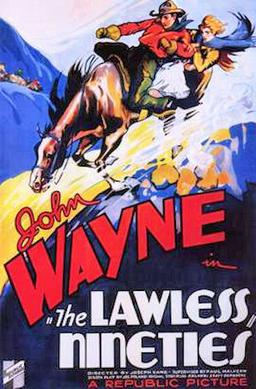
The Lawless Nineties (1936, directed by Joseph Kane)


The year is 1890 and Wyoming is on the verge of voting for statehood.  Newspaperman Major Carter (George “Gabby” Hayes) believes that it’s time for Wyoming to become a state and most of the locals agree with him.  Businessman Charles Plummer (Harry Woods) does not want Wyoming to become a state and he’s willing to send out his main henchman, Steele (Al Bridge), to intimidate the voters and to silence Carter.  Plummer has a profitable racket going and the last thing he wants is for the U.S. government to get involved in his activities.  It falls to two federal agents, John Tipton (John Wayne) and Bridger (Lane Chandler), to supervise the voting and protect the citizen.  When Major Carter is shot by a drunk anti-statehood activist, the mission to make Wyoming a part of the Union becomes personal.

The Lawless Nineties is typical of the B-movies that John Wayne made for Republic Pictures before John Ford resurrected his struggling career by casting him as The Ringo Kid in Stagecoach.  There are plenty of gunfights and horse chases and explosions as the bad guys try to keep the townspeople from voting and the federal agents set up their own sting operation to expose Plummer’s gang.  Wayne seems more relaxed here than he did in some of his other B-movies.  He was obviously getting more comfortable with being on camera and playing the hero.  Probably the most interesting thing about this film is that Gabby Hayes (credited as George Hayes, without his famous nickname) plays the renowned and intelligent Major Carter.  Hayes was just a year away from establishing himself as a perennial B-movie sidekick and supplier comedy relief.  He would soon be best-known for playing characters who had little in common with the intelligent and well-spoken Major Carter.  In The Lawless Nineties, Hayes gets a chance to play something other than the comedic relief and turns out to be petty good at it.

This is another one of those westerns that will be enjoyed by fans of the genre.  It’s nothing special but it does allow Wayne to show hints of his future stardom and it also gives Gabby Hayes a chance to show what he was actually capable of.

Idaho Kid (1936, directed by Robert F. Hill)


When the wife of rancher Clint Hollister (Earl Dwire) died in childbirth, Clint was so distraught that he rejected his son, Todd.  Todd was raised by a rival rancher, John Endicott (Lafe McKee).  Hollister resented Endicott for taking his son and a feud developed between the two families.  Hoping the end the feud, 15 year-old Todd ran away from home and made a new life for himself as a frontier scout named Idaho.

15 years later, Idaho (Rex Bell) returns home with his sidekick, a reformed outlaw known as The Kid (David Sharpe).  Neither Hollister nor Endicott recognize Idaho and, without revealing his identity, Idaho tries to stop their feud.  Hollister’s men want to keep the feud going and they manipulate Hollister into challenging his own son to a duel.

Idaho Kid is one of the better B-westerns that Rex Bell made between 1928 and 1936.  Though the film has its share of action scenes, Idaho Kid‘s intelligent script puts more emphasis on character development than most B-westerns, with Hollister especially being portrayed as a complex character as opposed to just a stock western villain.  Rex Bell always seemed authentic whenever he was riding a horse or shooting a gun.  Idaho Kid shows that he could also play more than just a standard western hero.

Though he was being pushed for stardom by Fox Film, Rex Bell voluntarily retired from the film industry in 1936 and instead pursued a career in politics.  He was the Lieutenant Governor of Nevada when he died of a heart attack in 1962.


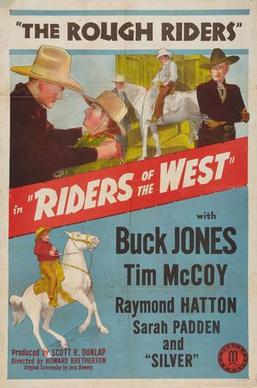
Riders of the West (1942, directed by Howard Bretherton)


In a frontier town, a gang of rustlers are stealing cattle as a part of a plot to force cash-strapped ranchers to take out exorbitant mortgages on their ranches.  Ma Turner (Sarah Padden) summons her old friend, Marshal Buck Roberts (Buck Jones), to come to town and take on the rustlers.  When the town’s corrupt banker is murdered and Ma Turner’s son, Steve (Dennis Moore), is framed for the crime, Roberts calls in his fellow Rough Riders, Tim McCall (Tim McCoy) and Sandy Hopkins (Raymond Hatton), to help him take down the gang.

In many ways, this is a familiar Rough Riders film, right down to the main bad guy being the owner of the town’s saloon and Charles King showing up as a member of the gang.  What sets it apart from the film that came before it is that, this time, Tim pretends to be an outlaw while Buck sets himself up as the new law in town.  Tim takes on the identity of Tim Steele, a sarsaparilla-drinking ne’er do well who has just gotten out of prison.  Jones and McCoy both seem to enjoy getting to switch their typical roles.  As for Sandy Hopkins, he goes undercover as a peddler of snake oil and provides the comic relief.  Riders of the West is a typical B-western but the chemistry between the three leads continues to shine through.

Previous Rough Rider Reviews:

  1. Arizona Bound
  2. The Gunman From Bodie
  3. Forbidden Trails
  4. Below the Border
  5. Ghost Town
  6. Down Texas Way

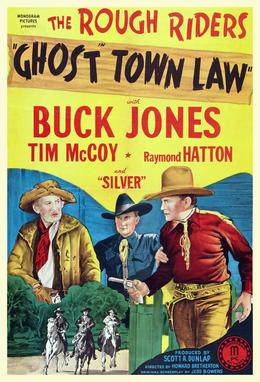
Ghost Town Law (1942, directed by Howard Bretherton)


When two U.S. marshals are ambushed and killed while searching for a group of outlaws in a nearly deserted ghost town, Marshal Tim McCall (Tim McCoy) leaves his ranch in Wyoming to investigate the crime.  He was friends with the two murdered men, making this case personal.  Of course, McCall’s two fellow Rough Riders ride into town to help McCall out.  Buck Roberts (Buck Jones) and Sandy Hopkins (Raymond Hatton) arrives separately and pretend to be prospectors.  Their investigation leads to the outlaws (led, as usual, by Charles King), a corrupt member of the community, and a network of underground tunnels that might lead to a gold mine.  As with all of the Rough Rider films, Ghost Town Law features a younger secondary protagonist who was there to appeal to audiences who didn’t remember Jones, McCoy, and Hatton from their silent and pre-code era heyday.  Virginia Carpenter plays Josie Hall, who comes to the town to search for her grandmother and brother.

Starting with the two marshals getting gunned down in the line of duty, this is one of the more violent of the Rough Riders films.  Since the Rough Riders are as interested in getting revenge as they are in getting justice, the Rough Riders themselves are quicker on the draw than usual.  The identity of the main villain will not be a shock to anyone who has watched any of the other Rough Rider films but the use of the underground tunnels adds a new element of danger to the movie.  For once, the outlaws and the Rough Riders seem evenly matched.  The film also features the very lovely and likable Virginia Carpenter, making the last of her five film appearances.

As always, the main appeal is watching Jones, McCoy, and Hatton acting opposite each other.  Due to the nature of the case, all three of them are more serious than usual in Ghost Town Law but it is still enjoyable to watch them discuss what’s been happening at their ranches since the last movie.

Previous Rough Rider Reviews:

  1. Arizona Bound
  2. The Gunman From Bodie
  3. Forbidden Trails
  4. Below the Border

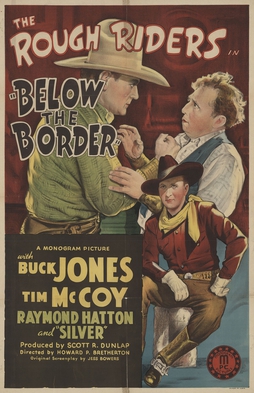
Below The Border (1942, directed by Howard Bretherton)


In the fourth Rough Riders film, the boys head down to Mexico City to defend the Garcia Ranch from a gang of cattle rustlers who are also planning on stealing the Garcia Family Jewels.  (Would the Rough Riders have any legal jurisdiction in Mexico?)  This time, Buck Roberts (Buck Jones) assumes the identity of a well-known outlaw who deals in stolen goods, Tim McCall (Tim McCoy) pretends to be a cattle buyer, and Sandy Hopkins (Raymond Hatton) gets a job sweeping up the local saloon.  As with almost all of the Rough Riders films, the owner of the saloon, Steve Slade (Charles King), is also the leader of the thieves.  Slade is blackmailing a reformed outlaw named Joe (Dennis Moore) into helping Slade and Scully (Roy Barcroft) steal the family jewels.  Joe is in love with Rosita Garcia (Linda Brent).

Below the Border has much in common with Forbidden Trails, the Rough Riders film that came before it, right down to a villainous saloon owner and a former outlaw being blackmailed to return to his old ways.  As usual, the outlaws try to humiliate Sandy Hopkins, just for Tim McCall to show up at the saloon and turn the tables.  Scully is a despicable bully and it feels good when McCall forces him to grab Hopkins’s mop and clean up the bar himself.

It’s not the strongest of the Rough Riders films. The plot is predictable, Linda Brent gives a terrible performance as Rosita, and even the action scenes are by-the-numbers.  The main appeal of Below the Border is to watch the three Rough Riders themselves.  Jones, McCoy, and Hatton all seem to have genuinely enjoyed working together and that comes through in their scenes together.  You never have any doubt that, even though they live in different parts of the country, all it would take is one telegram for them to get back together.  The highlight of each film is the final scene, where the Rough Riders tell each other what they’ve been up to between adventures.  This time, Buck invites everyone to visit him in Arizona but Tim has to get back to Wyoming and Sandy’s running a hotel in Texas.  They ride off separately but there’s little doubt they will reunite as soon as there’s a new rustler who needs to be brought to justice.

Previous Rough Rider Reviews:

  1. Arizona Bound
  2. The Gunman From Bodie
  3. Forbidden Trails

Forbidden Trails (1941, directed by Robert N. Bradbury)


Marshal Buck Roberts (Buck Jones) has finally retired after a long and a legendary career.  Two men who Buck arrested are not planning on allowing him to enjoy his retirement.  Having served their sentence for robbing a stagecoach, Fulton (Charles King) and Howard (Bud Osborne) are released from prison and head to Yucca City, Arizona.  They try to recruit their old partner, Jim Cramer (Dave O’Brien), into helping them get revenge on Buck but Cramer wants nothing to do with it.  He’s gone straight and is running his own general store with his fiancée, Mary (Christine McIntyre).  Cramer considers Buck to be a friend because Buck looked after Cramer’s children while Cramer was serving his sentence.

Fulton and Howard ambush Buck and nearly kill him.  With the help of his horse, Silver (of Lone Ranger fame), Buck is able to escape but he’s seriously injured.  His two fellow rough riders, Sandy Hopkins (Raymond Hatton) and Tim McCall (Tim McCoy), head down to Arizona to bring Fulton and Howard to justice.  (Sandy even rides away from his own wedding when he hears that Buck has been injured.)  While the Rough Riders search for Fulton and Howard, saloon owner Ed Nelson (Tris Coffin) works with the outlaws to steal a shipment of goods.

The third of the Rough Riders film, Forbidden Trails is memorable for acknowledging that the three Rough Riders were older than the most of the other contemporary western stars.  Buck Jones, Tim McCoy, and Raymond Hatton were all veteran stars who began their careers during the silent era and who transitioned to B-movies in the sound era.  At a time when their contemporaries were retiring, they were still appearing before the camera and riding the range.  Like the actor playing him, Buck Howard has reached the age when most people retire but he cannot escape his past.  Neither can Jim Cramer, who can’t live the law-abiding life that he desires as long as Fulton and Howard are free.  While Cramer has to escape from his former friends, Buck is lucky to have friends like McCall and Hopkins.  The movie showcases their loyalty and their friendship together and leaves no doubt that will never change, no matter how old the Rough Riders get.  Along with showcasing the friendship of its three stars, the movie is full of chases and gunfights.  The scene where Buck is ambushed is exiting and there’s also a good saloon shootout.  Jones and McCoy are as authentically western as ever.

Dave O’Brien and Christine McIntyre both appeared in the previous Rough Riders film but they’re playing different characters here.  Tris Coffin also played a similar crooked businessman in the first Rough Riders film, Arizona Bound.

Previous Rough Rider Reviews:

  1. Arizona Bound
  2. The Gunman From Bodie

Death Rides The Range (1939, directed by Sam Newfield)


In this “modern-day” western, Ken Maynard stars as Ken Baxter. While out camping in the wilderness with his trusty horse Tarzan and his two comic relief sidekicks, Pancho (Julian Rivero) and Panhandle (Ralph Peters), Ken comes across the gravely injured Professor Wahl (Michael Vallon). Wahl is an archeologist who has been left to die. Wahl is too weak to reveal who attacked him and, when Ken gets Wahl back to civilization, he discovers that Wahl’s colleagues, Dr. Flotow (William Castello) and Baron Starkoff (Sven Hugo Bard), aren’t willing to help Wahl unless he shares the location of a helium mine.

Flotow and the Baron are working for “a foreign power” and want to smuggle the helium back to Europe so that their country can use it to fuel their dirigibles. Ken and his sidekicks have to stop the bad guys from getting control of the ranch that sits near the mine. Going undercover, Ken allows himself to be hired by Joe Larkin (Charles King), who is trying to steal the property away from Letty Morgan (Fay McKenzie).  Romance and gunfight follows.  Ken’s horse, Tarzan, saves the day more than once.

The plot of Death Rides the Range is intriguing and, for a 55-minute programmer, complex. Unfortunately, the execution doesn’t allow the story to fulfill its potential. By the time Maynard starred in this film, the once-major cowboy star had alienated most of the major studios and he had a reputation being difficult. He was reduced to working for poverty row studios, like Colony Pictures. Maynard is a convincing hero and his horse, Tarzan, was one of the most talented of the animal actors working at that time but Death Rides The Range still feels rushed.

Death Rides The Range is mostly interesting as an example of the type of anti-German films that were being made before the U.S. officially entered World War II. The film keeps it ambiguous who Flotow and Starkoff are working for but any viewer who had been following the news out of Europe would automatically know they were working for the Germans. Even when he was making movies for Poverty Row, Ken Maynard was still fighting the good fight.

Lisa Reviews An Oscar Winner: The Broadway Melody (dir by Harry Beaumont)


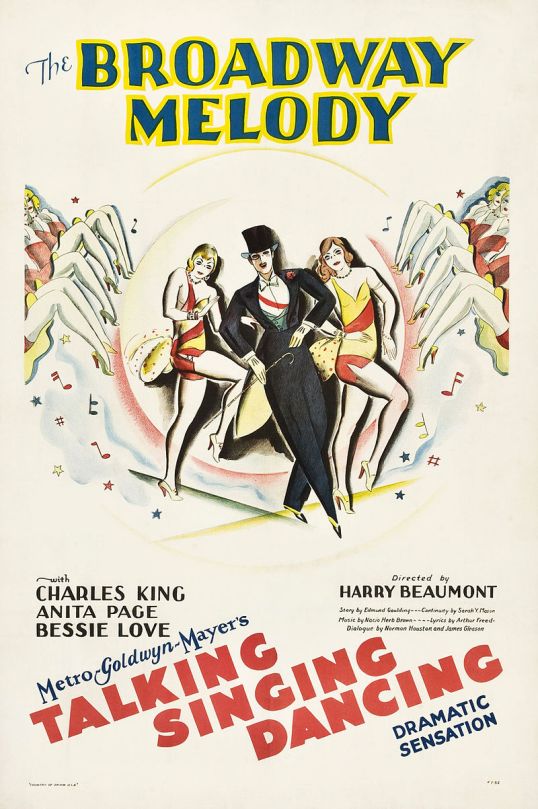
broadway_melody_poster

Oh, The Broadway Melody.

Where to begin?

First released way back in 1929, The Broadway Melody is a historically significant film.  You really can’t talk about the development of film — especially sound film — without taking at least a few minutes to acknowledge The Broadway Melody.  It was the 2nd film to ever win the Oscar for Best Picture (or Best Production, as it was called back then) and it was the first sound film to win the Oscar.  (In fact, it would be 83 years before another silent film won Best Picture and it’s debatable whether or not The Artist can really be considered a silent film in the same way that Wings was silent film.)  It was also the first musical to win best picture and some people consider it to be the first true musical to have ever been produced.  It was such a huge box office success that it could be argued that The Broadway Melody is responsible for nearly every musical that followed it.

To say that The Broadway Melody tells a familiar story would be an understatement.  I’ve read a few reviews that have suggested that the clichés in this film really weren’t clichés until after The Broadway Melody was released but I’ve seen enough silent films to know that this is not the case.  It tells the story of two sisters who want to be stars.  After spending years working in vaudeville, they’ve been invited to perform in a revue that’s being produced by Francis Zanfield (Eddie Kane).

(I assume that Zanfield was meant to be a stand-in for Florence Ziegfeld, himself the subject of a later Best Picture winner, The Great Ziegfeld.)

The sisters are Hank (Bessie Love) and Queenie (Anita Page).  Hank is the driven one.  Hank is the one with the raw talent and she’s also the one who best understands how the business of entertainment works.  Her younger sister, Queenie (Anita Page), may not have Hank’s drive or quite the same level of talent but she does have beauty.  Guess who finds the most success?

Songwriter Eddie Kearns (Charles King) is engaged to marry Hank but soon, both he and Queenie find themselves falling in love.  Not wanting to hurt her sister, Queenie instead runs off with a notorious playboy named Jock Warner (Kenneth Thomson).

As I stated previously, The Broadway Melody has not aged well.  The fact that it’s one of the first sound films just allows contemporary viewers to hear the creakiness of the plot.  As impressive as sound film was to audiences in 1929, it’s obvious today that the cast and crew of The Broadway Melody were still struggling to figure out how to work with the new technology.  As a result the performances are still a bit too broad, which only serves to make the film seem even more melodramatic than it actually is.  As for the songs, they’re not particularly memorable.  I always enjoy backstage musicals but Broadway Melody is no 42nd Street.

I did appreciate the relationship between Bessie Love and Anita Page.  That was one of the few things about the film that felt real to me, perhaps because I have three older sisters.  Interestingly enough, when Anita Page died in 2008, she was the last surviving attendee of the first Academy Awards ceremony.

The Broadway Melody was named the Best Picture of 1929.  This was the year that the winners were selected by a committee and there were no official nominations.  Though the notes from the meeting indicate that there was some consideration given to awarding the Best Actress Oscar to Bessie Love, Best Picture was the only Oscar that The Broadway Melody received.