Horror On TV: One Step Beyond 1.6 “Epilogue” (dir by John Newland)


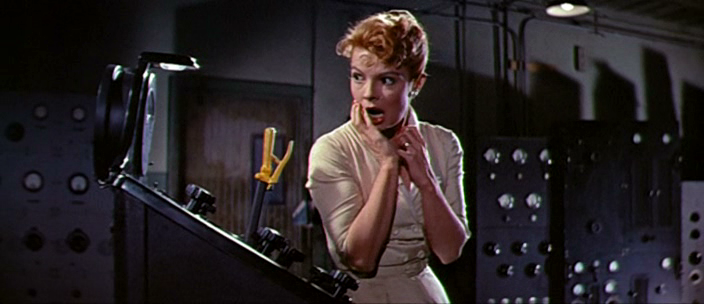
Carl Archer (Charles Aidman) is a recovering alcoholic who returns home after an extended stay in a rehab.  His wife (Julie Adams, of Creature of the Black Lagoon and The Last Movie fame) is skeptical about whether or not Carl has really sobered up and is prepared to be a responsible father to their son, Steve (Charles Herbert).  When Steve gets trapped in a cave, will Carl be able to use their psychic connection to find and rescue him?

Can you prove this didn’t happen!?

This episode originally aired on February 24th, 1959.

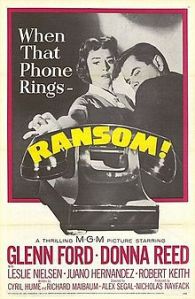
A Movie A Day #128: Ransom! (1956, directed by Alex Segal)


What would you do if your child was kidnapped?

That’s the question asked in this unjustly obscure film from 1956.  Dave Stannard (Glenn Ford) is a wealthy businessman, with a beautiful wife (Donna Reed), a big suburban home, and a butler named Chapman (the great Puerto Rican actor Juano Hernandez).  One day, his son Andy (Bobby Clark) does not come home from school.  The school says that a nurse showed up to pick Andy up for a doctor’s appointment but neither Dave nor his wife know about any appointment and their family doctor says that he would never send a nurse to pick up a patient.

Andy has been kidnapped.  When the kidnappers call, they tell Dave that they want half a million dollars in ransom.  Dave gets the money together but is then told, by reporter Charlie Telfer (Leslie Nielsen), that, once the kidnappers have the money, they will have no incentive to return Andy.  Since Andy is the only person who could identity them to the police, they may very well kill Andy after getting the money.  By paying the ransom, Dave will also be encouraging other kidnappers.

The next morning, Dave goes on television and announces that he will not be paying the ransom.  Instead, he announces that if the kidnappers do not immediately return his son, the money will be given as a reward to anyone who helps to track them down.

If this sounds familiar, it’s because Ransom! was later remade by Ron Howard, with Mel Gibson as the father and Gary Sinise as the kidnapper.  (Ransom! itself was a remake of a live television drama that aired in 1954.)  As opposed to the Howard film, the original Ransom! is a low-key character piece, one that takes place almost entirely in the Stannard home and in which the kidnappers remain largely unseen.  Almost the entire movie focuses on Dave, his decision, and his struggle to come to terms with that decision.  Was Dave right or was he wrong?  Ransom! is stagey but thought-provoking with excellent performances from the entire cast.  Even Leslie Nielsen, making his film debut, does well in the type of dramatic role that defined his career until he reinvented himself as a masterful comedic actor.

They don’t make them like this anyone and that is too bad.
 

Horror on the Lens: 13 Ghosts (dir by William Castle)


Since I reviewed the remake yesterday, today’s Horror on the Lens is the 1960 original, William Castle’s 13 Ghosts!

Now, William Castle was famous for his gimmicks.  For instance, theaters showing The Tingler were wired to give electrical shocks to random patrons.  He had a special gimmick for 13 Ghosts, a film about a house haunted by ghosts that you can only see while wearing special goggles.  Since I’m a lazy film blogger, I’m going to quote the film’s Wikipedia article on this particular gimmick:

“For 13 Ghosts, audience members were given a choice: the “brave” ones could watch the movie and see the ghosts, while the apprehensive among them would be able to opt out of the horror and watch without the stress of having to see the ghosts. The choice came via the special viewer, supposedly “left by Dr. Zorba.”

In the theatres, most scenes were black and white, but scenes involving ghosts were shown in a “process” dubbed Illusion-O: the filmed elements of the actors and the sets — everything except the ghosts — had a blue filter applied to the footage, while the ghost elements had a red filter and were superimposed over the frame. Audiences received viewers with red and blue cellophane filters. Unlike early 3D glasses where one eye is red and the other is cyan or blue, the Illusion-O viewer required people to look through a single color with both eyes. Choosing to look through the red filter intensified the images of the ghosts, while the blue filter “removed” them. Despite Castle’s claims to the contrary, not many heart failures or nervous breakdowns were averted by the Illusion-O process; although the blue filter did screen out the ghostly images, the ghosts were visible with the naked eye, without the red filter.”

Personally, if I had been alive in 1960, I totally would have watched the whole movie through the red filter.  Go ghosts go!

Anyway, 13 Ghosts is actually a lot of fun in a low-budget, 1960s drive-in sort of way.  Watch it below and, as always, enjoy!


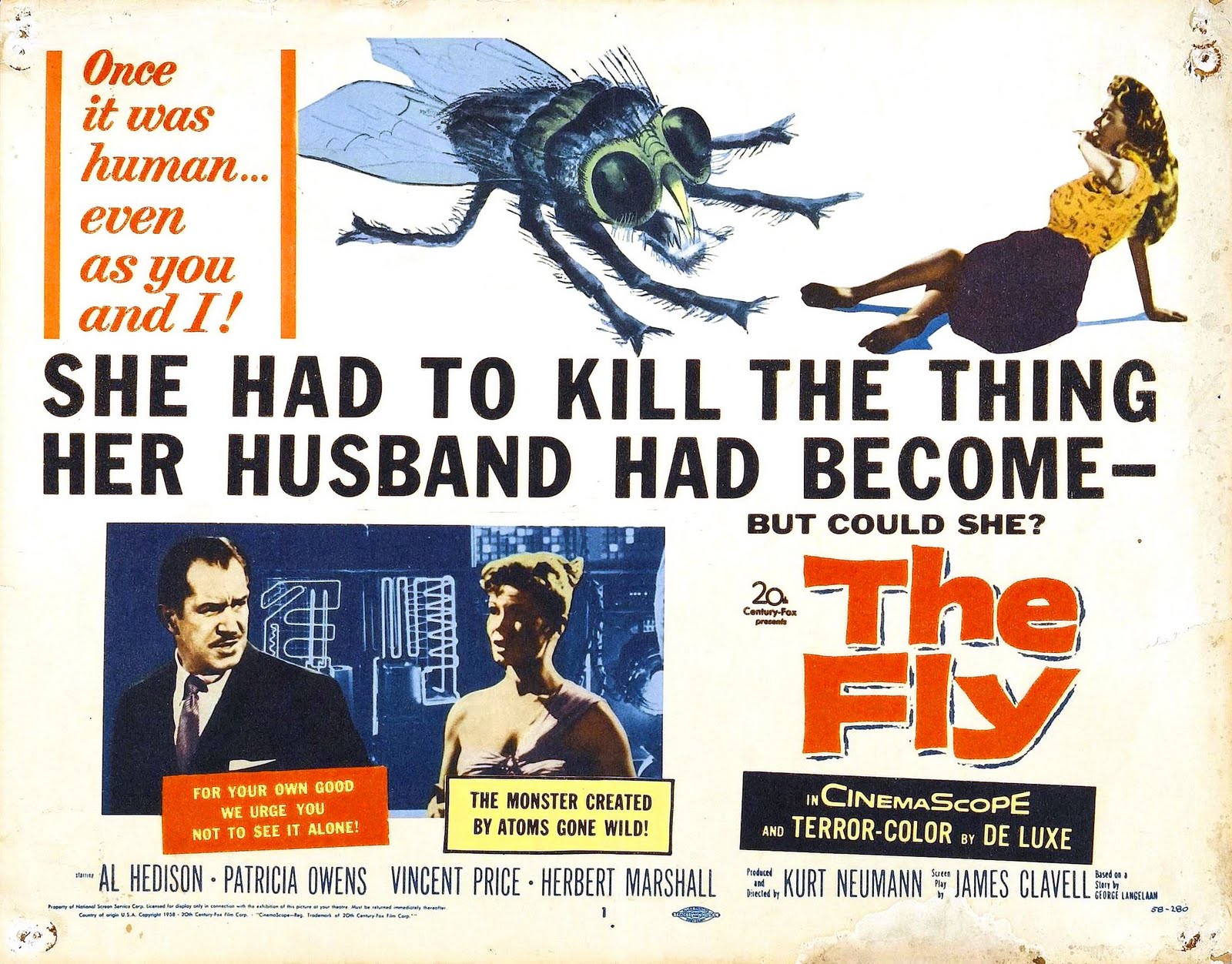
Halloween Havoc!: THE FLY (20th Century Fox 1958)


gary loggins's avatarcracked rear viewer

fly1

THE FLY is one of those films you’re probably familiar with if you’re a horror/sci-fi fan. I’ve seen it many times, but was under the impression it was a black & white movie (probably due to early viewings as a young’un, deprived of color TV). So when I rewatched it again in glorious Technicolor, I was pleasantly surprised. This tale of science gone wrong has held up well, and its iconic scene of The Fly’s unmasking still manages to jolt the viewer (even if you know it’s coming!).

fly2

The film’s framing device finds us witnessing Helene Delombre murdering her husband Andre by squishing his head and arm under a huge hydraulic press (and it’s a pretty gruesome demise), then calling her brother-in-law Francois to tell him. Francois is stunned, to say the least, and gets ahold of his friend Inspector Charas. They drive over to the Delombre Freres (the movie’s set in Montreal)…

View original post 827 more words