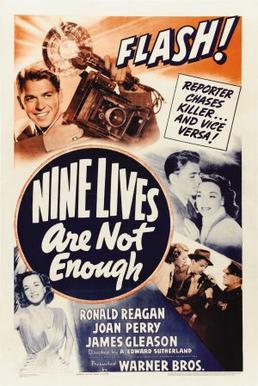
Nine Lives Are Not Enough (1941, directed by A. Edward Sutherland)


Matt Sawyer (Ronald Reagan) is a junior reporter whose enthusiasm for breaking the big news is always getting him in trouble.  Sometimes, he runs with a story before getting all of his facts straight and the newspaper gets sued.  If not for his enthusiasm and his affability, Matt would have been fired a long time ago.  Instead of losing his job, Matt just finds himself demoted to riding in a squad car with Sgt. Daniels (James Gleason) and the slow-witted Officer Slattery (Edward Brophy).  Matt still manages to find a story when he and the cops discover a dead man in a flophouse.

The man turns out to have been a millionaire.  The coroner rules his death a suicide but Matt is convinced that it was murder.  How could the man have shot himself if he died with his hands in his pockets?  Over the objections of the police and his editors, Matt investigates the man’s death.  Helping him out is the man’s daughter, Jane Abbott (Joan Perry).

Nine Lives Are Not Enough is one the many B-pictures that Ronald Regan made for Warner Bros.  It’s only 63 minutes long and, despite the murder mystery, the emphasis is more on comedy than drama.  For all of his reputation for being a stiff actor, Reagan proves himself to be surprisingly adroit when it comes to exchanging snappy dialogue with his editor.  This film showcases the innate likability that made Reagan a success as both an actor and a politician.  What he lacks in range, he makes up for in sheer affability.  Watching Reagan in movies like this, it is easy to see the limitations that kept him from being a major star while also revealing why he later had so much success asking people to vote for him.

Considering how the press felt and still feels about Ronald Reagan, it’s entertaining to see him cast as a reporter who has a reputation for getting the story wrong.  When it’s really important, though, Matt Sawyer gets it right.

Retro Television Reviews: The Screaming Woman (dir by Jack Smight)


Welcome to Retro Television Reviews, a feature where we review some of our favorite and least favorite shows of the past!  On Sundays, I will be reviewing the made-for-television movies that used to be a primetime mainstay.  Today’s film is 1972’s The Screaming Woman!  It  can be viewed on YouTube!

In this made-for-tv movie from 1972, the great Olivia de Havilland plays Laura Wynant. Laura is a wealthy woman who has just been released from a mental institution. She goes to her country estate to recuperate but, as soon as she arrives, she starts to hear a woman’s voice in the back yard.

“help me …. help me….” the voice cries.

Laura looks around and she soon realizes that the voice is coming from the ground! A woman has been buried alive in the backyard and will soon die if not rescued! At first Laura tries to dig up the woman on her own but her hands are crippled by arthritis. An attempt to get a neighborhood child to help her dig just leads to Laura being confined to her home, under doctor’s orders. No matter how much Laura tries to get the people around her to listen for the sound of the woman crying for help, everyone just assume that Laura must be imagining things.

Further complicating things is the fact that the person who put the woman in the ground is still out there. And, when he discovers that Laura has been hearing voices, he decides that maybe he needs to do something about both Laura and the screaming woman….

The Screaming Woman is an effective psychological thriller and, considering that it was made for early 70s network television, surprisingly suspenseful. If the film were remade today, I imagine it would try to keep us guessing as to whether or not Laura was hearing an actual woman or if it was all in her mind.  However, by revealing early on that Laura actually is hearing what she thinks she’s hearing, The Screaming Woman puts us right into Laura’s shoes and we share her frustration as she desperately tries to get someone — anyone — to take her seriously. It helps that Laura is played by Olivia de Havilland, who gives a very sympathetic and believable performance. De Havilland, who started her career appearing in Errol Flynn movies back in the 30s and who most famously played Melanie in Gone With The Wind, was one of the longest-lived stars of Hollywood’s Golden Age, living to the age of 104 and winning two Academy Awards for Best Actress.

The film is based on a short story by Ray Bradbury. In the story, it’s a little girl — as opposed to an old woman — who hears the voice. I haven’t read the short story so I don’t know how else it compares to this adaptation but, as a film, The Screaming Woman is an entertaining and creepy thriller and, when viewed today, it serves as a reminder of what a good actress Olivia De Havilland truly was.  She takes a simple thriller and turns it into a meditation on aging and the one person’s determination to do the right thing even when the entire world seems to be against her.

Hail, Hero! (1969, directed by David Miller)


After going away to college, Carl Dixon (25 year-old Michael Douglas, in his film debut) has returned to his rural hometown.  Though Carl comes from a family with a long military tradition, he’s against the war in Vietnam and is considered to be a hippie by his family.  As soon as his stern father (Arthur Kennedy) sees Carl, he sits him down in the kitchen and, after declaring that no one is going to mistake his son for a girl, cuts his hair.  Meanwhile, Carl’s mother (Teresa Wright) stays out of the conflict between her husband and her son while Carl’s older brother (Peter Strauss) continues to resent Carl for the accident that injured his spinal cord and kept him from going off to war.

Carl has an announcement to make.  Despite being against the war in Vietnam, he’s joined the army.  He will soon be going overseas, where he’ll get a chance to be a hero and where he says he hopes to love the enemy.  No one in his family can understand his decision, though they certainly spend a lot of time talking about it.  Carl can’t explain it either, though he certainly keeps trying.  Eventually, Carl ends up going for a swim with a local girl (Deborah Winters), smoking weed with a woman who lives in a cave with a mummified baby, and painting the family barn with a mural that’s supposed to explain it all.

Hail, Hero! is an extremely talky film that wants to say something about the war in Vietnam but it doesn’t seem to know what.  The film’s too sincere in its confusion to be a disaster but it’s also too muddled to really be effective.  Carl is opposed to the war but he drops out of college and enlists because it’s what his father would have wanted him to do but his father doesn’t seem to be impressed with the decision and Carl doesn’t seem to like his father to begin with so why volunteer for something that you find to be immoral?  The film would have been effective if Carl had been drafted into the war and had to choose between reporting for duty or fleeing to Canada.  But having him drop out of college and volunteer to serve makes it more difficult to sympathize with him when he talks about how opposed he is to the war.

If the film gets any attention today, it is probably because of Michael Douglas in the lead role.  This was Douglas’s film debut.  He was 25 when he made the film and he was already a dead ringer for his father.  Unfortunately, he doesn’t give a very good performance.  He’s miscast in the lead role.  Carl Dixon is supposed to be insecure and conflicted.  Insecure is not something that comes to mind when you think about Michael Douglas.  Instead, Carl just comes across as being petulant and self-righteous.  Hail, Hero! tries to say something about the war in Vietnam but Carl Dixon’s the wrong messenger.

Horror on the Lens: The Screaming Woman (dir by Jack Smight)


Today’s horror on the lens is The Screaming Woman, a 1972 made-for-TV movie that’s based on a Ray Bradbury short story.

Olivia de Havilland plays Laura Wynant, who has just returned home from a stay at a mental institution.  Soon after her arrival, Laura starts to hear a woman crying for help.  Laura becomes convinced that the woman has been buried alive on her property but, because of her debilitating arthritis, she can’t dig the woman up on her own.  And, because of her own mental history, no one believes her when she tries to tell them about what she’s hearing!

The Screaming Woman features screen legend Olivia De Havilland giving a sympathetic performance as Laura.  It also features two other luminaries of the golden age of Hollywood — Joseph Cotten and Walter Pidgeon — in supporting roles.  It’s a good little thriller so watch and enjoy!

(And of course, I should mention that the great Olivia De Havilland is still with us, 103 years old and living in France.)

Film Review: Tobor The Great (dir by Lee Sholem)


Last week, along with my friends and fellow members of the Late Night Movie Gang, I watched the 1954 sci-fi film, Tobor The Great.

As you can probably tell by looking at the top of this review, Tobor came with a really great poster.  It’s a poster that promises all sorts of sci-fi thrills and chills.  It screams, “B-movie masterpiece!”  You look at that poster and you think to yourself, This film is probably extremely silly but I absolutely have to watch it!

Of course, if you know anything about the B-movie aesthetic of the 50s and 60s, you won’t be shocked to learn that the poster has next to nothing to do with the actual film.  True, there is a robot is featured in the film.  The poster is honest about that.  And Tobor actually looks just as good in the movie as he does on the poster.  And there is a subplot about space travel but, at no point, do we see Tobor walking across the surface of Neptune or Jupiter or wherever it is that Tobor is supposed to be in this poster.  Maybe he’s on one of the moons of Saturn.  Who knows?

Also, at no point, does Tobor carry around a woman.  In fact, Tobor is pretty much a film for kids.  The main character, other than Tobor, is an 11 year-old boy named Gadge (Billy Chapin).  I can only imagine how audiences reacted when they went into the film expecting to see the scene in the poster and instead, they were confronted with a movie about a little boy and his robot.

Tobor is one of those films that opens with several minutes of stock footage.  Rockets take off.  The stars shine in the sky.  Scientists and engineers do stuff.  It all looks pretty impressive but, of course, none of it was actually shot for this film.  In fact, the use of all that stock footage mostly serves to highlight how cheap the rest of the movie looks.

As for the film’s plot, it has apparently been determined that it’s too dangerous to send humans into space.  So, Professor Nordstrom (Taylor Holmes) and Dr. Harrison (Charles Drake) build a robot that is specifically designed to fly an interstellar craft.  They name their creation Tobor, because that’s robot spelled backwards.  (Tobor even points out that his name is robot spelled backwards.)  In order to help Tobor explore the universe, they design him to be able to simulate human emotions.  In fact, they’re so successful at it that Tobor ends up befriending Nordstrom’s grandson, the aforementioned Gadge.

The press and the military are all very impressed with Tobor.  Unfortunately, it’s the 1950s and that means that the communists are impressed by Tobor as well!  Can the scientists and their families keep Tobor from getting abducted by a bunch of Russian agents!?  Let’s hope so because there’s a lot of space that needs to be explored….

Anyway, Tobor The Great is silly but kind of fun.  It has its slow spots but it also has a really cool robot and it’s always fun to watch the commies get thwarted.  It’s a real time capsule film, one that not only reflects the decade in which it was made but which also has a somewhat charming innocence to it.  If nothing else, it’s nice to think that, in the days before CGI, the filmmakers actually had to make a Tobor of their own.  Apparently, Tobor is currently in a private collection and I hope whoever has him is treating him well.

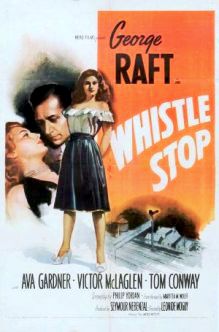
The Fabulous Forties #19: Whistle Stop (dir by Leonide Moguy)


Whistle_stop_poster_small

The 19th film in Mill Creek’s Fabulous Forties box set was 1946’s Whistle Stop and I’m sad to say that I ran into some trouble when I tried to watch it.  As much as I love the Mill Creek box sets, the DVDs within are somewhat notorious for getting easily damaged.  That was the problem that I ran into when I tried to watch Whistle Stop.  From the minute I hit play, the film would randomly pause.  The picture would randomly pixelate.  The sound would randomly vanish.  As you may have picked up, it was all very random but it also made it impossible for me to watch Whistle Stop.

However, like almost every other film that’s ever shown up in Mill Creek box set, Whistle Stop is in the public domain and, therefore, it’s been uploaded to YouTube by dozens of different accounts.  Once I realized that the DVD wasn’t going to work, I switched over to YouTube and I finally got watch Whistle Stop.

Really, I probably shouldn’t have gone to all the trouble.  Of the 19 Fabulous Forties films that I’ve watched so far, Whistle Stop is perhaps the least interesting.  Half of the film is a film noir and the other half if a small town melodrama but, with its convoluted plot and uninspired direction, it really doesn’t work as either.

Mary (Ava Gardner) grew up in a small town but, eventually, she left and went to the big city, hoping to make a new life for herself.  Apparently, she didn’t succeed because, two years later, she returns to the small town.  (The town is so small and obscure that it’s mostly known for its train stop.  Hence, it’s a “whistle stop.”)  When she returns, she discovers that her ex-boyfriend, Kenny Veech (George Raft) has become a loser in her absence.  Kenny is still in love with her but he’s also bitter at her for leaving town.

Making things even worse, from Kenny’s point of view, is that Mary is now dating a sleazy nightclub owner named Lew Lentz (Tom Conway).  Kenny’s best friend, Gitlo (Victor McLaglen), comes up with a plan, in which he and Kenny will kill Lew and make it look like a robbery.  However, Lew has plans of his own and…

You know what?  I’m probably making Whistle Stop sound more interesting than it actually is.  This is one of those films were the plot manages to be absurdly complicated without actually adding up to much. On the plus side, Ava Gardner, one of my favorite of great femme fatales, is beautiful and sultry as Mary and reminded me of why, for several years, Film Noir Femme Fatale was my default Halloween costume.  Tom Conway makes Lew Lentz so amazingly sleazy that you can’t help but admire his commitment to the role.  On the other hand, George Raft is totally miscast and way too handsome and naturally rakish to play a total loser like Kenny Veech.  Watching the film, you can tell that he wasn’t particularly comfortable playing such an insecure and passive character.

Whistle Stop wasn’t particularly memorable but if you want to watch it, you can do so below.  It’s free!

http://www.youtube.com/watch?v=UE8gzD-J8FA

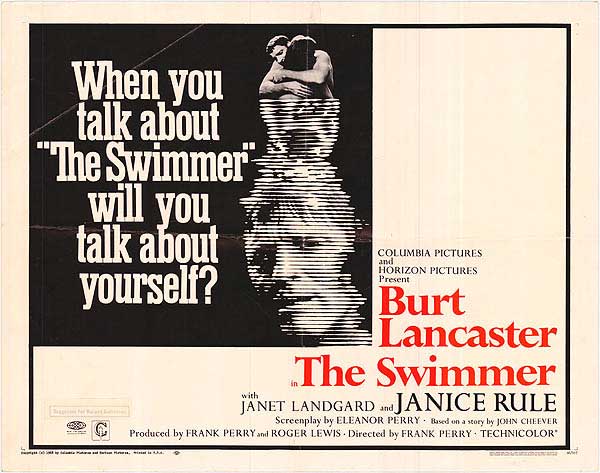
Embracing the Melodrama #23: The Swimmer (dir by Frank Perry)


The Swimmer

The 1968 film The Swimmer opens with Ned Merrill (Burt Lancaster) emerging from the woods that surround an affluent Connecticut suburb.  He’s a tanned, middle-aged man and, because he spends the entire film wearing only a bathing suit, we can tell that he’s still in good shape for a man in his 50s.  When Ned speaks, it’s with the nonstop optimism of a man who has found and claimed his part of the American Dream.  In short, Ned appears to be ideal American male, living in the ideal American community.

However, it gradually starts to become apparent that all is not well with Ned.  When he mysteriously shows up at a pool party being held by a group of his friends, they all seem to be shocked to see him, commenting that it’s been a while since Ned has been around.  Ned, however, acts as if there’s nothing wrong and instead talks about how beautiful the day is and says that he’s heading back to his home.  He’s figured out that all of his neighbor’s swimming pools form a “river” to his house and Ned’s plan is to swim home.

And that’s exactly what Ned proceeds to do, going from neighbor to neighbor and swimming through their pools.  As he does so, he meets and talk to his neighbors and it becomes more and more obvious that there are secrets hidden behind his constant smile and friendly manner.  As Ned gets closer and closer to his actual home, the neighbors are far less happy to see him.

At one house, he runs into Julie (Janet Landgard) who used to babysit for his daughter.  Julie agrees to swim with Ned and eventually confesses that she once had a crush on him.  When Ned reacts by promising to always protect  and love her, Julie gets scared and runs away.

At another house, Ned comes across another pool party.  A woman named Joan (played by a youngish Joan Rivers) talks to him before a friend of her warns her to stay away from Ned.

When Ned reaches the house of actress Shirley (Janice Rule), it becomes obvious that Shirley was once Ned’s mistress.  They discuss their relationship and it quickly becomes apparent that Ned’s memories are totally different from Shirley’s.

And, through it all, Ned keeps swimming.  Even when he’s offered a ride to his house, Ned replies that he has to swim home.

The Swimmer is a film that I had wanted to see ever since I first saw the trailer on the DVD for I Drink Your Blood.  (That’s an interesting combination, no?  I Drink Your Blood and The Swimmer.)  I finally saw the film when it showed up on TCM one night and, when I first watched it, I have to admit that I was a little disappointed.  Stylistically, the film itself is such a product of the 1960s that, even though suburban ennui and financial instability are still very relevant topics, The Swimmer felt rather dated.  I mean, I love a good zoom shot as much as anyone but, often times during the 60s, they seemed to be used more for the sake of technique than the sake of story telling.

However, the second time I sat through The Swimmer, I appreciated the film a bit more.  I was able to look past the stylistic flourishes of the direction and I could focus more on Burt Lancaster’s excellent lead performance.  Lancaster plays Ned as the epitome of the American ideal and, as a result, his eventual collapse also mirror the collapse of that same ideal.  The Swimmer is based on a short story by John Cheever and, quite honestly, the film’s story is a bit too much of a literary conceit to really work on film.  That said, The Swimmer — much like the character of Ned Merrill — is an interesting failure, which is certainly more than can be said of most failures.