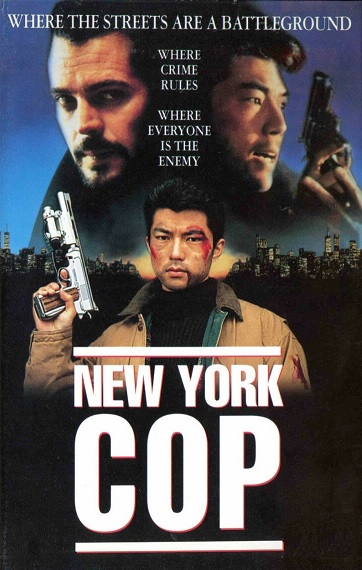
Toshi (Tôru Nakamura) is a tough New York cop who is assigned to work undercover in the East Village because, according to his boss, no one will suspect that a Japanese man is actually a cop. Disguising himself as a homeless gambling addict who has connections with the Tongs, Toshi infiltrates the Brotherhood. He becomes friends with the gang’s leader, Hawk (Chad McQueen), and he even falls in love with Hawk’s sister, Maria (Mira Sorvino!). Hawk is buying guns from a mobster named Mr. C (Tony Sirico!!) and Mr. C’s main assassin, Ferrara (Andreas Kastsulas), is driving around New York in a taxi cab and killing undercovers. Can Toshi take down Mr. C without compromising his relationship with Maria and revealing that he’s actually an undercover cop? The short answer is no.
New York Cop works best when it focuses on action. Tôru Nakamura is convincing in the fight scenes but he’s less convincing whenever he has to show emotion or have a conversation with anyone. The idea that the NYPD would send a Japanese cop undercover to infiltrate a Hispanic gang never makes makes much sense, as Toshi himself points out when the idea is first brought up. Toshi never makes much of an effort to disguise the fact that he is a cop, which makes Hawk look incredibly stupid for not seeing through him. The main appeal for most people will probably be the chance to see Tony Sirico and Mira Sorvino in early roles. Sirico, the former gangster-turned-actor, is convincing as Mr. C and gets all of the film’s best lines. As for Mira Sorvino, this was only her second or third film role and the script doesn’t give her much to work with. There are a few scenes where she gets to bring some genuine New York attitude to her character, telling off both her brother and Toshi. But otherwise, there’s little about her performance that suggests the actress that she would become. Fortunately, films like Barcelona and Sweet Nothing were right around the corner.
As far as New York cops go, nothing has yet to beat the episode of Barney Miller where Christopher Lloyd vandalizes the station house.
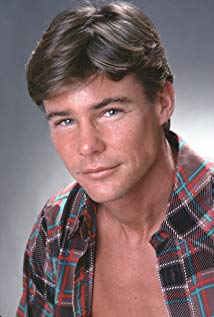
When Jan-Michael Vincent died on February 10th, we lost a legend.
For obvious reasons, the life and career of Jan-Michael Vincent is often held up as a cautionary tale. Vincent went from being a rising star in the 70s to being nearly unemployable in the 90s. When you watch Vincent in one of his early film, like The Mechanic or Big Wednesday, you see an actor who had both the talent and the looks to be a major star. He was such a natural and deceptively low-key performer that it is not a surprise that he was twice cast as Robert Mitchum’s son. He could play everyone from a hippie to a cowboy to a surfer to an assassin. Unfortunately, once the 80s rolled around, Vincent became better known for his struggles with drugs and alcohol than for his talent. After a brief but profitable stint starring in Airwolf, Jan-Michael Vincent found himself appearing mostly in straight-to-video action films. By the mid-90s, he was a mainstay on late night Cinemax. Even though the films had gotten smaller and his famous good looks had been ravaged by years of hard living, Vincent was still capable of giving a good performance.
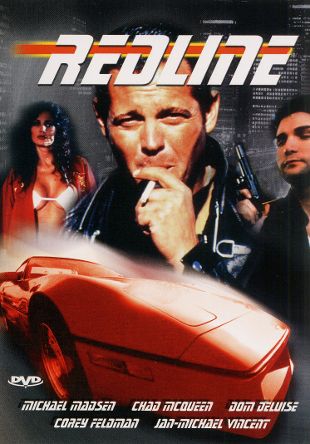
It is impossible to talk about the legend of Jan-Michael Vincent without talking about Red Line. In this direct-to-video car chase film, Vincent was cast as a gangster named Keller. When an auto mechanic named Jim (Chad “Son of Steve” McQueen) makes the mistake of taking one of Keller’s cars for a joyride, Keller blackmails Jim into stealing a corvette from a police impound lot. Red Line was typical of the type of films that Vincent was usually offered in the 90s, an action-filled crime film with a handful of recognizable faces.
It was also a film that Vincent nearly didn’t live to make. Two days before filming was to begin, Jan-Michael Vincent was nearly killed when he crashed his motorcycle. Vincent suffered severe facial lacerations and he would later tell Howard Stern that his eye was nearly popped out of his head as a result of the accident. Vincent was rushed to the hospital and put in intensive care.
However, Jan-Michael Vincent still had a movie to make. So, what did he do? Two days after his accident, he checked himself out of the hospital and, unexpectedly, showed up on set. With his face noticeable bruised and swollen and with the stitches and sutures still visible, Vincent played the role of Keller. If you watch carefully, you can even spot his hospital ID, still hanging around his wrist. The script was hastily rewritten to explain Vincent’s injuries and, though he could barely speak or walk, he still delivered his lines and filmed his scenes. And goddamn if Jan-Michael Vincent didn’t steal the entire movie. Even after years of hard-living (not to mention just two days after nearly dying), Jan-Michael Vincent still had it. Even though he had to whisper his lines and film most of his scenes sitting down, Vincent was still credibly threatening in the role of Keller. He even points out his own injuries, saying, “I’m sick of looking like Frankenstein!”
Jan-Michael Vincent in Red Line
The rest of the cast was made up of an eclectic collection of familiar faces. Dom DeLuise played Chad McQueen’s boss. Michael Madsen and Corey Feldman (!) both played rival gangsters while Roxanna Zal played the young woman who becomes McQueen’s partner in crime. B-movie fans will want to keep an eye out for Julie Strain, Robert Z’Dar, and Chuck Zito. None of them make as much of an impression as Vincent, though.
Red Line was meant to be an homage to the type of car chase films that Steve McQueen made famous. Chad McQueen even gets to drive a replica of the car that his father drove in Bullitt. Some of the chase scenes are exciting but Chad doesn’t have his father’s screen presence and the film never overcomes its low-budget. Watching the movie is a lot like watching someone else play Grand Theft Auto. Red Line is a forgettable movie but it will always be remembered as an important chapter in the legend of Jan-Michael Vincent.
Howard Hansen (Ted Prior) is a best-selling horror writer who is suffering from writer’s block. With his agent, Murray (Frank Sivero), pressuring him to get something written, Howard decides to seek inspiration in Chinatown. When he steps into a curio shop and sees a grotesque, one-eyed blob floating in a jar of formaldehyde, Howard buys it. He hopes that the blob will give him an idea for a great book but instead, it just causes him to have nightmares and violent sex with his wife, Peggy (Sandahl Bergman).
Meanwhile, Murray is in debt with loan shark Scott Lindsey (Henry Silva) and Scott’s number one debt collector, Gus (Chad McQueen). Murray needs money and he needs it quickly. Murray sends his “secretary,” Carol (Shannon Tweed), to live with the Hansens and steal an unpublished romance novel that Howard wrote when he was just starting out as a writer. However, the one-eyed blob possesses Carol and she is soon climbing onto both Howard’s workout equipment and Howard! Soon everyone is under the influence of the one-eyed blob, Carol is forcing Howard and Peggy to make love while she holds the gun on them, and both Gus and Murray are sneaking around the house, trying to find the manuscript.
A movie that was once very popular on late night Cinemax, Possessed By The Night is a sometimes awkward but frequently entertaining horror/thriller hybrid from B-auteur Fred Olen Ray. Along with giving Frank Sivero a rare leading role (Sivero is best known for playing Frankie in Goodfellas and providing the inspiration for the Simpsons character of the same name), Possessed By The Night proves that no movie can be that bad when featuring both Sandahl Bergman and Shannon Tweed. When you watch a Fred Olen Ray/Shannon Tweed collaboration from 1994, you know what you’re getting and Possessed By The Night delivers.
Finally, I am getting a chance to continue my series of Back to School reviews!
Earlier today, we had a pretty big storm down here in Texas and it knocked out the electricity for three and a half hours! There I was, sitting in the dark and wondering if I would ever get a chance to review the 16th movie in this 56-film review series.
(Originally, I was planning on being done by this weekend but, as always seems to happen whenever I do a review series, I’m currently running behind so it’ll probably won’t be until the weekend after next that I post my final Back to School review.)
Fortunately, the Oncor truck eventually showed up in the alley. I, of course, ran out into the back yard and started to shout at them, “I need power! I have movies to review!” They must have heard me because, suddenly, the power came back on. And now, I can finally get around to sharing a few thoughts on the original, 1984 version of The Karate Kid!
Up until last night, believe it or not, I had never seen The Karate Kid before. Certainly, I knew about it. Much like Star Wars and Star Trek, The Karate Kid is one of those cultural landmarks that everyone knows about even if they haven’t actually sat down and watched the movie. Even before I watched the film, I knew about Mr. Miyagi. I knew about “wax on” and “wax off.” I knew about the crane. I even knew about “You’re alright, LaRusso!”
But I hadn’t actually seen the film and I have to admit that I was a little bit hesitant about doing so. Everything I had heard about The Karate Kid made it sound like a thoroughly predictable and excessively 80s sports film. I was expecting the film to be all about power ballads and training montages and uplifting dialogue and certainly, The Karate Kid had a lot of that.
But what took me by surprise is what a genuinely sweet movie The Karate Kid is. Yes, it’s predictable and it’s full of clichés but dammit, it all works. It still brought tears to my mismatched eyes.
The karate kid of the title is Daniel LaRusso (Ralph Macchio), who moves, with his mother, from New Jersey to California. Daniel’s a nice kid who has learned a little karate from reading books but he’s still no match for the bullies at his new high school. Daniel does get a girlfriend, Ali Mills (Elisabeth Shue, giving a performance that feels far more genuine than any of her more recent work), but even that leads to him getting in trouble. It turns out that Ali’s ex-boyfriend is Johnny (William Zabka), the top student at Cobra Kai. Oddly enough, Johnny’s teacher is also named John. John Kreese (Martin Kove) is a Vietnam veteran who decorates his dojo with pictures of himself looking threatening. Kreese, we soon discover, is a total psychopath. “NO MERCY!” he shouts at this students.
When Johnny and his fellow Cobra Kai students beat up Daniel on Halloween, Daniel’s life is saved by Mr. Miyagi (Pat Morita). Mr. Miyagi may appear to just be a simple maintenance man but he’s actually a total badass. He teaches Daniel not only the moves of karate (“Wax on…wax off…”) but the philosophy as well. He explains to Daniel that there are “No bad students. Just bad teacher.” In short, he is the exact opposite of Kreese.
Who is the better teacher? That’s a question that will be answered when Daniel faces off against the Cobra Kai bullies at the Under-18 All-Valley Karate Tournament. Can Daniel defeat Johnny, win Ali’s love, and earn the right to live free of harassment?
Well, it would be a pretty depressing movie if he didn’t…
Anyway, The Karate Kid turned out to be a really sweet and likable movie. I was never surprised by the movie’s plot but I still found myself being drawn into the story and hoping that everything would work out for Daniel and Ali. The character of Mr. Miyagi has been parodied in so many other films that I was a bit surprised to see just how good Pat Morita was in the role. Yes, Morita gets to say a lot of funny lines but he also gets a rather harrowing dramatic scene where talks about how his wife and child died while he was away, serving in the army.
It’s interesting to note that, at the end of the film, even Johnny got to show a glimmer of humanity, suggesting that even the worst jerk in the world can be redeemed by a good ass-kicking. That said, Kreese is pure evil from beginning to end and Johnny’s friend, Dutch (played by Chad McQueen), is about as scary a high school bully as I’ve ever seen. But at least Johnny is willing to admit the truth.
 It is impossible to talk about the legend of Jan-Michael Vincent without talking about Red Line. In this direct-to-video car chase film, Vincent was cast as a gangster named Keller. When an auto mechanic named Jim (Chad “Son of Steve” McQueen) makes the mistake of taking one of Keller’s cars for a joyride, Keller blackmails Jim into stealing a corvette from a police impound lot. Red Line was typical of the type of films that Vincent was usually offered in the 90s, an action-filled crime film with a handful of recognizable faces.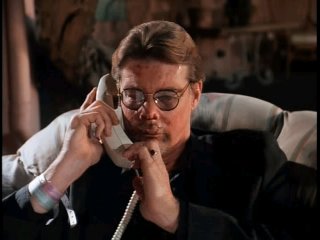

 Howard Hansen (Ted Prior) is a best-selling horror writer who is suffering from writer’s block. With his agent, Murray (Frank Sivero), pressuring him to get something written, Howard decides to seek inspiration in Chinatown. When he steps into a curio shop and sees a grotesque, one-eyed blob floating in a jar of formaldehyde, Howard buys it. He hopes that the blob will give him an idea for a great book but instead, it just causes him to have nightmares and violent sex with his wife, Peggy (Sandahl Bergman).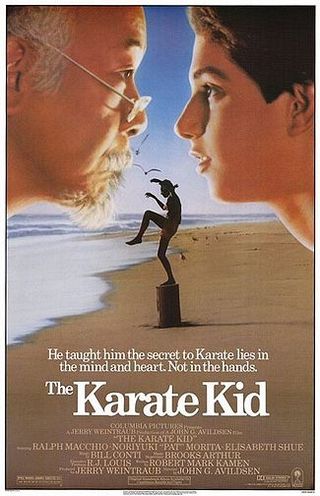
 Through the Shattered Lens