October True Crime: Ed Kemper (dir by Chad Ferrin)


In 1964, 15 year-old Edmund Kemper murdered his grandparents.  When he was asked why he had killed the two people who basically raised him, Kemper reportedly replied, “I just wanted to see what it was like to kill grandma.”

Kemper spent the next five years imprisoned by the California Youth Authority.  He was discovered to have an IQ of 138.  The psychiatrists who examined him all commented on what a friendly and conscientious prisoner Kemper was.  Kemper never caused trouble.  He always cleaned up after himself.  He seemed to be truly happy while incarcerated.

When Kemper turned 21, he was released back into the world.  He moved in with his domineering mother, who worked as an administrative assistant at the local college.  Because it had been determined that he would probably never reoffend, his juvenile record was expunged.  Kemper went to community college.  He hung out at a local cop bar.  (He applied unsuccessfully to be a police officer.)  He got a job with Departments of Highways.  Because he stood 6’9, everyone knew him as the friendly and somewhat dorky “Big Ed.”

Edmund Kemper went on to kill eight more people, including his mother and her best friend.

Kemper turned himself into the police and confessed to his crimes.  At his trial, his lawyers unsuccessfully went with an insanity defense.  When he was convicted, Kemper requested the death penalty, just to learn that the Supreme Court had (temporarily) outlawed capitol punishment.  Kemper was sent to prison, for life.  And that’s where he is to this day.

What’s odd about Kemper is that, once he was back in prison, he again impressed everyone by being a friendly, polite, and conscientious prisoner.  Unlike most convicted murderers, Kemper admitted his crimes and was even willing to analyze the darkness that drove him to commit them.  In the early days of criminal profiling, Edmund Kemper was frequently interviewed by FBI agent Robert Ressler and his insights into his own mind are still frequently used to profile serial killers to this day.  Both Ressler and profiler John Douglas described Kemper as being a sensitive and likable man with a good sense of humor.  Thomas Harris has said that Kemper was one of the inspirations for Dr. Hannibal Lecter.

Released earlier this year, Ed Kemper stick fairly closely to the facts of the case.  Brandon Kirk may not be as a tall as the real-life Kemper but he’s still convincing as a socially awkward, somewhat nerdy man who seems to be as shocked as anyone by his crimes.  The majority of the film deals with Kemper’s relationship with his mother (Susan Priver), who is portrayed as being a deranged tyrant who alternates between gently teasing Kemper and telling him that he’s destined to be miserable and alone forever.  Gava gives a convincing performance but, at times, the film almost seems as if it’s putting all the blame for Kemper’s crimes on his mother.  In the end, Kemper’s the one who killed those hitchhikers, regardless of how much his mom yelled at him beforehand.

Ed Kemper is a bit of an uneven film.  Brandon Kirk, Susan Priver, and Brinke Stevens (cast as Kemper’s mom’s best friend) all give good performances but some of the other actors are a bit less convincing in their roles.  The film deserves some credit for not shying away from the darkness of Kemper’s crimes but the pacing is also off, with some scenes dragging forever and others ending quickly.  The film’s best scene comes towards the end, when Ed Kemper is interviewed by the FBI and points out that he could kill the agent anytime that he felt like it.  It’s a tense scene that reminds us that even the likable killers are still killers.

(An earlier version of this review mistakenly listed Cassandra Gava as the actress who played Kemper’s mother.  Gava plays Kemper’s grandmother.  Susan Priver played Kemper’s mother.  I regret the error and I apologize to both actresses.)
Late Night Retro Television Review: CHiPs 4.4 “The Poachers”


Welcome to Late Night Retro Television Reviews, a feature where we review some of our favorite and least favorite shows of the past!  On Mondays, I will be reviewing CHiPs, which ran on NBC from 1977 to 1983.  The entire show is currently streaming on Prime!

This week, Ponch brings us all closer together.

Episode 4.4 “The Poachers”

(Dir by Barry Crane, originally aired on October 19th, 1980)

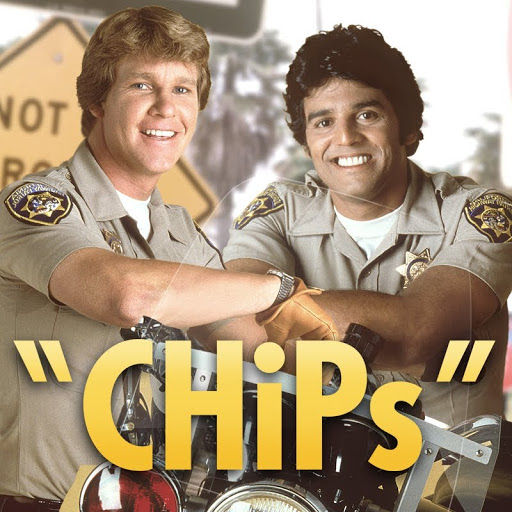
In the beautiful hills surrounding Los Angeles, Jon and Ponch (but mostly Ponch because, as of the start of season four, this is The Ponch Show) pursue two poachers (Robert F. Lyons and Michael Gwynne).  However, Ponch is not the only one after the poachers.  A Native American grandfather named Nathan (Michael Ansara) is in the hills with his grandson (Tony Raymond) and, together, they shoot arrows at the poachers.

Hey, that’s attempted murder!

Well, no matter.  No one like poachers, least of all me.

While Ponch captures the poachers and befriends the grandfather, the rest of the Highway Patrol spend their time at the drag strip and try to win races and set records.  Ponch insists that he should be the one allowed to represent the force on the track and he’s probably right because he’s Ponch and this is The Ponch Show.  Instead, Sgt. Getraer — who technically outranks Ponch but who knows how long that will last — takes to the track himself and amazes everyone with his speed.  Woo hoo!  Meanwhile, poor Baker stands in the background and perhaps remembers how, when the show started, he actually got to do stuff other than follow Ponch around.

This episode was nothing special.  It was well-intentioned with its anti-poaching storyline but it also featured even more cliches than usual.  Michael Ansara was himself not Native American.  He was born in Syria.  The actors who played his son and his grandfather were also not Native American, at least not as far as I could detect from their IMDb profiles.  In short, this was an episode about the wisdom of Native Americans that doesn’t appear to have featured any actual Native Americans.

All that said, it was nice to Robert Pine get to have some fun with the role of Sgt. Getrear.  Pine’s tough-but-fair performance as Getraer has often been this show’s secret weapon and, in this episode, he at least got to smile for once.  He earned it!

Retro Television Review: Fantasy Island 5.1 “Show Me A Hero/Slam Dunk”


Welcome to Retro Television Reviews, a feature where we review some of our favorite and least favorite shows of the past!  On Tuesdays, I will be reviewing the original Fantasy Island, which ran on ABC from 1977 to 1984.  Almost the entire show is currently streaming on Daily Motion, YouTube, Plex, and a host of other sites.

Smiles, everyone, smiles!  It’s time to start the 5th season!

Episode 5.1 “Show Me A Hero/Slam Dunk”

(Dir by Phillip Leacock, originally aired on October 10th, 1981)

The fifth season brings some changes to Fantasy Island.

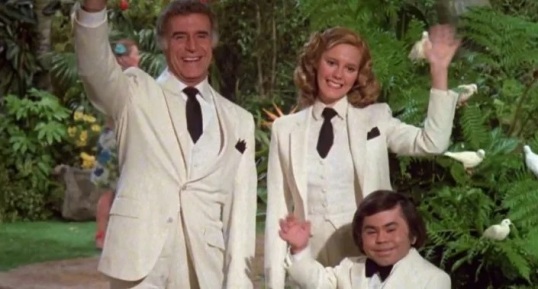
For instance, at the start of the season premiere, Roarke gifts Tattoo a platform that he can stand on while greeting and saying goodbye to the guests and so that he can, visually, be on equal footing with Mr. Roarke.  From what I’ve read, this was something that Herve Villechaize specifically requested as a condition for agreeing to continue with the show.  Considering that the previous season didn’t give Tattoo much to do, I can understand Villechaize’s logic.

The other big change is that Roarke has a new assistant.  His goddaughter, Julie (Wendy Schaal), has spent the summer working on Fantasy Island.  She only appears briefly in this episode, asking Mr. Roarke if she can greet the guests with him.  Roarke tells her that she’s not quite ready but perhaps next week, she will get the opportunity….

And really, Julie should feel good about that because neither fantasy is really that interesting this week.

Matt Kane (Sonny Bono) is a short sportswriter who wants to become a great basketball player and play for a team called the California Top Hatters (who the Hell came up with that name?) because he thinks that’s the only way that he’ll be able to win the heart of Ginger Donavon (Jenilee Harrison), the daughter of the team’s coach (Forrest Tucker).  Mr. Roarke warns Matt that there’s more to love than being able to play basketball but he still gives Matt a pair of magic sneakers.

Matt becomes a great basketball player.  (For some reason, the team is practicing on Fantasy Island).  Coach Donavon says that, if Matt wants a place on the team, he’ll have to beat out rookie sensation Skyhook Schuyler (Peter Isacksen).  Fortunately, Matt comes to realize that he can’t win Ginger by being the best player.  Instead, he has to be a better person.  He removes his shoes and bombs the try out.  But he gets to leave the island with Ginger.

Sonny Bono was a frequent guest star on both this show and The Love Boat.  He always played dorky guys who tried too hard to be cool.  That’s certainly the case here but what should be charming is made a bit bland by the total lack of chemistry between him and Jenilee Harrison.  On the plus side, Tattoo actually gets to do something in this fantasy, serving as a confidante to Skyhook.  It turns out that Skyhook is just as insecure about being tall as Tattoo is about being short.  To help Skyhook, Tattoo paints a picture of him so that Skyhook can see his kind soul.  Awwww!  Seriously, Herve Villechaize totally earned his right to stand on that platform.

As for the other fantasy, Helen Ross (Connie Stevens) is engaged to Ted Kingman (Martin Milner) but she can’t get over her former lover, John Day (David Hedison).  She thinks that John died while serving in the military but Mr. Roarke reveals that John actually survived the war and he lives on a nearby island.  Helen is reunited with John, just to discover that he’s a cad who faked his own death and became a deserter.  Helen leaves the Island feeling confident in her decision to marry Ted.

It’s only after she leaves that the truth is revealed.  Ted is currently serving a prison sentence.  Mr. Roarke arranged for Ted to have a weekend with freedom, on the condition that he lie about his situation to Helen so that she could move on from their failed romance.  So, basically, Mr. Roarke took Helen’s money and then lied to her.  Uhmm …. seriously, what the Hell, Mr. Roarke?

This was a bit of an underwhelming start for the fifth season but fear not!  Next week …. Roddy McDowall returns as the Devil and he wants Mr. Roarke’s soul!

Til then….

Review: Conan the Barbarian (dir. by John Milius)


Khitan General: “Conan, what is best in life?”
Conan: “To crush your enemies, see them driven before you, and to hear the lamentations of their women!”

1982 premiered what has to be one of my favorite films ever. It was a film that was year’s in the making and had as one of it’s producers the eccentric and powerful Hollywood icon, Dino De Laurentiis. It also starred who was then a very much unknown Austrian bodybuilder-turned-actor in Arnold Schwarzenneger. To round out this unusual cast of characters producing this film would be the maverick screenwriter-director John Milius not to mention a young writer still fresh from Vietnam, Oliver Stone. During it’s production there were conflicts between producer and director as to the tone of the film right up to who should actually play the lead character. It’s a good thing that Milius was the ringmaster of this group of characters as his personality was able to steer things to what finally ended up as the film legions of fans have known and seen throughout the decades since it’s release. Conan the Barbarian was, and still is, a fantasy film of quality which still remains as action-packed and full of flights of fancy in the beginning of 2011 as it did when it premiered in 11982.

Milius and Stone adapted the stories of Robert E. Howard while adding their own flourishes to the iconic Cimmerian character. While many Howard purists were aghast at how these two writers had turned a character who was muscular but also athletic and lean into the hulking muscle-bound one Schwarzenneger inhabited the final result would silence most of these critics. The film kept the more outlandish backstory of Howard’s writing, but left enough to allow the film’s story and background to remain something out of Earth’s past prehistory. It was a film which was part origin tale for the title character, part coming of age film and part revenge story.

The film begins with a sequence narrated by iconic Asian-actor Mako as he tells of the beginnings of his liege and master Conan and the high adventures which would soon follow. Conan the Barbarian actually has little dialogue in the very beginning outside of that narration and a brief interlude between a young Conan and his father about the meaning of the “riddle of steel”. Most of the film’s beginning is quite silent in terms of dialogue. This didn’t matter as film composer Basil Poledouris’ symphonic score lent an air of the operatic to the first ten to fifteen minutes of the film. It’s here we’re introduced to James Earl Jones’ Atlantean-survivor and warlord in Thulsa Doom whose barband scours the land trying to find the meaning to the “riddle of steel”. The destruction of Conan’s village and people is the impetus which would drive the young Conan to stay alive through years of slavery, pit-fighting and banditry. He would have his revenge on Thulsa Doom and along the way he meets up and befriends two other thieves in Subotai (Gerry Lopez) and Valeria (Sandahl Bergman whose presence almost matches Schwarzenneger’s in intensity and confidence).

The rest of the film sees these three having the very tales of high adventures mentioned of in the film’s beginning narration and how an unfortunate, albeit succcesful robbery of a cult temple, leads Conan to the very thing he desires most and that’s to find Thulsa Doom. It’s here we get veteran actor Max Von Sydow as King Osric in a great scene as he tasks Conan and his companions to find and rescue his bewitched daughter from the clutches of Doom. In King Osric we see a character who may or may not be a glimpse into Conan’s future, but as Conan’s chronicler says later in the film that would be a tale told at another time.

Conan the Barbarian is a film that was able to balance both storytelling and action setpieces quite well that one never really gets distracted by the dialogue that at times came off clunky. Plus, what action setpieces they were to behold. From the initial raid by Doom and his men on Conan’s village right up to the final and climactic “Battle of the Mounds” where Doom and his men square off against Conan and his outnumbered friends in an ancient battlefield full of graveyard mounds. The film is quite bloody, but never truly in a gratuitous manner. Blood almost flows like what one would see in comic books. Conan is shown as an almost primal force of nature in his violence. In the end it’s what made the film such a success when it first premiered and decades since. It was Howard’s character (though changed somewhat in the adaptation) through and through and audiences young and old, male and female, would end up loving the film upon watching it.

This film would generate a sequel that had even more action and piled one even more of the fantastical elements of the Howard creation, but fans of the first film consider it of lesser quality though still somewhat entertaining. The film would become the breakout role for Arnold Schwarzenneger and catapult him into action-hero status that would make him one of the best-known and highest paid actor’s in Hollywood for two decades. It would also catapult him to such popularity that some would say it was one of the stepping stones which would earn him seven years as California’s governor at the turn of the new millenium.

In the end, Conan the Barbarian succeeds in giving it’s audience the very tales of myths and high adventures spoken of by Conan’s chronicler. It’s a testament to the work by Milius and Schwarzenneger couple with one of the most beloved and iconic film scores in film history by Basil Poledouris that Conan the Barbarian continues and remains one of the best films of it’s genre and one which helped spawn off not just a sequel but countless of grindhouse and exploitation copies and imitation both good and bad. The film also is a great in that it helped bring audiences to want to learn more about the character of Conan and as a lover of the written word the impact this film had on Howard’s legacy is the best compliment I can give about this film.