Retro Televison Review: Homicide: Life on The Street 4.9 “Sniper, Part Two”


Welcome to Retro Television Reviews, a feature where we review some of our favorite and least favorite shows of the past!  On Sundays, I will be reviewing Homicide: Life On The Street, which aired from 1993 to 1999, on NBC!  It  can be viewed on Peacock.
This week, the sniper shootings continue.

Episode 4.9 “Sniper, Part Two”

(Dir by Darnell Martin, originally aired on January 12th, 1996)

Despite the suicide of William Mariner, people in Baltimore are still falling victim to a sniper who attacks every eight hours.  All of the detectives, many of whom have just returned home from spending several sleepless days and nights investigating the first sniper, are called back in.  At first, Pembleton and Bayliss suspect that Mariner must have had an accomplice.  However, when a strange young man named Alex Robey (David Eigenberg) just happens to be at the scene of two separate shootings, it becomes clear that the second sniper is just a copycat who is looking for attention.

It’s quite a contrast between William Mariner, who lived in an upper class neighborhood and who died without revealing his motivations, and Alex Robey, who lives in a rowhouse and who reveals that he was obsessed with Mariner’s crimes.  It’s a reminder that some murderers are easier to figure out than others.  The detectives will never know what caused Mariner to snap.  But Robey?  Robey’s just desperate for attention.

Recently demoted Megan Russert works with the Squad, despite Barnfather ordering Giardello to keep her away from the case.  (Wisely, Giardello ignores Barnfather.)  By pretending to be sympathetic to his resentment over being treated as a “nobody,” Russert plays a key role in Robey eventually confessing to being the sniper.  The episode makes it clear that Russert is going to become the latest member of the Homicide squad.  That’s fine but I do sometimes wish that this show could introduce a new detective without having them miraculously solve the big case.  This season started with Kellerman displaying detective skills that he has not displayed in any episode since.  This week, it was Russert’s turn to suddenly be the greatest detective this side of Frank Pembleton.  It makes me miss the relative realism of the earlier seasons, where even the best detectives sometimes struggled.  Bayliss failing to close the case of Adena Watson was one of the defining events of Homicide’s first season.  If Adena had died during the fourth season, there’s no way the Arraber would have gotten away with it.

With Alex Robey confessing to being the second sniper, it looks like maybe the people of Baltimore are actually going to break from being shot at people on rooftops.  Good for them, they deserve a break.

October True Crime: Cries Unheard: The Donna Yaklich Story (dir by Armand Mastroianni)


In 1994’s Cries Unheard: The Donna Yaklich Story, Jaclyn Smith is miscast as Donna, a naive young woman who is charmed by a cop named Dennis Yaklich (Brad Johnson).  The film is told in flashback and, for some reason, it was decided to have Jaclyn Smith (who was 49 when this film aired) not only play the middle-aged Donna but also to play her where she was just supposed to be in her 30s and looking for a husband.

Anyway, Dennis starts out charming but he soon turns out to have some problems.  He is easily angered.  He spends all of his time lifting weights.  He’s possessive.  He pops pills and shoots up steroids and, by the end of the movie, he’s grown out one of those madman beards that crazy men in movies always end up with.  When Dennis discovers that Patty (Hillary Swank), his daughter from his first marriage, is pregnant, he flies into a rage.  Donna does some research and comes to the conclusion that Dennis murdered his first wife.  When she confronts Dennis with this, he just laughs.

Donna is too frightened to grab her toddler son and run away from home, despite the fact that Dennis is hardly ever at home.  (In fairness, Dennis is a cop so he would definitely have the resources to track her down if she did leave.)  Instead, Donna hires two no-good trailer park boys to shoot Dennis when he comes home from work.  Dennis dies in his driveway, still holding the toy truck that he hoped to give his son.  It’s also raining when he dies because that’s the type of movie this is.

Donna made the mistake of hiring the dumbest people possible to carry out the crime and soon, she is getting arrested and being put on trial for murder.  Later, she tells her story to her now-teenage son, Denny (David Lascher).  Denny is angry because he had to grow up without a dad but he still assures his mother that she’s a wonderful person and the he can’t wait to pick her up from prison in 40 years.

Watching Cries Unheard was an odd experience for me.  By all logic, I should have been on Donna’s side but I found myself getting pretty annoyed with her.  Some of it was because Jaclyn Smith was totally miscast in the role.  Donna is supposed to be naive and meek and easily gaslit by her husband but Jaclyn Smith seemed as if she had just returned from a Paris shopping trip.  The other problem is that the film, which was heavy-handed even by the standards of a made-for-TV movie from the 90s, tried too hard to pretend as if hiring a hitman is something that anyone would have done in Donna’s situation.  The film ends with a Jaclyn Smith voice-over in which she points out that husbands who hire hitmen to kill their wives usually get a shorter sentence than women who do it and I really wanted to throw a shoe at the TV.  Regardless of the circumstances, hiring a hitman is an extreme step to take.  Most people will go through their entire life without ever hiring a hitman.  Most people don’t even know anyone who they could hire to be a hitman.  So, don’t sit there and act like this is the equivalent of women not getting paid as much men for the same amount of work.  I did a little research and discovered that this film was based on interviews that Donna gave in prison.  Dennis’s other daughter– who was not portrayed in the film — called the film a complete fabrication.

I should note that this film was directed by Armand Mastroianni, who also directed some of the best episodes of Friday the 13th: The Series and the classic slasher film He Knows You’re Alone.  (That film was also Tom Hanks’s feature debut.)  His direction embraces the melodrama but it can’t overcome a weak script and a miscast lead.

Retro Television Review: Homicide: Life on the Street 4.8 “Sniper, Part One”


Welcome to Retro Television Reviews, a feature where we review some of our favorite and least favorite shows of the past!  On Sundays, Lisa will be reviewing Homicide: Life On The Street, which aired from 1993 to 1999, on NBC!  It  can be viewed on Peacock.

This week, a sniper terrorized Baltimore.

Episode 4.8 “Sniper, Part One”

(Dir by Jean de Segonzac, originally aired on January 5th, 1996)

This week, Bayliss investigates a red ball!

Actually, the case turns out to be a red ball within a red ball!

And then it turns into a third red ball!

A red ball is a term used for a case that is going to draw a lot of media attention and which is going to result in pressure from the guys in command.  It’s an actual term, one that was introduced in the David Simon book that served as the inspiration for Homicide.  I’m pretty sure that the term was also used in The Wire, though perhaps not as much as it was used in Homicide.

It’s hard not to notice that, starting with the third season, there have been a lot of red balls on Homicide.  If one were to judge solely based on seasons 3 and 4, one might be justified in thinking that Baltimore was the serial killer capitol of the world.  That’s not really a complaint because most of the red ball episodes have been pretty entertaining.  Still, it’s very much a contrast to the first two seasons, where the emphasis was always put on gritty realism and the recurring theme was that, outside of the Homicide detectives, the media didn’t really care about the majority of the murders taking place in Baltimore because the victims were almost always minorities in economically disadvantaged neighborhoods.

This latest red ball involves a sniper who is gunning down people at random and leaving behind a hangman game at each location.  He’s trying to figure out a 9-letter word.  It’s an odd motivation but serial killers are odd people.  Bayliss, who is suffering from back pain and popping muscle relaxants like candy, gets the case because, as he continually reminds us, he was the one who answered the phone.  (Somehow, Bayliss does manage to get through the investigation without bringing up Adena Watson.)

While Bayliss tries to find a killer who shoots people at random, Russet deals with the brass.  Colonel Barnfather, who was originally quite enthusiastic about promoting her, now suddenly hates her and the episode ends with Russert getting demoted back down to being a detective.  (So, I guess that Giardello’s homicide squat will be getting a new investigator.)  Russert’s demotion felt like it came out of nowhere but, from a dramatic point of view, it made sense.  This show already has Giardello as the beloved boss.  It didn’t also need Russert in the role.

As for the killer, he is tracked down by his signature on the receipt that he signed when he purchased his chalk.  He turns out to be a nervous insurance agent who has a big house in the suburbs and who is playing a hangman game in his study.  When Bayliss attempts to negotiate with him and asks him to leave the study, the insurance agent asks for a letter.  “Uhmm …. B,” Bayliss says.  B turns out to be just the letter that was needed and the insurance agent promptly shoots himself in the head.

The word that he was trying to come up with turns out to be Eromitlab.  Look at in a mirror.

This was a good episode, even if it did sometimes go a bit over the top with everyone shouting, “We’ve got a red ball!” and the nonstop montages of the detectives swarming the streets of Baltimore.  I’ve really grown to love Kyle Secor’s performance as Tim Bayliss and this episode featured Bayliss at his loopy best.  For an episode about a serial sniper who ended up killing eight people, there was a rather odd sense of humor running through it.  This is an episode that started with Jay Leno coming in the Waterfront Bar.  (Munch tells Bayliss that Leno is probably sick of people treating him like he’s famous so they decide to ignore him until Leno gets mad and leaves the bar.)  When the first shooting is called in, the phone rings several times before anyone is able to answer, leading to Munch to question whether a murder has actually occurred if no one answers the phone.  Bayliss obsesses on his upcoming back surgery.  “Its says a possible side effect is death!” Bayliss exclaims, looking over the information about the operation.  Meanwhile, Brodie gets on everyone’s nerves with his big video camera.

Ominously, this episode with a second sniper climbing up to the roof of the building.  The red balls continue.


Lifetime Film Review: A Murder to Remember (dir by Robin Givens)


There’s been a murder.  Or has there?

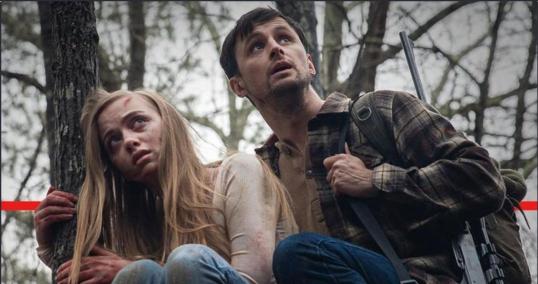
Two people emerge from the wilderness, both with a story to tell.  Sam Turner (T.C. Matherne) lives in the backwoods.  He’s a country boy, right down to his accent and the gun that he carries with him.  He’s the type who can lead you to the best places to fish but he gives off a vibe that says that you don’t want to turn your back on him for too long.  Accompanying Sam is Robin (Maddie Nichols), a young woman who appears to be shell-shocked.  They’ve spent the last few days in the woods.  Sam claims that he’s been caring for and protecting Robin as they made their way back to civilization.  Robin …. well, Robin doesn’t quite seem to remember exactly what’s been going on.

What both Sam and Robin both agree on is that Robin’s husband, Javier (Kevin Rodriguez), is dead.  Javier and Robin were celebrating their first anniversary by going on a camping trip.  Javier was an experienced camper.  Robin was not.  When Sam approached them and offered to show them the best place to fish, they followed him deeper into the forest.  According to Sam, he accidentally took a wrong turn and got them lost but is he telling the truth?

Sam says that he accidentally shot Javier.  At first, Robin backs up his story but later she says that Sam actually murdered Javier in cold blood and then proceeded to brainwash the shocked Robin to such an extent that Robin couldn’t remember what was true.  Sheriff Watkins (Leslie Hendrix) is inclined to believe Robin over Sam.  However, things are complicated when the two of them each take a polygraph test.  Sam passes.  Robin does not.

So, is Sam telling the truth?  Sam may have passed the polygraph but he’s so obviously sleazy that it’s hard to believe that he didn’t intentionally kill Javier.  Was Robin in on the murder or is she suffering from the after effects of Stockholm Syndrome, the phenomena in which the victim of an abduction will come to trust and, at the times, even help their abductor?

Based on a true story, A Murder To Remember makes it pretty clear from the start who is to be trusted and who isn’t.  Sam is obviously guilty and Robin is obviously telling the truth but, for most of the movie, there’s no way to prove any of it.  Unfortunately, because the truth is so obvious, the film is never as suspenseful as it could be.  Instead of trying to figure out what actually happened, the viewer instead just waits for Sam to finally slip up.  It takes a while as this is a rather slow movie, especially by the usually quick paced standards of Lifetime.

The film is at its best when it’s in the wilderness.  The film does a good job of capturing just how frightening it can be to be lost when there’s no hint of civilization anywhere around.  Maddie Nichols does a great job of capturing the fear that any of us would feel in her situation.  She’s not even an experienced camper and now, suddenly, her husband is dead and she’s going to have to depend on her husband’s murderer to survive.  That would be enough to send anyone into a state of shock and Nichols effectively portrays the gradual process that leads to Robin remembering what actually happened to Javier.

A Murder To Remember was uneven but, if nothing else, it reminded me of why I don’t go camping.