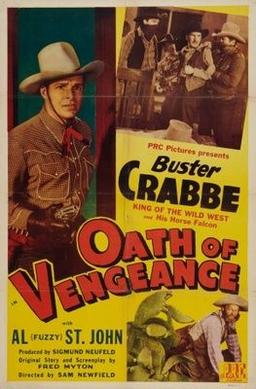
Oath of Vengeance (1944, directed by Sam Newfield)


In a small frontier town, the ranchers and the farmers are nearly at war with each other.  Cattle are being rustled.  The head of the farmers (Karl Hackett) is accused of killing a ranch hand.  Store owner Fuzzy Q. Jones (Al St. John) suspects that it’s all a set-up and he’s not going to stand for it.  If the farmers kill all the ranchers and the ranchers kill all the farmers, there won’t be anyone left to shop at his store.  Fuzzy calls in his friend, Billy Carson (Buster Crabbe).

Buster Crabbe may have gotten his start in the westerns by playing Billy the Kid but the producers of his films eventually realized that there was only so long that Buster could play a character known as “the Kid” and Billy the Kid’s reputation as an outlaw was actually not helpful at the box office because parents didn’t want to send their kids to a matinee that might teach them the wrong lessons.  After a handful of “Billy the Kid” films, Buster’s western hero suddenly had a new name.  Billy Carson was a standard western do-gooder, called in whenever a town needed to be cleaned up or his old sidekick Fuzzy needed some help around the store.  Crabbe was a convincing hero no matter what but the Billy Carson films lacked the thing that made the Billy the Kid films interesting.  Usually, no one was trying to arrest Billy Carson.

Oath of Vengeance isn’t bad, at least not by the standards of Poverty Row westerns.  There’s plenty of fights and Crabbe, being a former Olympian, looks convincing with he throws a punch.  The plot is a pretty standard B-western plot but Crabbe’s natural likability carries the day.  Fans of the genre will be happy to see Charles King and Kermit Maynard, playing bad guys.  Frank Ellis plays the ranch hand whose murder sets off the story.  It’s always good to see the old gang back together again.
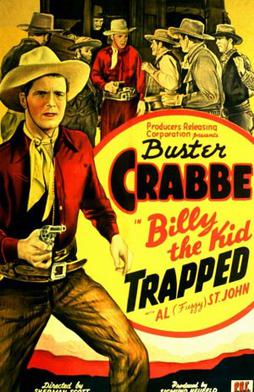
Billy The Kid Trapped (1942, directed by Sam Newfield)


Billy “The Kid” Bonney (Buster Crabbe) and his two buddies Fuzzy (Al St. John) and Jeff (Bud McTaggart) are just trying to mind their own business and make a living in the old west but they keep getting accused of every crime that happens.  This time, they’re sentenced to hang for a crime they didn’t commit.  Luckily, a group of strangers break Billy and his friends out of jail and send them on their way to the next town.  However, the men who broke them out of jail are soon committing crimes while disguised as Billy, Fuzzy, and Jeff!  Billy teams up with Sherriff Masters (Ted Adams) to stop the imposters, who are working for Boss Jim Stanton (Glenn Strange).

One of the joys of Poverty Row westers like this one is that they always featured the same stock company.  Al St. John was everyone’s sidekick.  Ted Adams was often a sheriff.  Glenn Strange was always the criminal mastermind pulling the strings.  Milton Kibbee was always a corrupt judge or ranch owner.  George Cheseboro, Horace B. Carpenter, Jack Curtis, and Budd Buster are amongst the very familiar faces in Billy The Kid Trapped.  It gives each film a homey feel that will be appreciated by fans of the genre.  The hero of the films often changed but the stock company always remained the same.

I like the idea behind Billy The Kid Trapped but the film still feels repetitive, even though it’s less than an hour long.  After Billy captures the men who are imitating him and his friends, a crooked judge sets the men free and the immediately go back to imitating Billy.  Billy has to capture them all over again.  No wonder Billy aged so quickly!  (Buster Crabbe was in his mid-thirties when he was playing The Kid.)  The movie does have all the usual gunfights and horse chases that people watch these movies for.  It’s comforting that, no matter what, the villain is always going to turn out to be Glenn Strange.

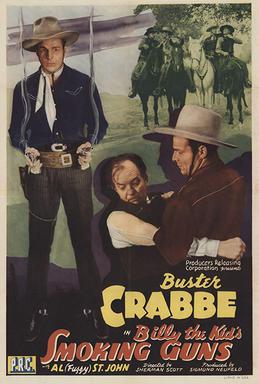
Billy The Kid’s Smoking Guns (1942, directed by Sam Newfield)


It’s a tale as old as time.  During the days when the west was wild, the U.S. Army is planning on setting up a new outpost near a town so the bad guys want to run all the ranchers off of their land so that they can be the ones to sell it.  Sheriff Carson (Ted Adams) is corrupt and working for the bad guys so the ranchers have to turn to Billy the Kid (Buster Crabbe) and his sidekicks, Jeff (Dave O’Brien) and Fuzzy (Al St. John) for help.  When Jeff is wounded in a fight, Fuzzy takes him to Doc Hagen (Milton Kibbee), little suspecting the doctor is actually the leader of the bad guys and using his medical practice to kill anyone who won’t give up their land!

Coming to us straight from Poverty Row, this B-western is interesting in that it seems to take a very cynical view of law enforcement.  Sheriff Carson is corrupt and Billy and his friends are running from the law themselves.  Buster Crabbe’s Billy the Kid films always kept it unclear why Billy was in trouble with the authorities.  Crabbe’s Billy the Kid always seemed to be the nicest guy in the west.  (Of course, Crabbe was also 33 and no longer seemed like he should have been known as “the Kid.”)  Eventually, the series was retconned and Buster Crabbe was no longer playing Billy the Kid but instead he was playing an upstanding citizen named Billy Carson.

Crabbe may not be a convincing outlaw but he is a convincing hero, which is all these films really required.  Billy the Kid’s Smoking Guns is a little bit interesting because of the character of Doc Hagen, whose occupation makes him a little more memorable than typical B-western bad guy.  The film is also interesting in that, for once, there’s no love interest.  Instead, it’s just men in hats shooting at each other.  That probably made the film’s youthful target audience happy.

The real-life Billy The Kid was killed when he was only 21 and after he had been an outlaw for only three years.  Buster Crabbe would g0 on to play Billy (or o some variation of Billy) until he was closing in on 40.


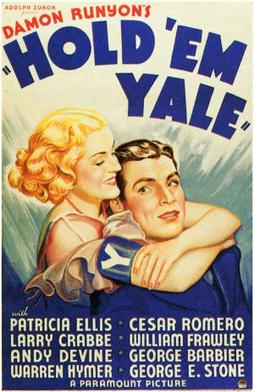
Hold ‘Em Yale (1935, directed by Sidney Lanfield)


Georgie, the Chaser (Cesar Romero) is a con artist who works for a low-level gangster named Sunshine Joe (William Frawley).  When Georgie reads about an heiress named Clarice van Cleve (Patricia Ellis) who impulsively falls in love with any man wearing a uniform, Georgie pretends to be a member of the Foreign Legion and tracks her down.  Georgie thinks that Clarice’s father will pay him off, just as he’s paid off all of her other suitors.  Instead, Clarice’s father disinherits her and Clarice ends up living at Georgie’s place, along with his other criminal associates (Andy Devine, Warren Hymer, and George E. Stone).

Georgie reacts by getting out of town, leaving Clarice behind with his good-natured gang.  However, even the gang gets tired of Clarice insisting that they dress up for dinner and that they all get a good night’s sleep.  After Sunshine Joe cheats them out of their money, the remaining criminals head to the Yale-Harvard football game, hoping to win some bets and to set Clarice up with the player that her father wants her to marry, studious benchwarmer Hector Wilmot (Buster Crabbe).

Just a little over an hour long, HoldEm Yale is actually a pretty amusing movie.  It was based on a short story by Damon Runyon and all of the characters are familiar Runyon types, streetwise but good-natured criminals who enjoy drinking and gambling and the film gets a lot of laughs out of their reactions to Clarice’s attempts to civilize them.  Patricia Ellis is great as the ditzy Clarice and this film provides a chance to see Buster Crabbe playing a character who isn’t a natural-born athlete for once.  It’s a minor film but worth watching for the cast and the snappy dialogue.  Who would have guessed a good movie could be built around Ivy League football?


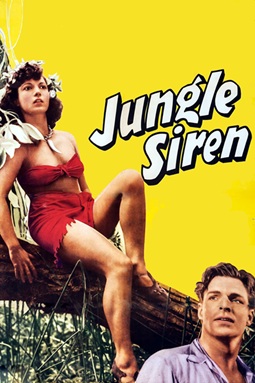
Jungle Siren (1942, directed by Sam Newfield)


Captain Gary Hart (Buster Crabbe) and his sidekick, Sgt. Mike Jenkins (Paul Bryar), are sent to the jungles of Africa, where Nazi infiltrators are encouraging Chief Selangi (Jess Lee Brooks) to side with the Third Reich and allow them to set up a base.  In their effort to stop the Nazis, Hart and Jenkins are aided by Kuhlaya (Ann Corio), a woman whose parents were killed by Selangi and who now lives in the jungle with a chimpanzee and a doctor (Milton Kibbee) who serves as her protector.  Kuhlaya carries a bow and arrow, which she used to battle the Nazis.  Hart and Jenkins have actual guns and probably could have ended the Nazi plot early just by using them as soon as they arrived but then the movie couldn’t be stretched to 68 minutes.

This is a pretty bad Poverty Row film, memorable just for Crabbe’s typically earnest and athletic performance and the presence of Ann Corio, who was a famous stripper in the 40s who tried to transition into films after Mayor La Guardia ordered the closure of New York’s burlesque houses.  Corio had legs for miles but she was a terrible actress.  At one point, Mike Jenkins says that if he keeps exercising, “I’ll have a physique like Buster Crabbe!”  That’s about as clever as this slow-moving film gets.

As is typical of jungle films that were made in the 40s, the “tribesmen” are pretty much treated as if they’re interchangeable and the only one who is given a personality is the evil Selangi.  Several of them are killed over the course of the movie, not because they were doing anything wrong but just because they were in the wrong place.  (The most egregious example is an innocent native who ends up with one of Kuhlaya’s arrows in his back because he was unfortunate enough to step in front of Selangi at the last moment.)  No one, our heroes included, really seems to care about them or their future.  Even by the standards of the era, Jungle Siren feels extremely condescending and prejudiced in its portrayal of the natives.  The idea that the Nazis, with their Aryan obsession, would ever team up with Chief Selangi is just one of the film’s problems.

Director Sam Newfield was responsible for some entertaining and cheap westerns.  I’ve reviewed a few of them.  He should have stayed out the jungle.

Shadows of Death (1945, directed by Sam Newfield)


After a railroad agent is murdered and his map of the future locations of the railroad is stolen, Billy Carson (Buster Crabbe) rides into a frontier town and searches for the guilty party.  Fortunately, for Billy, his best Fuzzy Q. Jones is the mayor, the sheriff, and the town barber!  Unfortunately, local gunslinger Clay Kincaid (Eddie Hall) wants to make a name for himself by taking on the famous Billy Carson.  Corrupt businessman Landreau (Charles King) encourages Clay by lying to him and telling him that Bully is planning on stealing Clay’s girl, Babs (Dona Dax).

A standard Poverty Row western, Shadows of Death was made by the same crew and cast who were involved with most of Buster Crabbe’s Billy The Kid films.  I’m not sure if Billy Carson is meant to be the same character as Billy the Kid, though.  Billy the Kid always had bounty hunters after him but Billy Carson works for the railroad.  However, it would be strange if Fuzzy Q. Jones just happened to be the favored sidekick of two gunslingers who just happen to both be named Billy.  Along with Fuzzy’s vaudeville style comedy, one thing that audiences could always take for granted was that Charles King would play the villain in these movies and Frank Ellis would always be his henchman.  I always wonder if audiences in the 40s noticed that Charles King’s businessman and Frank Ellis’s gunslinger always returned from the dead with every B-western that came out.

My favorite scene in this one is Billy bursting into Landreau’s office, just for Landreau to say that he expects visitors to knock.  Billy pauses long enough to knock on the door before getting down to the business of frontier justice.

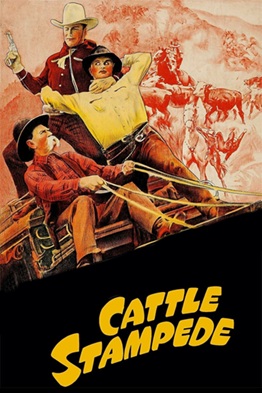
Cattle Stampede (1943, directed by Sam Newfield)


Billy the Kid (Buster Crabbe), that western do-gooder who has been framed for crimes that he didn’t commit, narrowly escapes being captured by a group of bounty hunters.  To thank the man who helped him and his sidekick, Fuzzy Q. Jones (Al  St. John), escape, Billy agrees to help the man’s family make a cattle drive.  It turns out that local ranchers are being targeted by rustlers who cause the cattle to stampede and then buy up what’s left of the herd at a discount.  Even though Mary Dawson (Frances Gladwin) doesn’t trust Billy and initially suspects him of being one of the rustlers, Billy and Fuzzy take over the cattle drive and protect the family from Coulter (Glenn Strange) and Elkins (Frank Ellis).  They even prove their worth by rescuing Mary after she’s kidnapped by the villains.

This is one of the many Poverty Row westerns to feature Billy the Kid not as an outlaw but instead as a hero.  Best-known for playing Tarzan, Flash Gordon, and Buck Rogers, Buster Crabbe was a believable hero even if he was more than a little too old to be nicknamed “the kid.”  Al St. John provides the comedic relief and veteran bad guys Charles King, Glenn Strange and Frank Ellis go through the motions as the villains, much as they did in countless other westerns of the era.  Cattle Stampede is typical of the cheap western programmers that came out of the Poverty Row studios in the 40s.  It was simplistic and predictable but featured enough western action to keep the kids in the audience entertained.  Today, its main selling point is a nostalgic one.

The Billy the Kid films are always strange because they avoid the reason why Billy is being pursued by the law and instead just present him as being another generic western hero.  It seems like a waste of a good legend.

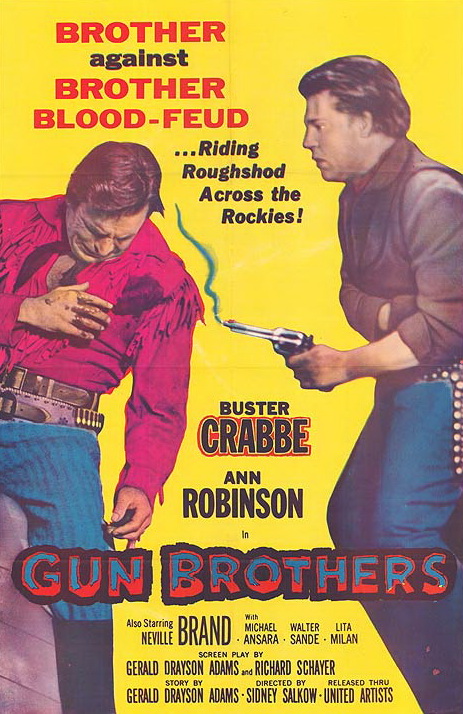
Gun Brothers (1956, directed by Sidney Salkow)


In this western, Buster Crabbe plays Chad Santee, a former Calvary officer who has traveled to Wyoming so he can visit his brother Jubal (Neville Brand) and see Jubal’s ranch.  Traveling by stagecoach, Chad meets and falls in love with a saloon singer named Rose Fargo (Ann Robinson).  When the stagecoach is held up by outlaws and one of them steals Rose’s broach, Chad decides to track the outlaws down.  What Chad doesn’t know is that Jubal is one of those outlaws.

Gun Brothers is an entertaining B-western.  There’s nothing surprising about the story but Buster Crabbe is a believable hero and Ann Robinson gets a chance to show off her saloon singing skills.  Neville Brand steals the film as Jubal.  Before going into acting, Brand was a highly decorated World War II combat officer and he brought his real-life toughness to every role that he played.  He could throw a punch and shoot a gun with an authority that few other actors could match.  Jubal, like Brand, has obviously seen and experienced things that his self-righteous brother will never be able to understand and, as a result, he’s not as tied down to the laws of society as everyone else.   Also turning in good performances are Michael Ansara as an outlaw and Lita Milan, as a Native American woman who is involved with the gang.

Not surprisingly, for a B-western, Gun Brothers is full of characters with names like Shawnee Jack, Yellowstone Kelly, Blackjack Silk, and Moose McClain.  It’s a simple movie but one that will be enjoyed by fans of old fashioned western action.

The TSL’s Horror Grindhouse: The Alien Dead (dir by Fred Olen Ray)


This 1978 film takes place in Florida.

No, not in Miami.  Not Jacksonville.  Not Ft. Lauderdale.  Certainly not Orlando.  No, this film takes place off the back roads of Florida, where people are honest country folk and some folks live in a houseboat and you should always be careful when walking around the bayous because there might be some alligators lurkin’ about.  Of course, in this part of Florida, they call them gators.  Anyone who says alligator obviously thinks they’re too good for downhome country living.

Anyway, it turns out that there’s more to worry about in Florida then just alligators.  There’s also the chance that your houseboat might get struck by a meteor.  And then, everyone on the houseboat might be transformed into a zombie and, after they’ve eaten all the alligators, they might start eating all the humans.

When a sudden zombie outbreak occurs, you have to hope that you’ll get a good law enforcement response.  Unfortunately, law enforcement in these parts means an elderly sheriff and a bearded deputy who is always trying to catch a peek of the local women skinny dipping.  The sheriff, by the way, is played by Buster Crabbe.  In the 20s and 30s, Crabbe was an champion swimmer who won Olympic medals and went on to play Tarzan, Flash Gordon, and Buck Rogers.  At the height of his popularity, he was known as “the King of the Serials.”  In The Alien Dead, the 70-something Crabbe plays Sheriff Kowalski and, if nothing else, it seems like he was enjoying himself.  Really, that’s important thing when it comes to a movie like this.

The Alien Dead is an extremely-cheap looking film and, with the exception of Crabbe, none of the actors appear to have done much before or after appearing in The Alien Dead.  There are some scenes that are so dark that it’s next to impossible to actually tell what’s going on.  Despite being a rather short film, the pace is still slow and there are certain scenes that seem to drag on forever.  There’s a lot of perfectly valid criticisms that one can make about The Alien Dead.

But you know what?

I like the film.

Seriously, in a strange way, the film actually does work.  Yes, the acting is pretty bad and the dialogue is often rather clunky and the plot doesn’t make sense and blah blah blah.  Those are all true facts.  But, there are isolated moments where The Alien Dead achieves a dream-like intensity.  For instance, there’s a lengthy scene where the zombies attack and all of the action is shown in slow motion.  I realize that may have been done to pad the film’s running time but strangely enough, it works.  Even more oddly, the film’s cheap gore effects add to the movie’s already dream-like feel. Finally, if nothing else, the film captures the humid atmosphere of the Florida bayou.  Watching the film, you can feel the sweat and hear the buzzing of mosquitos.  At its best, The Alien Dead works as a piece of outsider art.

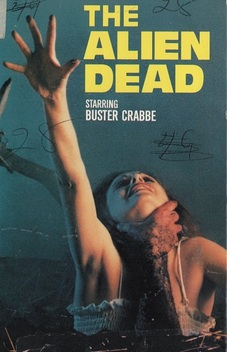
Finally, The Alien Dead is one of those films that had been released and re-released a few times on video.  As you can see below, one of those releases was apparently inspired by the success of Evil Dead.

A Move A Day #190: The Contender (1944, directed by Sam Newfield)


Gary Farrell (Buster Crabbe) is a widowed truck driver who wants his son to have a better life than his old man.  Good luck pulling that off on a salary of $45 a week.  Gary enters a boxing tournament, just hoping to win enough money to pay for his son to go to military school.  But, under the tutelage of veteran trainer Pop Turner (Milton Kibbee), Gary becomes a real contender.  He also becomes a first class heel, turning his back on his old, honest lifestyle and getting involved with fast-living socialite, Rita London (Julie Gibson).  Can Gary’s friends and newspaper reporter Linda Martin (Arline Judge) get Gary to see the error of his ways?

The Contender, which is in the public domain and can be viewed at the Internet archive, is a typical poverty row production, with all the expected boxing clichés.  Gary’s initial rise is just as predictable as his downfall and eventual redemption.  For fans of Buster Crabbe, though, it is a chance to see Crabbe playing someone other than Tarzan, Flash Gordon, or Buck Rogers.  (Crabbe was the only actor to play all three of these roles over the course of his long career.  He also appeared as Billy the Kid in several westerns.)  Though he was a swimmer and not a boxer, Crabbe’s natural athleticism made him a good pick for the role of Gary.  Julie Gibson is sexy and fun as the bad girl and be sure to keep an eye out for Glenn Strange, who plays Gary’s best friend.  Just as Crabbe was forever typecast as Flash Gordon, Strange will always be remembered for replacing Boris Karloff in the role of Frankenstein’s Monster.