Film Review: Thunderbolt and Lightfoot (dir by Michael Cimino)


1974’s Thunderbolt and Lightfoot opens with two men, one young and one middle-aged, facing a moment of truth.

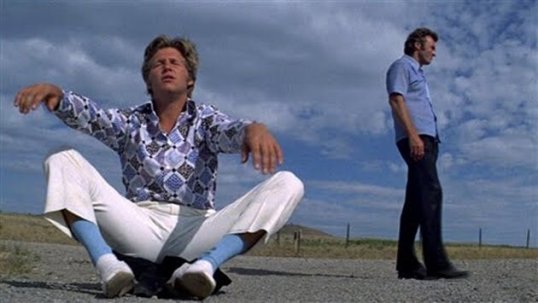
The younger of the two is Lightfoot (Jeff Bridges), a wild and hyperactive rich kid who is in his 20s and who steals a corvette right off of a used car lot.  The other man is simply known by his nickname, Thunderbolt (Clint Eastwood).  When we first see Thunderbolt, he’s giving a sermon in a small Montana church.  When a gun-wielding man steps into the church and promptly starts firing at Thunderbolt, he takes off running.  Pursued by his attacker, Thunderbolt runs through a field and just happens to jump onto Lightfoot’s speeding corvette.  Lightfoot runs over the Thunderbolt’s pursuer.  Thunderbolt slips into the car and Lightfoot drives on for a bit.  Lightfoot is excited and talkative.  Thunderbolt is more concerned with popping his shoulder back into its socket.  A stop at a gas station leads to the men stealing someone else’s car.

And so it goes for a good deal of the movie.  Thunderbolt and Lightfoot is a road movie, the majority of which is taken up with scenes of the two men just hanging out.  Thunderbolt and Lightfoot take an instant liking to each other.  When Lightfoot picks up a prostitute (Catherine Bach), he makes sure to ask that she bring along a friend for Thunderbolt.  When a criminal punches Lightfoot, Thunderbolt is quick to punch back.  “That’s for the kid,” Thunderbolt says.  That’s the type of friendship that they have.  Jeff Bridges is handsome and full of energy as Lightfoot and Clint Eastwood smiles more in this film than I think I’ve seen him smile in any other film.  For once, Eastwood is not playing a perpetually grumpy stranger or a supercop.  Instead, he’s just a blue collar guy who enjoys having a friend to travel with.

Eventually, Thunderbolt and Lightfoot meet up with two of Thunderbolt’s former associates.  Red (George Kennedy) is a brutal brawler who, it is suggested, served with Thunderbolt in the Korean War.  Goody (Geoffrey Lewis) is a gentle soul who takes orders from Red but still can’t bring himself to shoot anyone, no matter how much Red demands that he pull the trigger.  Red and Goody have always assumed that Thunderbolt stole the loot from a bank robbery that they pulled off.  Thunderbolt explains that he didn’t steal the money.  He just got arrested after hiding it.  Lightfoot suggests that maybe the four of them could pull off another bank heist….
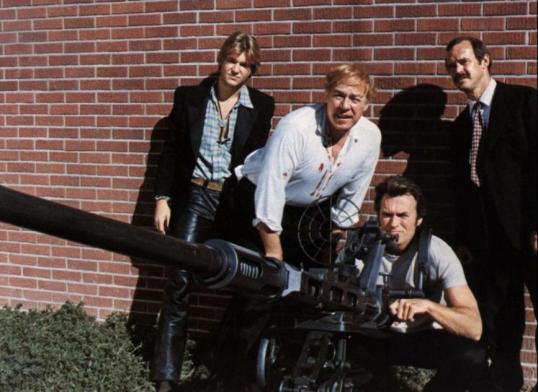
Kennedy and Lewis are perfectly cast as the two criminals who end up working with Thunderbolt and Lightfoot.  In many ways, the relationship between Red and Goody mirrors the relationship between our lead characters.  The main difference is that Red is sadistic and quick to loose his temper, whereas Thunderbolt controls his emotions and tries not to hurt anyone while committing his crimes.  Lightfoot looks up to Thunderbolt and Goody looks up to Red.  Again, the difference is that Thunderbolt actually cares about Lightfoot, whereas Red is incapable of truly caring about anyone but himself.  Eastwood, Bridges, Kennedy, and Lewis make quite a team and it’s hard not to worry about all four of them, especially when the film takes an unexpectedly dramatic turn during its third act.

I really wasn’t expecting Thunderbolt and Lightfoot to make me cry but the final thirty minutes of the film brought tears to my eyes as what started out as a buddy comedy turned into a tragedy.  (I shouldn’t have been surprised.  I’ve seen enough 70s movies that I really should have known better than to have expected a happy ending.)  Thanks to the perceptive script by Michael Cimino (who would go on to make The Deer Hunter and Heaven’s Gate) and the performances of Eastwood and Bridges, the movie’s final moments carry quite a punch and they leave you wondering if Thunderbolt and Lightfoot’s road trip was worth the price that was ultimately paid.  The film works as not only a tribute to friendship but also as a fatalistic portrait of life on the backroads of America.

Thunderbolt and Lightfoot was the first Eastwood film to receive an Oscar nomination, with Jeff Bridges competing for Best Supporting Actor.  (He lost to Robert De Niro’s star turn in The Godfather, Part II.)  Eastwood, reportedly, felt that he deserved a nomination for his performance as Thunderbolt and, considering that that Oscar itself was won by Art Carney for his pleasant but hardly revelatory work in Harry and Tonto, Eastwood was correct.  Instead, Eastwood would have to wait for another 18 years before he finally received Academy recognition for starring in, producing, and directing Unforgiven.
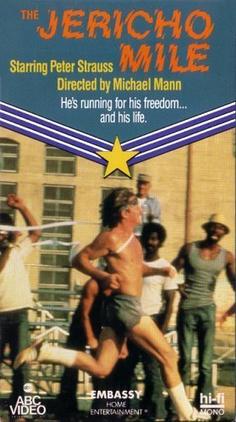
Made For TV Movie Review: The Jericho Mile (dir by Michael Mann)


1979’s The Jericho Mile tells the story of Larry Murphy (Peter Strauss).

Larry is serving a life sentence at Folsom Prison, convicted a crime that he admits to having committed.  Larry murdered his father, specifically to protect his stepsister from being raped.  Larry feels no guilt for his crime and, at the same time, he’s willing to quietly serve his sentence.  He’s a loner, avoiding the rival racial factions in the prison.  (Brian Dennehy leads the Aryans while Roger E. Moseley leads the black prisoners and Miguel Pinero is the head of the Mexican Mafia.)  Larry just wants to spend his time running around the prison yard.

When Dr. Bill Janowski (Geoffrey Lewis) sees how fast Larry can run, he arranges for a local track coach, Jerry Beloit (Ed Lauter), to come up to the prison with a few potential Olympians so that they can race Larry.  Larry manages to outrun all of them.  Jerry becomes convinced that Larry could qualify for the Olympics, if only he had a regulation track to run on.  The Warden, knowing good publicity when he sees it, assigns the inmates to build the track but doing so means dealing with Folsom’s highly charged racial politics.  No matter how fast Larry can run and no matter how inspiring it would be for Larry to go from serving a life sentence to competing in the Olympics, Folsom is still a prison and Larry is still a prisoner.  And while the guards may have the guns and may be the only ones who are allowed to go home at the end of the game, it’s the prison gangs who have all the power.  When the Aryans go on strike and refuse to work on the track, it puts Larry’s chances in jeopardy.

Of course, Larry’s chances are already in jeopardy just because of who he is.  Larry is a prisoner who refuses to show remorse.  While other prisoners embrace religion or politics and try to convince outsiders that they’ve either reformed or been wrongly convicted, Larry just wants to run.  Running is when he’s free.  (The film’s title refers to the Walls of Jericho coming down.)  And, for the other inmates, watching Larry run is a reminder that there are many ways once can escape from the drudgery of being locked away.

The Jericho Mile is a tough and rather cynical prison film, one that manages to combine downbeat social drama with a uplifting sports story.  You’ll want to cheer Larry while he’s running, even if you secretly suspect that he’s ultimately chasing something that will never happen.  Making his directorial debut, Michael Mann shot the film on location at Folsom and the cast is full of actual prisoners, all of whom bring some much need authenticity to the film’s story.  Mann never lets us forget that this is a film about people in a very dangerous situation and, even at its most inspiring, the film leaves you feeling as if violence could break out at any moment.  Peter Strauss, who usually played somewhat more refined characters, is totally believable as the taciturn Larry and character actors like Dennehy and Mosely skillfully blend in with the actual prisoners in the cast.  The Jericho Mile is a portrait of crime, punishment, and dreams.  It’s a movie that will stay with you.


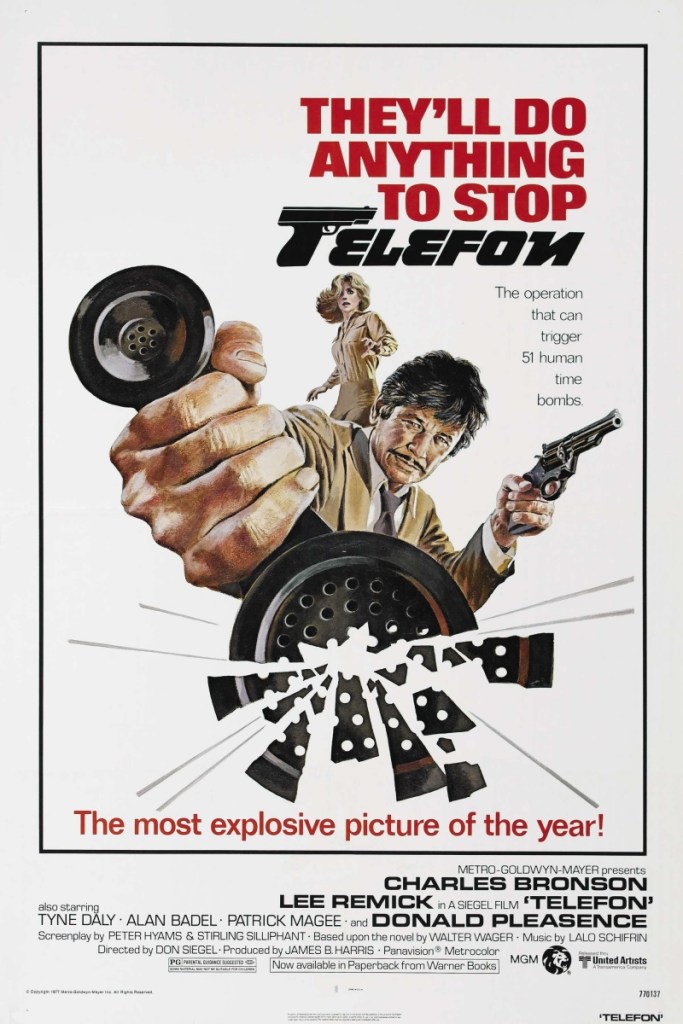
TELEFON – Charles Bronson plays a KGB agent in a movie that inspired The Naked Gun and Tarantino’s Death Proof!


When I was a kid, FOX-16 out of Little Rock, Arkansas would have “Charles Bronson weeks” where every night they’d show a different Bronson film.  I saw several of his films for the first time during those weeks and TELEFON was one of those movies.  I remember really enjoying it that first time I saw it, and I’ve always carried that positive feeling with me.  

The plot of TELEFON is pretty interesting.  In a nutshell, Charles Bronson is Russian KGB agent, Grigori Borsov, who’s been sent to the United States to stop radical Russian Nicolai Dalchimsky (Donald Pleasance), before he can set off more hypnotized human time bombs.  Lee Remick is a beautiful Russian agent (double agent?) who helps him with his mission.  

I personally think TELEFON is an underrated Charles Bronson film, and it seems like a movie that has almost been forgotten.  This is strange to me because it had quite the pedigree at the time of production.  Bronson was a huge star at the time, and the director was Don Siegel, the man behind such classics as DIRTY HARRY, ESCAPE FROM ALCATRAZ, and THE SHOOTIST.  The cast is exceptional as well, with Bronson being joined by the likes of Donald Pleasance, Lee Remick, Tyne Daly, Sheree North and Patrick Magee. The screenplay was co-written by Peter Hyams, who would go on to direct such excellent films as OUTLAND, THE STAR CHAMBER, and RUNNING SCARED.  My point of sharing all of this is that true professionals were at work in front of, and behind the camera, and they created a damn fine Cold War thriller.  I was glad that Shout Factory put out a nice blu ray of the film in January of 2024.  Hopefully film enthusiasts will begin discovering the film again.  

With that said, TELEFON isn’t a perfect film and I do have a few small complaints.  First, Charles Bronson doesn’t appear in the film until we’re already 21 minutes deep.  That’s a long time for me to have to wait for the man!  Second, Bronson and Remick don’t have a lot of sexual chemistry.  She’s beautiful and he oozes masculinity, but somehow it doesn’t really extend to a real connection between their characters.  That’s one of the reasons I like it when Bronson works with his wife Jill Ireland.  That chemistry is usually there between them.  Third, Donald Pleasance wears several wigs and looks kind of dorky at times.  Fourth, Sheree North wears a housecoat during her section of the film.  If you’ve seen her in BREAKOUT with Bronson from a couple of years earlier, you understand just what a missed opportunity that was.  Finally, Tyne Daly is so good in her small role, but she ultimately just kind of exits the film.  I’d have liked even more of her.  These are small complaints, with the exception of Bronson’s entrance & North’s wardrobe choice, that I don’t really hold against the movie.  

The last thing that I want to mention is that there are a couple interesting pop culture references to TELEFON in movies that came out later.  First, the writers of THE NAKED GUN borrowed the plot about hypnotized human time bombs in their own plot to assassinate the visiting Queen of England.  Certain scenes are taken directly from TELEFON.  I remember watching THE NAKED GUN in theaters in the late 80’s and wondering if I was the only person who realized this fact.  Second, in DEATH PROOF, Quentin Tarantino used the major plot device of quoting the Robert Frost poem “Stopping by Woods on a Snowy Evening” in order to trigger something. In TELEFON, it was human time bombs.  In DEATH PROOF, it was human lap dances.  God bless Quentin Tarantino!

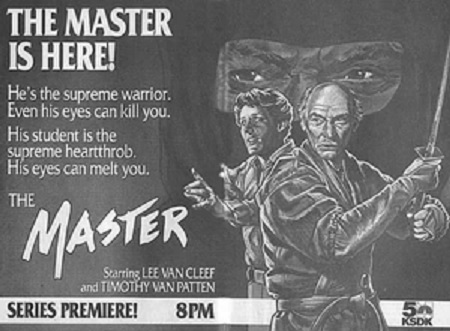
Retro Television Reviews: The Master 1.7 “Juggernaut”


Welcome to Retro Television Reviews, a new feature where we review some of our favorite and least favorite shows of the past! On Fridays, I will be reviewing The Master, which ran on NBC from January to August of 1984.  The show can be found on Tubi!

This week, Lee Van Cleef gets a chance to show off what he can do!

Episode 1.7 “Juggernaut”

(Dir by Gordon Hessler, originally aired on March 16th, 1984)

This week’s episode of The Master opens with Max’s totally groovy van driving across what appears to be farmland.  Judging from the mountains in the background, it appears that they are back in California.  (If they did mention their specific location during this episode, I missed it.)  Last week, as you may remember, Max and McAllister were looking for McAllister’s daughter in Louisiana.  Now, they’re apparently just hanging out in California again.  It’s odd that McAllister left behind his life in Japan so that he could come to America to find his daughter but, now that he’s actually in America, there doesn’t really seem to be any sense of urgency when it comes to actually tracking her down.

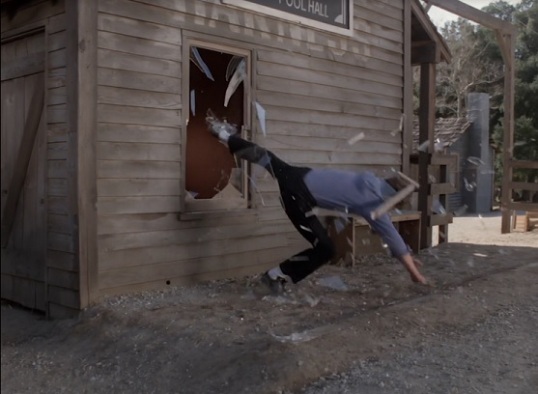
Inside the van, McAllister informs Max that he’s concerned about the way that Max is always losing his temper and starting fights.  Max promises that there will be no more unprovoked fights on his part.  When they stop in front of a local bar, Max says he’s going to get a beer but he also promises McAllister that he will not be getting tossed through the bar’s window.

Five minutes later:

Now, in all fairness, it isn’t totally Max’s fault that he got thrown through that window.  Max went in the bar and saw Alan Kane (veteran TV and movie bad guy William Smith) harassing Cat Sinclair (Tara Buckman).  When Max told Alan to back off, Alan challenged Max to a fight.  Max was forced to explain that he’s not allowed to fight.  Cat rolled her eyes and then Alan tossed Max through the window.  Seeing that his protegee is in trouble, McAllister enters the bar, beats up Alan, and saves Max and Cat.

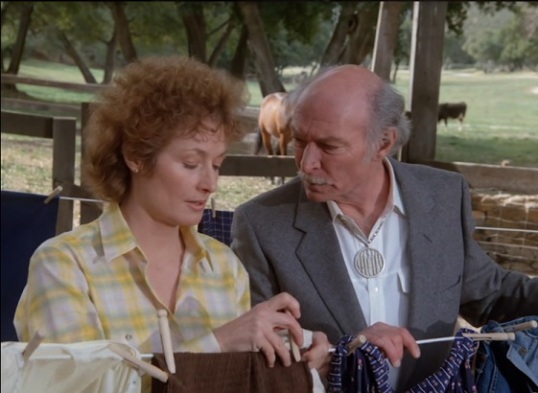
Even though Cat is not impressed with Max’s refusal to fight, she still gets in his van and allows him to give her a ride home.  It turns out that Cat and her mother, Maggie (Diana Muldaur), are farmers but an evil land baron named Hellman (Stuart Whitman) is trying to intimidate them off their land.  Alan works for Hellman and, because of him and his thugs, none of the farmers have been able to get their crops to market.

Both Cat and Maggie refuse to accept any help from Max and McAllister so our heroes get back in their totally happening van and try to leave town.  However, when one of Hellman’s truckers runs the love van off the road, the engine is damaged and the local mechanic informs Max that it will take 48 hours to fix it.  Stranded in town, Max searches for proof that Hellman’s trucker was the one who ran them off the road.  Meanwhile, McAllister returns to the farm and, turning on some of that Lee Van Cleef charm, proceeds to fall in love with Maggie.

If any of this sounds familiar, it’s because, with the exception of McAllister falling in love, it’s pretty much the same thing that happened in not only the first episode but also the third episode.  Max and McAllister have an uncanny talent for randomly wandering into towns that are controlled by evil businessmen.  Just as the first and third episodes featured Max giving impassioned speeches about the rights of the workers, this episode features McAllister giving a speech at a meeting in a barn.

While McAllister is giving his speech, Max is getting arrested for snooping around Hellman’s property.  Fortunately, McAllister puts on a fake beard and breaks him out of jail.  McAllister then directs the farmers to form a convoy and to work together to get their crops to market.  Though Alan attempts to set off a bunch of explosives on the way, McAllister uses a cropduster to fool Alan into setting off the explosions early.  Then, Lee Van Cleef’s stunt double beats up Hellman.  McAllister and Max congratulate each other on a job well done.

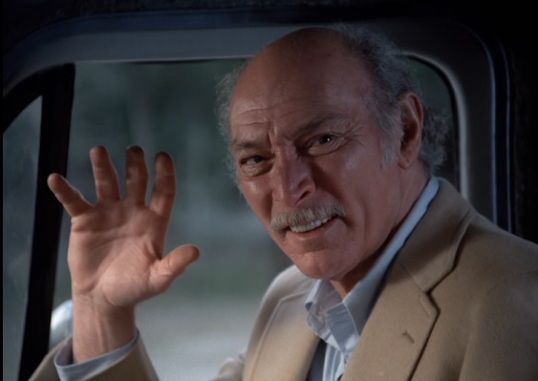
Having saved the farmers and beaten up the bad guys, it’s time for Max and McAllister to once again continue their journey across America.  McAllister may love Maggie but he still needs to (eventually) find his daughter so he gets in the Chevy van and waves goodbye.

As I said before, this episode felt very familiar.  It’s probably not a good sign that, after just seven episodes, The Master was pretty much repeating itself.  That said, the episode did feature the great William Smith playing yet another rural bully and Stuart Whitman always made for a convincing villain.  With Max sidelined by McAllister’s demand that he stop fighting, Lee Van Cleef got his moment to shine in this episode.  He was obviously frail, making it all the more obvious that his fight scenes involved a stunt man, but Van Cleef still got a chance to show off some of his old school movie star charisma.

Next week: The Master steals the Crown Jewels of the United Kingdom! …. sure, why not?

A Movie A Day #9: Gator (1976, directed by Burt Reynolds)


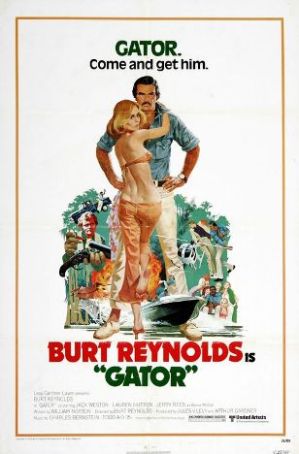
gatorposterGator McClusky is back!

Since the events in White Lightning, Gator (Burt Reynolds) has been released from prison and he’s now living in the Okefenokee Swamp.  Other than running moonshine, Gator is laying low and keeping to himself.  Gator may be done with the feds but the feds are not done with him.

Gator’s old friend, Bama McCall (Jerry Reed), is now unofficial boss of Dunston County and both the Department of Justice and the Governor of Georgia (played by talk show host Mike Douglas) are determined to take him down.  Federal agent Irving Greenfield (Jack Weston) is convinced that he can get Bama on charges of tax evasion.  But Irving’s from New York and he does not know how to talk to the good ol’ boys.  He needs someone on the inside and that’s where Gator comes in.

Gator not only starred Burt Reynolds but it was his directorial debut as well.  Though it’s a sequel to White Lightning, Gator feels like a very different movie.  Whereas Joseph Sargent kept White Lightning relatively serious, Reynolds take a more jokey approach with Gator.  Reynolds has his famous mustache and his hairpiece in Gator and the self-amused attitude that went along with them.  Gator is full of car chases, fist fights, willing women, and corny jokes.  It also has Lauren Hutton, playing a familiar character who would appear in all of Reynolds’s movies, the sophisticate who cannot resist Burt’s good ol’ boy, country charm.  In the 1970s, audiences couldn’t resist Burt’s good old boy charm, either.  Critics hated Gator but it made a lot of money.

Gator is dumb but fun.  The most interesting part of the movie is seeing Jerry Reed playing a ruthless villain.  Reed is thoroughly convincing as a Dixie Mafia crime boss, the type of redneck who earlier inspired Buford Pusser to pick up a baseball bat and destroy pool halls.  One year later, Jerry would play Burt Reynolds’s best friend in Smoky and the Bandit so it’s interesting to see them playing deadly rivals in Gator.

For tomorrow’s movie a day, Burt’s a football player in jail in The Longest Yard.