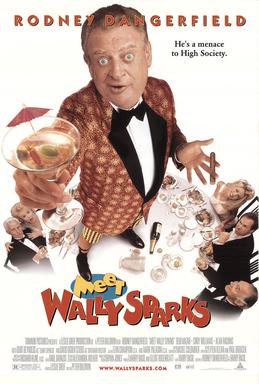
Meet Wally Sparks (1997, directed by Peter Baldwin)


Wally Sparks (Rodney Dangerfield) is a talk show host with a program that is so raunchy that even Jerry Springer says, “At least this isn’t The Wally Sparks Show!”

Despite being a huge hit amongst teens and college students, the show is on the verge of being canceled by the head of the network, Mr. Spencer (Burt Reynolds, wearing a fearsome toupee).  He is tired of Wally’s antics and he tells Wally and his producer, Sandy Gallo (Debi Mazar), that they have a week to make the show respectable.

Wally doesn’t know what to do.  Wally Sparks act respectable?  Wally’s a guy who don’t get no respect, no respect at all.  Then Sandy finds a letter inviting Wally to attend a party at the home of Georgia Governor Floyd Patterson (David Ogden Stiers), a noted critic of the show.  Hoping to get the interview that will save the show, Wally and Sandy head down south.

At the party, Wally acts like Wally and scandalizes all of the politicians and socialites.  He also shares a bottle of whiskey with a horse and then rides the horse through the mansion.  The party is a disaster but, after Wally claims that he can’t walk because of a spinal injury he suffered when he fell off the horse, the Governor allows him to recuperate in the mansion.  Wally causes more chaos while also teaching the Governor’s wife (Cindy Williams) how to play strip poker and eventually exposing a scheme to blackmail the Governor into building  a Confederate-themed amusement park.

Rodney Dangerfield playing a talk show host sounds like a great idea and there are a lot of talented people to be found in Meet Wally Sparks.  Debi Mazar is an actress who should have appeared in a lot more movies and she and Rodney Dangerfield make a good team.  The movie actually gets off to a funny start, with a montage of actual talk show hosts talking about how much they hate Wally Sparks and his show.  Gilbert Gottfried has a cameo as a manic guest and Wally repeats some of Rodney Dangerfield’s classic jokes.

Unfortunately, the movie starts to fall apart as soon as Burt Reynolds threatens to cancel the show for being too lowbrow.  No network executive has ever threatened to cancel a show that’s bringing in the ratings, regardless of how lowbrow it might be.  Things get even worse after Wally goes to Atlanta and ends up staying there.  The movie tries to recreate the Snobs vs. the Slobs dynamic of previous Dangerfield films but the Governor comes across as being such a decent man that there’s no joy to be found in watching his life get turned upside down.  The movie has a surprisingly large number of subplots, including one about Wally’s son (Michael Weatherly) falling for the Governor’s daughter (Lisa Thornhill), but most of them go nowhere and just distract from the man who should have been the film’s main attraction, Rodney Dangerfield.  By the end of the movie, even the usually irrepressible Dangerfield seems to have been neutered.

Rodney Dangerfield was a national treasure but Meet Wally Sparks was not the best showcase for his persona or his style of humor.  Fortunately, Caddyshack and Back To The School are available to watch anytime that we need a good laugh and we want to show Rodney Dangerfield a little respect.
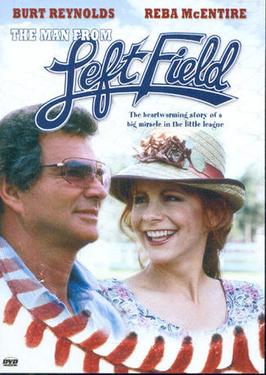
I Watched “The Man From From Left Field” (1993, dir. by Burt Reynolds)


A group of boys from the wrong side of the tracks want to start a little league baseball team but they have to find a coach.  Luckily, right before the deadline, they find a homeless drifter (Burt Reynolds) sleeping in the dugout.  The drifter doesn’t know his name or anything about his past but he does know a lot about baseball.  The team names him Jack Robinson (after Jackie Robinson) and he teaches them how to play baseball and they find a barn for him to sleep in.  Jack dates one the player’s mom (Reba McIntire) and helps the kids with their homelives before a near-tragedy causes him to remember who he used to be.

I like most baseball movies but this one sent a pretty bad message.  If you’re looking for a coach for your baseball team, don’t just give the job to the first drifter who shows up.  The kids were lucky that the drifter turned out to be someone with baseball experience instead of a cannibal.  Jack was a good coach and I appreciated his emphasis on the fundamentals but I also thought it was strange that none of the parents were worried about a total stranger wanting to spend all of his time with their children.  Except for Reba McIntire, the acting was pretty forgettable but all of the kids looked like they knew what they were doing in the baseball scenes so that was a plus.  This movie never scored but it did get a few base hits.

Scenes That I Love: Burt Reynolds Meets Burt Reynolds in The Last Movie Star


Today, the national speed limit is 50 years old.

Boooo!

Yes, it was 50 years ago today that President Richard Nixon signed the law that set the national speed limit as being 55 miles per hour.  Perhaps this was Nixon’s final revenge on a nation that was making a huge deal out of Watergate.  Who knows?

In honor of the occasion, today’s scene that I love is from 2018’s overlooked The Last Movie Star.  In this scene, an elderly Burt Reynolds finds himself transported back to the days of Smokey and the Bandit, where he meets his younger self and takes a ride in a famous black sportscar.  It turns out that the two Burts do not agree when it comes to observing the posted speed limit.

Monday Live Tweet Alert: Join Us For Hard Time and Bad News Bears!


As some of our regular readers undoubtedly know, I am involved in hosting a few weekly live tweets on twitter and occasion ally Mastodon.  I host #FridayNightFlix every Friday, I co-host #ScarySocial on Saturday, and I am one of the five hosts of Mastodon’s #MondayActionMovie!  Every week, we get together.  We watch a movie.  We snark our way through it.

Tonight, for #MondayActionMovie, the film will be 1998’s Hard Time, a film featuring Burt Reynolds!

Then, on twitter, #MondayMuggers will be showing 1976’s Bad News Bears, starring Walter Matthau!  The film is on Prime and it starts at 10 pm et!

It should make for a night of fun viewing and I invite all of you to join in.  If you want to join the live tweets, just hop onto Mastodon, pull up Hard Time on YouTube, start the movie at 8 pm et, and use the #MondayActionMovie hashtag!  Then switch over to twitter, pull Bad News Bears up on Prime, and use the #MondayMuggers hashtag! 

Enjoy!

10 Oscar Snubs From the 1970s


Ah, the 70s. The decade started with the collapse of the studio system and the rise of the so-called movie brats. For the first half of the decade, Hollywood was producing the type of challenging films on which they would never again be willing to take the risk. The 70s were indeed a second cinematic golden age, full of anti-heroes and dark endings. Then, in 1977, Star Wars changed all of that and ushered in the era of the blockbuster. The 1970s gave the world disco, The Godfather, and some of the best Oscar winners ever.  It also gave us more than a few snubs.

1971: Dirty Harry Is Totally Ignored

Dirty Harry may be one of the most influential films ever made but the Academy totally snubbed it.  My guess is that, with The French Connection coming out that same year, the Academy only had room for one morally amibiguous cop film in its heart.  Still, Dirty Harry has certainly held up better than the nominated Nicholas and Alexandra.  Both Clint Eastwood and Andrew Robinson gave performances that were award-worthy as well.  Say what you will about Eastwood’s range, I defy anyone not to smile at the way Harry snarls when he discovers that the man he’s talking to teaches a constitutional law course at Berkley.

1971: Gimme Shelter Is Not Nominated For Best Documentary Feature

Considering that Woodstock won the Documentary Oscar the previous year, it only seems appropriate the Gimme Shelter should have won the following year.  In the end, the Academy decided to celebrate the best of the 60s while snubbing the worst of it.

1972: Burt Reynolds Is Not Nominated For Deliverance

If you’ve ever seen Deliverance, you know how important a character Lewis Medlock (played by Burt Reynolds) was.  Not only was he the one who persuaded everyone to spend the weekend risking their lives on a canoeing trip but he also set the standard for “manlinness” that the rest of his friends tried to live up to.  When Lewis ends up getting a compound fracture and is forced to spend the rest of the film deliriously lying in a canoe, it’s a reminder that nature and fate don’t care how confident or outspoken you are.  Reynolds was perfectly cast.  1972 was a strong year with a lot of worthwhile nominations and, to be honest, there’s really not a bad or an unworthy performance to be found among the acting nominees.  Still, it’s hard not to feel that the Academy should have found some room for Burt Reynolds.

1974: John Huston Is Not Nominated For Chinatown

In the role of Chinatown‘s Noah Cross, John Huston gave one of the great villainous performances.  Cross represented pure avarice and moral decay, a man who committed terrible crimes but who, the film suggested, was also responsible for creating not only modern Los Angeles but also providing a home for Hollywood.  Admittedly, there were a lot of good performances to choose from and I certainly can’t complain that the Academy awarded the Oscar for Best Supporting Actor to Robert De Niro, who deserved it.  Still, in retrospect, John Huston’s evil turn was at least as strong as Fred Astaire’s likable (and nominated) turn in The Towering Inferno.

1974 and 1975: John Cazale Is Not Nominated For Best Supporting Actor

John Cazale had a brief but legendary career.  A noted stage actor, Cazale made his film debut in 1972 with The Godfather.  He played Fredo, the Corleone son who couldn’t get any respect.  He final film, released after his early death from cancer, was 1978’s The Deer Hunter.  Cazale appeared in a total of five films, every one of which was nominated for Best Picture.  That this talented actor was never nominated for an Oscar just doesn’t seem right.  But for which film should he have been nominated?

Godfather Part II received three nominations for Best Supporting Actor: Robert De Niro, Lee Strasberg, and Michael V. Gazzo.  Personally, I would probably replace Gazzo with Cazale.  Cazale’s performance as Fredo was one of the strongest parts of Godfather Part II.  Who can forget Fredo’s legendary meltdown about always being overlooked?  I would also say that Cazale deserved a nomination for his performance in Dog Day Afternoon, in which he played Sal and provided the film with some of its saddest and funniest moments.  Neither Fredo nor Sal survive their films and, in both cases, it’s impossible not to feel that they deserved better than the world gave them.

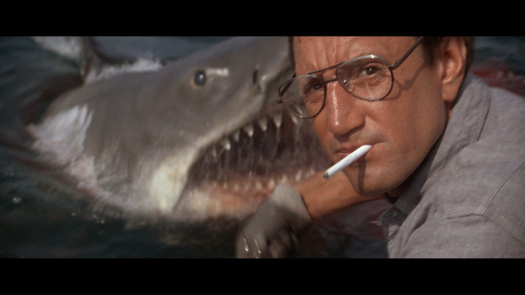
1975: Steven Spielberg Is Not Nominated For Jaws

Seriously, what the Heck?  Jaws totally reinvented the movies.  It received a deserved nomination for Best Picture but the true star of the film, Steven Spielberg, was somehow not nominated.

1976: Martin Scorsese is Not Nominates For Taxi Driver

Seriously, what the Heck?  Taxi Driver totally reinvented the movies.  It received a deserved nomination for Best Picture but the true star of the film, Martin Scorsese, was somehow not nominated.

1977: Harrison Ford Is Not Nominates For Star Wars

Harrison Ford, despite having had the type of career for which most actors would sacrifice their soul, has never had much success with the Oscars.  He’s been nominated exactly once, for Witness.  That he’s never won an Oscar just feels wrong.  The fact that he wasn’t even nominated for playing either Han Solo or Indiana Jones feels even more wrong.  In the role of Solo, Ford bring some much needed cynicism to Star Wars.  His decision to return and help the Rebels destroy the Death Star is one of the best moments in the film.

1978: National Lampoon’s Animal House Is Totally Ignored

This film deserved a nomination just for the scene in which John Belushi destroyed that annoying folk singer’s guitar.  Seriously, though, this is another film that, more or less, defined an era.  I’m not saying it deserved to win but it at least deserved a few nominations.

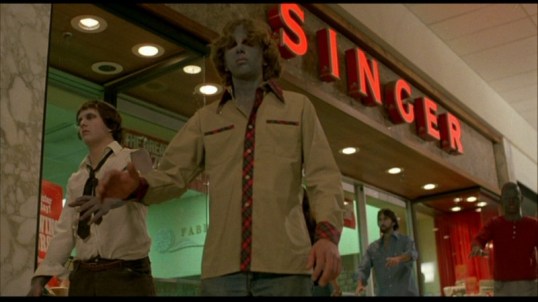
1979: Dawn of the Dead Is Not Nominated For Best Picture

Considering the Academy’s general resistance to honoring horror, it’s not really a shock that Dawn of the Dead was not nominated for Best Picture but still, it would have been nice if it had happened.

Agree?  Disagree?  Do you have an Oscar snub that you think is even worse than the 10 listed here?  Let us know in the comments!

Up next: The 80s arrive and the snubs continue!

Dawn of the Dead (1978, dir by George Romero)

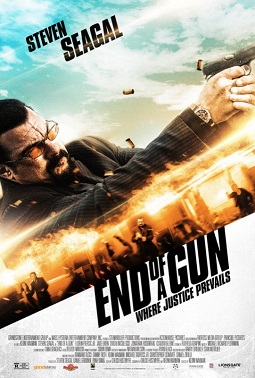
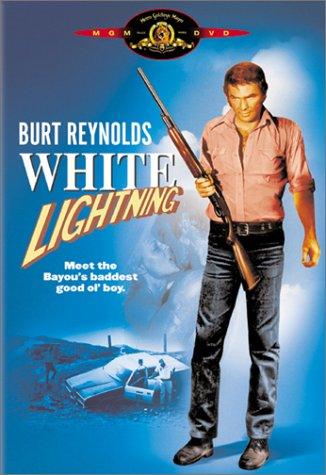
Monday Live Tweet Alert: Join Us For End of a Gun and White Lightning!


As some of our regular readers undoubtedly know, I am involved in hosting a few weekly live tweets on twitter.  I host #FridayNightFlix every Friday, I co-host #ScarySocial on Saturday, and I am one of the five hosts of #MondayActionMovie!  Every week, we get together.  We watch a movie.  We tweet our way through it.


Tonight, for #MondayActionMovie, the film will be 2016’s End of a Gun!  Selected and hosted by Matthew Titus, it features Steven Seagal being Steven Seagal.


Following #MondayActionMovie, Brad and Sierra will be hosting the #MondayMuggers live tweet.  We will be watching 1973’s White Lightning, starring Burt Reynolds!  This film can be found on Prime and Tubi!

It should make for a night of fun viewing and I invite all of you to join in.  If you want to join the live tweets, just hop onto twitter, start End of a Gun at 8 pm et, and use the #MondayActionMovie hashtag!  Then, at 10 pm et, start White Lightning , and use the #MondayMuggers hashtag!  The live tweet community is a friendly group and welcoming of newcomers so don’t be shy.   

Burt says “Come on in!”

Monday Live Tweet Alert: Join Us For Crash & Byrnes and White Lightning!


As some of our regular readers undoubtedly know, I am involved in hosting a few weekly live tweets on twitter.  I host #FridayNightFlix every Friday, I co-host #ScarySocial on Saturday, and I am one of the five hosts of #MondayActionMovie!  Every week, we get together.  We watch a movie.  We tweet our way through it.


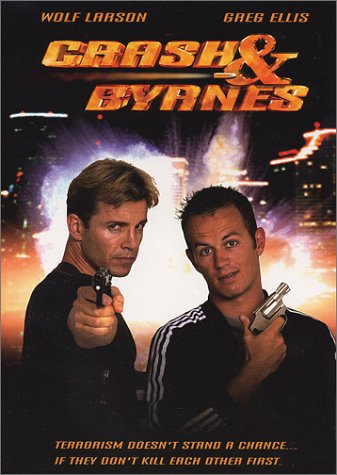
Tonight, for #MondayActionMovie, the film will be 2000’s Crash & Brynes!  Selected and hosted by RevMagdalen, this movie is about two British cops who just happen to have last names that go together!


Following #MondayActionMovie, Brad and Sierra will be hosting the #MondayMuggers live tweet.  We will be watching 1973’s White Lightning, starring Burt Reynolds!  This film can be found on Prime and Tubi!

It should make for a night of fun viewing and I invite all of you to join in.  If you want to join the live tweets, just hop onto twitter, start Crash & Byrnes at 8 pm et, and use the #MondayActionMovie hashtag!  Then, at 10 pm et, start White Lightning , and use the #MondayMuggers hashtag!  The live tweet community is a friendly group and welcoming of newcomers so don’t be shy.   

Burt says “Come on in!”

Big City Blues (1997, directed by Clive Fleury)


If you have ever wonder why Burt Reynolds, despite receiving an Oscar nomination for Boogie Nights and being a favorite of so many of the up-and-coming directors of the 90s and early 2000s, never made a real comeback, you only have to watch Big City Blues.

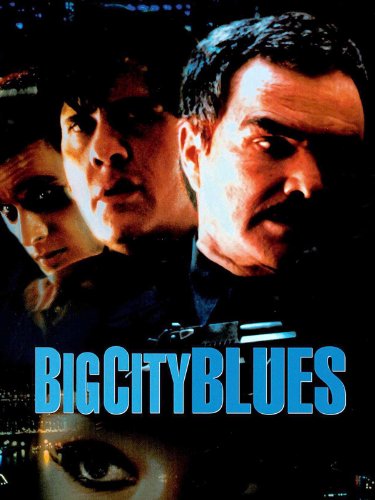
In Big City Blues, Burt plays a hitman who loves to watch and talk about old movies.  Over the course of one very long night, Burt and his partner (played by William Forsythe) drive through the city.  In between doing violent jobs for their boss, they talk.  Burt talks about movies.  Forsythe talks about how he doesn’t understand Burt’s love of the movies.  They talk nonstop and if this is making you think of Pulp Fiction, it’s probably intentional.  Today, I think people forget just how many Pulp Fiction rip-offs were released throughout the 90s, all featuring talkative criminals who were obsessed with pop culture.  Burt Reynolds and William Forsythe have got the equivalent of the roles played by John Travolta and Samuel L. Jackson.  Unfortunately, Reynolds and Forsythe don’t have the same chemistry as Travolta and Jackson.  You believed that Travolta and Jackson had been working together for years and, when they talked, that they were having an actual conversation.  Despite both of them being credited as executive producers on the film, Reynolds and Forsythe come across as being two talented actors who are phoning it in for a paycheck.

When the film isn’t focused on Reynolds and Forsythe, it follows two trans women (played by Giancarlo Esposito and Ayre Gross) as they walk around the city and debate whether or not Esposito should get sex reassignment surgery.  When it’s not following Esposito and Gross, it’s focusing on a sex worker (Georgina Cates) who wants to be a movie star and who keeps seeing evidence that she has a doppelganger who is living the respectable life that she craves.  Cates searches for her doppelganger while also servicing her clients, who are all typical middle-aged pervs.  (One gets off from listening to Cates sing Ol’ McDonald Had a Farm.)  Eventually, the paths of all the characters cross and Reynolds talks about how life is just celestial roulette.

Big City Blues doesn’t add up to much.  Like many 90s indie films, the characters are all talkative to the point of feeling like parodies.  (When the movie isn’t trying to rip-off Quentin Tarantino, it feels like a half-baked imitation of Richard Linklater.)  Even the likable performances of Cates, Esposito, and Gross can’t overcome how overwritten and derivative the script feels.  Beyond the script, the film just looks bad.  All of the scenes take place at night and the lighting is often so dark that it’s impossible to see what’s actually happening from scene to scene.  It feels amateurish.

So why was Burt Reynolds in this?  This was the first film that Reynolds made after the filming of Boogie Nights.  Probably thinking that Boogie Nights would flop, Reynolds signed up to appear in this Pulp Fiction knock-off, which is something that many former stars did in the 90s.  Instead of flopping, Boogie Nights turned out to be the film that reminded everyone that Reynolds could be a very good actor with the right material.  Unfortunately, Reynolds himself didn’t think much of the film and, perhaps even worse as far as Hollywood was concerned, he was open about not thinking much of the film.  As a result, even with that Oscar nomination, Reynolds didn’t get the type of career resurrection that John Travolta got from Pulp Fiction and Robert Forster and Pam Grier got from Jackie Brown.  That’s too bad.  Burt  Reynolds deserved better.

The Further Adventures of Smokey and the Bandit


The first Smokey and the Bandit is a classic.  What about the sequels?

Smokey and the Bandit II (1980, directed by Hal Needham)

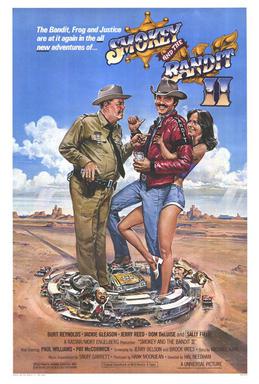
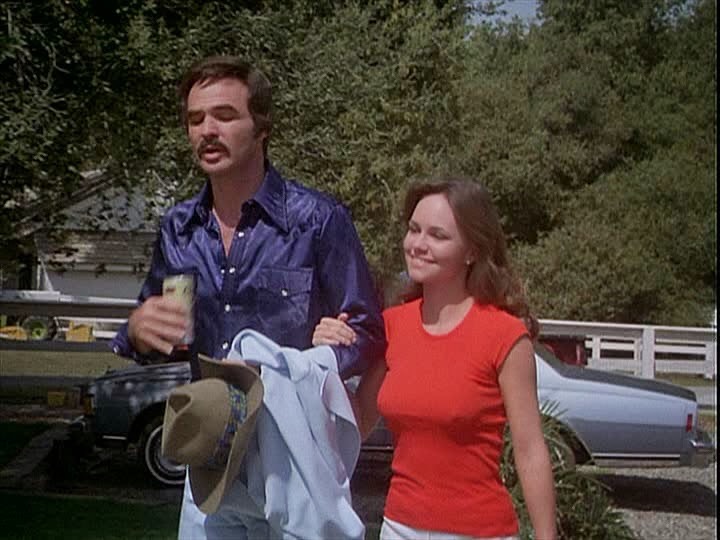
The gang’s all back in this sequel to Smokey and the Bandit!  Burt Reynolds is the Bandit!  Jackie Gleason is Sheriff Buford T. Justice and his two brothers, Reginald and Gaylord!  Jerry Reed is Snowman!  Sally Field is Carrie!  Pat McCormick and Paul Williams are Big and Little Enos!  Mike Henry is Junior!  Dom DeLuise is an Italian doctor!  Terry Bradshaw and Mean Joe Greene play themselves!  There’s an elephant!

You get the idea.  Smokey and the Bandit II promises more of the same.  In some ways, it delivers.  There are some entertaining stunts.  The finale features what was, at the time, the biggest car chase ever filmed.  But Smokey and the Bandit II fails at the most important part.  It fails to recreate the fun of the first film.  Everyone is just going through the motions.  Burt Reynolds later said that he only made the film as a favor to Hal Needham while Sally Field said that she agreed to appear in the film as a favor to Burt Reynolds.  Jackie Gleason did the movie because he needed the money but, because he was also in poor health, he requested that his scenes be filmed first and that they be filmed quickly.  That the three stars didn’t have much enthusiasm for the project is obvious while watching the movie.

This time, Big Enos wants the Bandit to transport an elephant to the Republican National Convention in Dallas.  The Bandit, however, has been an alcoholic wreck ever since Carrie left him to, for some reason, get back with Junior.  Snowman manages to sober up the Bandit and, after they help Carrie run out on her wedding for a second time, it’s time to transport an elephant.

In hot pursuit, Sheriff Justice gets help from his brothers, all of whom are also played by Gleason.  Reginald Justice is a Canadian Mountie who speaks with a posh accent that is in no way Canadian.  Gaylord Justice is a flamboyant state patrolman.  Whenever the brothers talk to each other, doubles are used.  There are a few split screen shots that are so ineptly handled that it ends up looking like a page from a comic book with each Gleason standing in a separate panel.  The end credits list Gaylord as having been played by “Ms. Jackie Gleason,” just in case you’re wondering the level of this film’s humor.

Dom DeLuise gets some laughs as an Italian doctor who is recruited to take care of the elephant but otherwise, this is a depressing movie.  Burt Reynolds and Sally Field were on the verge of breaking up when this film was made and neither one of them acts their scenes with much enthusiasm.  Watching the movie, it’s impossible not to compare their strong chemistry in the first movie to their total lack of it in the second movie.  There’s a subplot about the Bandit trying to prove that, even though he’s getting older, he’s still a legend and, for those who know anything about Burt Reynolds’s career, it hits too close to home.  Combining that with the sight of an obviously unwell Jackie Gleason and you’ve got a surprisingly depressing comedy.

There is one cool thing about Smokey and the Bandit II.  After the critics thoroughly roasted the film, Hal Needham took out a one-page ad in Variety.  The ad was a picture of Needham sitting in a wheel barrow full of money.  That’s one way to answer your critics!

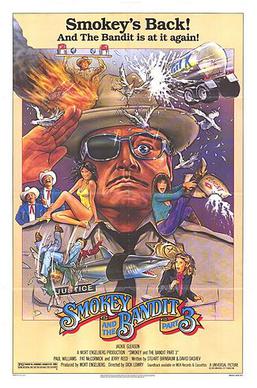
Smokey and the Bandit 3 (1983, directed by Dick Lowry)

Smokey and the Bandit 3 is even more depressing than the second film.  Not surprisingly, Sally Field is nowhere to be found.  She had broken up with Burt after the second film and was busy pursuing a career as the type of actress who didn’t appear in car chase films.  Burt does appear in the film but he only makes a cameo appearance, showing up for a few minutes at the end with a resigned look on his face as if he realized that he was never going to escape being typecast as an aging good ol’ boy.  Also not returning was Hal Needham.  Needham was busy directing Stroker Ace so he was replaced by Dick Lowry.  What type of director was Dick Lowry?  Other than Smokey and the Bandit 3, Lowry’s best known credit is for Project Alf.

Jackie Gleason, Jerry Reed, Pat McCormick, Mike Henry, and Paul Williams all return but none of them look happy to be there.  The plot is that Sheriff Buford T. Justice has retired to Florida but he just can’t turn down a challenge from Big Enos and Little Enos to drive a stuffed shark from Miami to Dallas.  Smokey is the Bandit!  (That was originally the title of this film.)  When it looks like Buford is doing too good of a job of transporting the shark, the Enoses hire Snowman to chase Buford and slow him down.  It doesn’t make any sense and Jerry Reed and Jackie Gleason don’t share any scenes together despite co-starring in the film.  Supposedly, Gleason was originally cast as two characters — Buford and the man hired to slow Buford down — but when preview audiences were confused by the film, the studio demanded reshoots.  Jerry Reed was brought back and all of the scenes featuring Gleason as the new Bandit were reshot with Reed.  Reed even grew a mustache, wore a red shirt, and broke the fourth wall just like Burt did in the first film.

Not surprisingly, Smokey and the Bandit 3 is a disjointed mess that doesn’t even have any spectacular car crashes to justify its existence.  Jerry Reed is as amiable as he was in the first two films but Jackie Gleason’s Buford Justice was never meant to be a lead character.  In small doses, he was funny but Buford was too one-dimensional of a character to build an entire film around.

Smokey and the Bandit 3 was a failure with critics and at the box office so the Bandit’s adventures came to a temporary end.  Years later, Hal Needham produced four made-for-TV prequels the starred Brian Bloom as a young Bandit.  I haven’t seen them.  If I ever do, I’ll review them.

Hooper (1978, directed by Hal Needham)


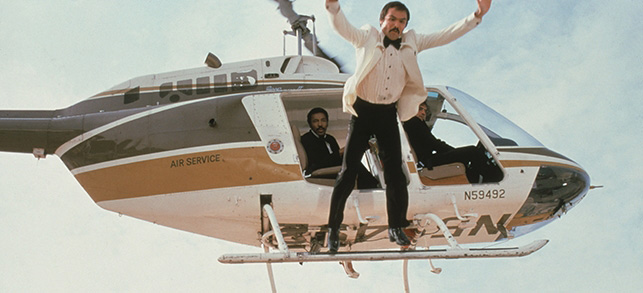
Reuniting the Smokey and the Bandit team of director Hal Needham and stars Burt Reynolds and Sally Field, Hooper is a film that pays tribute to stuntmen.

Hooper (Burt Reynolds) is a respected but aging stunt coordinator who is currently working on an overblown action film called The Spy Who Laughed At Danger.  (The spy is played by Adam West, who appears as himself.)  Hooper knows that he’s getting too old to keep putting his life at risk but he’s addicted to thrill of doing what he calls “gags.”  Every morning, Hooper wakes up, pops pills, has a beer, and then falls off a building or crashes a car.  When he’s not doing movies, he’s getting into bar brawls.  As demonstrated during a visit to Dodge City, Hooper and his friends are modern day cowboys  but time is catching up to them.  Hooper’s girlfriend, Gwen (Sally Field), wants Hooper to settle down and retire from the business before he ends up a physical wreck like her father (Brian Keith).  Hooper feels that he has to do one last, record-setting stunt before he passes the torch over to younger stuntmen like Ski Shidski (Jan-Michael Vincent).

Hooper is a classic Burt Reynolds film, with everything that you expect from late 70s Burt.  As always, Burt is deceptively laid back.  Sally Field is cute as a button.  Old hands like Brian Keith and James Best provide strong support while Robert Klein plays the type of pompous Hollywood director who is just begging to get slugged at the end of the movie.  (He does.)  The plot of Hooper is even simpler than the plot of Smokey and the Bandit but Hooper is a more heartfelt film.  Hal Needham was a stuntman before he became a director and this film was his tribute to the underappreciated people who risked their physical well-being to make movie magic.  Needham knew men like Hooper and his friends.  They were his people.  Needham’s love for the stunt players comes through in every scene.

As for the stunts, they’re real and they’re spectacular.


Hal Needham, of course, will always be associated with Burt Reynolds.  Before moving into directing, Needham frequently served as Reynolds’s stunt double and the two were such close friends that Needham spent 12 years living in Reynolds’s guest house.  Quentin Tarantino’s Once Upon A Time In Hollywood was partially inspired by the friendship of Burt Reynolds and Hal Needham, with Leonardo Di Caprio and Brad Pitt playing characters who were based on the two men.  (Reynolds was even originally cast in Once Upon A Time In Hollywood as George Spahn but he died before he could shoot his scenes. The role was taken over by Bruce Dern.)  Needham was responsible for directing some of Burt’s best films (Cannonball Run, Smokey and the Bandit and this one) and some of his worst (Stroker Ace and Cannonball Run II).  Needham also directed Megaforce, which didn’t feature Burt but which is still, in its own way, unforgettable.

Hal Needham (1931 — 2013)

The critics may not have loved the movies that Hal and Burt made together but audiences did.  Needham’s best films are just as entertaining today as they were when they were originally released.  They don’t demand much but they deliver everything you could possibly want.  Whenever the real world is getting to be overwhelming, I’m thankful that I can turn on a Hal Needham film and return to a world where the only thing that matters is driving fast, loving hard, and having a good laugh while you’re doing it.  Today, more than ever, the legacy of Hal Needham is just what we need.