(Lisa is currently in the process of cleaning out her DVR! It’s going to take a while. She recorded this 1962 literary adaptation off of FXM on January 30th!)
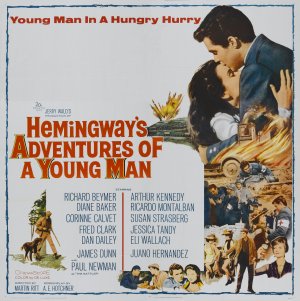
Hemingway’s Adventures Of A Young Man is one of those films that you just know was made specifically to win Oscars. It’s a big prestige production, complete with a historical setting, an epic scope and big, all-star cast. That most of those stars appear in relatively small roles was undoubtedly meant to evidence of the film’s importance.
“Look!” the film seems to shout at times, “This is such an important film that even Paul Newman was willing to stop by for a day’s work!”
The film is based on ten short stories by Ernest Hemingway and, loosely, A Farewell to Arms. The stories all dealt with the early life of Nick Adams, who was a literary stand-in for Hemingway. Since the Nick Adams stories were autobiographical (and, for that matter, so was A Farewell to Arms), the film can also be viewed as biopic. Richard Beymer (who, a year earlier, had starred in West Side Story and who is currently playing Ben Horne on Twin Peaks) may be playing Nick Adams but the film leaves little doubt that he was actually meant to be playing Ernest Hemingway.
The film opens with Nick hunting with his father, Dr. Harold Adams (Arthur Kennedy). He is present when his father travels to an Indian camp and helps to deliver a baby. He respects his father but Nick wants to see the world and the film follows him as he explores America, working odd jobs and meeting colorful characters along the way. Paul Newman shows up as a punch-drunk boxer and proceeds to overact to such an extent that he reminded me of Eric Roberts appearing in a Lifetime film. Nick meets rich men, poor men, and everything in between. He works as a journalist. He works as a porter. Eventually, when World War I breaks out, Nick enlists in the Italian army and the film turns into the 100th adaptation of A Farewell to Arms.
And really, I think it would have been an enjoyable film if it had been directed by someone like Otto Preminger, George Stevens, or maybe even Elia Kazan. These are directors who would have embraced both the pulpy potential of the Nick Adams stories and the soapy melodrama of the war scenes. A showman like Preminger would have had no fear of going totally and completely over the top and that’s the approach that this material needed. Instead, Hemingway’s Adventures Of A Young Man was directed, in a painfully earnest style, by Martin Ritt. Ritt tries to imitate Hemingway’s famously understated style with his understated direction but, cinematically, it’s just not very interesting. Ritt portrays everything very seriously and very literally and, in the end, his direction is more than a little dull.
Sadly, the same can be said for Richard Beymer’s performance in the lead role. Beymer comes across as being the nice guy who everyone says you should marry because he’ll be able to get a good and stable job and he’ll probably never go to jail. Two months ago, when I watched and reviewed Twin Peaks, I really loved Beymer’s performance as Ben Horne. He just seemed to be having so much fun being bad. Unfortunately, in Hemingway’s Adventures Of A Young Man, he never seemed to be having any fun at all. No wonder he temporarily put his film career on hold so that he could fully devote himself to working as a civil rights activist.
In the end, this is a movie that’s a lot more fun to look at than to actually watch. Visually, the film is frequently quite pretty in an early 1960s prestige movie so sort of way. And there are some good performances. Eli Wallach, Ricardo Montalban, Susan Strasberg, Arthur Kennedy — there’s a whole host of performers doing memorable supporting work. Unfortunately, even with all that in mind, this well-intentioned film largely falls flat.
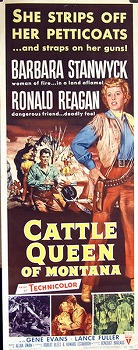 Pop Jones (Morris Ankurm) and his daughter Sierra Nevada (Barbara Stanwyck) leave their ranch in Texas and head up to Montana to take over some land that Pop has inherited. Evil Tom McCord (Gene Evans) wants the land for himself and conspires with a member of the local Blackfoot tribe, Natchakoa (Tony Caruso), to take it over. After a surprise attack leaves Pop dead, Sierra is nursed back to health by Colorados (Lance Fuller), the son of the Blackfoot chief. Sierra tries to reclaim her land from McCord, with the eventual help of the mysterious gunslinger Farrell (Ronald Reagan).
 Through the Shattered Lens