Shattered Politics #8: Magnificent Doll (dir by Frank Borzage)


Poster - Magnificent Doll_02

I’ve always been tempted to write one of those quizzes that you always see on Facebook, “Which American first lady should you be?”  That’s a question that I’ve often asked myself.  I know that I would not want to be any of our most recent first ladies.  (Sorry, Michelle.  Sorry, Laura.  Sorry, Hillary.)  Occasionally, I think that I would have liked to have been Jacqueline Kennedy, if not for what happened in Dallas.  Teddy Roosevelt’s daughter, Alice, is definitely a historical role model for me but it’s debatable whether she could truly be considered a first lady.  And, of course, there’s always Grover Cleveland’s wife Julia but ultimately, for me, there’s really only one choice.

If I could be any American first lady, I would be Dolley Madison.

Dolley, of course, was the wife of James Madison, who was not only our fourth President but also one of the smartest.  Madison was a skilled writer and scholar but he had absolutely no social skills.  Dolley, on the other hand, was vivacious and was, by the standards of the dentistry-free days of the 19th Century, one of the most beautiful women in America. Whereas James was uncomfortable meeting with people and struggled to express himself, Dolley was the world’s greatest hostess, bringing opposing forces together through the sheer force of her own charm and ability to throw a great party.  When the British invaded Washington D.C. during the War of 1812, Dolley was the one who saved the famous portrait of George Washington from being burned with the rest of the White House.

So, yes, I would definitely be Dolley Madison.

(Yes, I know that there’s some debate over whether her name should be spelled Dolly, Dolley, or Dollie.  I spell it Dolley and since I would have been her, I think my opinion counts for something.)

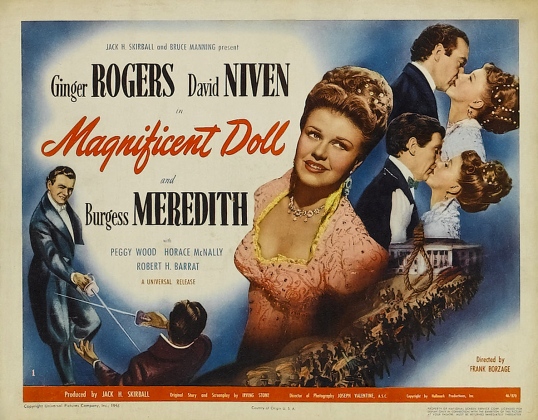
It’s a shame that there haven’t been many movies made about Dolley Madison.  Perhaps the best known is 1946’s Magnificent Doll, which is not a very good movie but which is amusing if you know something about history.

Magnificent Doll opens with young Dolley Payne (Ginger Rogers) being forced to marry John Todd (Horace McNally), a much older lawyer.  (John saved the life of Dolley’s father and, in gratitude, Dolley’s father gave him his daughter.)  Though John falls in love with her, Dolley refuses to show him any sign of affection and good for her!  (Seriously, arranged marriages suck.)  But then John dies of yellow fever and Dolley declares that she did love him all along.

But life goes on!

Soon, Dolley and her mother are running a boarding house in Philadelphia.  Fortunately, they happen to be running it at the same time that the Continental Congress is attempting to write the Constitution.  Several of the delegates are staying at the boarding house and two of them take a romantic interest in Dolley.

First there’s Aaron Burr (David Niven), a charming scoundrel who appeals to Dolley’s wild side.  Aaron does things like take her to a bar and kiss her underneath a staircase.  Aaron is vain.  Aaron is self-absorbed.  Aaron is an ambitious and charismatic brooder whose moods can be unpredictable.  Aaron is exiting!  Aaron is dangerous!  Aaron is a rebel!

And then you’ve got Aaron’s friend, James Madison (Burgess Meredith).  James is shy and gentle.  He’d rather read a book than go out.  He’s the type of smart kid who all the other kids make fun of but he’s also a good, decent man who has a great future ahead of him.  He just needs someone to bring him out of his shell.

In short, Aaron is the type of boy that you hope invites you to prom.  James is the type of boy that you marry.

And, when Dolley does marry James, it sends Aaron Burr into such a tail spin that he nearly prevents Thomas Jefferson from becoming President in 1800…

And, needless to say, this film is in no way historically accurate.  It is true that Aaron Burr was nearly elected President in 1800 and, had he been, Thomas Jefferson would never have been President.  However, most historians seem to agree that has more to do with Aaron Burr being ambitious and nothing to do with Dolley Madison.  In the end, Magnificent Doll may be amusing in its inaccuracies but bad history is still bad history.

That said, there’s still a part of me that enjoyed Magnificent Doll, despite the fact that it moves way too slowly and none of the actors (with the exception of David Niven) appear to be all that invested in their roles.  I think, ultimately, the reason I enjoyed Magnificent Doll was because it really is basically just a YA version of American history and, as a result, it does have some curiosity value.  One gets the feeling that if Magnificent Doll were released today, it would be split into two different films and that it would be promoted on social media with hashtags reading #TeamAaron and #TeamJames.

That said, if there’s any first lady who deserves a biopic (one that’s good as opposed to so-bad-its-interesting) it’s Dolley Madison.  (Personally, I would cast Amy Adams in the role.)  #TeamDolley all the way!

Horror on TV: The Twilight Zone Ep. 111 “Printer’s Devil”


TheTwilightZoneLogo
In this episode of The Twilight Zone, Robert Sterling plays the editor of a failing newspaper. After being forced to fire all of his employees, Sterling prepares to commit suicide. However, before going through with it, Sterling is approached by a friendly old man (Burgess Meredith) who offers to both pay off Sterling’s debts and to work for him as the newspaper’s only reporter. Sterling agrees and…

Well, just the fact that this episode is entitled Printer’s Devil probably gives you a clue about what’s really going on with that nice old man…

Printer’s Devil is one of the rare hour-long episodes of The Twilight Zone. If nothing else, it’s worth watching just to compare Meredith’s performance here with his far different performance in Time Enough At Last.

Horror On The Lens: Burnt Offerings (dir by Dan Curtis)


To be honest, I really don’t like Burnt Offerings, a 1976 film about what happens when an odd family moves into an even odder house.  I find it to be slow and predictable and, to be honest, the only part that really works are the flashback scenes that feature a skeletal Anthony James playing a sinister chauffeur.

However, I’ve discovered that there’s a lot of people online who disagree with me and who consider this to be one of the best haunted house movies ever!  So, in the spirit of agreeing to disagree, here is Burnt Offerings

(If nothing else, the film is worth it for the chance to see Oliver Reed, Karen Black, Bette Davis, Anthony James, and Burgess Meredith all in one film together.)

http://www.youtube.com/watch?v=yHBOMnFVHLo

Horror on TV: Twilight Zone 1.8 “Time Enough At Last”


TheTwilightZoneLogo

In this early episode of The Twilight Zone, poor and meek Henry Bemis (Burgess Meredith) is literally the last man on Earth and that suits him just fine. He finally has time to read everything that he’s always wanted to read. This episode is best remembered for Burgess Meredith’s eccentric lead performance and the somewhat mean-spirited twist ending.

Embracing the Melodrama #31: When Time Ran Out (dir by James Goldstone)


If I had been alive in the 70s, I would have been terrified if I had ever found myself in the same general location of Paul Newman, William Holden, Ernest Borgnine, Red Buttons, Jacqueline Bisset, or Burgess Meredith.  Just based on the movies that they spent that decade appearing in, it would appear that disaster followed them everywhere.

Just consider:

Both Paul Newman and William Holden were trapped in The Towering Inferno. 

Ernest Borgnine and Red Buttons both ended up taking an unexpected Poseidon Adventure together.

Jacqueline Bisset was a flight attendant in the first Airport and nearly got killed by a mad bomber.

And finally, Burgess Meredith was a passenger on The Hindenburg.

Seriously, that’s a dangerously disaster-prone bunch of thespians!

So imagine how terrifying it must have been on the set of the 1980 film When Time Ran Out when all 6 of those actors — along with a lot of other disaster film veterans — were first gathered in one place.  People were probably running for their lives, both on-screen and off.

Lava3

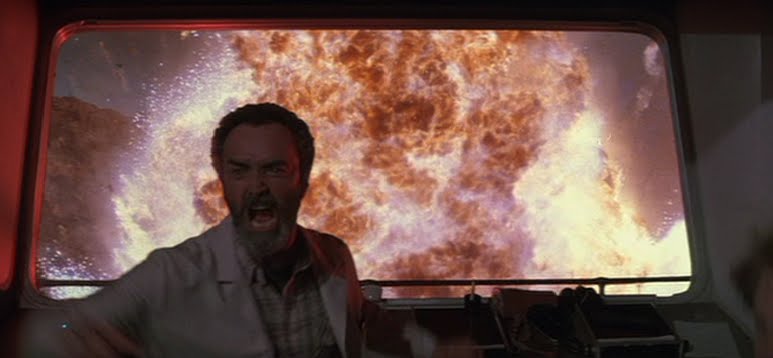
When Time Ran Out takes place on an island in the South Pacific.  Shelby Gilmore (William Holden, playing yet another ruthless but essentially good-hearted businessman) owns a luxury resort that happens to be sitting dangerously close to an active volcano.  Oil rigger Hank Anderson (Paul Newman) is convinced that the volcano is about to erupt but Shelby’s son-in-law, Bob Spangler (James Franciscus), refuses to listen and claims that even if the volcano does blow, the resort will be safe.

(As a sidenote, why were William Holden’s son-in-laws always too blame in disaster movies?  First, you had Richard Chamberlain in The Towering Inferno and now, it’s James Franciscus in When Time Ran Out…)

Suspended over a volcano

Suspended over a volcano

You can just look at the film’s title (When Time Ran Out!) and guess that Bob is probably wrong.  However, Bob has other things on his mind.  First off, he’s cheating on his neurotic wife (Veronica Hamel) with a native islander (Barbara Carrera) who happens to be married to the hotel’s general manager, Brian (Edward Albert).  Brian also happens to be Bob’s half-brother and is therefore owed at least half of Bob’s fortune but nobody but Bob realizes that.

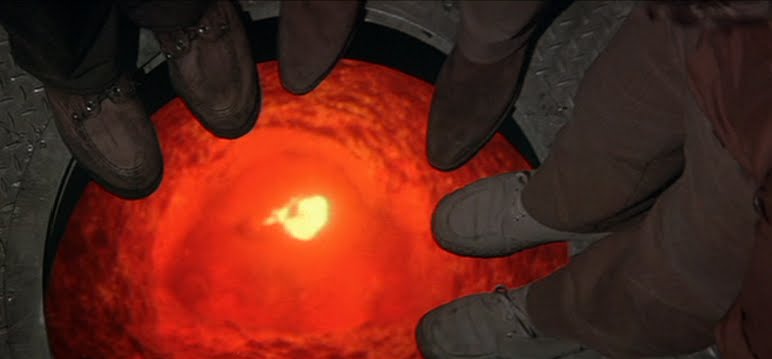
And, of course, there are other colorful guests at the hotel who will soon find themselves either fleeing from or drowning in molten lava.  There’s a white-collar criminal (Red Buttons) who is being pursued by a detective from New York (Ernest Borgnine, of course).  There’s also two retired tightrope walkers (Burgess Meredith and Valentina Cortese) and you better believe that there’s going to be a scene where one of them is going to have to walk across a plank that happens to be suspended over a river a lava…

Told ya!

Told ya!

Eventually, that volcano does erupt and…well, let’s just say that When Time Ran Out is no Towering Inferno as far as the special effects are concerned.  The scene where one random fireball flies out of the volcano and heads for the resort is particularly amusing for all the wrong reasons.  Not only does the volcano apparently have perfect aim but it’s also painfully obvious that the fireball is streaking across a matte painting.  This is the type of film where, when people plunge into a river lava, they do so with heavy lines visible around their flailing bodies.  That, along with the cast’s obvious lack of interest in the material, adds up to make When Time Ran Out a film that is memorable for being so ultimately forgettable.

The Horror!

The Horror!

(It’s odd to consider that this film was directed by the same James Goldstone who directed such memorable films as Rollercoaster and Brother John.)

When Time Ran Out is something of a historical oddity because it was the last of the old 70s all-star disaster films.  (This may have been released in 1980 but it’s a 70s film through and through.)  The movie was such a monumental failure at the box office that it pretty much ended an era of disaster films.

For that reason, it also feels like an appropriate film with which to close out the 70s.  Tomorrow, we’ll continue to embrace the melodrama with the 1980s.

when time


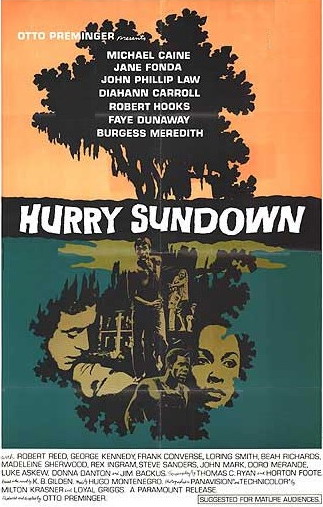
Were the critics right? A Review of Otto Preminger’s Hurry Sundown


It seems like whenever film bloggers and reviewers are making out a list of the worst films of all time, somebody always mentions Hurry Sundown.

Now, don’t get me wrong.  It doesn’t get mentioned as often as Battlefield Earth or Adam Sandler’s latest comedy.  And, when it does get mentioned, it’s done with little of the warmth that’s given to Troll 2, The Room, or Birdemic.  Instead, one gets the impression that Hurry Sundown is a film so bad that even those of us who appreciate bad films would find little to love about it.

But y’all know me.  I’m the type that prefers to judge for herself and I’m also someone who rather enjoys being a contrarian.  There’s a reason why one of my most read posts on this site is entitled 10 Reasons Why I Hated Avatar.  Add to that, Hurry Sundown was directed by Otto Preminger who also directed one of my favorite films of all time, Anatomy of a Murder.  How, I asked myself, could the man who made Anatomy of a Murder possibly also direct one of the worst films of all time?  As a result, every time that I saw someone claiming that Hurry Sundown was one of the worst films of all time, I grew more and more determined to someday see the film and judge for myself.

Well, I finally got my chance this weekend.  Hurry Sundown was on one of my newest favorite channels, The MOVIES! TV Network.  And I proceeded to watch it.  I sat through all four hours of this film (that’s including commercials and, oh my God, was I thankful for the distraction that those commercials provided).  I watched Hurry Sundown and …. wow.  Was it ever bad.

Hurry SundownReleased in 1967, Hurry Sundown was Otto Preminger’s attempt to take a look at race relations in the deep south.  It’s a film full of good, liberal intentions and an apparent lack of knowledge about — well, about everything.  As I watched this slow, almost formless blob of a film, I found myself wondering how the director who gave us Laura and Anatomy of a Murder could have possibly directed a film with a gigantic cast but absolutely no interesting characters.  I wondered how the director who had been willing to challenge the racist assumptions of 1950s Hollywood by directing Carmen Jones could have been responsible for the corny and subtly condescending look at race relations that was Hurry Sundown.

Hurry Sundown takes place in 1946 and is set in rural Georgia.  The war is over, the soldiers are coming home, and nobody in the film can maintain a convincing Southern accent for more than a line or two.  (Seriously — I’ve heard a lot of really bad Southern accents in a lot of really bad films but none of those accents were as bad as what I heard in Hurry Sundown.)  It’s a brand new world but the South is clinging to the old ways of racism and classism.

Preminger slowly (and clumsily) introduces us to the huge cast of characters who populate the slice of Hollywood Georgia.

There’s the sheriff (George Kennedy) who is so stupid that he can be distracted by an offer of fried chicken.  Kennedy actually gives a good comedic performance but his character seems like he belongs in another movie and you have to wonder how civil rights activists in 1967 — many of whom had undoubtedly been arrested and harassed by Southern sheriffs much like this one — reacted to Kenendy’s character being presented as harmless comic relief.

There’s the racist judge (Burgess Meredith) who, much like the sheriff, is presented as being a comedic buffoon as opposed to an actual threat.  The judge uses the n-word in every other sentence, which should be shocking and infuriating but, as a result of Meredith’s over-the-top delivery, instead simply comes across as being gratuitous and tasteless.

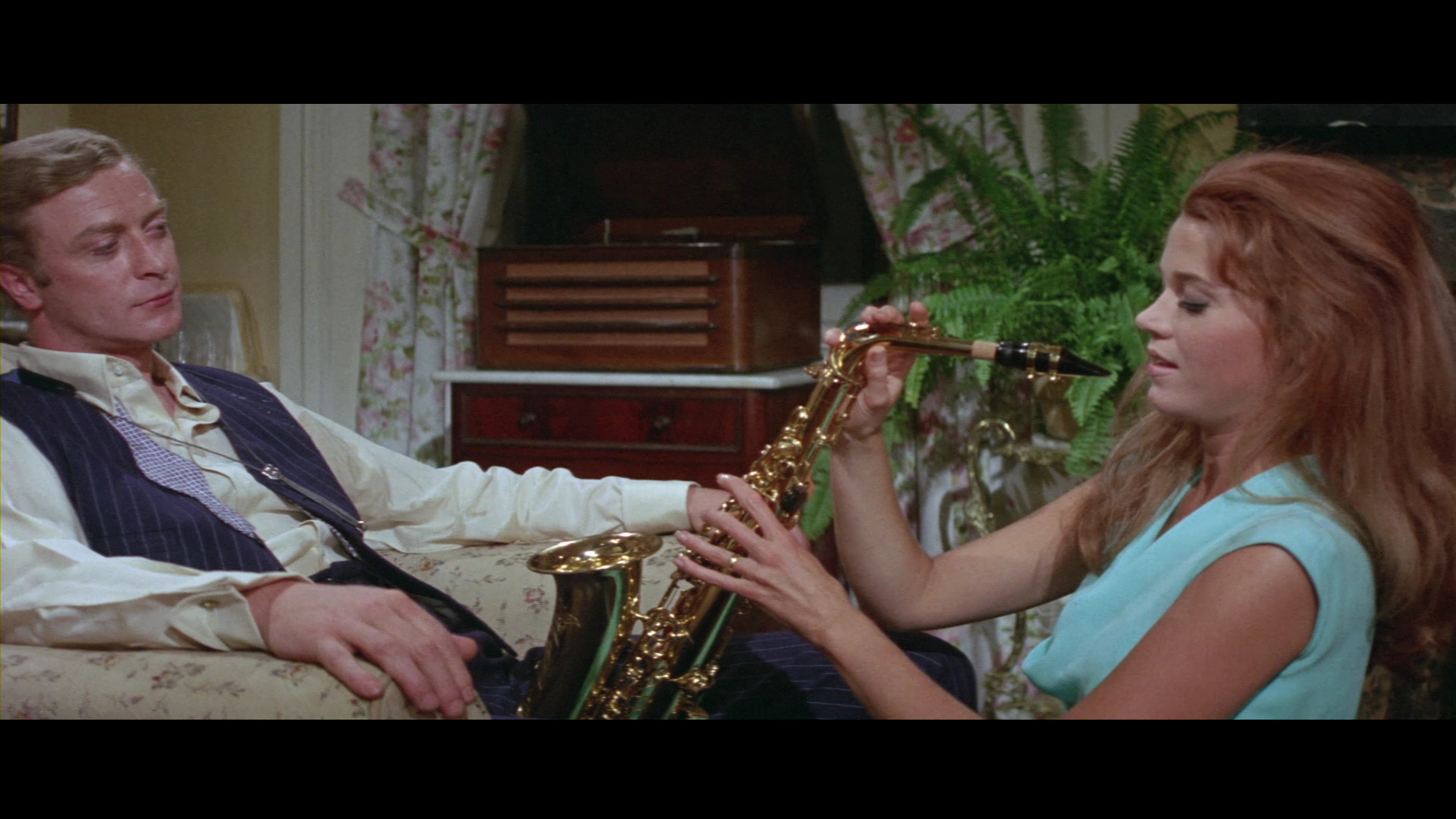
Then there’s Henry.  Henry is a businessman who dodged the draft, cheats on his wife, and who has a son who literally spends the entire movie screaming at the top of his lungs.  (Whenever that kid was on-screen, I imagined Preminger standing behind the camera and going, “More!  More!  Scream more!”)  Henry is also a racist, though for some reason he loves jazz and often plays the saxophone.  I kept waiting for someone in the movie to point out to him that jazz was created by black musicians but nobody did.  (If Henry had appeared in Anatomy of a Murder, someone would have.)

Did I mention that Henry is played by Michael Caine?  And did I also mention that Caine is the most cockney-sounding Southerner that I’ve ever heard?  Because he totally is.

Henry’s wife is named Julie and is played by Jane Fonda.  At one point, she suggestively blows on Henry’s saxophone.  One can only imagine how audiences in the 60s reacted to that.  (Actually, they probably didn’t.  They probably just said, “Good thing she’s pretty because she ain’t no musician…”)

Michael Caine and Jane FondaAnyway, Harry wants to buy up some farmland but half of that land is owned by Henry’s poor cousin Rad (John Phillip Law) and Rad doesn’t want to move.  Rad has just returned from fighting in the war and he views Harry as being a cowardly draft dodger.  Rad is married to Lou (Faye Dunaway) and wow, are they ever a boring couple!  Dunaway was under a five-picture contract to Preminger when she made this film and apparently, she had such a terrible time on the set of Hurry Sundown that she sued to get out of ever having to make another movie with Otto.  Dunaway’s misery comes through in every scene.

The other half of the farmland is owned by Reeve (Robert Hooks), a black farmer whose mother (played by Beah Richards) is Julie’s former mammy.  Julie goes down to the farmhouse to convince Reeve to sell and Reeve’s mother responds by having the most (over)dramatic heart attack in the history of cinema.  Saddened by death of his mother, Reeve is definitely not going to sell.  When he’s not chastely romancing the local teacher (played by Diahann Carroll, who appears to have wandered over from a different, far more glamorous movie), Reeve is singing sprituals and working out in the fields.

One of the things that Reeve does not do — no matter how many times he gets called the n-word or is treated unfairly — is get mad.  Rad gets mad.  Julie gets mad.  A liberal white preacher (Frank Converse) gets mad.  But Reeve and the other black characters in the film are never really allowed to get mad or do anything that might make the film’s white audience feel nervous.  Watching a film like Hurry Sundown, you can understand why — in just a few more years — Blaxploitation films would suddenly become so popular.  It was probably the first time that black film characters were actually allowed to not only get angry over the way they were being treated but to fight back, as opposed to reacting in the Hurry Sundown-way of passive acceptance.

Anyway, Rad and Reeve come together to protect their land and Henry and the evil judge conspire to cheat them out of their land and — well, let’s just say that Hurry Sundown is one of those films that has a lot of plot and very little action.  Preminger directs with a stunning lack of pace or grace, the actors deal with a poorly written script by either engaging in histrionics or going catatonic, and Michael Caine’s attempt at a Southern accent will amuse anyone who has ever been south of the Mason-Dixon.

https://www.youtube.com/watch?v=GBkWLkQvoXA

I have to admit that I was really hoping that Hurry Sundown would turn out to be a sordid and tawdry little masterpiece, the type of overheated misfire that you love despite your better instincts.  But, no.  Hurry Sundown is just boring.  The film is such a misfire that it doesn’t even work as a piece of history.  The critics were right.  Hurry Sundown sucks.

Hurry_sundown_moviep


Horror On TV: Twilight Zone 2.23 “The Obsolete Man”


I know that some people will claim that The Obsolete Man really isn’t a horror story but consider this:  What’s more horrifying than a world without freedom of thought or expression?  The Obsolete Man takes place in a world where books have been banned.  As a result, librarian Romney Wordsworth (Burgess Meredith) has been determined to be obsolete and, hence, is now scheduled to be executed.  Wordsworth appears to have accepted his fate but, as the Chancellor (Fritz Weaver) discovers, Wordsworth is far more clever than he originally appears.

This episode of The Twilight Zone was written by Rod Serling and directed by Eliot Silverstein.  It was originally broadcast on June 2nd, 1961.

What Lisa Watched Last Night: Rocky (dir. by John G. Avildsen)


A few days ago, I set the DVR to record the 1976 Best Picture winner Rocky off of TCM.  Last night, I finally got a chance to sit down and actually watch it.

Why Was I Watching It?

I’ll be honest here and admit that I wasn’t watching it because I’ve ever had any great desire to see this movie or, for that matter, any other Sylvester Stallone film.  (Though, for the record, I thought the Expendables was vaguely entertaining.)  However, this being Oscar season, my mind right now is pretty much dominated by 1) a mental list of all 493 best picture nominees and 2) an obsessive need to see every single one of those films. 

And since we’re focusing on reviewing best picture nominees this month, I figured why not take this opportunity to watch Rocky.  After all, I thought, this is the film that managed to win best picture over Network, Taxi Driver, and All The President’s Men.  How bad can it be?

What’s It About?

So, there’s this guy named Rocky Balboa (Sylvester Stallone) and he’s got to be the nicest Mafia goon alive.  He spends his time collecting debts for the local loan shark (played by the Maniac himself, Joe Spinell) but he refuses to break anyone’s thumbs while doing so and even offers up helpful advice like, “Yo, you got to start thinking.”  Spinell’s all like, “Rocky, why aren’t you breaking anyone’s thumbs?” and Rocky says he doesn’t want to and Spinell’s all like, “That’s okay,” because oddly enough, Joe Spinell is the only guy in the Mafia who is nicer than Rocky.

Anyway. Rocky is also a boxer who fights “bums” (as his trainer Burgess Meredith is fond of bellowing) and who is sweetly courting Adrian (Talia Shire), a shy girl who works in the local pet store.  Adrian’s brother (played by Burt Young) is named Paul but since everyone in the film is Italian, he’s called “Paulie” instead.  (I can say this because I’m a fourth Italian and if your name is Paul, I’m going to call you “Paulie” whether you like it or not.) 

Anyway, there’s another boxer (played by Carl Weathers) and he’s named Apollo Creed.  Apollo is the champ because when you’ve got a name like Apollo Creed, you better be the best or else you’re just going to look silly.  For publicity reasons, Apollo gives the unknown Rocky the chance to fight him for the championship.  Apollo is expecting an easy fight but he hasn’t taken into consideration that Rocky is not only willing to run every morning but he’s willing to run up steps as well!

What Worked?

(WARNING: SPOILERS BELOW.)

The love story between Rocky and Adrian was kinda sweet, largely because Talia Shire and Sylvester Stallone both had a very genuine chemistry and Shire gave such a good performance that Stallone (who spends most of the film coming across like a parody of a method actor) gives a better performance when he’s sharing the screen with her.  I spent a lot of this movie rolling my eyes at just how shamelessly manipulative it was but I have to admit that the final scene — with Adrian going “I love you, Rocky,” and a bloody and kinda gross-looking Rocky replying with a heartfelt, “I love you!” — brought tears to my multi-colored eyes.

What Didn’t Work?

Rocky has got to be one of the most shamelessly manipulative films ever made.  Director John G. Avildsen (who won best director while Martin Scorsese wasn’t even nominated for Taxi Driver) pushed every obvious button and used every technique at his disposal to force the audience to root for Rocky.  Hence, we get the famous training montage set to soaring music and the subtle appeals to racism that are inherent in the portrayals of Apollo Creed and his entourage.  Admittedly, one reason that a lot of these scenes fell flat is because I’ve seen them duplicated in thousands of other sports films.  I know its possible that the reason I’ve seen them duplicated is because of Rocky’s success but still, it doesn’t make those scenes feel any less obvious and vaguely silly.

Do you know how sometimes you just watch a movie and you go, “There is absolutely nothing in this movie for me to relate to and I really should be watching the Real Housewives of Beverly Hills right now?”  Well, my reaction to Rocky wasn’t that extreme but it was pretty close.  I watched this film — which I’ve seen described as one of the most emotional films ever made — feeling oddly detached from everything I was seeing on-screen, my attention only being held by a clinical fascination concerning just how shamelessly manipulative this film was.  Try as I might, I simply could not get emotionally invested in what I was watching.  Some of that, undoubtedly, has to do with the fact that I’m not into sports films in general.  However, I think most of it comes down to the fact that I have a vagina and, quite frankly, the appeal of Sylvester Stallone is lost on me.

Speaking of the appeal of Sylvester Stallone…

“Oh my God!  Just like me!” Moments:

None.  It’s rare that I say that because I can usually find a way to relate any movie I see to my life but Rocky was just too alien to me.

Lessons Learned:

Best is a subjective term.