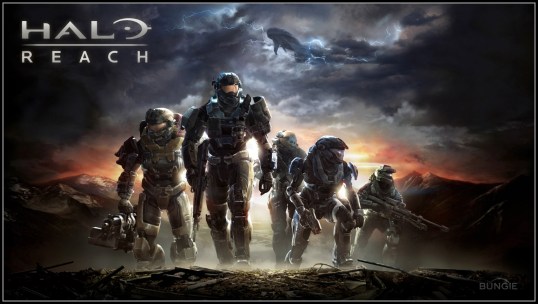
Sometimes, a full review isn’t terribly useful to people. Quantitative numbers on Halo: Reach from me aren’t particularly likely to sell more copies of the game. But I do think this game is worth discussing; it’s important, in a way. So here’s some thoughts, for which you are most welcome to join me.
Halo: Reach
I was only peripherally aware that Halo: Reach was launching. I mean, it wasn’t marketed, and it’s only a small-time game series… okay, no, of course, I was suffocated by the news. And I was as excited as any casual fan of the series. The problem is… I’ve never been a casual fan of the series. I’ve played thousands of games of Halo between Combat Evolved, Halo 2, and of course, Halo 3 (I only got Halo ODST because it was bundled for free with my new XBox Arcade), and that’s the telling point for me. By the time Halo: Reach came out, I wasn’t as excited for it as I should have been. I didn’t have it pre-ordered, I wasn’t enticed by the Legendary Edition (although I’m not much for collector’s editions of any kind). And the reason why is very simple, and it’s ultimately the most important thing that I can tell you about this game.
I already knew what to expect, and I wasn’t as excited as I used to be. Were you?
By now, Halo fans know exactly what to expect. The game is based around the balanced trinity of grenades, guns, and melee attacks. It is not a cover or tactical shooter, but rather a fast-paced action shooter with players protected by regenerating energy shields. In most ways, the popular multi-player shooter was defined by Halo: Combat Evolved. The graphics are an improvement, the features have expanded, and this is the biggest and best game that we’ve yet seen in the Halo universe. Bungie is run by very intelligent people; the fans don’t want the wheel to be re-invented. They want a new release that fixes perceived problems with previous titles, hands over a whole new slew of maps, re-imagines some of the weapons while leaving other fan favourites in place, and adds a couple toys that we haven’t seen before. In a lot of ways, Halo: Reach is like Madden 11. If you change too much, then you’re not playing Halo anymore, and then what’s the point? Bungie themselves obviously understand this; to go in a new creative direction, they must create a new series.
So what’s my bottom line with Reach?
Well, like all of the Halo titles, it has a surprisingly meaty single player experience. I know that people look at you funny if you even mention the story of Halo: Combat Evolved, but there’s more there than you might expect. It’s at least as elaborate as the story in any Call of Duty title. And the storytelling is done partially through the environments we travel through. Bungie has done a consistently good job of creating beautiful environments scored by epic music. The locations and places are familiar, and yet somehow very alien. It’s an excellent narrative when you bring everything together, complete even with single moments that make you get the tingles. For my money, Halo 2 was the weakest single player campaign, but the story bridged between the set-up in Combat Evolved and the conclusion of Master Chief’s story in Halo 3.
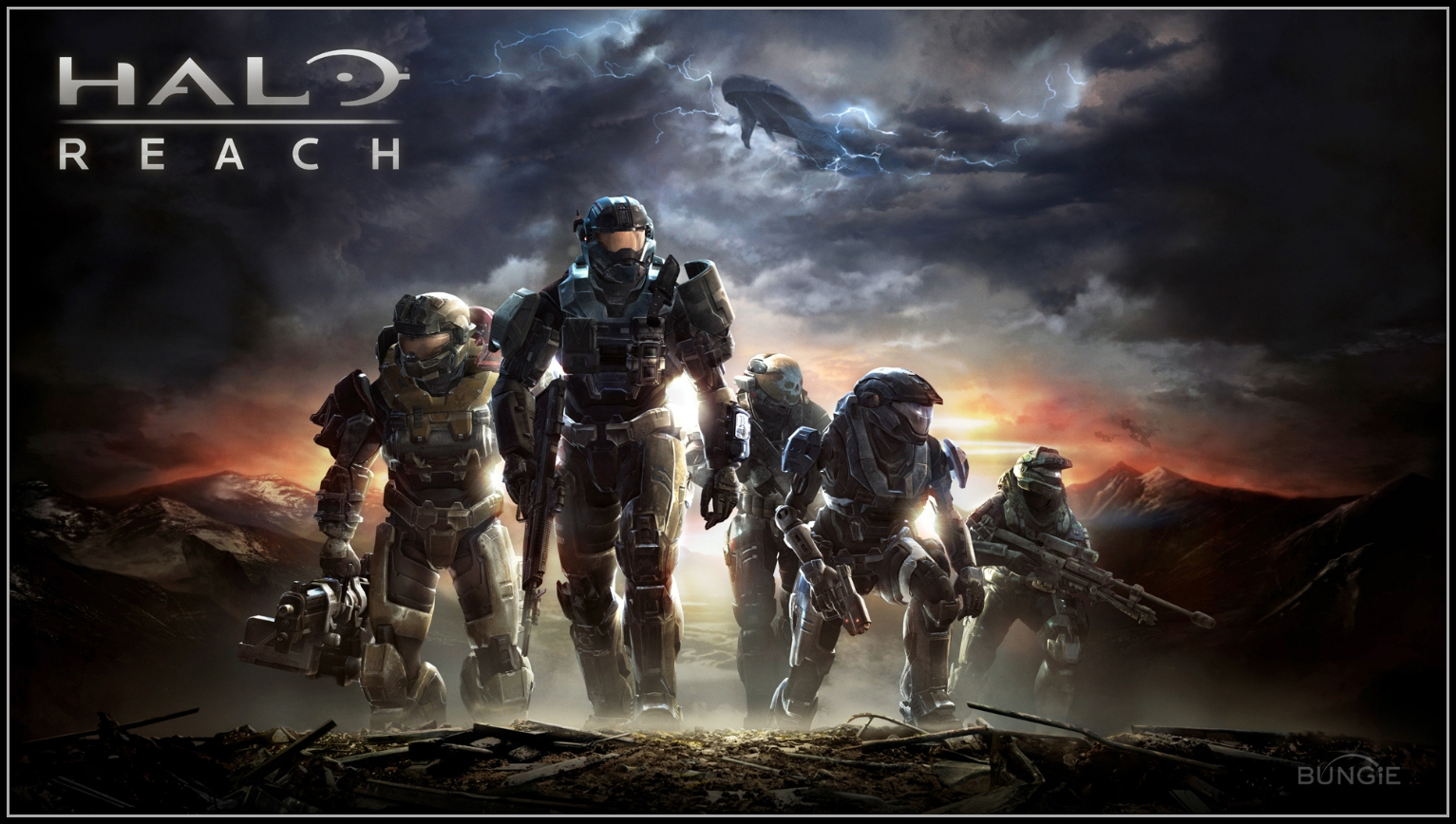
ODST took things to another level, adding more characters to the dynamic. We saw real interaction between characters, even if the player’s character, the rookie, is the typical “strong, silent type”. Reach, I think wisely, took its cues from ODST. We’re treated to an entire cast of powerful Spartan soldiers in their powered armor, with disparate personalities and motivations that make them interesting to us. But Reach also taps into something that we haven’t seen before in the Halo universe. Reach is a prequel. It’s a historical event in the universe, and we already know how things turn out. Disastrously. So woven into the narrative of Reach is a sense of despair. The Covenant is overwhelming. Each move the Spartans make seems like it could be the tipping point, but we’re always knocked back down by the inevitability of it all. It’s rather sad.
Now, from a gameplay standpoint, I had my problems with Reach‘s single player mode. I thought it went on ages too long (although, for me, it seems that I just don’t love Halo the way I used to) and grew tedious. But the narrative quality of the single player was good; far and away better than contemporary rivals like Call of Duty: Black Ops. It took a little time for me to digest the experience, but in the end, I thought that Halo: Reach was definitely worth playing, and makes a fantastic capstone to a series that has really been revolutionary in terms of a genre that is now one of the biggest around.
Oh, and the multi-player is good. I didn’t focus on it here, though, because as I said in the open, it is exactly what you expect. There are new wrinkles – and they’re good ones! – but all it boils down to is this: Do you still love Halo? Then play on!
 Through the Shattered Lens