Sixteen year-old Jimmy Mulligan (Tucker Albrizzi) is a nice kid with a big problem. His high school is ruled by a gang led by a bully named Miles (Jack DiFalco) and the overweight and quiet Jimmy has become the gang’s number one target.
Miles has decided that Jimmy owes him a hundred dollars. Even though Jimmy has never borrowed any money from Miles and is obviously not from a family that would have a hundred dollars to just toss around, Miles insists that Jimmy is in his debt. When Jimmy refuses to pay, Miles beats the poor kid while he’s walking home from school. However, the beating is observed by a retired boxer named Clarence “Action” Jackson (Ron Canada). Action runs off Miles and then he makes Jimmy an offer. He’ll help Jimmy learn how to box as long as Jimmy agrees to only use his skills for self-defense. At first Jimmy and his parents are reluctant but, after he gets beaten up for a second time, it’s time to go to Manny’s Gym!
Manny (Danny Trejo!), who is a legendary trainer, takes Jimmy under his wing and teaches him how to throw a punch and avoid a jab. Soon, Jimmy is losing weight, gaining confidence, and even going out on a date with a supercool goth girl named Adrian (Elanna White). But Miles still wants his money and eventually, Jimmy is going to have to put his training to use.
In many ways, Bully is every bullied kid’s dream. Not only does Jimmy learn how to throw a punch and get a girlfriend but he also gets to hang out with Danny Trejo! Manny is a tough but funny guy with a rough past but a good heart and he is using his skills to try to make the world a better place. The same can be said for Danny Trejo himself, so he’s the perfect choice to play Manny. Ron Canada is also good as Action Jackson, bringing a lot of quiet dignity to the part. Tucker Albrizzi does a good job of going from being insecure to being confident.
It’s just too bad that the film itself isn’t better. Bully has good intentions but the execution is lacking. The movie kept suggesting that there would be a scene where Jimmy had to chose between using his new skills for revenge or just for self-defense but it never happened. There were too many scenes that did not seem to go anywhere and, for all of the build-up, the final fight between Jimmy and Miles was anti-climatic and confusingly filmed. During the final 15 minutes, several new characters show up and suddenly become central to the story. Somehow, the Mafia finds out about the fight and takes an interest in whether or not Jimmy is going to be able to beat up Miles. On the one hand, it’s cool because Vincent Pastore is one of the gangsters but on the other hand, what’s going on? Why are they there?
Danny Trejo’s cool, though. That counts for a lot.
There was a lot of Oscar-related news yesterday. Along with the NYFCC giving their best picture award to Zero Dark Thirty, the Academy’s Documentary branch announced this year’s 15 sem-finalists for the Best Feature Length Documentary Oscar. From this list, the final five nominees will be selected.
Needless to say, I was happy to see that my favorite documentary of 2012, Ai Weiwei: Never Sorry, made the shortlist.
At the same time, I’m also disappointed that the great ballet documentary First Position was snubbed.
And, finally even though I knew it wouldn’t have been nominated and I’m not saying that it should have been, wouldn’t it have been fun to watch the online critical establishment descend into mass hysteria if 2016: Obama’s America had somehow appeared on the list of semi-finalists?
While I try to review just about every film I see, there are times when I don’t get to review a film as soon as I would like. Fortunately, in this age of Netflix, DVDs, and Blu-ray, it’s never too late to review a film! I saw the following four films earlier this year. These reviews are a little late but here they are.
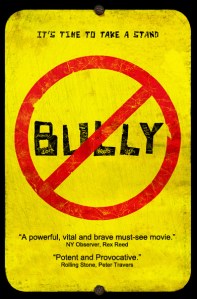
1) Bully (directed by Lee Hirsch)
This documentary, which follows and tells the story of several bullied teenagers over the course of one year, has the best of intentions and it’s definitely effective as far as making you dislike bullies and feel sorry for their victims. That said, did anyone really like bullies before this film was released?
Bully got a lot of attention when it was released earlier this year and a lot of people (who should have known better) said that the film itself was a solution to the problem of bullying. I doubt that this film (or anything else, for that matter) will solve the issue of bullying but it is a well-made look at what kids do whenever adults aren’t watching (and, sad to say, sometimes when they are).
One problem I did have with this film is that it chooses to limit itself to schools in small towns and rural communities, which gives the whole enterprise something of an elitist feel. Are there no bullies up north?
2) For Greater Glory (directed by Dean Wright)
For Greater Glory is a dramatization of the bizarrely obscure period of Mexican history known as the Cristero War. In 1920s, Mexican President Plutarco Elias Calles (played in this film by Ruben Blades) started a violent and relentless crackdown on the country’s Catholic faithful. Churches were burned, priests and nuns were murdered by supporters of the government, and eventually Catholic peasants rose up in violent rebellion. The Cristero War lasted from 1926 until 1929, eventually ending with a truce that was brokered by the U.S. Ambassador to Mexico, Dwight Morrow (played by Bruce Greenwood).
For Greater Glory set box office records in Mexico but it received some pretty negative reviews from American film critics. To a certain extent, the negative reviews are not surprising. The film is long, frequently heavy-handed and melodramatic and it’s also unapologetically pro-Catholic in its storytelling. (Roger Ebert, who never seems to get tired of apologizing for having been born into a Catholic family, was especially critical of that aspect of the film.)
With all that in mind, I still enjoyed For Greater Glory. It’s a well-made and ultimately rather moving film (though I imagine some parts of the film might be a bit confusing if you don’t have at least a little bit of a Catholic background) and it features excellent performances from Andy Garcia and Oscar Isaac as two of the rebel leaders. In many ways, For Greater Glory feels like a throwback to the epic films of the past and that’s not necessarily a bad thing.
3) Sound of My Voice (directed by Zat Batmanglij)
Like last year’s Another Earth, Sound of My Voice is a science fiction film that stars and was co-written by Brit Marling. The difference between the two is that Another Earth was a pretentious mess while Sound of My Voice is an effectively creepy little film that puts story and atmosphere above trite pronouncements about the state of existence.
Brit Marling plays a mysterious woman who claims to have been sent from the future. She has a devoted cult of followers who spend their nights sitting on the floor around her, listening to her talk about the horrors waiting for them in the future. Two journalists go undercover and infiltrate her cult, hoping to expose her as a fraud.
Sound Of My Voice keeps the viewer guessing as to whether or not Marling is who she says she is and the film’s ending, while not a total surprise, is still effective enough to inspire debate after the end credits roll. As opposed to Another Earth, Marling gives an actual performance here and is both creepy and sympathetic at the same time.
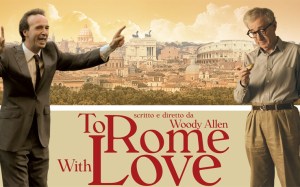
4) To Rome With Love (directed by Woody Allen)
Woody Allen’s follow-up to Midnight in Paris, To Rome With Love tells four separate stories that all take place in Rome. Despite the fact that the cast features everyone from Alec Baldwin to Roberto Begnini to Penelope Cruz to Ellen Page, the true star of the film is the city of Rome. I spent the summer after I graduated high school in Italy and this film brought back a lot of good memories.
Unfortunately, the film’s four stories are pretty uneven and the film’s frequent transitions from story to story are pretty awkward. The worst story features Alec Baldwin meeting his younger self (played by Jesse Eisenberg) and trying to prevent him from falling in love with a neurotic actress (Ellen Page). The film’s best story is a satiric fable about an ordinary man (played, in an excellent performance, by Roberto Begnini) who wakes up one day to discover that he’s the most famous man in Italy.
The film doesn’t really work but I still loved to getting to see Rome once again.
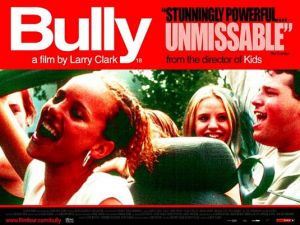
Bullying has been in the news a lot lately. The fact that some people are bullies is hardly a new development, it’s just that now people are actually paying attention to the possible consequences of cruelty. Tragically, it appears it takes people killing themselves for the rest of the world to consider that “Hey, maybe concentrated, socially accepted sadism isn’t a harmless thing.” With so many people finally admitting what they had to have known was true all along, now seems like a good time to reconsider Larry Clark’s controversial and much-maligned 2001 film, Bully.
I can still remember the night, five years ago, that I first saw Bully. I was at a party with a group of friends. Nine of us ended up in a random bedroom, drinking, smoking, and going through all the closets and dressers. I might add, we found some very interesting things while searching. Anyway, someone eventually turned on the TV and there was Bully, playing on one of the movie stations. Since we knew Bully was supposed to be a very explicit, very controversial movie, we left the TV playing and hung out in a stranger’s bedroom for two more hours. There was, obviously, a lot going on in that room and I have to admit that I only paid attention to bits and pieces of the movie. But what I saw stuck with me enough that the next chance I got, I bought the movie on DVD so I could actually devote my full attention to it. In the years since, Bully is not a film that I revisit frequently because, to be honest, it’s the type of movie that makes you take a shower after watching it. It’s also an unusually powerful and disturbing film that sticks with you for a long time after it ends. It’s not a film that I would recommend anyone watch a hundred times. But it’s definitely worth viewing at least once (or maybe even four times if you’re like me).
The bully of the title is 20 year-old Bobby Kent (played by Nick Stahl). Bobby’s “best friend” is passive, blank-faced Marty Puccio (Brad Renfro). Despite being physically stronger, Marty allows himself to be totally dominated by Bobby. Marty accepts Bobby’s constant insults and physical abuse with the meek acceptance of a battered spouse. Bobby, who is on the verge of starting college and presumably making a life for himself that high school dropout Marty could never dream of, even forces Marty to moonlight as a male stripper and to take part in making cheap, gay-themed porn videos. (Bobby insists that he’s not gay himself and, like most guys in denial, goes out of his way to act as much like an insensitive asshole as possible as if to scream to the world, “I’m straight!” despite all the evidence to the contrary.)
As the film begins, Ali (Bijou Philips) and her friend Lisa Marie Connelly (Rachel Miner) step into sandwich shop where both Bobby and Marty work. (Bobby, of course, is the boss.) Apparently, they are appropriately impressed by the sight of Bobby slamming Marty’s head against a refrigerator because soon, all four of them are going out on a double date. While Ali’s content to just give Bobby a blow job, the far more insecure Lisa decides that Marty is the love of her life and starts a relationship with him that the ever-passive Marty simple accepts. However, what Lisa has failed to take into account, is that Marty is already in a relationship and Bobby isn’t ready to just let go. Bobby expresses this by walking in on Marty and Lisa while they’re having sex, beating Marty up, and then (unlike everything else in this movie, this is never explicitly shown) raping Lisa. After this, Lisa discovers that she’s pregnant but she doesn’t know if the baby’s father is the man she claims to love or the man who raped her.
(One thing that surprised me, that night I first watched Bully out of the corner of my eye while me and my friends searched through a stranger’s lingerie, was just how little sympathy most of my friends had for Lisa. While I wasn’t surprised that the majority of guys in the room seemed to feel that Lisa was somehow to blame for disrupting all that precious male bonding, it was the reaction of some of the other girls that truly caught my off guard. While none of them went as far as to say that Lisa deserved to be raped by Bobby, quite a few of them took the attitude that she either brought it on herself or she was lying. Unlike the boys, these girls also felt the need to make several snide remarks about Rachel Miner’s physical appearance. At the time, their attitude really bothered me and I have to admit that I wasn’t as close to any of them afterward.)
(Of course, we Lisa Maries have to stick together…)
Despite having raped his girlfriend, Bobby still considers himself to be Marty’s best friend and Marty — again like an addicted spouse — proves himself to be incapable to simply cut off all ties with Bobby even as the abuse gets worse and Bobby grows increasingly unstable. In one of the film’s more controversial scenes, Bobby and Ali are about to have sex when Bobby decides that the only thing the scene is missing is a gay porn video playing in the background. Ali finds the idea to be disgusting and insinuates that Bobby must be gay. Bobby responds by raping Ali.
Finally, Lisa tells Marty and Ali that they have little choice but to murder Bobby. While this starts out as a somewhat innocent suggestion of the “I wish he was dead,” kind, Lisa soon begins to insist that Bobby must die. Ali recruits her friend Heather (Kelli Garner) and an ex-boyfriend named Donny (a truly scary Michael Pitt) into the conspiracy. (Heather and Donny both agree that Bobby must die though neither one has ever met him.) Lisa, meanwhile, brings in her cousin, video-game geek Derek. Finally, and most fatefully, they decide to get some pointers from the neighborhood hitman (Leo Fitzpatrick).
That’s right. The neighborhood hitman. He’s actually a pretty familiar figure in the suburbs. He’s the 17 year-old white boy who tries to stare out at the world with hateful eyes. He brags to you about how he’s a member of a gang. He tries to rap and speaks in dialogue lifted from Grand Theft Auto. In short, he’s the guy that everyone laughs at whenever he’s not around. His lies should be obvious to anyone with a brain which is exactly why Lisa, Marty, and Ali all assume that he’s an actual hitman. The Hitman agrees to direct their murder and help them kill a person who (like almost everyone else now involved in the conspiracy) he has never actually met.
It all climaxes in one of the most disturbingly graphic and harrowing murder scenes I’ve ever seen, one that manages to snap the audience back into reality after the (needed) comic relief of Fitzpatrick’s absurd wannabe gangster. As he’s repeatedly attacked by this group of made up of bumbling strangers and his “best” friend, Bobby proves himself to be not quite as powerful a figure as everyone had assumed. Instead, he’s revealed as a pathetic, frightened teenager who begs Marty to forgive him (for “whatever I did”) even as Marty savagely stabs him to death.
Unlike the standard rape-revenge flick (and have no doubt, that’s what Bully essentially is), the film’s climatic act of violence doesn’t provide any sort of satisfaction or wish-fulfillment empowerment. Instead, it just sets up the chain of events that leads to the film’s inevitable and disturbing conclusion.
When it first came out, Bully was controversial because of its explicit sex and violence. As a director, Clark employs his customary documentary approach while, at the same time, allowing his camera to frequently linger over the frequently naked bodies of his cast. More than one reviewer has referred to Clark as “a dirty old man” while reviewing this film. (More on that in a minute.) What those critics often seem to fail to notice is that, as explicit as the movie is, some of the most powerful and disturbing elements (like Bobby’s repressed homosexuality) are never explicitly stated.
After seeing this movie a few more times, the thing that gets me is that — in the end — the film’s nominal villains — Bobby and Lisa — are also the only two compelling characters in the entire movie. While all the other characters are essentially passive, Bobby and Lisa are the only ones actually capable of instigating any type of action. As such, they become — almost by default — the heroes of the movie. On repeat viewings, it’s apparent that Bobby and Lisa are really two sides of the same coin. The film’s title could refer to either one of them. They are both insecure, unhappy with who they are, and both of them seem to find a personal redemption by dominating Marty. One of the great ironies of the film is that Bobby and Lisa are essentially fighting a war for the soul of a guy who is eventually revealed to be empty inside. For his part, Marty simply shifts his “forbidden” relationship with Bobby over to Lisa, a relationship that is just as exploitive and destructive as his friendship with Bobby but which is also more socially acceptable because it’s so heterosexual in nature that he’s even knocked up his girlfriend. When Marty finally does kill Bobby, he’s not only killing a bully but he’s attempting to kill of his own doubts about his sexual identity. It’s his way of letting the world know that he’s a “real” man. As for the other characters — Ali, Donny, Heather, and even the swaggering hitman — they are all defined by their utter shallowness. While its clear that none of them are murderous on their own, it also becomes clear that none of them have enough of an individual identity to resist the Bobbys and Lisas of the world.
Despite playing shallow characters, nobody in the cast gives a shallow performance. Down to the smallest role, the actors are all believable in their roles. Whether it’s Michael Pitt’s blank-faced aggression or Leo Fitzpatrick’s comedic swagger, all of the actors inhabit these characters and give performances that are disturbingly authentic. The late Brad Renfro gave one of his best performances as Marty, just hinting at the anger boiling below the abused surface. However, the film belongs to Miner and Stahl. Stahl displays a sordid charm that makes his character likable if never sympathetic while Miner manages to do something even more difficult. She makes Lisa into a character who is sympathetic yet never quite likable. When Bully first came out, critics spent so much time fixating on the fact that Miner’s frequently naked on the film that they forgot to mention that she also proves herself to be an excellent actress.
As I stated, Bully is not a universally beloved film. Most of the reviews out there are negative with a few of the more self-righteous critics accusing the film of being “pornographic” as if the whole thing was filled with close-up money shots of Brad Renfro ejaculating on Rachel Miner’s ass. Strangely enough, you can find hundreds of critics complaining that Clark filmed full frontal nudity but next to none complaining that Clark filmed a brutal and realistic murder scene.
The two most frequent criticisms of Bully are that 1) it plays fast and loose with the true story that it’s based on and 2) that the film is exploitive.
Both criticisms are valid but the first one is the only one that would really bother me. I have to admit that I don’t really know much about the real life murder of Bobby Kent. I just know the version presented in this movie and in the Jim Schultze book that the movie was based on. Of course, everyone arrested and convicted for Kent’s murder has been quick to claim that the movie makes them look more guilty than they actually are. That’s to be expected. However, the main difference between the film and the reality — for me — was that, in reality, victim Bobby Kent did not look a thing like Nick Stahl. Whereas Stahl is clearly no physical match for any of the characters in the film (and hence, it’s easier to feel sorry for him when everyone attacks him at once), pictures of the real-life Bobby Kent reveal an intimidating, muscular, young man who few people would probably ever chose to mess with. Stahl’s Bobby is a bully because everyone else in the film is too passive to stand up to him. The real Bobby could probably get away with being a bully because he literally looked like he could rip another man’s arm off.
The other criticism is that this movie — with its combination of tits and blood — is essentially just an “exploitation” film. Well, it is. But as I’ve explained elsewhere, just because a film is exploitive, that doesn’t mean that it’s not a good movie. Art and exploitation, more often than not, are clandestine lovers and not bitter enemies. Yes, all of the characters — male and female — do spend a good deal of time showing off their bodies but then again, what else would these otherwise empty characters do? Their surface appearance is really all they have. Yes, the camera does linger over all the exposed flesh but then again, so do most people. If anything, critics attempted to punish Clark for openly acknowledging that majority of his audience is waiting to either see Bijou Phillips’ twat or Nick Stahl’s dick. Yes, Bully is exploitation but it’s exploitation in the best grindhouse tradition. It’s a film that’s honest specifically because it is so sordid and exploitive.
When all is said and done, Bully is the epitome of a movie that is too sordid to ever be corrupted.
 Sixteen year-old Jimmy Mulligan (Tucker Albrizzi) is a nice kid with a big problem. His high school is ruled by a gang led by a bully named Miles (Jack DiFalco) and the overweight and quiet Jimmy has become the gang’s number one target.






 Through the Shattered Lens