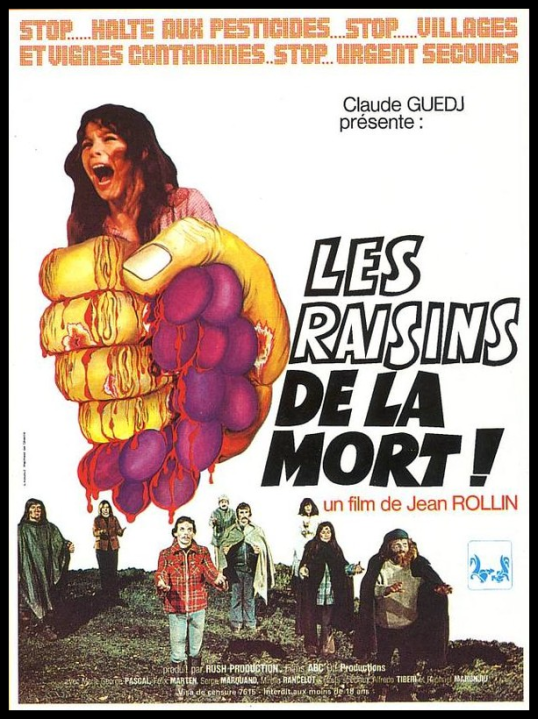
Horror Film Review: The Grapes of Death (dir by Jean Rollin)


1978’s The Grapes of Death is a zombie film that moves at a relentless place, combining effective body horror with an ominous atmosphere that leaves you feeling as if anyone could be the next victim of the zombie horde.

At a vineyard, a worker complains about the new pesticides that are being used and is told, by his smug manager, not to worry so much.  Later, when that worker stumbles aboard a train, his face is pulsing with hideous ulcers.  He kills one woman and chases another, Elizabeth (Marie-Georges Pascal), off the train.  Elizabeth, who is just trying to visit her boyfriend in a nearby village, makes her way across the French countryside, meeting men and women who have been infected by something and who are now going mad.  They may not technically be the undead but, with their nonstop pursuit and their obsession with killing everyone that they come across, they are definitely zombies.

The Grapes of Death is also one of the most French films ever made.  In this film, the zombies are not the creation of a voodoo curse or outer space radiation or even there no longer being room in Hell.  (In fact, it becomes fairly obvious that The Grapes of Death takes place in a world in which there is no Heaven or Hell.)  Instead, this film features people who are transformed into zombies because they drank contaminated wine at an annual festival.  When Elizabeth does eventually meet two men who have not been turned into zombies, they are both revealed to be beer drinkers.  One could actually argue that, despite the film’s grim atmosphere and all of the violence committed and the blood shed and the philosophical discussions that occur, The Grapes of Death is ultimately a satire of French culture.  Only in France could a bad crop of wine lead to the zombie apocalypse.

The Grapes of Death was one of the more commercially successful films to be directed by the great Jean Rollin.  Rollin is best-known for his surreal and dream-like vampire films.  In an interview, he stated that The Grapes of Death was his attempt to make a commercial horror film and that, when he was writing the script, he closely studied the structure of Night of the Living Dead.  While the film does have its similarities to Romero’s classic zombie film, The Grapes of Death is still definitely the work of Jean Rollin.  The lingering shots of the fog-shrouded French countryside and the ancient French villages, with blood staining the cobblestone streets, could have come from any of Rollin’s vampire films.  The film also uses the same serial structure that Rollin used in many of his film, with Elizabeth going from one adventure to another and almost always managing to narrowly escape danger.  Elizabeth goes from fleeing the infected man on the train to finding herself a near prisoner in an isolated house to protecting a blind girl (Mirella Rancelot) for her crazed boyfriend to being menaced by the mysterious Blonde Woman (played by frequent Rollin collaborator Brigitte Lahaie).  There’s a new cliffhanger every fifteen minutes or so.

(Rollin said that he originally envisioned contaminated tobacco as being the cause of the zombie outbreak but he ultimately went with wine instead.  Not everyone smokes but, in France, just about everyone drinks wine.)

First released as Les raisins de la mort, The Grapes of Death has been described as being “France’s first zombie film.”  I don’t know if it was the first but it’s certainly one of the best, a relentless chase through the French countryside that ends on a proper note of downbeat horror.  This film made me happy that I’m not a wine drinker.
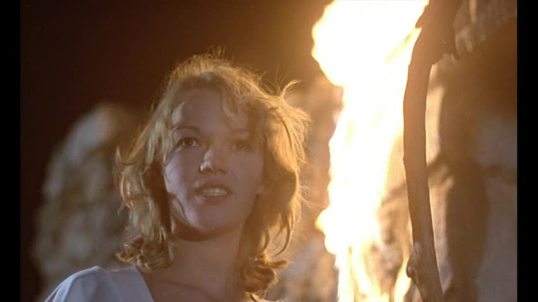
(Be sure to read Arleigh’s thoughts here!)

International Horror Review: The Two Orphan Vampires (dir by Jean Rollin)


Louise (Alexandra Pic) and Henriette (Isabelle Teboul) are two orphaned sisters.  They’re both blind and, as the nuns at the orphanage explains to Dr. Dennary (Bernard Charnacé), innocent to the ways of the world.  When Dr. Dennary adopts them, everyone tells him that he’s made the right choice.  Never have there been two sisters as sweet and beatific as Louise and Henriette.

Of course, what neither the nuns nor Dr. Dennary know is that, when the sun goes down, Louise and Henriette’s vision returns.  They sneak out of Dennary’s home, exploring the nearby cemeteries and meeting other beings who can only move freely during the night.  The sisters tells each other stories of their past and we see memories that seem to suggest that they have been alive for centuries.  But, the sisters also often talk about how they can’t remember their past and it’s suggested that their “memories” are just stories that they’ve created to give themselves a history that they don’t otherwise possess.

At times, you wonder if they’re even sisters.  Perhaps they’re just two vampires who manged to find each other at some point over the past few centuries.  Still, you can never doubt the strength of their bond.  When one of them is weak from a lack of blood, the other allows her to drink from her neck.  When they find themselves being pursued by angry villagers, they refuse to be separated.  Even if it means dying, at least they’ll die together.

Throughout the film, the orphans eagerly await for night to fall so that they can see and sneak out of the house.  But, at the same time, they know that their time is limited.  When the sun rises, they will again lose their sight.  These vampires don’t need to sleep in coffins.  In fact, they don’t need to sleep at all.  But they need the night to see the world around them.

Unfortunately, Dr. Dennary may be kind-hearted but he’s still not happy about the idea of the two orphans sneaking out of his house during the night.  When the sisters go to drastic means to ensure their freedom, they find themselves in even greater danger….

First released in 1997, The Two Orphan Vampires is perhaps my favorite Jean Rollin film.  Rollin, himself, once described it was being one of his best films because it was a film that told a story that went beyond his own personal obsessions.  That may be true but this is definitely a Jean Rollin film.  It’s not just the use of the vampirism or the fact that frequent Rollin co-star Brigitte Lahaie has a cameo.  It’s that the film centers not just on the supernatural but also the way that our memories and our fantasies can provide comfort in an uncertain world, which was a favorite Rollin theme.  Whether their memories are true or not is not important.  What’s important is that the two sisters share them.

In typical Rollin fashion, the movie unfolds at its own deceptively leisurely pace.  The imagery is frequently dream-like, with the orphan vampires discovering an underworld of paranormal creatures.  The film also reflect Rollin’s love of the old serials, with frequent cliffhangers.  By the final third of the movie, you can already guess what’s going to end up happening to the two orphan vampires but I still had tears in my eyes by the time the end credits started to roll up the screen.

For whatever reason, Two Orphan Vampires seems to get a mixed reaction from several Rollin fans, who perhaps are disappointed that it’s considerably less bloody and/or sordid as some of Rollin’s other vampire films.  The film is one of Rollin’s more contemplative films and it has more in common with The Night of the Hunted and The Iron Rose than some of Rollin’s other vampire films.  That said, Two Orphan Vampires is my personal favorite of Rollin’s filmography.  It’s a film that bring me to tears every time that I watch it.


The TSL’s Daily Horror Grindhouse: Faceless (dir by Jess Franco)


FacelessPoster1988

Whenever it comes time to review a film like 1988’s Faceless, movie bloggers like me are faced with a very important question.  Which name should we use for this film’s prolific director?  The director was born Jesus Franco Manera and, for a very small handful of his 200+ film, he’s actually credited by his full name.  However, for the majority of his films, he dropped the Manera.  Sometimes, he is credited as Jesus Franco and then other times, the director’s credit reads Jesse Franco or just simply Jess Franco.

Myself, I usually prefer to go with “Jess Franco,” because it just seems to go with his “never give up” style of filmmaking.  At the same time, it seems rather appropriate that Franco is known by more than one name because he was a director with a many different personas, occasionally a serious artist, occasionally a subversive prankster, and sometimes a director-for-hire.  Franco was a lover of jazz and his films often had a similarly improvised feel.  Sometimes, the results were, to put it lightly, not very memorable.  But, for every Oasis of the Zombies, there was always a chance that Franco would give the world a film like Female Vampire.  The imdb credits Franco with directing 203 films before his death in 2013 but it’s generally agreed that he probably directed a lot more.  A lot of his films may not have worked but the ones that did are memorable enough to justify searching for them.

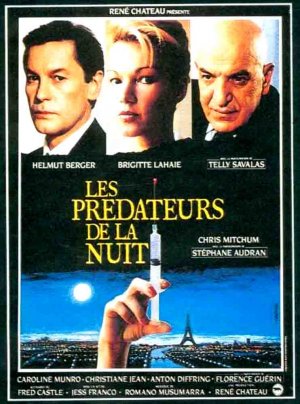
Faceless is Franco’s take on Eyes Without A Face, as well as being something of a descendant of his first film, The Awful Dr. Orloff.  All three of these films deal with a doctor trying to repair a loved one’s disfigured face.  In Faceless, the doctor is Dr. Flammad (Helmut Berger), a wealthy and decadent Paris-based plastic surgeon.  One night, while out with his sister Ingird (Christiane Jean) and his nurse and lover Nathalie (Brigitte Lahaie, the former pornographic actress who appeared in several of Jean Rollin’s best films, including the brilliant Night of the Hunted), Dr. Flammad is confronted by a former patient.  Flammad botched her operation so the patient tries to get back at him by tossing acid in his face.  However, Ingrid shoves Flammad out of the way and ends up getting splashed by the acid instead.

Now disfigured, Ingrid spends her time hidden away in Flammad’s clinic and wearing a mask.  Flammad and Nathalie start to kidnap models and actresses, searching for a perfect face.  Flammad’s plan is to perform a face transplant, giving Ingrid a new and beautiful face.

Needless to say, a face transplant is not a simple thing to do.  In order to get some advice, they go to the mysterious Dr. Orloff (Howard Vernon) and Orloff directs them to a Nazi war criminal named Dr. Moser (Anton Diffring).  Now, if you’re not familiar with Franco’s work, the scene with Dr. Orloff will probably seem like pointless filler.  However, if you are a Francophile, you will feel incredibly relieved to see Howard Vernon suddenly pop up.  When it comes Franco’s films, a Howard Vernon cameo is usually a good sign.

Flammad’s search for the perfect face is complicated by the fact that his assistant, the moronic Gordon (Gerard Zalcberg), keeps accidentally killing and otherwise damaging all of the prospects.  As the bodies continue to pile up, Nathalie even points out that there’s “too many dead bodies” in the clinic.

(Of course, Nathalie isn’t doing much to solve that problem.  When the film got to the moment where Nathalie plunged a syringe into one troublesome patient’s eye, I ended up watching the movie between my fingers.)

Eventually, Nathalie kidnaps a coke-addicted model named Barbara (Caroline Munro).  Flammad thinks that Barbara might finally be the perfect face that they’ve been looking for but there’s a problem.  (Actually, two problems if you count Gordon…)  Barbara’s father (Telly Savalas) is a wealthy industrialist and he wants his daughter back.  He hires an American private investigator, Sam Morgan (Chris Mitchum, looking a lot like his father Robert), to track her down.

Actually, it’s not that much of a problem.  It quickly turns out that Sam is kind of an idiot.  Plus, since he’s American, nobody in Paris wants to help him.  A Paris police inspector orders him to go home, yells at him for always chewing gum, and then adds, “You are not Bogart!”

And things only get stranger from there…

Faceless is one of Franco’s better films, a mix of over-the-top glamour (Faceless was filmed in Paris, after all) and grindhouse sleaze.  Though there is a definite storyline, the film still feels like an extended improvisation, with characters and plot points coming out of nowhere and then disappearing just as quickly.  If we’re going to be totally honest, the film is kind of a mess but it’s a glorious and stylish mess, one that is never less than watchable.

One of the great tragedies of American politics is that Chris Mitchum has twice been defeated when he ran for a seat in the U.S. House of Representatives (though he did come close to winning in 2014).  Not only would it be great to have Robert Mitchum’s son as a member of Congress but it would be even better to know that our laws were being written, in part, by the star of Faceless.  Unfortunately, Chris is sitting out the 2016 election.  Hopefully, he’ll reconsider and file for at least one office.

Run, Chris, run!

6 Trailers That Make Lisa Marie Go Yay!


Hi everyone! 

I will be the first to admit that I can occasionally be a little moody but tonight, as I sit here typing, I am in such a good, extremely hyper mood.  Maybe it’s because I’m wearing my beloved black Pirates shirt.  Or it could be because, for once, this house is neither too cold nor too warm.  Then again, it could just be because it’s time for me to bring you another edition of Lisa Marie’s Favorite Grindhouse and Exploitation Trailers!

1) I Dismember Mama/The Blood-Splattered Bride (1974)

This is a trailer for a “double feature of horror,” featuring I Dismember Mama and The Blood-Splattered Bride.  When I’ve spoken with other grindhouse movie fans on the web, this trailer is often cited as being a favorite.  Personally, I think it goes along for about a minute too long but I can understand why it’s so popular.  For one thing, it’s nothing like the trailers that are currently playing in theaters across America in that it’s a short film in itself.  By the way, the trailer for Blood-Splattered bride sans I Dismember Mamma can be viewed here.

2) Killer Nun (1978)

From the wonderful nation of Italy comes this example of the odd little grindhouse genre known as nunsploitation.  I can probably count the number of good nunsploitation films on one hand.  And yet when confronted with a film like this, I cannot look away.  Maybe it’s because I was raised in the Catholic church.  Or it could just be because the totally hot and lickable Joe Dallesandro is in so many of them.  Along with Dallesandro, Killer Nun features Anita Ekberg of La Dolce Vita fame and Alida Valli of Third Man, Suspiria, and Inferno fame.

(Sidenote: Once when I was going to Catholic school, this really mean, fat girl was jealous of me because I was prettier than her so she whacked me in the face with a ruler so hard that it actually broke the skin right over my right eye and I had to get 3 stitches to close the cut and I’ve still got this little scar and sometimes, when I wink or seductively arch my right eyebrow, it still hurts a little.  I hope somebody eventually went all Killer Nun on that girl…)

3) Lady Kung Fu (1972)

When I showed my sister Erin this trailer, she said, “You’re not going to jump up and start trying to do any of that stuff yourself, are you?”  “Uhmmm…no,” I replied but, to be honest, I was totally about to do it.  I don’t know much about Angela Mao but just, on the basis of this trailer, she’s my hero.  This trailer is just infectious and, as I watched, I wondered, “How difficult can it be?”  Well, apparently, it’s very difficult but that’s a story for a different time.

4) The Bullet Machine (1969)

“He can hack it!”  Uhmmm….well, yes, okay then.  At first, I thought I had actually found a trailer that was more violent than the trailer for Massacre Mafia Style but, upon careful reflection, I have to say that Massacre Mafia Style is still the king.  The two hitmen in Massacre Mafia Style may not fire as many bullets but they still manage to kill everyone else in the trailer.  Whereas The Bullet Machine is constantly shooting his gun but doesn’t really seem to accomplish much as a result.  Plus, the mafia hitmen had style whereas the Bullet Machine just seems to be kind of a prick.  If ever I have to prove the thesis that most men use guns as a substitute for their own limp penis, this trailer will be exhibit one.

5) Alien 2 (1980)

I don’t know much about this film other than it’s obviously an Italian attempt to capitalize on the success of the original Alien and it is not — as I originally assumed — the same film as Luigi Cozzi’s Alien Contamination.  One of the things that I love about Italian exploitation cinema is just the pure shamelessness of it all.  I imagine there had to have been about a thousand remakes of Alien in the early 80s but only the Italians would have the balls to actually name a film Alien 2.

As for this trailer, it has its slow spots but seriously, stick with it for the final shot.  And remember — you could be next!

(On the plus side, a young Michele Soavi is in this film.  YAY!)

6) Fascination (1978)

I’m in such a good mood right now that I’m just going to have to end this latest entry with a little Jean Rollin.  Now, just in case anyone out there is unfamiliar with the unique cinematic vision of Jean Rollin, you should understand that this trailer is far more explicit than any of the other trailers featured in this post.  In fact, I’m surprised that Youtube hasn’t taken it down yet.  So, if you’re easily offended, I don’t know why you would be visiting this site in the first place.  But anyways, if you’re easily offended, consider yourself warned.

As for Fascination, it’s actually one of the more accessible of Jean Rollin’s vampire films.  The image — seen towards the end of this trailer — of Brigittie LaHaie with a scythe has become iconic.

Lisa Marie Does 6 Trailers In The Snow


I was so happy today and it didn’t  even have anything to do with the movies, either!  Early this afternoon, I was watching my cat twitch in his sleep (he has very violent dreams, apparently) when I happened to look out my bedroom window and you know what I saw?  Snow!  “Yay!” I yelled, waking up the cat. 

Now, I know that everyone else in the country gets a blizzard every other month but I live in Texas so snow is kind of a big deal to me.  I jumped off my bed, threw my Hello Kitty robe on, and went running down stairs.  I threw open the door, ran out to the front porch, and then slipped and fell right on my backside. 

My neighbor stared at me from his yard.  “Are you okay?” he asked. 

“Yay!”  I replied, “it’s snowing!”

He nodded and then went, “Better hope those power lines don’t ice over or we might be without electricity.”

At that point, I resolved to never speak to my neighbor again.

So, I was very, very happy but now, the snow’s gone.  It’s moved along to Arkansas and Mississippi.  Now, the only thing falling rom the sky is freezing rain and the roads will probably be really icy and scary when I’m going to work tomorrow.  So, as I sit here all kinds of pantsless with a big purple bruise on my ass, I’m cheering myself up by putting together the latest installment of Lisa Marie’s Favorite Grindhouse and Exploitation Trailers.

1) The Dunwich Horror

From 1970: Dean Stockwell kidnaps and brainwashes Sandra Dee and he’s doing it all in the name of all mighty Cthulhu.  This is actually kind of a fun film as long as you can get the image of H.P. Lovecraft spinning in his grave out of your mind.

2) Curtains

I’ve never seen this 80s slasher film but I’ve read about its troubled production on various web sites.  I’m kinda embarrassed to admit it but I actually get scared when I see this trailer.  First off, that mask is disturbing.  And secondly, that doll…

3) Black Belt Jones

Fortunately, even if this world does occasionally give us a demon doll, it can also give us a Black Belt Jones.  I loved the trailer as soon as I saw Gloria Hendry shooting the dishes…

4) Frightmare

From Peter Walker, comes one of the greatest British horror films ever made.  It’s all about cannibalism, psychology, and fire place pokers.

5) Faceless

Jess Franco has directed close to a thousand films and approximately 12 of them are worth watching.  This is one of the lucky dozen, a remake of Eyes Without A Face.  The film gave Brigitte LaHaie her best role outside of the films of Jean Rollin and it also co-stars the great Caroline Munro.  And since it’s a Franco film, Howard Vernon plays a character named Dr. Orloff.  Plus, its got that cute little panther animation at the start of the trailer.

6) Electra Glide In Blue

Finally, it’s up to Robert Blake to restore some order.  This is actually a fairly interesting little movie as long as you realize that it’s such a 70s film, it might as well be wearing a suit with lapels stretching all the way to the end of the shoulders.

The Daily Grindhouse: Le Raisins de la Mort (dir. by Jean Rollin)


The latest pick for the Daily Grindhouse should delight fellow site contributor Lisa Marie. I say this because I know of no one else who loves all things Jean Rollin as much as she does. I also picked this particular grindhouse flick because it has the lovely Brigitte Lahaie in it. Those who know need no explanation as to why that coulnts a lot in my pick and for those not in the know will just have to figure it out themselves.

I picked Jean Rollin’s Le Raisins de la Mort (also known as The Grapes of Death) because the title just spoke to me. A zombie (or at least zombie-like) flick with the word “raisins” in the title. What’s not to love and, not to continue repeating myself, it has the lovely Brigitte Lahaie in it even if for just a supporting role. A role that definitely shows her best front, sides and back (I’m a guy so sue me).

If there was ever a reason Jean Rollin has my undying props it’s for always finding a reason to cast Brigitte Lahaie in his films. Now, if Steven Soderbergh can just follow his lead and just keep casting Sasha Grey in all his future films then he’ll have my undying support as well.

This particular grindhouse pick definitely doesn’t make for a good way to promote France’s great wine traditions and their fabulous vintages. What it does promote is France’s own particular take on the zombie genre of the 70’s. Where zombie flicks were always seen as American and Italian provinces of the horror scene other countries had their hand in pushing the genre, but France (with some help from Rollin himself) added their own spin on it by shamelessly (one I applaud and am thankful for) keeping the lovely female performers in them in differing modes of undress.

For that I just have to say one thing: Vive la France!

Review: Night of The Hunted (dir. by Jean Rollin)


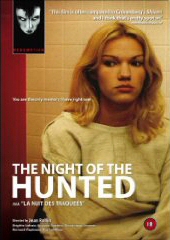
When, at that age of 22, I first saw Jean Rollin’s Night of the Hunted, I cried as much as the first time I saw Titanic at the age of 12.  In both cases, the tears were inspired by a “doomed” love story.  The main difference between the two films is that I don’t cry over Titanic anymore.  But Night of Hunted still brings me to tears every time I see it.

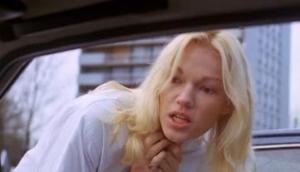
The film opens with the image of a terrified young woman (Brigitte Lahaie) running through a dark forest until she eventually reaches a highway.  She’s picked up by a young man (Vincent Gardere) who, being a guy, proceeds to take her back to his apartment in Paris.  She confesses that she can’t remember who she is, why she was running, or even being picked up by the young man in the first place.  Saying that she needs some sort of memory to fill the emptiness, she proceeds to make love to Gardere.  Gardere, being a guy, doesn’t object.

However, he does make the mistake of later leaving Lahaie alone in the apartment afterwards.  As soon as Gardere leaves, Lahaie forgets ever meeting him and why she’s even in the apartment in the first place.  Even as she tries to figure out what’s going on, the apartment is visited by a doctor who tells Lahaie that she is his patient and that she needs to go with him to a “clinic” where he can treat her.  No longer remembering her encounter with Gardere, Lahaie agrees.

Needless to say, the “clinic” turns out to be what Lahie was so desperately trying to escape just a few hours before.  We learn that Lahie is merely one of several hundred people who, months earlier, were exposed to a biological warfare experiment gone wrong.  Now, as a result, her brain is slowly dying one cell at a time.  The clinic is actually a government-run prison where she and her fellow victims have been sent to be forgotten about and to eventually die.  Lahie finds herself surrounded by men and women who, as they slowly lose everything that made them unique, revert back to their most primal instincts.  While Gardere tries to find her, Lahie struggles to survive just one final night in both the clinic and in the prison of her own fading mind.

Director Jean Rollin is best known for his sexually-themed vampire films but the Night of the Hunted is not as huge a departure for him as it may first seem.  One of Rollin’s reoccurring themes is the importance of our memories, no matter how idealized they may sometimes be and this theme is present in every frame of Night of the Hunted.

The lead role is played by Rollin’s frequent muse and collaborator, Brigitte Lahaie.  Because the majority of Lahaie’s career has been spent making adult films, she’s never gotten the due she deserves as an actress.  Playing a difficult role here, Lahaie is the movie’s greatest strength.  She brings a real sincerity and empathy to her role and its impossible to imagine this movie working without her.  If nothing else, this movie is a wonderful display of Lahaie’s often underrated talent. 

Rollin made the film for very little money and used a cast made up almost entirely of nonprofessionals and French adult film veterans.  So, yes the film does sometimes have a grainy look and the editing is definitely jagged.  When the characters shoot at each other, it is obvious that they’re firing toy cap guns.  To me, however, this works in the film’s favor.  The raw quality of the film perfectly mirrors that constant fear and confusion that Lahaie and her fellow prisoners live in.  No, the film is not technically perfect but a flawed masterpiece is preferable to uninspired technical perfection any day.

Despite working with a miniscule budget, Rollin captures some haunting images in this film.  Never has Paris looked as desolate as in this movie.  One of Rollin’s trademarks has always been his own fascination with architecture and, as a result, the cold skyscraper where Lahaie is held prisoner almost becomes a character itself.  I’ve always considered Jean Rollin to be horror cinema’s equivalent to Jean-Luc Godard and, with its images of a sterile city run by passionless autocrats, Night of the Hunted brings to mind Godard’s Alphaville.

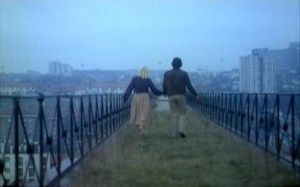
 The film’s most haunting image comes at the end and it is this image that brings tears to my eyes every time.  Whatever flaws the film may have, Night of the Hunted has one of the best final shots in the history of cinema.  Even if everything preceeding it had been worthless, this movie would be worth sitting through just for the stark beauty of the final shot.  Night of the Hunted ends on a note that manages to be darkly sad and inspiringly romantic at the same time.  It’s an ending that makes Night of the Hunted one of the most romantic films of all time.

Night of the Hunted was released in 1980 and, like the majority of Rollin’s films, was never released in the States.  Redemption, however, has released it on DVD (which is how I first saw it in 2008.)   While the transfer is undeniably rough, that actually gives the movie a documentary-like quality that works in its favor.  The film is in French with English subtitles.   As is so often the case with subtitles, a lot of the film’s nuance is sacrificed in translation.  Fortunately, the combination of Rollin’s visual sense and Lahaie’s lead performance more than makes up for it.