Film Review: Kelly’s Heroes (dir by Brian G. Hutton)


1970’s Kelly’s Heroes takes place in France during the Second World War.  The American army is moving through the country, liberating it town-by-town.  Private Kelly (Clint Eastwood) is a former lieutenant who was busted down in rank after leading a disastrous raid on the wrong hill.  (It was the fault of the generals but Lt. Kelly was set up as a scapegoat.)  When Kelly learns that the Germans are hiding a huge amount of gold in an occupied town, he gathers together a team of weary soldiers, misfits all, and plans to go AWOL to steal the gold for themselves.

Kelly’s Heroes was one of the big budget studio films that Eastwood made after finding stardom in Europe with Sergio Leone’s Spaghetti westerns.  This is very much an ensemble film, in the vein of The Dirty Dozen.  Indeed, Eastwood’s co-star, Telly Savalas, was in The Dirty Dozen.  Here, Savalas plays Big Joe, the sergeant who isn’t sure that he wants to put his men in danger for gold that may or may not exist.  Don Rickles plays Crapshoot who is …. well, imagine Don Rickles in the middle of World War II and you have a pretty good idea of who Crapshoot is.  Stuart Margolin, Harry Dean Stanton, Perry Lopez, Gavin MacLeod shows up as soldiers.  Carroll O’Connor plays the bombastic general who mistakes Kelly’s attempts to go AWOL for a brilliant tactical maneuver,  Like all of the senior officers in this film, O’Connor’s general is a buffoon.  Kelly’s Heroes was made during the Vietnam War and, much like Patton (released the same year), it attempts to appeal to both the establishment and the counterculture by making the heroes soldiers but their bosses jerks.

And that brings us to Donald Sutherland, who plays a tank commander named Oddball.  You may not have know this but apparently, there were hippies in the 40s!  Actually, I don’t think that’s true but there’s really no other way to describe Oddball than as a Hollywood hippie.  He’s a blissed-out, spacey guy who thinks nothing of accidnetally driving his tank through a building.  The films ask us to believe that the long-haired and bearded Oddball is a World War II tank commander and Sutherland is such a likable presence that it’s temping to just go with it.  Oddball was obviously included to bring in “the kids” but he does generate some needed laughs.  This is a very long movie and the comedic moments are appreciated.

Kelly’s Heroes is two-and-a-half hours long and it definitely could have been shorter.  Director Brian Hutton allows some scenes to drag on for a bit too long and he sometimes struggles to balance the moments of comedy with the moments of violent drama (quite a few character dies) but he does get good performances from his ensemble.  Eastwood’s taciturn acting style is nicely matched with Savalas’s more expressive style and it’s hard not smile at Don Rickles, insulting everyone as if they were guests at Joe Gallo’s birthday party.  The film, at times, doesn’t seem to know if it wants to be a satire or a straight heist film but the cast keep things watchable.  Eastwood even gets to show a few hints of the dry sense of humor that always hid behind the perpetually bad mood that often seemed to hang over him in his early films.  Whatever flaws the film may have, it was a box office success.  One year after this release of Kelly’s Heroes, Eastwood would make history as Dirty Harry.
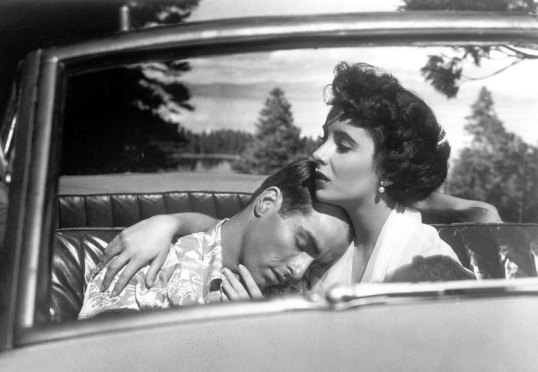
4 Shots From 4 Elizabeth Taylor Films: A Place In The Sun, Suddenly Last Summer, Boom!, Night Watch


4 Shots From 4 Films is just what it says it is, 4 shots from 4 of our favorite films. As opposed to the reviews and recaps that we usually post, 4 Shots From 4 Films lets the visuals do the talking!

Today is the birthday of one of the greatest films stars ever, Elizabeth Taylor!  And you know what that means.  It’s time for….

4 Shots From 4 Elizabeth Taylor Films

A Place in the Sun (1951, dir by George Stevens)

Suddenly, Last Summer (1959, dir by Joseph L. Mankiewicz

Boom! (1968, dir by Joseph Losey)

Night Watch (1973, dir by Brian G. Hutton)

4 Shots From 4 1973 Horror Films: The Creeping Flesh, The Exorcist, Night Watch, The Wicker Man


4 Shots From 4 Films is just what it says it is, 4 shots from 4 of our favorite films. As opposed to the reviews and recaps that we usually post, 4 Shots From 4 Films lets the visuals do the talking.

Since I just reviewed 1973’s Don’t Look Now, here are 4 shots from 4 other horror films that were released the same year.

4 Shots From 4 1973 Horror Films

The Creeping Flesh (1973, dir by Freddie Francis)

The Exorcist (1973, dir by William Friedkin)

Night Watch (1973, dir by Brian G. Hutton)

The Wicker Man (1973, dir by Robin Hardy)

Cleaning Out The DVR: Night Watch (dir by Brian G. Hutton)


I recorded 1973’s Night Watch off of TCM on March 17th!

There’s a tendency, among critics, to dismiss almost every film that Elizabeth Taylor made after Who’s Afraid of Virginia Woolf?  Sure, Reflections In A Golden Eye has its defenders but, otherwise, Taylor’s later films are often viewed as being overproduced and self-indulgent with Taylor giving uncertain, occasionally histrionic performances.

Those criticisms aren’t entirely unjustified.  Some of it may have been due to her own notoriously poor health and her troubled marriage to Richard Burton.  Even more of it was probably due to Taylor’s struggle to remain relevant as a middle-aged actress working in the 1970s.  I have to admit that I’m strangely fascinated by the latter half of Taylor’s film career, just because it does feature so many bizarre films and strange performances.  Taylor was always a good actress but, in her later films, it was hard not to get feeling that her stardom was her own worst enemy.  Taylor was often cast specifically because of her notoriety and she often seemed to work with directors who weren’t willing to reign her in whenever she started to go overboard.

That, however, doesn’t mean that every film that she made in the 70s was a bad one.

Take Night Watch, for instance.  Yesterday, as I watched Night Watch, I asked myself, “How is it that I’ve never seen or even heard of this film before!?”

Because seriously, Night Watch was really good.

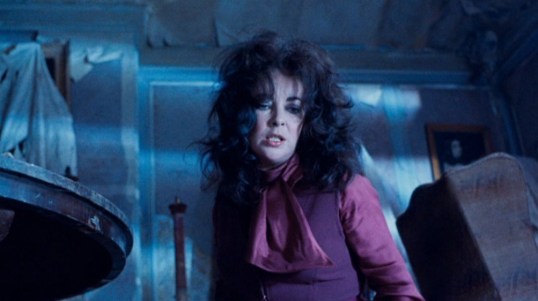
Liz plays Ellen Wheeler, an apparently unstable woman living in the UK.  She’s haunted by the night that her first husband was killed in a car crash, along with his mistress.  Ellen has remarried but she worries that her new husband, John (Laurence Harvey), might be cheating on her with her best friend, Sarah (Billie Whitelaw).  It turns out that she has good reason to be worried because that’s exactly what John is doing!  It’s not that John doesn’t love Ellen.  It’s just that he doesn’t know how to deal with her constant nightmares and delusions.

For instance, Ellen is convinced that she’s witnessed a murder!  She says that, in the abandoned house next door, she saw a man with a slit throat.  Later, she claims that she saw a woman murdered over there as well.  When the police investigate, they find no one in the house.  But Ellen swears she saw something.  She even suspects that her neighbor, Mr. Appleby (Robert Lang), may have buried the bodies in his garden.

(Mr. Appleby is not amused by the suggestion.)

Is Ellen going crazy or did she really see something?  I bet you think you already know the answer.  I know that I did.  But then Night Watch ends with a twist that is shockingly effective and unexpected.  For once, I didn’t know how the movie was going to end and now, a day later, I’m still thinking about those final scenes.

Night Watch has its flaws.  With the exception of when he played Col. Travis in The Alamo, Laurence Harvey was never a particularly sympathetic actor and he comes across as his usual cold self in Night Watch.  And, as good as Taylor is, there are still a few moments where she does go a bit overboard.  During the first half of the film, you have to make your way through a lot of yelling to get to the good part.

But that good part is so good that it’s worth it!  Night Watch is a genuinely atmospheric and surprising film, one that catches you off guard and one in which the tension does not relent until the final credit has rolled across the screen.  Ellen’s nightmares are especially well-realized and the film’s final moments are both frightening and surprisingly graphic.  This is a film that sticks with you.

If you haven’t seen it yet, keep a watch for it!

http://www.youtube.com/watch?v=Aao2hzmuNes

Action in the Alps: WHERE EAGLES DARE (MGM 1969)


gary loggins's avatarcracked rear viewer

Alistair MacLean’s adventure novels, filled with muscular action and suspenseful plot twists, thrilled moviegoers of the 60’s and 70’s in such big budget hits as THE GUNS OF NAVARONE and ICE STATION ZEBRA. In his first foray into screenwriting, 1969’s WHERE EAGLES DARE,  he adapted his own work to the silver screen, resulting in one of the year’s biggest hits, aided by the box office clout of Richard Burton and Clint Eastwood . The film’s a bit long, running over two and a half hours, but action fans won’t mind. There’s enough derring-do, ace stunt work, explosions, and cliffhanging (literally!) to keep you riveted to the screen!

A lot of the credit goes to veteran stunt coordinator Yakima Canutt, in charge of all the action scenes as second unit director. Canutt staged some of the most exciting scenes in film history, from John Ford’s STAGECOACH to William Wyler’s BEN HUR, and certainly keeps things busy…

View original post 617 more words