The Eric Roberts Collection: Devil’s Knight (dir by Adam Werth)


2024’s Devil’s Knight opens in the kingdom of Veroka.  A group of thieves all discuss what they’ve stolen over the course of the day.  The leader of the thieves is named Orwell.  Another thief — played by Daniel Baldwin — is named Camus.  The group is joined by as stranger named Sigurd (John Wells), a man who has only one eye.  He tells them the story of how he and his friends — The Lost Blades — were hired to vanquish the fearsome Bone Devil….

Yep, it’s one of those type of movies.  There’s a lot of sword fights.  There’s a lot of monsters.  There’s a hint of sorcery, though not as much as you might expect from a movie like this.  The thieves are named after philosophers.  The huge cast is full of streaming stars and a handful of actors who are known for appearing in just about anything.  Kevin Sorbo plays Baldur, the noble head of the king’s guards.  Angie Everhart plays the Duchess who speaks French despite living in a mythical kingdom.  Eric Roberts shows up as Lord Sussex.  He only onscreen for a few minutes, though he does get a few funny lines.  Sadly, Roberts doesn’t even get to fight a monster.  At least Sorbo gets a big battle scene.

Here’s the thing, though.  Taken on its own terms, Devil’s Knight is a lot of fun.  You can tell it was made by people who have a genuine love for the sword and sorcery genre and there’s enough intentional humor to keep things interesting.  With the exception of some blood splatter, there’s also a definite lack of CGI.  The monsters are played by actual actors wearing costumes and under makeup and it’s surprisingly effective.  The film’s plot is not always easy to follow.  In the tradition of many medeival legends, the film’s story really is just one random incident after another, the majority of which lead to a fight and at least a few deaths.  The cast is huge but few of the characters are still alive by the end of the movie.  Monsters aren’t something to mess with and I actually appreciated that the film was willing to even kill off the characters who usually survive a film like this.  It really did create the feeling that anyone could die if they ran into a monster in a hallway.  (Even the stereotypical princess-who-wants-to-be-a-warrior character was taken in a surprising direction.)  The film moves quickly with a lot of energy and enthusiasm.  I enjoyed it.

Previous Eric Roberts Films That We Have Reviewed:

  1. Star 80 (1983)
  2. Runaway Train (1985)
  3. Blood Red (1989)
  4. The Ambulance (1990)
  5. The Lost Capone (1990)
  6. Love, Cheat, & Steal (1993)
  7. Voyage (1993)
  8. Love Is A Gun (1994)
  9. Sensation (1994)
  10. Dark Angel (1996)
  11. Doctor Who (1996)
  12. Most Wanted (1997)
  13. Mercy Streets (2000)
  14. Wolves of Wall Street (2002)
  15. Mr. Brightside (2004)
  16. Six: The Mark Unleased (2004)
  17. Hey You (2006)
  18. Amazing Racer (2009)
  19. In The Blink of an Eye (2009)
  20. Enemies Among Us (2010)
  21. The Expendables (2010) 
  22. Sharktopus (2010)
  23. Beyond The Trophy (2012)
  24. The Dead Want Women (2012)
  25. Deadline (2012)
  26. The Mark (2012)
  27. Miss Atomic Bomb (2012)
  28. Bonnie And Clyde: Justified (2013)
  29. Lovelace (2013)
  30. The Mark: Redemption (2013)
  31. Self-Storage (2013)
  32. A Talking Cat!?! (2013)
  33. This Is Our Time (2013)
  34. Inherent Vice (2014)
  35. Road to the Open (2014)
  36. Rumors of War (2014)
  37. Amityville Death House (2015)
  38. A Fatal Obsession (2015)
  39. Stalked By My Doctor (2015)
  40. Enemy Within (2016)
  41. Joker’s Poltergeist (2016)
  42. Prayer Never Fails (2016)
  43. Stalked By My Doctor: The Return (2016)
  44. The Wrong Roommate (2016)
  45. Dark Image (2017)
  46. Black Wake (2018)
  47. Frank and Ava (2018)
  48. Stalked By My Doctor: Patient’s Revenge (2018)
  49. Clinton Island (2019)
  50. Monster Island (2019)
  51. The Reliant (2019)
  52. The Savant (2019)
  53. Seven Deadly Sins (2019)
  54. Stalked By My Doctor: A Sleepwalker’s Nightmare (2019)
  55. The Wrong Mommy (2019)
  56. Exodus of a Prodigal Son (2020)
  57. Free Lunch Express (2020)
  58. Her Deadly Groom (2020)
  59. Top Gunner (2020)
  60. Deadly Nightshade (2021)
  61. The Elevator (2021)
  62. Just What The Doctor Ordered (2021)
  63. Killer Advice (2021)
  64. The Poltergeist Diaries (2021)
  65. The Rebels of PT-218 (2021)
  66. A Town Called Parable (2021)
  67. Bleach (2022)
  68. My Dinner With Eric (2022)
  69. Aftermath (2024)
  70. The Wrong Life Coach (2024)
  71. When It Rains In L.A. (2025)

October True Crime: Chapter 27 (dir by J.P. Schaefer)


On December 8th, 1980, John Lennon was shot and killed in New York City by a man named Mark David Chapman.

While much has been written about John Lennon and his life and his beliefs, Mark David Chapman, serving a life sentence and rarely giving interviews, has always remained more of an enigma.  What exactly motivated him to shoot John Lennon remains a mystery.  At the time of the shooting, Chapman was carrying a copy of Catcher In The Rye and some accounts insist that Chapman believed himself to be Holden Caulfield or that he shot Lennon to try to bring more attention to the book.  Depending on which source you go to, Chapman was either a Beatles superfan or he was someone who rarely listened to rock ‘n’ roll.  Chapman either worshipped Lennon or he was offended by Lennon’s flippant remark about the Beatles being bigger than Jesus.  Some people claim that Chapman was looking for fame by killing someone famous.  Others claim that Lennon was not even Chapman’s main target and Chapman, in one of the few interviews that he did give, listed a long list of targets — including several other celebrities and politicians — that he considered going after at one point or another.

If anything, Mark David Chapman would appear to be a lot like Arthur Bremer, the directionless drifter who seriously wounded Governor George Wallace in 1972 and whose diary inspired Paul Schrader to create the character of Travis Bickle in Taxi Driver.  Like Chapman, Arthur Bremer traveled the country without apparent direction.  Like Chapman, Bremer considered many different targets before settling on Wallace.  And like Chapman, Bremer gave a lot of conflicting reasons for his actions.  One gets the feeling that neither Chapman nor Bremer (nor a lot of other assassins) really understood why they were driven to kill (or, in Bremer’s case, attempt to kill) so they grasped at whatever solution seemed to convenient at the time.  Apparently, anything was preferable to just admitting to being a severely damaged human being.

2007’s Chapter 27, follows Mark David Chapman (played by Jared Leto) as he travels to Manhattan and spends several days camped outside of the famous Dakota Apartment Building, hoping to see John Lennon (played by Mark Lindsay Chapman, who reportedly missed out on an earlier opportunity to play Lennon because he shared the same name as Lennon’s assassin).  The film is narrated by Mark David Chapman, who tries to talk tough just like Holden Caulfield but who can’t hide the fact that he’s basically just a fat loser who has no idea how to communicate with any of the other people that he meets in New York.  He creeps out a friendly groupie (played by Lindsay Lohan).  He gets into an argument with a photographer (Judah Friedlander).  He annoys countless Dakota doormen.  About the only person who isn’t annoyed by Chapman is Lennon himself, who politely signs an autograph just a few hours before Chapman shoots him in the back.

It’s a well-made and well-directed film and Jared Leto gives a memorably creepy performance as Mark David Chapman.  (That said, the accent that he uses while speaking as Chapman once again proves the danger of giving a method actor any role that involves a Southern accent.)  Leto gained a good deal of weight to Chapman and he’s thoroughly believable as a very familiar type of obsessive fan.  That said, the film still can’t make Chapman into a particularly compelling character because there’s really nothing compelling about someone like Mark David Chapman.  The man he killed was compelling, regardless of what you may think about the politics of a song like Imagine.  But Chapman himself was just a fat loser.  Leto does a good job of portraying Chapman as being a fat loser but it’s still hard to watch the film without wondering what the point of it all is.  We don’t need a movie to tell us that Mark David Chapman was a loser.

At its best, the film creates a sense of claustrophobia.  Almost the entire film is told from Chapman’s point of view and the best moments are the ones where Chapman finds himself overwhelmed by 1980s New York.  It’s a film that does inspire one to consider how strange it is that someone like Mark David Chapman could change the course of the culture through one deadly action.  (The film did cause me to think about how different things would have been if Chapman had boarded a Greyhound and left New York without returning to the Dakota that night.)  But, in the end, the film cannot answer the question of why Chapman did what he did.  Perhaps that’s because there really is no answer, beyond the randomness of fate and the dangers of fame.

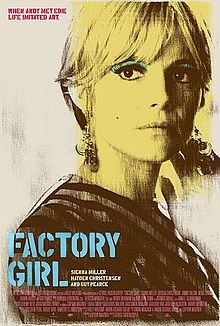
Film Review: Factory Girl (dir by George Hickenlooper)


Oh God.  Factory Girl.

Released in 2006, Factory Girl was a biopic about Edie Sedgwick, the tragic model/actress/artist who was briefly both Andy Warhol’s muse and one of the most famous women in America.  Before I talk too much about this film, I should probably admit that I’m probably the worst possible person to review a movie about Edie Sedgwick.

Why?

Allow me to repost something that I wrote when I reviewed Edie’s final film, Ciao Manhattan:

“In the late 60s, Edie Sedgwick was a model who was briefly the beautiful face of the underground.  Vogue called her a “youthquaker.”  She made films with Andy Warhol, she dated the rich and the famous and for a brief time, she was one of the most famous women in America.  But a childhood full of tragedy and abuse had left Edie fragile and unprepared to deal with the pressures of being famous.  She was fed drugs by those who claimed to care about her, she had numerous mental breakdowns, and, when she was at her most vulnerable, she was pushed away and rejected by the same people who had loved her when she was on top of the world.  Edie died because, when she asked for help, nobody was willing to listen.


Edie Sedgwick (1943 — 1971)

I guess I should explain something.  I don’t believe in reincarnation but if I did, I would swear that I was Edie Sedwick in a past life.  Of all the great icons of the past, she, Clara Bow, andVictoria Woodhull are the ones to whom I feel the closest connection. (Edie is the reason why, for the longest time, I assumed I would die when I was 28.  But now I’m 29, so lucky me.)”

(Incidentally, I wrote that two years ago and I’m still alive so, once again, lucky me.)

Anyway, my point is that I’m always going to be a hundred times more critical of a film about Edie Sedgwick as I would be about any other film.  If you’re already guessing that I didn’t particularly care for Factory Girl, you’re right.  However, there are some people whose opinions I respect and some of them love this film.

Anyway, Factory Girl is a biopic that’s structured so conventionally that it even opens with Edie (played by Sienna Miller) narrating her story to an unseen interviewer.  I can count on one hand the number of successful biopics that have featured someone telling the story of their life to an unseen interviewer.  It’s a conventional and kind of boring technique.  Anyway, the film follows all of the expected beats.  Edie arrives in New York.  Edie is spotted by Andy (Guy Pearce).  Edie makes films with Warhol.  Her famous dance in Vinyl is recreated.  Edie becomes Andy’s platonic girlfriend but then, she meets and falls in love with Bob Dylan…

Oh, sorry.  He’s not actually Bob Dylan.  According to the credits, his name is Folksinger.  He says Bob Dylan type stuff.  He rides around on a motorcycle.  He carries a harmonica.  Oh, and he’s played by Hayden Christensen.

See, the first half of Factory Girl is actually not bad.  Sienna Miller gives a pretty good performance as Edie, even if she never comes close to capturing Edie’s unforced charisma.  Despite being several years too old, Guy Pearce is also credible as Andy Warhol.  The film itself is full of crazy 60s clichés but, even so, that’s not always a terrible thing.  Some of those 60s clichés are a lot of fun, if they’re presented with a little imagination.

But then Hayden Christensen shows up as Bob Dylan and the film loses whatever credibility it may have had.  Hayden, who gave his best performance when he played a soulless and largely empty-headed sociopath in Shattered Glass, is totally miscast as a musician who once said that if people really understood what his songs were about, he would have been thrown in jail.  The film attempts to portray Dylan and Warhol as two men fighting for Edie’s soul but Christensen is so outacted by Guy Pearce that it’s never really much of a competition.  Even though the film makes a good case that Edie’s relationship with Andy was ultimately self-destructive, Guy Pearce is still preferable to Hayden Christensen trying to imitate Dylan’s distinctive mumble.

Anyway, Factory Girl doesn’t really work.  Beyond the odd casting of Hayden Christensen, Factory Girl is too conventionally structured.  In its portrayal of the Factory and life in 1960s New York, the film never seems to establish a life beyond all of the familiar clichés.  (Before anyone accuses me of contradicting myself, remember that I said that the old 60s clichés are fun if they’re presented with a little imagination.  That’s a big if.)  At no point, while watching the film, did I feel as if I had been transported back to the past.  If you want to learn about Edie Sedgwick, your best option is to try to track down her Warhol films.

Edie!