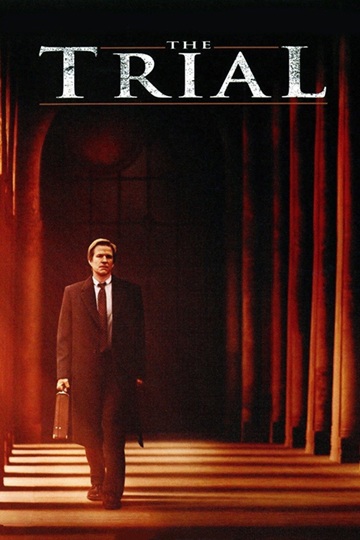
Mac is a Southern lawyer, even though it’s been a while since he practiced. After his wife and children were killed in a car accident, Mac decided to retire from practicing law but he never surrendered his license. A judge (Rance Howard) reaches out to him, asking him to serve as a public defender for Pete Thomason (Randy Wayne), a young man who has been accused of murdering his girlfriend. The evidence is stacked against Pete and there are plenty of wealthy people who, for various reasons, want Pete to quickly be convicted. Mac takes the case because he can tell that Pete is being railroaded. When he discovers that Pete will possibly be facing the death penalty if he’s convicted, the case becomes very personal for Mac.
The prosecuting attorney (Bob Gunton) has managed to find a doctor (Brett Rice) who is willing to testify that Pete is a sociopath. (The doctor has a reputation for finding just about anyone on trial to be a sociopath.) Mac finds a doctor of his own, Dr. Anne Wilkes (Clare Carey), his testifies that Pete is nowhere near being a sociopath. The problem is that Pete has no memory of what happened the night of the murder. Mac may believe that Pete is innocent but can he convince the jury when the evidence all seems to suggest otherwise?
Like The List, The Trial was based on a novel by Robert Whitlow and it was directed by Gary Wheeler. I was pretty hard on The List in last night’s review but I actually rather enjoyed The Trial, which was a solid and well-made legal thriller. (The film’s status as a faith-based film largely comes from a scene in which Mac quotes the Book of Provers in regards to how, during a trial, it’s easy to believe the first person who speaks but it’s equally important to listen to how the accused replies.) I enjoyed the twists and turns of the plot and the film’s ending worked well. Though the film had a a made-for-television feel to it (despite having been a theatrical release), it still held and rewarded my interest.
It helped that the cast was well-selected and everyone gave good performances. Matthew Modine, in particular, gave a strong performance as Mac, playing him not as being a saint but instead as being someone who was just determined to give his client the defense he deserved and to ultimately do the right thing. Robert Forster played Mac’s brother-in-law and lead investigator and he brought his own brand of world-weary determination to the part. Nobody plays a smug prosecutor as well as Bob Gunton, though it should be noted that the character himself never became a caricature. Rance Howard was the ideal judge, tough but fair. Randy Wayne was sympathetic as the confused Pete. The cast really brought the film’s world to life.
I always enjoy a good legal thriller and The Trial was certainly that.
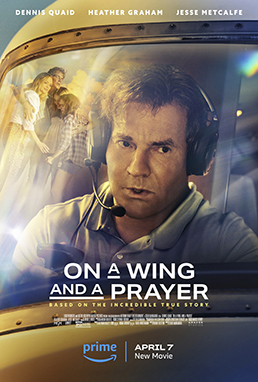
Having just attended the funeral of his brother, Doug White (Dennis Quaid) and his family — wife Terri (Heather Graham) and daughters Bailey (Abigail Rhine) and Maggie (Jessi Case) — are flying back to their home in Louisiana. Unfortunately, shortly after takeoff, their pilot suffers a heart attack and dies. Now Doug, who’s had only one flight lesson in his entire life, has to not only fly the plane but also land safely.
Doug has people on the ground, trying to talk him through the landing even though they don’t know what is actually happening in the cockpit. Hard-drinking Dan Favio (Rocky Myers) calls his friend, Kari Sorenson (Jesse Metcalfe). Kari has never gotten over the death of his family in a similar plane crash so, for him, helping Doug land is about more than just saving Doug and his family. It’s also about achieving his own personal redemption and hopefully finding the strength to forgive himself.
While this is going on, two kids — Donna (Raina Grey) and Buggy (Trayce Malachi) — follow the flight online and then head down to the airport so that they can watch it try to land. To be honest, I’m really not sure why either one of them is in the movie. When Donna first showed up, talking about how she wanted to be a pilot because “Mr. Jones” told her that girls can’t fly planes, I found myself dreading the inevitable moment when the kids would take it upon themselves to help Doug land the plane. I dreaded Donna calling the cockpit and Doug going, “Wait a minute …. you’re just a kid!” Fortunately, that moment didn’t happen but I was still left wondering why Donna and Buggy were in the film to begin with.
It feels almost churlish to be overly critical of a film like On a Wing and a Prayer because it is based on a true story. Doug White really did have to land an airplane after the pilot died mid-flight and he really was instructed on what to do by a group of air traffic controllers and Kari Sorenson. It’s a good story and the film ends with some undeniably touching shots of the real people involved in the landing. That said, this is ultimately a film that many filmgoers will want to like more than they actually do. Thanks to some dodgy special effects, the viewer never forgets that Dennis Quaid and his family aren’t really tapped up in the sky. Instead, one is always aware that they’re just watching a movie and a rather cheap-looking one at that. As well, the script is full of awkward dialogue and heavy-handed moments. As soon as I saw that one of the daughters wouldn’t stop looking at her phone, I knew that she would be the one who would be forced to grow up in a hurry. As soon as the other daughter ate something with nuts in it, I knew that there was going to be a desperate search for an epi-pen.
On the plus side, Dennis Quaid was as likable as ever and Heather Graham managed to wring some genuine feeling out of even the most sentimental of dialogue. On A Wing and a Prayer was directed by Sean McNamara, who also directed one of my favorite films of 2011, Soul Surfer. (Later this year, McNamara and Quaid have another project that is scheduled to be released, a biopic of President Ronald Reagan.) On A Wing and A Prayer doesn’t really work as a film but, as a story, it at least reminds us of what people are capable of doing when they all work together.
What a long and strange trip it has been for Foxcatcher.
Originally, Bennett Miller’s latest film was scheduled to be released at the end of 2013 and it was expected to be a major player in the 2013 Oscar race. And then it was suddenly announced that Sony Pictures would, instead, wait an extra year to release the film. Usually, this is a sign of a film that’s not expected to live up to expectations. (Case in point: The Monuments Men.) But, in this case, it was seen as being the exact opposite. Sony had such faith in the Oscar prospects of Foxcatcher that they were willing to hold off a year so it wouldn’t get lost in all of the attention that was being given to American Hustle, Gravity, 12 Years A Slave, and Wolf of Wall Street.
Then, during the summer, Foxcatcher premiered at Cannes and was one of the hits of the festival. With the notable exception of the A.V. Club’s A.A. Dowd, the reviewers at Cannes were rapturous in their praise of Foxcatcher. And, though it failed to win the Palme d’Or, it did win best director for Bennett Miller and it cemented it’s status as the Oscar front-runner.
And then, something started to happen.
There was backlash against Foxcatcher. As more and more critics saw the film, we started to hear more and more speculation that the film would fail to live up to all of the hype. Critics generally praised the performers but many complained that the film was too cold and detached for its own good. At first, it was easy to say that this was partially the result of unrealistically high expectations. But, as more and more reviews came in, it became almost fashionable to speculate that Foxcatcher would be left out of the Oscar race.
Of course, most of us who were doing the speculating were doing so without actually having seen the film for ourselves. After all, film critics and festival goers aren’t the ones who actually vote on what films will be nominated for and win Oscars. One need only look at the nominations for Extremely Loud and Incredibly Close to realize that.
Well, Foxcatcher has finally been released and we’ve all finally gotten a chance to see it. I saw it last week, while I was in Fort Worth for the Christmas holidays. And my reaction…
Well, there’s a reason why it’s taken me nearly a week to write this review.
Ultimately, Foxcatcher is a good film. In fact, on a purely technical level, it’s probably one of the best films of the year. If it is nominated for best picture, the nomination will not necessarily be undeserved. Bennett Miller comes up with some hauntingly chilly images. Steve Carell, Channing Tatum, and Mark Ruffalo all give excellent performances. It’s a film that stays with you, a powerful depiction of a true crime.
But it’s still not an easy film to enjoy.
Those critics who complained that Miller’s approach was too cold and detached have a point. You watch the film with a sense of dread, knowing what’s going to eventually happen. (Though I didn’t know anything about the murder of Dave Schultz before the film, I had read the reviews and I knew that eventually Mark Ruffalo’s kind-hearted family man would end up being gunned down in front of his family.) But Miller always keeps the characters and the story at a distance. You watch the characters and you struggle to understand them but, by the end of the film, you’re no closer to understanding why John E. du Pont (the eccentric millionaire turned murdered, played by Steve Carell) murdered Dave Schultz than you were at the beginning.
Instead, Miller is more interested as looking at John du Pont as being an example of American exceptionalism gone crazy. Throughout the film, characters frequently comment on the fact that the du Ponts are one of the oldest and richest families in America. (Not coincidentally, we’re also told that they initially made their fortune by producing and selling gunpowder.) Du Pont is an outspoken and proud American. Along with training wrestlers on the grounds of his estate (the Foxcatcher of the title), he also frequently invites the police to use the grounds for target practice. Though Miller couldn’t have realized it when the film was originally shot in 2013, the scenes of the obviously unstable du Pont hanging out with the cops take on an extra resonance in this time of Eric Garner and Tamir Rice.
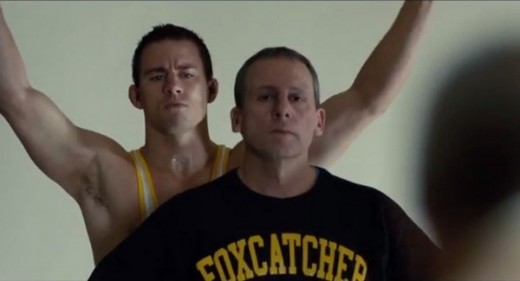
John du Pont frequently talks about how his plan to open a world-class wrestling training facility is, at heart, a patriotic act. The world wrestling championship, du Pont believes, belongs in America and he’s going to make sure that it gets there. In order to achieve this goal, he hires Olympic gold medalist Mark Schultz (Channing Tatum) to be his wrestling coach. Mark, who has always lived in the shadow of his older brother Dave (Mark Ruffalo), jumps at the chance to establish his own identity. At first, du Pont is like the father that Mark has never had. They even become friends. (Du Pont, at one point, talks about discovering that all of his childhood friends had been paid to be his friend.) Mark shows du Pont some wrestling moves. Du Pont introduces Mark to cocaine.
But, ultimately, it becomes apparent that du Pont’s friendship with Mark was really just a ruse to get Mark to convince his older brother to come work for du Pont. When Dave finally does join Mark at Foxcatcher, it causes Mark to turn self-destructive and du Pont to eventually turn into a murderer.
And, as I said, it’s a powerful film. Channing Tatum gives the performance of his career and Steve Carell is frighteningly believable as John du Pont. (One minor complaint: Carell is being promoted for best actor, even though his performance was clearly a supporting one.) Mark Ruffalo, as well, does great work as Dave and somehow manages to make innate human decency compelling.
But the film itself is so cold and detached that, ultimately, this is a film that you end up respecting more than you end up enjoying.
 Through the Shattered Lens